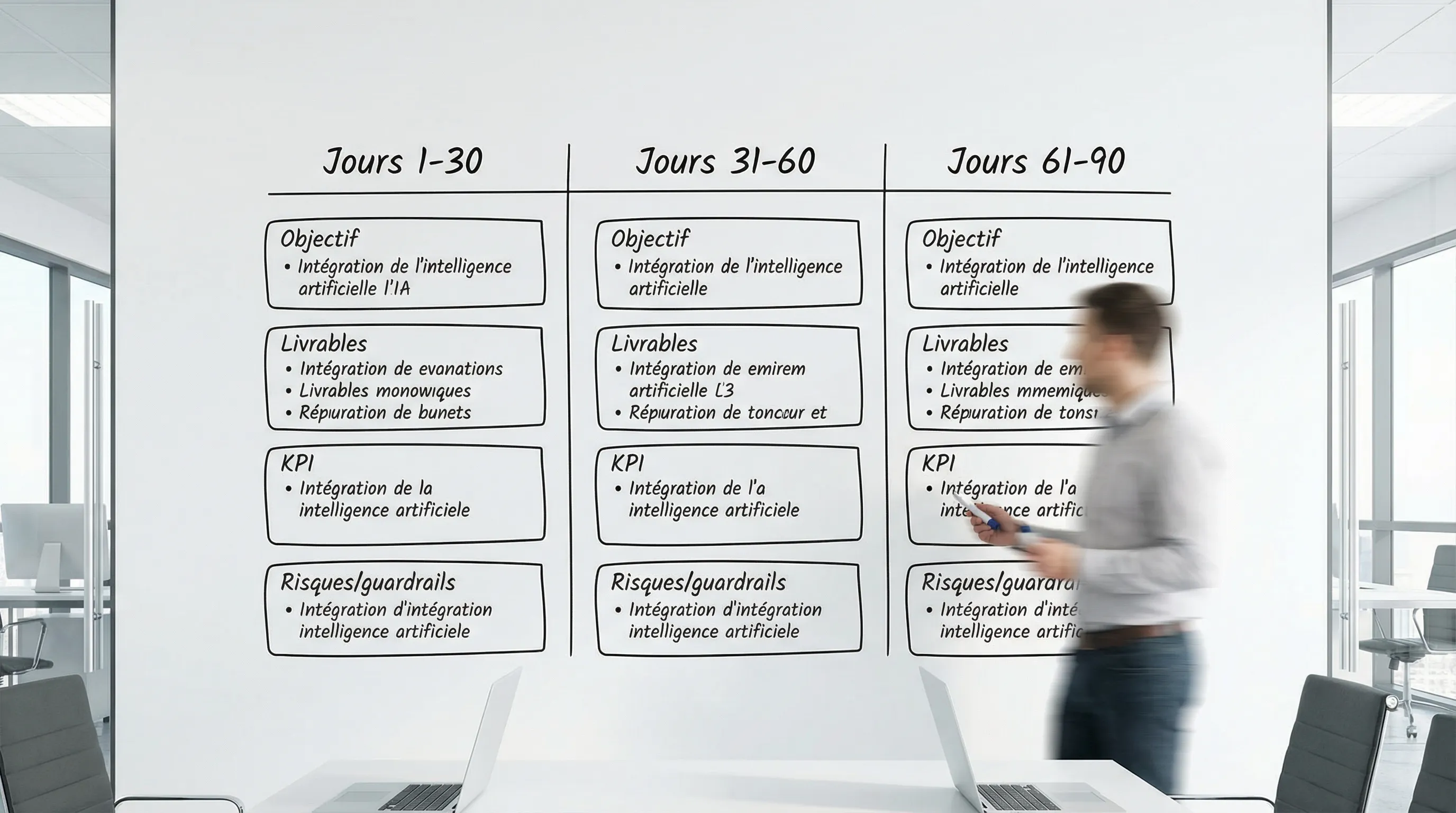
Many companies tested AI in 2024-2026 via ChatGPT or isolated tools, often yielding limited scalable gains and growing concerns about data and costs. This post outlines a pragmatic 30-60-90 day roadmap to transform experiments into operational, measured, and secure capabilities.
Many companies have already “tested AI” in 2024-2026, often via ChatGPT or isolated SaaS tools. The result is frequently the same: a few individual gains, few measurable gains at scale, and growing concern regarding data, compliance, costs, and quality.
An enterprise AI plan serves precisely to avoid this scenario. It is a short, results-oriented roadmap that transforms trials into operational capabilities (integrated into workflows, measured, secured). Here is a pragmatic version in 30-60-90 days adapted for SMEs, scale-ups, and growing companies.
What exactly is an enterprise AI plan?
An AI plan is not “a list of tools to deploy.” It is a mini-product program that aligns on:
The why (priority business objective, quantified)
The what (maximum 2 use cases to start, chosen for their frequency and measurability)
The how (data, integration, UX, governance, run)
The proof (before/after KPIs, guardrails, go/no-go decision)
The right AI plan has a key property: it produces a useful V1 in less than 90 days, without creating unmanageable technical or legal debt.
Before Day 1: 5 prerequisites that speed everything up (without a “big project”)
You can start without overhauling your IS, but you need a minimal foundation.
1) A sponsor and an arbiter
A sponsor (executive or head of) prioritizes, frees up time, and decides on trade-offs (quality vs speed, confidentiality vs SaaS, etc.). Without arbitration, pilots die in discussion loops.
2) A simple data classification rule
Before any experimentation, formalize a color code (e.g., public, internal, sensitive) and what is authorized in each tool. For France, the CNIL publishes useful benchmarks on AI and data protection: CNIL references on artificial intelligence.
3) A KPI baseline per use case
A pilot without a baseline proves nothing. Measure at a minimum: volume, time, quality, cost. Even if it is approximate, do it beforehand.
4) A business “owner”
AI is not solely an IT subject. Each use case must have a business owner responsible for defining scenarios, validating quality, and driving adoption.
5) A short delivery channel
Your AI plan must iterate quickly (ideally weekly). The longer your loops, the more you “over-specify” and the less you learn.
The 3 phases of the 30-60-90 day AI plan
The goal is not to “do a lot.” It is to do a little, but in controlled production, with a clear decision at Day 90.
Overview of expected deliverables
Period
Objective
Concrete Deliverables
Expected Decision
D1 to D30
Frame and secure
1-2 use cases, KPI baseline, data and integration mapping, guardrails, instrumented prototype
“What are we piloting, with what KPIs and limits?”
Showcase: visible, rapid impact (e.g., support triage, lead qualification, data extraction from documents)
The most predictive criterion is not “the most impressive AI,” it is frequency. A gain of 30 seconds on 2,000 monthly occurrences beats a gain of 30 minutes on 5 occurrences.
2) Define 3 to 5 KPIs, including 1 North Star
A minimal set per use case:
North Star (impact): processing time, resolution rate, conversion rate, response time, etc.
Process KPIs: usage rate in the workflow, completion rate, volume processed
Guardrails (risks): human escalation rate, critical error rate, potential data leak, unit cost
At this stage, the goal is not perfection, but making the impact manageable.
3) Choose a realistic integration strategy
The classic trap: building “a chatbot on the side” that has access to nothing and can do nothing.
At Day 30, you must document:
Sources of truth (CRM, helpdesk, drive, ERP, knowledge base)
4) Set proportionate guardrails (quality, security, compliance)
In 2026, the right reflex is to apply a “risk-based” logic consistent with reference frameworks (e.g., NIST AI RMF and the European approach to AI). For the EU context, you can consult the European policy on artificial intelligence.
Concretely, at Day 30 you want a simple document:
What the assistant is allowed to do (and what it is not allowed to do)
When it must escalate to a human
Which data is forbidden as input
What is logged (for audit, debug, improvement)
5) Deliver an instrumented prototype (not a demo)
The Day 30 prototype must already:
Run on real examples (scenarios)
Produce usable logs
Make costs visible (even if approximate)
A demo without instrumentation sets you back 30 days.
Days 31-60: Build a useful, integrated, measured pilot
This is the phase where you move from “it seems to work” to “it works within our constraints.”
1) MVP integrated in the right place
A good pilot is placed in the daily tool, not in yet another tab. Examples:
In a helpdesk (triage, assisted response, article suggestion)
In a CRM (call summaries, pre-filled fields, follow-ups)
In an intranet (document search with sources)
2) Simple and repeated evaluation protocol
At Day 60, you must be able to answer with facts:
What proportion of responses is acceptable without editing?
What types of requests fail?
What is the “critical” error rate (legal, factual, security)?
Even a basic protocol on a stable sample (e.g., 100 cases) is already a huge advantage.
3) Short feedback loop
AI is managed like a product. The pilot must integrate:
A user feedback channel
A weekly review (30 minutes): top errors, top gains, decisions
A version discipline (prompts, rules, sources)
4) Micro-training and “in situ” adoption
Training “everyone” in a room for a day rarely works.
What works better: training teams on their use case, with:
5 typical scenarios
5 anti-patterns (what not to do)
1 rule on data
Days 61-90: Controlled production, run, scaling decision
From Day 60 onwards, the question is no longer “is it possible?” but “is it operable continuously?”.
1) Add the “production pack” (runbook + monitoring)
At Day 90, you want simple operations:
Who is on-call (even if light)?
What do we do when quality drops?
What do we do when a connector fails?
What do we do when costs rise?
2) Cost control and unit economics
Many companies discover too late that the cost is not just “the model price,” but also: integration, monitoring, knowledge maintenance, internal support.
The right reflex at Day 90: track a cost per useful action (e.g., cost per ticket resolved, cost per document extracted, cost per qualified lead) and not just a global monthly cost.
3) Light but real governance
You don’t need a monthly committee of 12 people. You need a short ritual, with a decision.
Example of pragmatic governance:
Ritual
Participants
Duration
Goal
Weekly pilot review
business owner, tech lead, ops
30 min
Correct, prioritize, decide
Day 90 Gate
sponsor, owner, tech, compliance if needed
45 min
Scale, iterate, or stop
4) Day 90 Scorecard: decide with a clear rule
Here is a simple scorecard that avoids endless debates.
Dimension
Question
Decision Threshold (examples)
Value
Is the gain measured vs baseline?
Yes, significant and stable
Quality
Are critical errors rare and detected?
Yes, with escalation
Integration
Is the workflow fluid, without friction?
Yes, natural usage
Cost
Is the unit cost acceptable?
Yes, controlled
Risk
Data, compliance, security under control?
Yes, documented
The idea is not to have 100/100, but to avoid a “go” on an uncontrolled solution.
Mistakes that cause an AI plan to fail (even with a good team)
Confusing usage with impact
“The teams are using it” is not a business KPI. Measure time saved, quality, resolution rate, incremental revenue.
Starting with a case that is too broad
An “assistant for the whole company” right from the start often leads to a vague system that is impossible to evaluate. Start with a tight scope.
Underestimating integration
An AI that doesn’t read your reliable sources and cannot trigger actions remains a gadget. Integration is often the real barrier.
Adding governance after an incident
Data rules and human escalation must exist before production, not after a leak or an error.
Frequently Asked Questions
What is the best first use case for an enterprise AI plan? The best first case is generally frequent, measurable, and low risk, for example, an internal knowledge assistant with verified sources, or support triage with human escalation.
Can you do a 30-60-90 day AI plan without a data team? Yes, if you start with use cases that rely on your existing tools and light integration. However, you will need a business owner, a technical lead, and KPI discipline.
Which KPIs should be chosen to prove ROI quickly? Take 1 North Star KPI (impact) and 2 to 4 support and risk KPIs. Example for customer support: first response time, resolution rate, escalation rate, critical error rate, cost per ticket.
Should we buy a tool or build custom? This depends on your integration, data, and governance constraints. A simple rule: if the AI needs to integrate finely with your processes and sources, custom (or a hybrid approach) often becomes more robust in the medium term.
How to remain compliant with AI in 2026? Adopt a risk-based approach: data classification, usage rules, traceability (logs), continuous evaluation, and guardrails. Align with your GDPR obligations and governance compatible with European requirements.
Build your AI plan with Impulse Lab
If you want an enterprise AI plan that leads to a measurable V1 in 90 days (and not a graveyard of POCs), Impulse Lab can assist you on all or part of the journey:
AI Opportunity Audit to prioritize 1 to 2 use cases with rapid ROI (see our guide on strategic AI audit).
Development and integration of custom web and AI solutions, connected to your tools.
Process automation and controlled production deployment.
Adoption training oriented towards real usage and data rules.
Discover the agency at Impulse Lab and let’s discuss your 30-60-90 day roadmap.