Enterprise AI Testing: A Simple Protocol to Validate Your Ideas
Intelligence artificielle
Stratégie d'entreprise
Stratégie IA
Validation IA
Stop debating AI ideas for weeks. Test, measure, then decide. This guide offers a simple 7-step protocol to validate corporate ideas without complex infrastructure. Perfect for SMEs and scale-ups wanting to move quickly from pitch to measurable results using AI-driven E2E testing.
décembre 25, 2025·8 min de lecture
Stop debating an AI idea for weeks. Test, measure, then decide. This guide proposes a simple and reproducible protocol to validate your ideas in a corporate setting, in 7 steps, without complex infrastructure or excessive budget. It is aimed at SMEs and scale-ups that want to move from pitch to measurable result quickly, relying notably on AI-driven E2E tests.
Why an AI testing protocol changes the game
Most AI projects fail not for algorithmic reasons, but due to a lack of structured validation. A simple protocol allows you to:
Aligner the team on explicit hypotheses and clear metrics.
Reduce technical and regulatory risk before investing heavily.
Quickly identify where AI creates real value: time savings, error reduction, customer satisfaction, revenue.
Two principles guide this approach:
Measure business and AI quality, not just seductive demos.
Automate end-to-end tests as early as possible to capture the reality of user journeys, integrations, and data.
To strengthen your approach, rely on recognized frameworks like the NIST AI Risk Management Framework (NIST AI RMF) and the Google Research "ML Test Score" grid for production readiness (ML Test Score).
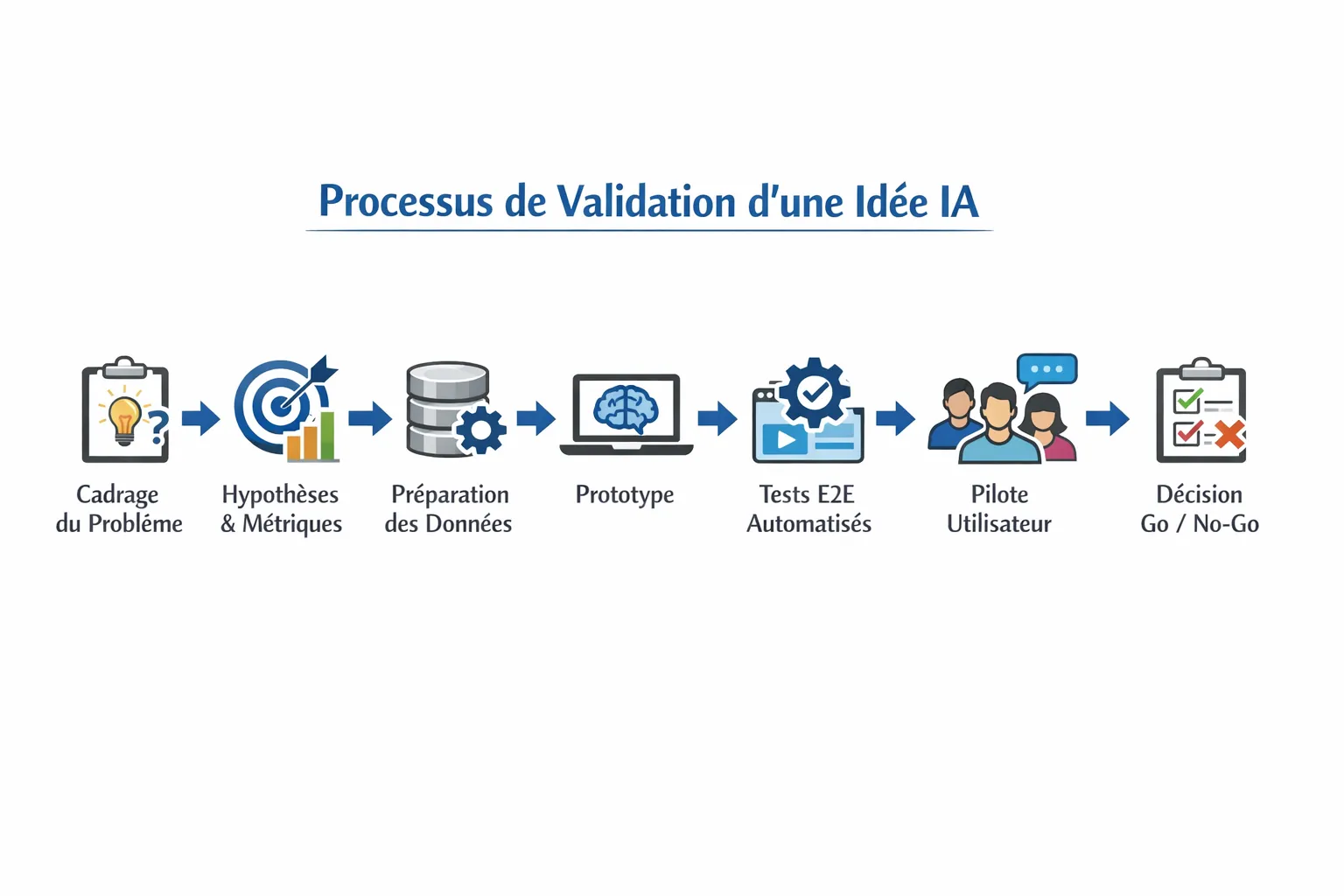
The simple 7-step protocol
Frame the problem in 60 minutes
Formulate the job-to-be-done and the critical journey you want to accelerate or make more reliable.
List constraints: security, GDPR, existing tools, SLAs, volume.
Define the minimum observable result, for example, "30 percent reduction in processing time for a simple ticket".
Write 3 hypotheses and 5 success metrics
Typical hypotheses: AI classifies 80 percent of requests without an agent, error rate drops below 2 percent, end-user rates satisfaction above 4 out of 5.
Recommended metrics: time saved per task, automation rate of the critical scenario, error/hallucination rate, pilot satisfaction, cost per execution.
Prepare 20 to 50 representative scenarios
Combine anonymized real data and synthetic data to cover common and edge cases.
Define readable acceptance criteria, for example, "the response contains a valid order number and cites the exact return policy".
Build an AI MVP in 1 to 3 days
Use your existing tools, a RAG connector, a prompt orchestrator, or a mini-API service.
Avoid over-engineering. The goal is to prove value, not freeze the architecture.
Automate AI-driven E2E tests
End-to-end tests simulate a real user, go through the critical flow, and verify that the AI and integrations produce the expected result.
Dedicated solutions like Autonoma.app highlight an agentic approach to execute E2E journeys and automatically validate acceptance criteria in real contexts.
Launch a mini pilot with 10 to 20 users
Run your protocol for 3 to 5 days. Collect metrics, qualitative feedback, incidents.
Hold a short daily review, adjust prompts, context data, and guardrails.
Decide with a scorecard
If 4 out of 5 target metrics are met, move to progressive industrialization.
Otherwise, archive learnings, iterate on the riskiest hypothesis, or stop cleanly.
AI Tests, from Unit to E2E: What to Measure and When
Type of test
Main objective
When to use it
Key indicators
Examples of tools/approaches
Unit (functions, prompts)
Verify isolated components
From MVP onwards
Accuracy on simple cases, stability
Function tests, parameterized prompts
Integration (API, RAG)
Validate interactions between modules
After first assembly
Correct retrieval rate, latency
Golden sets, source verification
AI Evaluation (LLM-as-judge, rubrics)
Score output quality
In parallel with devs
Relevance score, absence of hallucination
Eval rubrics, comparison to reference
Red teaming
Search for vulnerabilities
Before pilot
Resilience to prompt injection, non-compliant content
Attack lists, guardrails
Automated E2E
Replay complete real scenario
As soon as critical flow is wired
Journey pass rate, regression
E2E test agents, CI/CD scheduling
Tip: keep a small "golden set" of 30 to 100 immutable cases to detect regressions after any change in prompt, model, or source.
Zoom on AI-Driven E2E (Autonoma Spotlight)
E2E tests verify operational reality, from initial click to final result. Driven by AI, they allow:
Generation and execution of realistic high-coverage scenarios, including rare cases.
Automatic verification of acceptance criteria, by comparison with clear business rules.
Rapid detection of regressions during prompt, model, or integration updates.
Players like Autonoma.app position themselves precisely on this need for end-to-end tests accelerated by AI. Their promise, beyond recording journeys, is to introduce intelligence into the creation, adaptation, and execution of scenarios to save validation time and reduce test debt.
Three frequent use cases for SMEs and scale-ups:
E-commerce checkout: verify cart, delivery, taxes, transactional emails, and compliance of generated message (e.g., return policy) on different profiles.
Customer support with chatbot: test identification, classification, knowledge retrieval, response, and escalation with anti-hallucination guardrails.
Back-office: control an automation flow that creates an invoice, enriches it, validates it, and deposits it in the ERP with compliant logs.
Measure What Matters: Decision Scorecard
Metric
Type
Validation Target
Quick Measurement
Time saved per task
Business
30 percent or more
Sample of 20 timed tasks
Critical journey automation rate
Operational
80 percent or more
E2E on 50 scenarios
Error/hallucination rate
AI Quality
Less than 2 percent
Eval rubric + human review
Pilot satisfaction
Experience
4.0 out of 5 or more
Short NPS/CSAT survey
Cost per execution
Financial
Below target economic threshold
API/infra call tracking
Simple rule: if the business value per execution is greater than 3 times the cost per execution, and if quality is stable for 5 consecutive days, you have a solid candidate for industrialization.
Governance and Risks: 5 Minimum Controls
Data: anonymization and minimization. No sensitive data in prompts without legal basis or protection measures.
Guardrails: content policies, security filters, style constraints, and source citations.
Logging: logs of decisions and metadata for audit and debugging, with controlled retention.
Ethics and bias: tests on varied populations and cases, explicit evaluation criteria, human review of risky decisions.
Compliance: mapping of processing, DPA with providers, DPIA if necessary, alignment with the NIST AI RMF.
Concrete Example: Validating a Support Assistant in 7 Days
Day 1, framing: define 3 high-volume contact reasons and acceptance criteria. Prepare 30 representative tickets.
Day 2, MVP: orchestrate an AI agent connected to your knowledge base, with style guardrails and citations.
Day 3, unit and integration tests: verify retrieval of correct articles, response format, latency.
Day 4, AI E2E: setup of a first set of automated E2E tests on 20 scenarios, including expected responses.
Day 5, red teaming: attempt prompt injections, forbidden content, out-of-scope requests. Adjust policies and prompts.
Day 6, mini pilot: 10 internal agents use the solution. Measure time, quality, satisfaction.
Day 7, decision: move to limited production if 4 out of 5 metrics are met. Otherwise, iterate on the riskiest hypothesis or stop.
Marketing tip: align your tests with campaigns and landing pages to measure end-to-end impact. Working with a specialized team, for example a digital marketing agency in Chennai, can help coordinate SEO, PPC, and pages tested during your pilot.
"Ready to Use" Checklist
Problem and critical journey defined in one sentence.
3 hypotheses, 5 metrics, and their target thresholds documented.
20 to 50 test scenarios, with clear acceptance criteria.
AI MVP connected to necessary data, guardrails active.
Automated E2E tests configured and integrated into a daily report.
Mini pilot of 3 to 5 days, structured collection of metrics and feedback.
Scorecard and go/no-go decision, plus industrialization plan if go.
FAQ
What is the minimum duration for this protocol? One week is often enough for a first validation, provided you have a well-defined critical journey and a tight scope.
Do I need real data? Ideally a mix. Use anonymized real data for frequent cases and synthetic data to cover edges without exposing sensitive information.
How to avoid hallucinations? Define precise acceptance criteria, constrain the response (format, style, citations), use RAG with controlled sources, and measure a maximum tolerated error rate.
Do AI-driven E2E tests replace manual QA? No, they complement it. Automation covers regression and repeatable scenarios; human QA handles ambiguity, fine UX, and rare cases.
Can I use this protocol without a data team? Yes. Start with a lightweight MVP, well-framed prompts, and AI-driven E2E test tools. Evolve towards more advanced integrations later.
How to integrate GDPR compliance? Minimize and anonymize data, keep a register of processing activities, sign DPAs with your providers, and assess risks via a DPIA if necessary.
Which methodological references to follow? The NIST AI RMF for risk management and the Google Research "ML Test Score" to structure your tests and production readiness.
Take Action with Impulse Lab
You have an AI idea to validate now. Impulse Lab accompanies you from end to end, from framing to industrialization, with:
AI opportunity audits to prioritize high-ROI cases.
Development of custom web and AI platforms, integrated with your tools.
Process automation and clean, secure integration models.
Training for adoption and involvement of your teams throughout the project.
Weekly delivery rhythm and dedicated client portal for tracking.
Referral program with commission.
Book a call to transform your ideas into measurable value, in a few weeks, not a few quarters. We will set up your AI test protocol, your metrics, and, if relevant, AI-driven E2E tests with suitable partners like Autonoma.app, in order to decide quickly and with confidence.