5 Artificial Intelligence Examples for SME Procurement
Intelligence artificielle
Stratégie d'entreprise
Outils IA
Automatisation
Optimisation
Looking for practical AI examples to improve SME procurement? The most useful applications tackle concrete tasks: comparing quotes, analyzing spend, forecasting demand, auditing invoices, and locating key contract clauses.
October 14, 2026·10 min read
Looking for “artificial intelligence examples” to improve procurement in your SME? The most useful applications often tackle very concrete tasks: comparing quotes, analyzing spend, forecasting demand, auditing invoices, and locating key clauses in contracts.
The goal is not to outsource your vendor decisions to software. It is to reduce prep work while keeping full control over commitments. Here are five use cases, complete with the required data, necessary controls, and metrics to measure their value. The scenarios presented are illustrative, not actual client results.
“Artificial Intelligence Examples”: Five Use Cases for Procurement
Not all procurement needs require the same technology. Generative AI can extract and summarize information found in documents. A predictive model can estimate future demand based on historical data. A traditional rule-based approach often remains preferable for verifying calculations or enforcing approval thresholds.
A reliable solution combines these approaches rather than relying on a single conversational assistant to do everything.
Use Case
Input Data
AI-Prepared Work
Human Decision Kept
Quote Comparison
Quotes and specifications
Comparative table and missing items
Supplier selection
Spend Analysis
Invoices and accounting exports
Classification and grouping of purchases
Negotiation strategy
Demand Forecasting
Consumption, stock levels, and lead times
Future needs estimate
Order quantity
Invoice Auditing
Purchase orders, receipts, and invoices
Extraction and discrepancy alerts
Payment approval
Contract Search
Contracts and amendments
Sourced answers with references
Renewal or renegotiation
1. Comparing Quotes Without Rebuilding Spreadsheets by Hand
An SME consults three suppliers to purchase packaging materials. The quotes arrive in different formats: price per carton from one, unit price from another, shipping billed separately by the third. Comparison takes time, and a lower sticker price may conceal a higher total cost.
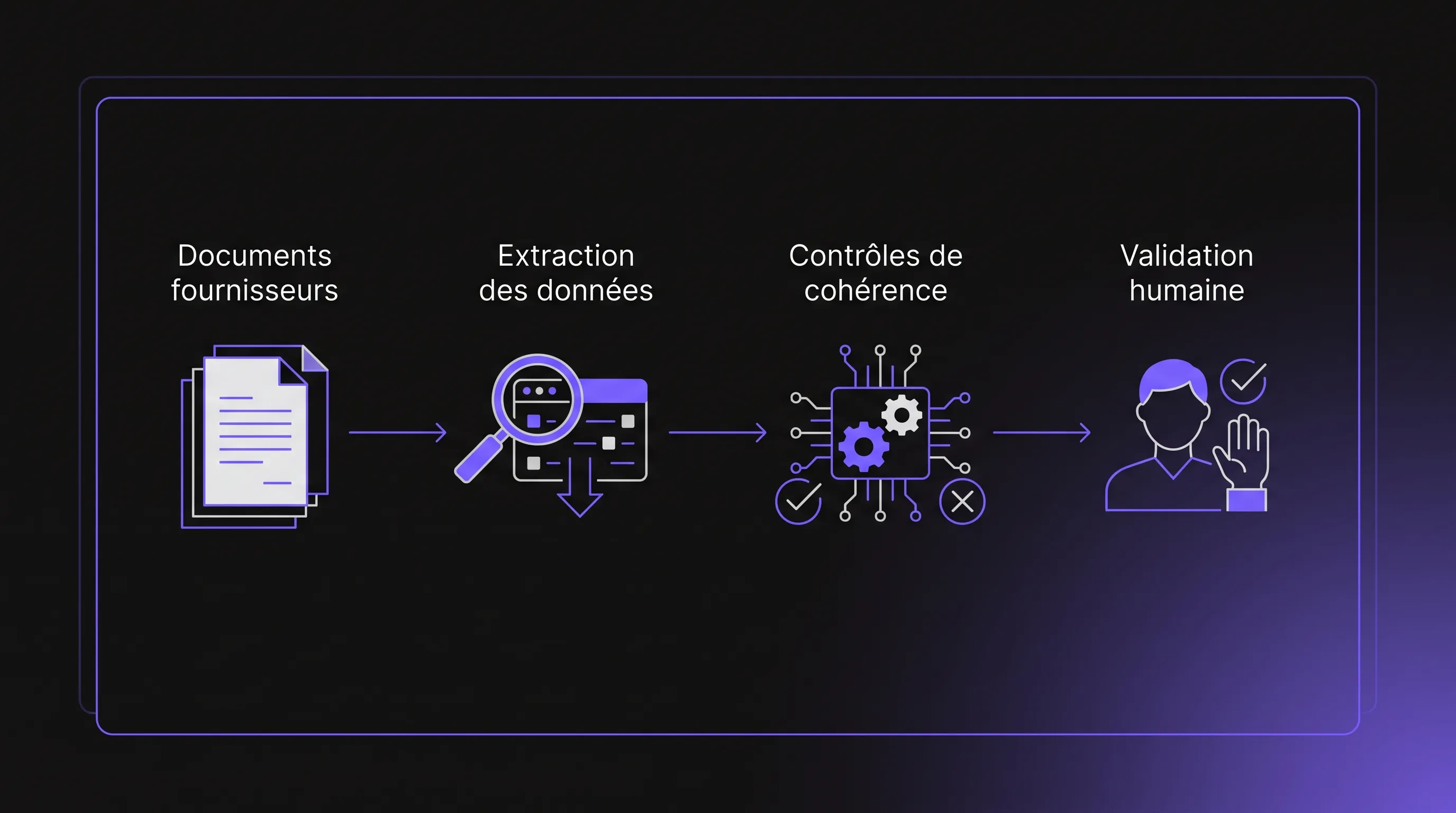
In this first artificial intelligence example, a system extracts item numbers, quantities, units, pricing, shipping fees, lead times, and payment terms. It prepares a standardized comparison table and flags missing information. The team can then request necessary clarifications before making a decision.
The decisive factor is data normalization. A carton of 200 items shouldn't be directly compared to a pack of 100. Total cost calculations must rely on verifiable formulas, not on an estimate drafted by the model.
Every extracted value must be traceable back to the source quote. If a lead time isn't mentioned, the correct response is “not provided”, never an assumed figure. Technical equivalence between offers must also be verified: dimensions, quality, and required certifications can alter the final decision.
To measure the system's value, track the time required to produce a validated comparison, including corrections. Factor in the number of errors caught during review. A fast but unreliable spreadsheet provides zero real benefit.
2. Categorizing Spend to Prepare for Negotiations
Purchases are often scattered across multiple departments, corporate cards, and vendor accounts. The same vendor might appear under several different names in accounting records. As a result, leadership cannot easily see how much the SME actually spends per category or with any given supplier.
AI can suggest a classification for invoice descriptions and reconcile name variations. For example, it distinguishes between packaging, freight, IT services, and office supplies. It can also flag similar purchases made across multiple vendors.
These artificial intelligence examples applied to spend analysis serve to prepare for commercial negotiations, not to promise guaranteed savings. Consolidating volume can strengthen negotiation leverage, but maintaining multiple suppliers may also be necessary to safeguard supply chains.
Start with an accounting export that includes date, vendor, amount, currency, and line description. Have someone familiar with purchasing validate a sample of categories. Ambiguous line items should be flagged for review rather than classified with false certainty.
Vendor IDs are particularly helpful to prevent merging two distinct companies. To evaluate results, measure the share of spend correctly categorized, the time required to prepare the analysis, and the actual savings achieved post-negotiation on a like-for-like basis.
3. Anticipating Needs to Adjust Replenishment
A maintenance company uses spare parts irregularly. Certain items run out right when a service job is scheduled, while others sit in stock for months. Forecasting can help prepare purchase orders by factoring in historical consumption and supplier lead times.
Key data includes inventory issues, available stock levels, open orders, and observed lead times. Depending on the business, scheduled interventions, promotions, or seasonal trends should also be included. Promised delivery dates should never be confused with actual delivery dates.
Among these artificial intelligence examples, forecasting is particularly sensitive to the quality of historical data. Low recorded consumption may simply stem from a stockout: due to lack of availability, demand was never fulfilled. The model risks underestimating real demand as a result.
If data is sparse or the business has recently changed, simple reorder points might be more appropriate than a complex model. The forecast should always be benchmarked against this baseline solution before adoption.
Initially, the system suggests quantities and explains the underlying factors. A human validates the order according to cash flow, warehouse capacity, and commercial commitments. Then, track stockouts, inventory value, and rush orders. Reducing stockouts by doubling inventory does not demonstrate real profitability.
4. Spotting Discrepancies Between Orders, Receipts, and Invoices
An invoice lists 120 units, but the goods receipt note only shows 100. In another case, the invoiced rate differs from the agreed price. These discrepancies can be hard to catch when documents are scattered across inboxes and software platforms.
The system performs three-way matching: purchase order, receiving slip, and invoice. AI helps read the documents and align line items even when item descriptions vary. Explicit rules then check quantities, pricing, and calculations against tolerances defined by the company.
This artificial intelligence example works best when purchase order numbers are consistently communicated across teams. Without a shared identifier, matching becomes much less reliable. A discrepancy may also be legitimate: a partial shipment, a pending credit note, or an approved price change.
The system flags an anomaly; it does not automatically assume fraud. For the same reason, an invoice deemed consistent should not trigger automated payment on its own. Any change in banking details warrants independent verification with a known supplier contact.
Track audit time per invoice, the number of confirmed discrepancies, and the false positive rate. Too many false alerts can wipe out any time saved. To govern system permissions, the principles of automating with AI agents without losing control help distinguish between preparation, validation, and execution.
5. Finding Key Clauses in Supplier Contracts
An SME often has maintenance, lease, and software agreements scattered across folders. Before a renewal, locating notice periods, price revision terms, or service level agreements can mean rereading several documents and amendments.
A document assistant can answer specific questions: “What is the deadline to give notice of non-renewal for this contract?” It searches approved documents and surfaces the relevant clause, referencing the file name, page, and version used.
In these artificial intelligence examples, value stems from fast access to verifiable information. A summary without citations is insufficient for contractual decisions. The system must also flag if an amendment is missing or if two documents appear to contradict each other.
Signing dates, initial terms, automatic renewals, and notice periods interact closely. The assistant can prepare a reading and date calculation, but a qualified person must verify the interpretation before sending binding notices. It is not a substitute for legal advice.
Start with a limited set of complete, up-to-date contracts. Control access permissions, especially for documents containing confidential pricing. Measure the time required to find a clause and the proportion of properly sourced answers. Renewal alerts only become dependable once extracted dates have been verified.
Which Use Case Should Your SME Start With?
The best starting point is not necessarily the most ambitious one. Choose a frequent, measurable, and reversible task with easily accessible data. Quote comparison or invoice audit prep is often easier to test than demand forecasting on incomplete historical data.
To prioritize among these artificial intelligence examples, evaluate the volume processed, current time lost, and the cost of an error. The framework for prioritizing profitable AI use cases helps place procurement initiatives within the broader context of company needs.
Define a Testable Scope
Limit the pilot to a single purchasing category, document type, or team. Define the expected output: a comparison ready to review, categorized spend, or a list of discrepancies to inspect. Designate the person responsible for validation.
Assemble a representative test set that includes tricky documents: scanned quotes, mismatched units, partial shipments, or amended contracts. Test against cases with known correct outcomes first, then against new records. This verifies performance beyond the examples used to configure the system.
Calculate Net Gains, Not Just Theoretical Time
Here is an illustrative simulation, unrelated to any commercial offering. An SME processes 60 quote comparisons per month. Total time per file drops from 15 to 7 minutes, review included. That amounts to 8 hours saved per month. At an assumed fully burdened labor cost of €35/hour, that represents €280 in freed-up capacity.
If recurring software costs are €100 per month, the estimated net value is €180, before factoring in initial setup costs. This calculation does not automatically represent cash savings: you must determine how that freed-up time will be reinvested.
For these artificial intelligence examples, also account for data cleaning, maintenance, training, and exception handling. A reduction in data entry time is only valuable if it doesn't simply shift more effort to error correction.
Protect Data and Restrict Permissions
Procurement documents can contain negotiated pricing, personal contact info, and banking details. Before sending anything to an AI service, check its data usage terms, retention policies, access controls, and potential international transfers. CNIL resources on artificial intelligence offer a good starting point for personal data protection requirements.
Prioritize read-only access at first. Keep audit logs of sources, recommendations, and human approvals. Any capability to issue purchase orders, update vendor records, or trigger payments must have separate permissions and controls calibrated to the risk.
Frequently Asked Questions
Do you need an ERP to use AI in procurement? No. Accounting exports, quotes, and spreadsheets are enough to test a limited use case. An ERP or management software becomes helpful later to reliably pull consistent data and embed the workflow into daily operations.
Is a free AI assistant enough to get started? It can be used to experiment on mock or properly anonymized documents. Before handling real supplier documents, verify confidentiality, access rights, and terms of service. Price alone does not determine whether a tool is suitable.
Can supplier selection be fully automated? It is better to start by automating the preparation for that decision. Quality, supply risks, and contractual commitments require proper human judgment, even when prices are simple to compare.
How do you distinguish traditional automation from AI? Approval thresholds or calculating totals rely on traditional rule-based logic. Parsing variable documents, categorizing ambiguous line items, or forecasting demand can justify AI. The two approaches complement each other.
Scoping Your First Procurement AI Project
These five artificial intelligence examples share a common trait: they improve a specific step in the process without removing team accountability. Before picking a tool, define the task, available data, human review step, and success metrics.
Impulse Lab supports SMEs in their AI projects through opportunity audits, custom solutions, integration with existing tools, and training. For your next procurement initiative, start by scoping a focused pilot whose results can be directly compared to your current process.