AI Agency: Essential Criteria for Making the Right Choice
automatisations
Intelligence artificielle
Stratégie IA
Choosing an AI agency isn't just buying development; it's a bet on ROI and security. If you are hesitating between providers, use this guide to structure your decision, ask the right questions, and objectively compare proposals.
December 12, 2025·9 min read
Choosing an AI agency is not a simple development purchase; it is a bet on your ROI, your security, and your ability to execute quickly without breaking what already exists. If you are hesitating between several providers, use this guide to structure your decision, ask the right questions, and objectively compare proposals.
Before looking for an AI agency, clarify your need
The better the need is scoped, the stronger the collaboration starts. Upstream, formalize on one page maximum:
Business objectives and success metrics (examples: 30% reduction in processing time, 60% automation rate, 10-point NPS improvement).
Technical context, tools in place, sources of truth, security and compliance constraints.
Priority use cases, size of impacted population, risks if the initiative fails.
Realistic budget and time horizon for a useful first version.
Useful tip: classify your ideas into three families: process automation, internal copilots and assistants, and proprietary data valorization via RAG and semantic search. This simplifies evaluating agencies based on their strengths.
Criterion 1: Demonstrated expertise on your use cases
Ask for concrete cases close to your context, not just generic demos.
Types of projects: back-office automation, team copilots, internal chats linked to the document base, document extraction, vision, sector-specific predictive models.
Mastered technologies: proprietary and open source LLMs, RAG and vectors, orchestrators, data pipelines, MLOps and LLMOps.
Measured results: time saved, error reduction, adoption, controlled inference costs.
Demand a step-by-step: problem, approach, architecture, impact measurement. Beware of very general answers; they often hide a lack of real experience.
Criterion 2: Product approach and delivery pace
A good AI agency thinks product before code. Look for strong signals: structured discovery, prioritization by impact, short sprints, frequent demonstrations, and user involvement.
Ask for a 4 to 6-week plan for a useful V1, including alignment workshops, mockups, experimentation, and weekly iterations.
Favor partners who offer weekly delivery cadences and a client portal to track progress, decisions, and milestones. Transparency reduces drift risks.
Criterion 3: Integration and urbanization of your IS
Gains often come from fine integration with existing systems.
Data: governance, quality, freshness, traceability, update and indexing strategy if RAG.
Architecture: environment isolation, secrets management, logs, cost and performance.
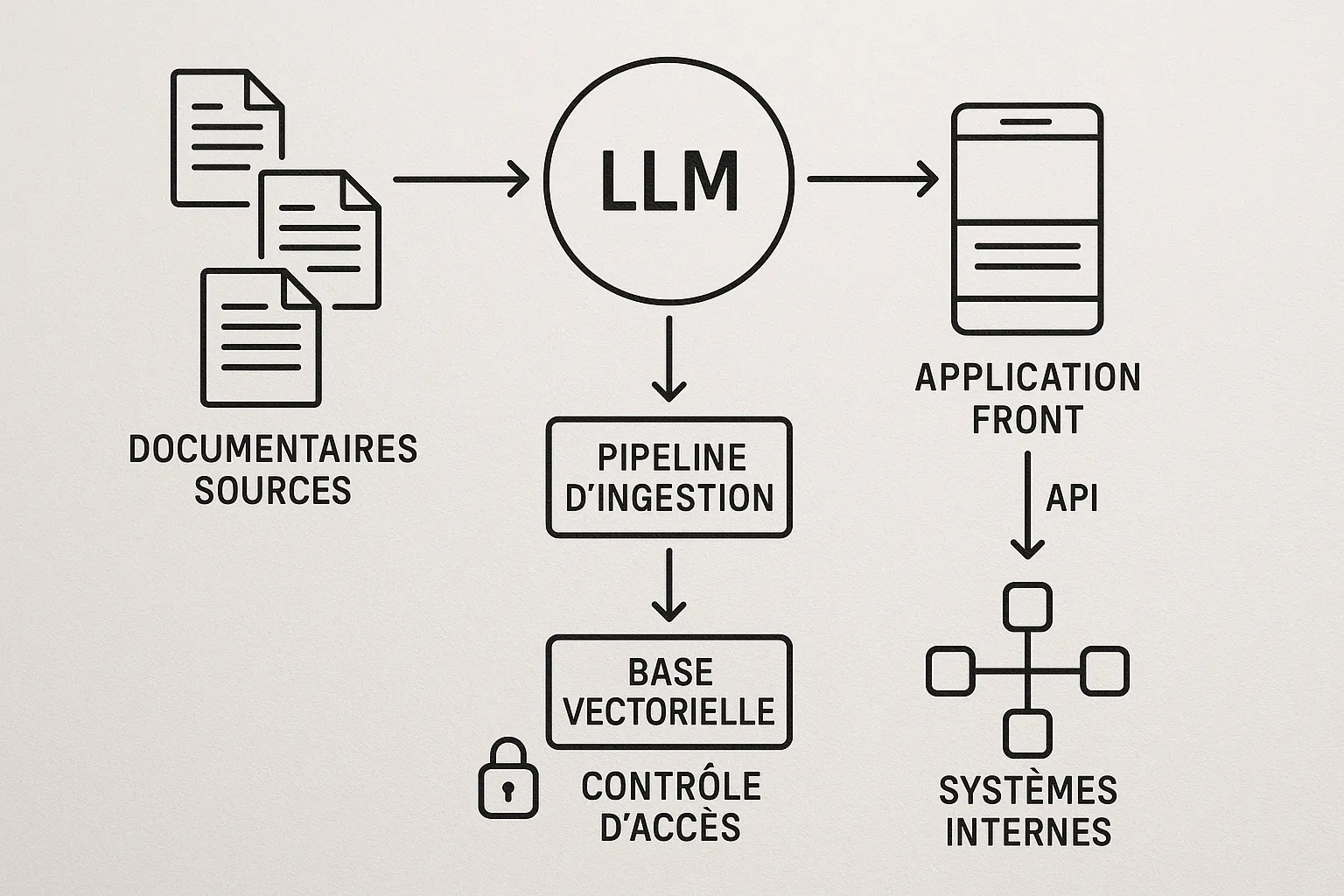
Ask for a target architecture diagram and a precise list of dependencies.
Criterion 4: Security, data protection, and compliance
Compliance is not optional. Verify that the agency masters relevant frameworks and implements them.
GDPR: minimization principles, legal basis, DPA, transfer outside EU, access and erasure rights, audit logs.
Security: encryption at rest and in transit, client data partitioning, key management, access control, penetration testing.
Public guidelines: the NIST AI Risk Management Framework serves as a compass for risk management, the CNIL publishes useful recommendations for AI, and the European AI Act enters into application in stages between 2025 and 2026.
Regarding LLMs, clarify data processing: retention at the model provider, data residency, hosting options, providers used (Azure OpenAI, Google, AWS, or open source models).
Criterion 5: LLM robustness, evaluation, and guardrails
AI systems must be measurable and resistant to abuse.
Evaluation: gold sets, business quality metrics, accuracy rates, refusal rates, inference costs per task, response time.
LLM Security: protections against prompt injection and data exfiltration, tool validation, pattern allowlist, sandbox. Consult the best practices of the OWASP Top 10 for LLM Applications.
Observability: traces, red teaming, escalation policy, and rollback mechanisms.
Criterion 6: Lifecycle management, MLOps and LLMOps
Ask how the agency operates after go-live.
Model promotion and versioning, feature stores, model registry, continuous evaluation.
Quality and drift monitoring, alerting, cost quotas, prompt governance.
Reproducible pipelines, CI, CD, prompt and template review, secrets.
Criterion 7: Change management, training, and adoption
An AI project creates new business actions. Verify the agency's ability to support teams.
Targeted training by persona: operators, managers, administrators.
Documentation, quick guides, ready-to-use use cases, prompt best practices.
Adoption measurement and feedback loops.
Favor partners who offer AI adoption training and involve your teams throughout the project.
Criterion 8: Collaboration model and financial steering
Clarify engagement and costs very early.
Initial scoping, discovery workshop, estimation, milestones and deliverables, acceptance criteria.
Billing: fixed price per batch, time and materials, team retention, and variable inference and hosting costs.
Intellectual property: component reuse, usage rights on prompts and datasets.
Demand precise visibility on Cloud and model costs to avoid surprises at scale.
Criterion 9: Support and service continuity
After production deployment, operations begin.
Response and resolution SLAs, support hours, on-call duty if critical.
Runbooks, incident procedures, recovery plan, tested backups and restoration.
Continuous improvement plan, quarterly roadmap aligned with business value.
Criterion 10: Ethics, transparency, and explainability
Depending on use cases, you will need to trace AI-assisted decisions, provide explanations or justifications, and manage opposition requests. Ensure the agency knows how to apply bias, robustness, and performance tests adapted to your context and that it documents system limits.
Scoring matrix: compare agencies in 30 minutes
Assign a weight to each criterion according to your context, then rate each agency out of 5. Here is an example grid; adapt the weights to your priorities.
Criterion
Weight
Agency A
Agency B
Agency C
Use case expertise
15
Product approach and delivery
12
IS Integration and architecture
12
Security and compliance
12
LLM evaluation and guardrails
10
MLOps and LLMOps
10
Change management and training
8
Multiply each score by the weight, then sum up. Keep the best score, but confront it with the feeling of collaboration and the clarity of residual risks.
Due diligence: 15 questions to ask absolutely
Domain
Key Question
Use case
Can you describe a comparable project, architecture, impact metrics, and lessons learned?
Data
What data sources will you use, what transformations, what governance and traceability?
Models
Which models do you recommend and why, selection criteria, cost, latency, license constraints?
RAG
What strategy for indexing, updating, and document-by-document access control?
Security
How do you isolate our data, encryption, secrets, audit logs, penetration tests?
GDPR
Where is data hosted, retention duration, DPA, anonymization or pseudonymization mechanisms?
Evaluation
What business metrics will you track, how frequently, with what A/B test or review protocol?
Guardrails
How do you manage prompt injection, jailbreak, exfiltration, hallucinations, and sensitive data?
Costs
How do you project and control inference and storage costs at scale?
Observability
What tools for tracing, alerting, and dashboards, and what escalation policies?
DevOps
How do you tool CI, CD, environments, and incident recovery?
IP
Frequent errors to avoid
Launching a large program without proof of rapid value; prefer a V1 focused on a critical and measurable case.
Underestimating data quality; without minimal governance, performance erodes quickly.
Forgetting adoption; a powerful copilot that is poorly integrated into the workflow will be little used.
Neglecting variable inference costs; a poorly optimized design can triple the Cloud bill.
Confusing demo and production; demand guarantees of exploitability and security.
Typical roadmap for a V1 in 6 weeks
Week 1: scoping workshops, flow mapping, definition of success metrics. Week 2: mockups and prototypes guided by real non-sensitive data, architecture choice. Week 3: priority integrations and first end-to-end usage. Week 4: evaluation, guardrails, cost and latency optimization. Week 5: security and compliance preparation, pilot training. Week 6: limited production deployment, observability plan, improvement loop.
How Impulse Lab can help you
Impulse Lab is an expert agency that designs custom web and AI solutions to transform AI into concrete value. The team intervenes end-to-end, from opportunity audits to development and integration, up to adoption training. Projects are led with a strong product mindset, weekly delivery, client involvement, dedicated portal, and integration with your existing tools. To discover our approaches or start a quick audit, contact us via impulselab.ai.
FAQ
A large IT consulting firm (ESN) or a specialized AI agency, which to choose? Both models can work. A specialized AI agency often brings specific expertise, execution speed, and a very pragmatic product approach. A large IT consulting firm can facilitate large-scale deployment if it has the right AI skills. Above all, compare concrete experience on your use cases and the ability to deliver fast.
Should AI development be internalized or outsourced? Often start with a partner to go faster and limit architecture errors, then gradually internalize operations and part of the development, especially if AI becomes a key competitive advantage.
How to measure the success of a first AI project? Define metrics before coding: time saved per task, automation rate, user acceptance rate, error reduction, cost per operation. Track them weekly after production deployment and iterate.
Will corporate data train public models? By default, serious providers offer options without reusing client data for training. Check retention settings, DPA contracts, and data isolation, and favor offers compliant with your security policy.
What regulatory obligations will apply in Europe? The European AI Act has entered into force with progressive application between 2025 and 2026 depending on risk categories. Furthermore, GDPR remains central for data protection. Rely on NIST, CNIL, and ISO standards guides to structure your governance.
Ready to evaluate an AI agency methodically and secure your first quick wins? Discuss your use case with Impulse Lab. AI opportunity audit, custom web and AI platforms, process automation, integration with your tools, adoption training, weekly delivery, and client portal. Let's start with clear scoping and a useful V1; contact us at impulselab.ai.
AI and Cybersecurity: The Minimum Controls for an SME
From summarizing contracts to drafting invoices, each AI use case introduces new access risks. For an SME, AI and cybersecurity must be addressed together before connecting sensitive data or automating actions. Discover eight essential controls and a 30-day rollout plan.