AI and Sales Training: Helping Reps Handle Objections
Intelligence artificielle
Outils IA
Productivité
Optimisation
Sales
Combining AI and training helps sales reps practice handling objections before prospect meetings. A simulator roleplays the buyer, challenges rushed answers, and builds observable reflexes: listening, clarifying, and responding with verified facts.
October 30, 2026·10 min read
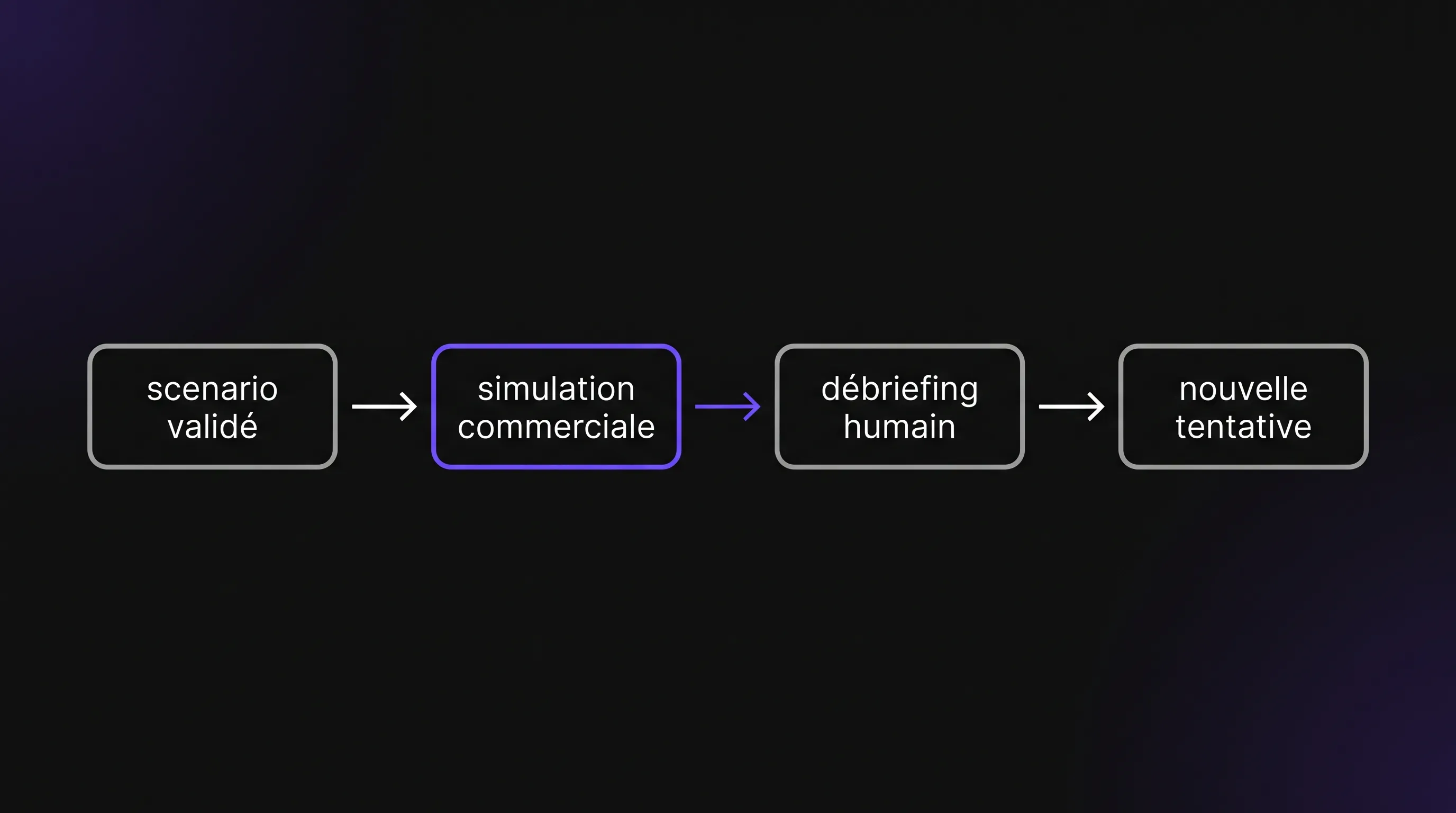
Combining AI and training can help your sales reps practice handling objections before encountering them in actual meetings. A simulator roleplays the prospect, pushes back against rushed answers, and allows for restarting the exchange. The goal is not to deliver a scripted, flawless comeback, but to build observable reflexes: listening, clarifying, responding with verified facts, and proposing an appropriate next step.
For an SME or scale-up, this format enables short practice drills between coaching sessions with a manager. However, you need to avoid artificially easy prospects, fabricated arguments, and unfounded ratings. Here is a framework to design effective exercises, structure debriefs, and verify that training genuinely improves real-world conversations. You can start with just a few scenarios, without building a dedicated platform right away.
AI and Training: Practicing a Skill, Not Reciting a Script
Handling objections is not about instantly neutralizing every pushback. "It’s too expensive" can indicate a budget constraint, misunderstood value, or a comparison with an alternative solution. The rep must first understand what is actually blocking the deal.
AI can take on the role of an interlocutor and adapt its responses based on a defined scenario. It can also flag a missed question or prompt the rep to rephrase a statement. This round-the-clock availability makes repetition easy, especially when a manager is onboarding multiple new hires.
The manager remains responsible for the pedagogical framework and the final feedback. A model does not inherently know your sales policy, contractual boundaries, or the true reasons behind a purchase. It simulates a plausible conversation, not the exact psychology of a specific buyer.
Start with a targeted skill: clarifying a price objection before defending value, for instance.
Building an Objection Library from the Field
Gather the objections your team actually encounters in the field. For each, document the context: persona/stakeholder, sales cycle stage, offer presented, and response given. The exact same objection does not call for the same handling during an initial discovery call as it does after sending a formal proposal.
The combination of AI and training proves useful when real situations serve as learning material, rather than relying on generic lists of answers expected to work everywhere.
Stated Objection
What to Clarify
Reflex to Train
"It's too expensive."
Unavailable budget, comparison, or insufficient value demonstrated?
Ask questions before defending the price
"We already have a vendor."
Current satisfaction and potential unmet needs
Explore without badmouthing the competitor
"It's not the right time."
Genuine constraint, competing priority, or lack of need?
Identify a relevant trigger without forcing urgency
"I need to discuss this with leadership."
Decision criteria and stakeholders involved
Secure a concrete, valuable next step
These angles are hypotheses to verify through questioning, not definitive intentions to assign to the prospect.
To begin, select three frequent objections and one situation where the right decision is to disqualify and walk away. This prevents teaching reps that every single conversation must force a sale.
Writing a Scenario That Truly Challenges the Rep
An actionable scenario includes context, a learning objective, information known to the prospect, and explicit boundaries. For example: a Head of Sales is evaluating a follow-up tracking tool, but doubts the effort required to integrate it into her team's daily workflow.
Certain details should remain hidden from the sales rep initially. The simulated prospect only reveals them if an insightful question is asked. Conversely, the AI must stick to the provided scenario: it should not fabricate technical constraints or contractual commitments just to make the conversation more dramatic.
Combining AI and training also requires calibrating difficulty. A beginner-level prospect articulates their hesitation clearly. A more advanced scenario weaves in two objections or provides incomplete answers, without turning arbitrarily hostile.
A simulated prospect should not back down simply because the rep is persistent. Define progression conditions: objection clarified, answer supported by facts, or a clear next step accepted. The interaction can also conclude with a legitimate refusal.
A Customizable Prompt to Launch a Roleplay
The following prompt separates the roleplay from the debrief. Replace the bracketed fields with validated information. If you are combining AI and training for the first time, use a fictional scenario rather than raw client meeting notes.
You are roleplaying a prospect in a sales training exercise.

CONTEXT
Offer: [description and verified capabilities]
Prospect: [job title, fictional company, and situation]
Initial objection: [exact phrasing]
Hidden information: [details to reveal only if I ask a relevant question]
Learning objective: clarify the objection before answering.
Boundaries: [forbidden promises, commercial terms, and unknowns]

SIMULATION
Respond only as the prospect, one turn at a time.
Do not coach or advise me during the exchange.
Stay consistent with the provided information.
Do not invent any offer features or customer proof points.
Do not give in to unsupported claims or repeated pressure.
If a piece of information is missing, keep it unknown.

DEBRIEF
When I type END, step out of character.
Evaluate my clarifying questions, my rephrasing, and my response.
Quote a specific excerpt for each observation.
Flag any claims not backed by the provided facts.
Suggest a single priority for improvement, then have me replay the relevant passage.
Have the manager test this prompt before rolling it out. Specifically check that the prospect does not give away all hidden information upfront. If the model blurs coaching and roleplay, separate the two steps into distinct conversations.
Evaluating Observable Behaviors
Feedback like "good objection handling" does not tell a rep what to improve. To tie AI and training to measurable progress, use a shared rubric across the rep, the manager, and the simulator.
Here is a sample internal rubric to adapt to your sales cycle. For each criterion, assign 0 if the behavior is absent, 1 if partial, and 2 if clearly observable. This scoring system is meant for debriefing, not to generate a scientific measurement of skill.
Criterion
Expected Behavior
Active Listening
Lets the prospect finish speaking and acknowledges their point of view
Clarification
Asks a question that pinpoints the underlying blocker
Rephrasing / Paraphrasing
Confirms understanding before delivering an answer
Grounded Response
Uses verified, authorized, and relevant information
Appropriate Next Step
Proposes a logical next step or agrees to disqualify/discontinue
Always instruct the model to quote the exact excerpt justifying its feedback. The manager can then validate or correct the assessment. Your approach to training managers to validate AI outputs applies directly to these debriefs.
Finish with a targeted replay. Practicing only the clarifying question again is often more effective than restarting the entire conversation without a clear focus.
Running a Pilot Without Overburdening the Team
Start with a Limited Scope
Select a small team, three scenarios, and an instructional lead. Prepare a shared offer cheat sheet: confirmed capabilities, limitations, verified proof points, and commitments that require prior approval. This sheet reduces the risk of practicing commercially appealing yet inaccurate claims.
Plan short sessions, reserving time for manager feedback. As a starting format, consider ten minutes of roleplay followed by five minutes of debriefing. Adjust based on your sales complexity and team availability.
Test Before Integrating Tools
Text-based practice helps refine reasoning and phrasing. A voice format can later be introduced to work on interruptions, pacing, and spontaneous reactions, provided the chosen tool supports it.
Do not immediately integrate CRM data or call recordings. First make sure the scenarios yield constructive situations and that reps understand the feedback. A technical integration cannot fix a poorly designed exercise.
Measuring Transfer to Real-World Meetings
The success of a project combining AI and training isn't measured by session volume or the model's score. The core question is whether the rep applies the right behaviors outside the simulator.
Run a baseline exercise before starting the pilot. After several sessions, use a different scenario of comparable difficulty. Keeping the exact same scenario would merely measure rote memorization. If possible, have the manager evaluate both exercises blindly, without knowing which was recorded before training.
In live calls, observe key behaviors: asking a clarifying question, accurate paraphrasing, and establishing a logical next step. Only review conversations you are authorized to access.
Post-objection conversion rates can supplement this analysis, but they also depend on pricing, lead quality, and deal maturity. A revenue bump during the pilot does not, on its own, prove training effectiveness.
Finally, track total cost of ownership: scenario development, potential tool subscriptions, practice time, and management coaching. This review helps you decide whether to scale up, refine the exercises, or wind down an underutilized program.
Protecting Data and Maintaining Human Oversight
Sales call transcripts often contain contact details, negotiated pricing, or confidential client information. To get started, prioritize fictional cases or anonymized summaries stripped of identifying and sensitive details. Simply swapping a company name is not always sufficient if context makes the business easily identifiable.
An initiative pairing AI with training must clarify who has access to conversations, data retention periods, and whether the vendor can train on your inputs. Review the specific terms of service rather than assuming an enterprise account automatically safeguards all data. For European organizations, guidance like the CNIL’s documentation on artificial intelligence offers a solid starting point for governance.
Inform employees of the program's purpose and who has access to their performance data. A training program introduced as a safe sandbox must not turn into an opaque grading system for promotions or disciplinary actions.
Also avoid automated emotion recognition from biometric data in the workplace, which is generally prohibited under the AI Act, barring specific exceptions such as medical or safety purposes.
Finally, review all generated arguments. The limitations of AI in negotiation apply during training as well: an articulate answer may still be factually incorrect or ill-suited to your actual product.
Frequently Asked Questions
What tool should you choose to combine AI and sales training? Start by evaluating data handling policies, the ability to inject detailed scenarios, and the quality of simulated conversations in your target language. A standard conversational AI tool may be enough to test the methodology. A specialized solution becomes worthwhile if you need advanced features whose value was validated during the pilot.
Can juniors and senior sales reps be trained together? Use the same evaluation rubric, but adapt the scenarios. A junior rep can practice handling explicit objections. An experienced rep can tackle stakeholder disagreements or scenarios where the best outcome is recognizing that the solution is a poor fit.
Can AI replace manager coaching? It can multiply practice opportunities and provide initial feedback. However, a manager is still essential to contextualize conversations, verify pitch accuracy, and tie exercises back to the challenges faced in the field.
Structuring Your First Training Initiative with Impulse Lab
Before building a custom solution, identify three priority objections, an observation rubric, and approved data guidelines. This defined scope clarifies your requirements and helps determine whether an off-the-shelf tool or custom development makes the most sense.
Impulse Lab supports organizations with AI opportunity audits, adoption training, and custom web and AI solutions. The initial goal: design a high-impact training program aligned with your sales workflow and tailored to your team's needs.