AI Lab: Turning an Idea into a Profitable Prototype
Many innovation teams launch POCs that impress in demos but fail due to lack of impact. A well-framed AI Lab does the opposite: starting from a business goal, it builds a usable prototype that proves profitability quickly and safely. Here is how to turn an idea into a profitable prototype.
Summarize this blog post with:
Many innovation teams launch a POC that impresses in demos but runs out of steam due to lack of measurable impact. A well-framed AI Lab does the opposite: it starts from an expected business result and builds a usable prototype that proves plausible profitability, quickly and safely. Here is how to turn an idea into a profitable prototype, without turning it into a science project.

What is a profitable AI prototype?
A profitable prototype is not a simple technical proof. It is a solution usable by a small group of real users, integrated into an existing process, demonstrating credible and measured economic value.
The criteria that matter:
A clear problem, linked to a financial indicator, for example: processing time, conversion rate, cost per ticket, avoided risk.
A quantified impact hypothesis, for example: reducing support email processing time by 30%.
Light integration where value materializes: CRM, helpdesk, intranet, ERP.
Quality and risk metrics: accuracy, hallucinations, GDPR compliance.
A capped and transparent cost: platforms, APIs, annotation, team hours.
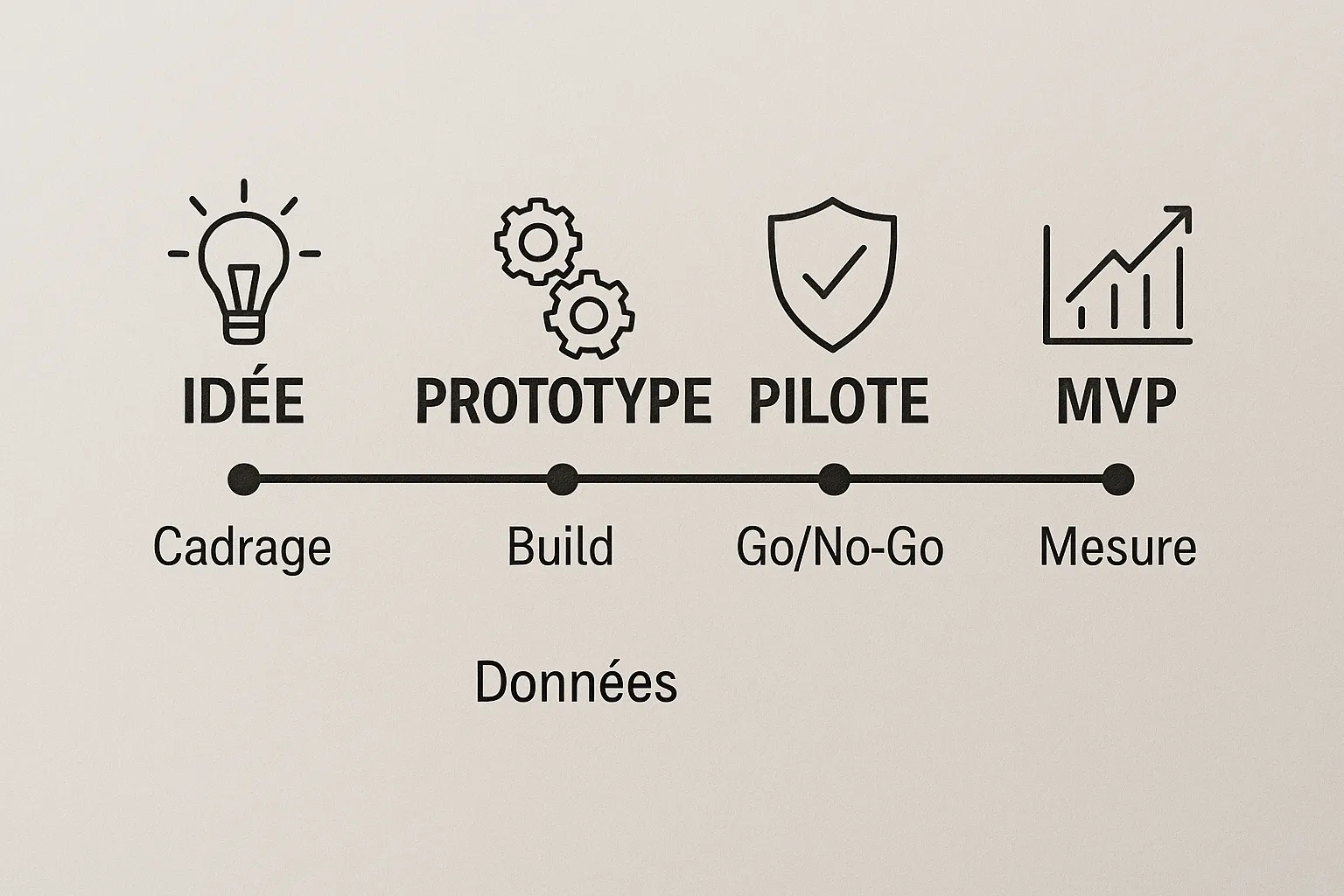
POC, prototype, MVP: what's the difference?
POC: proves that the idea works technically on a minimal case.
Prototype: usable version, measured, connected to real data and a process.
MVP: marketable or deployable version at scale, with robustness and operations.
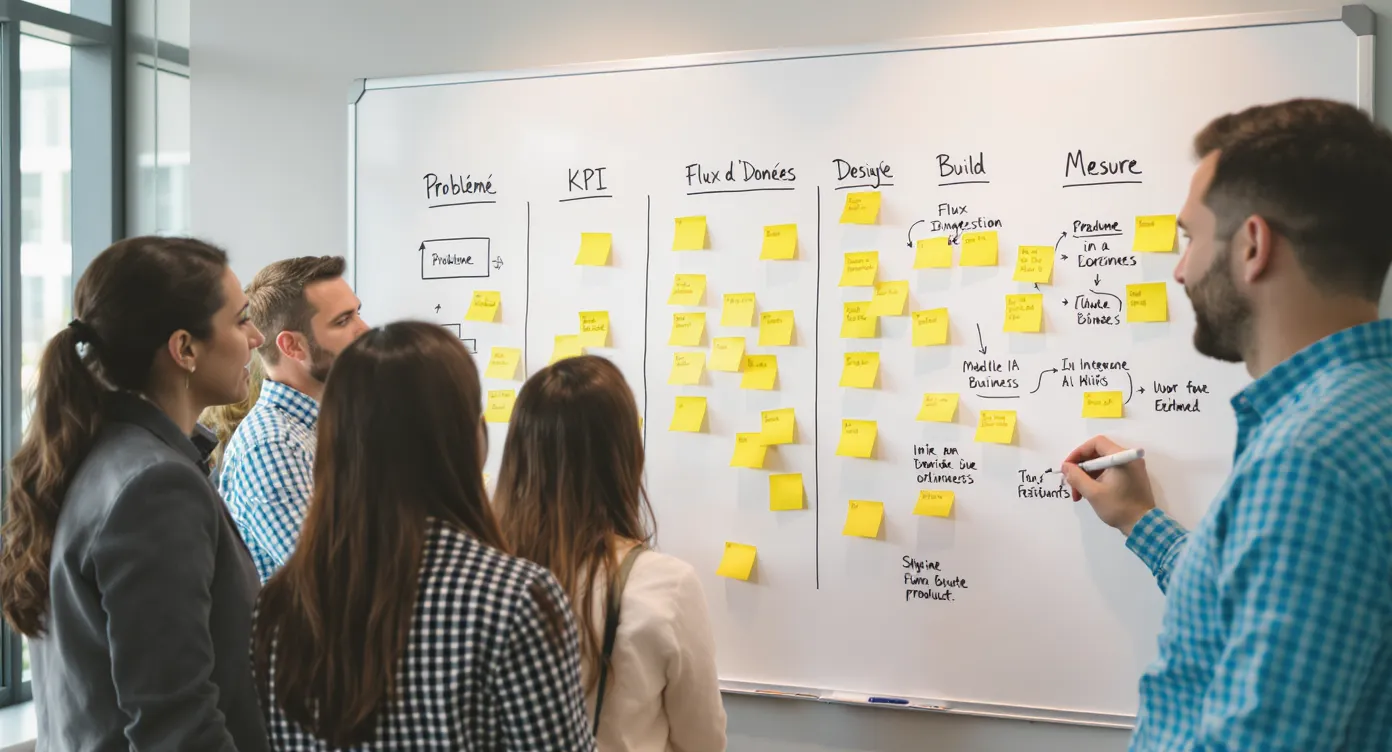
The 6 Steps of a Value-Oriented AI Lab
This approach relies on proven frameworks like CRISP‑DM for the data cycle and the NIST AI Risk Management Framework for risk management.
1) Frame the value, not the tech
Describe the current workflow: actors, volumes, pain points, and costs.
Choose a North Star indicator, for example: minutes saved per task, errors avoided, customer satisfaction.
Draft the value thesis: problem, AI lever, impact hypothesis, metrics, go/no‑go decision threshold.
Deliverables: opportunity sheet, quantified baseline, list of hypotheses and success criteria.
2) Audit processes and opportunities
Identify where AI truly helps: content generation, classification, extraction, semantic search, agents, prediction.
Map dependencies and constraints: GDPR, security, sovereignty, existing tooling.
Decide build vs assemble: LLM API, RAG, proprietary model, automations.
Deliverables: selection of a priority case, risks and guardrails, experimentation plan.
3) Prepare useful data
Inventory sources, formats, access rights, quality, potential biases.
Define the smallest representative dataset: anonymization, minimization, retention policy, see the CNIL recommendations on AI.
Establish an evaluation set (gold set) to objectively measure iterations.
Deliverables: data brief, test protocol, GDPR and AI Act checklist, overview of the EU AI Act.
4) Design the minimal architecture
Choose minimal bricks: data connector, vector search engine if RAG, language model or vision model, prompt layer or fine‑tuning if necessary, light interface or integration into the business tool.
Define guardrails: filtering, moderation, red teaming, prompt injection rules, see the OWASP Top 10 LLM.
Prepare telemetry: logs, cost per interaction, latency, automated evaluations.
Deliverables: architecture diagram, evaluation protocol, security plan.
5) Build in short iterations
Develop by functional increments: Case A pilotable by end of week 1, Case B in week 2, etc.
Test with real users: feedback collection, A/B measurements.
Adjust prompts, data, parameters, UX, integrate automation quick wins.
Weekly deliverables: demo, updated metrics, prioritized backlog.
6) Measure value and decide next steps
Compare to baseline: time, quality, cost, satisfaction, risk.
Document a realistic business case: annualized gains, recurring cost, estimated payback.
Decide: iterate, expand, industrialize towards an MVP, or stop wisely.
Deliverables: impact report, deployment plan or reasoned closure.
Measuring the Profitability of a Prototype
A profitable prototype requires simple and honest figures.
Prototype ROI: measured gains minus prototype costs, divided by costs.
Payback: prototype cost, divided by expected recurring monthly gains.
Sensitivity: best and worst-case hypotheses on volumes, adoption rates, quality.
Measurement table by use case:
Use Case | Primary KPI | Quality KPI | Cost KPI | Go Decision If |
|---|---|---|---|---|
Customer assistance, AI response in helpdesk | Minutes saved per ticket | Rate of exact answers on gold set | Cost per processed ticket | Over 20% productivity gain and stable satisfaction |
Invoice data extraction | Correct extraction rate | Critical error rate | Cost per document | Less than 1% critical errors and reduced cost |
Internal search with RAG | Time to find info | Evaluated relevance score | Cost per query | Time divided by 2 with acceptable accuracy |
Tip: keep the measurement setup in place; it becomes the basis for your future A/B tests.
Reference Architecture for Rapid Prototyping
Connectors: read-only source of truth, shared folders, CRM, knowledge base, data warehouse.
Minimal normalization: cleaning, deduplication, adding metadata, access security.
Optional RAG: vector index on validated documents, contextual retrieval.
AI Model: LLM via API, hosted open source model, classification, extraction, controlled generation.
Orchestration: workflow execution and guardrails, cost control, quota.
Interface: integration into existing tools (CRM, Slack, Teams, service desk) or web micro‑app.
Evaluation and observability: logs, traces, costs, automated evaluation set, feedback collection.
This architecture remains minimal to avoid premature debt, but it prepares for scaling if the prototype is successful.
Typical Schedule and Deliverables of an AI Lab
A pragmatic prototype is often built in 4 to 6 weeks, with weekly deliveries and guidance by metrics. Example of sequencing and deliverables.
Step | Objective | Key Deliverables |
|---|---|---|
Week 1, Value Framing | Alignment on problem, KPI, risks | Value thesis, baseline, test plan, compliance checklist |
Week 2, Data | Prepare data and evaluation | Data brief, gold set, secure access |
Week 3, Prototype v1 | End-to-end flow on 1 case | Demo v1, initial measurements, cost log |
Week 4, Improvements | Quality, guardrails, UX | Demo v2, evaluation report, industrialization plan |
Week 5+, Pilot | Real users, monitoring | Impact report, go/no‑go decision, MVP backlog |
Risks, Compliance, and Quality: To Address from the Prototype Stage
Data protection: minimization, anonymization, legal basis, DPA, rights of individuals, see the CNIL.
AI Act: risk classification, documentation, transparency, third-party management, see the EU AI Act.
AI Application Security: prevention of data leaks and prompt injections, OWASP LLM Top 10 reference.
Continuous evaluation: gold set, targeted human reviews, moderation, reasonable explainability.
Adoption will be sustainable if these topics are taken seriously from the AI Lab stage, rather than pushed to the end.
Common Pitfalls and How to Avoid Them
Starting with tech, not the problem -> Remedy: framing by KPI and value thesis.
Wanting to automate everything at once -> Remedy: aim for visible micro‑gains and stack quick wins.
Forgetting users -> Remedy: integrate the solution into their tools and test every week.
Not measuring -> Remedy: baseline, gold set, telemetry, and simple reporting.
Ignoring variable costs -> Remedy: cost cap per interaction, batch, cache, prompt optimization.
Underestimating security -> Remedy: access governance, log audit, prompt policy, red teaming.
No exit plan -> Remedy: written go/no‑go criteria, stop option if value is not there.
From Prototype to Production: Scaling Correctly
Industrialization criteria: KPI stability, controlled unit cost, covered risks, engaged business sponsor.
MVP Roadmap: robustness, monitoring, traceability, SSO, roles and permissions, support.
MLOps and AIOps: model and prompt versions, training data, alerts, periodic review.
Adoption: user training, playbooks, change management, usage measurement.

How Impulse Lab Transforms Your Idea into a Profitable Prototype
The core business of an AI Lab is to couple speed and rigor. The team at Impulse Lab works in product mode to maximize business impact while controlling risks.
What we concretely put in place:
AI Opportunity Audit: to select cases with high potential ROI and frame the value.
Development of custom web and AI platforms: with integration into your existing tools so that value materializes where your teams work.
Process automation and connection to existing APIs and IS: avoiding copy‑paste and double entry.
Training and adoption: to equip your teams and anchor responsible AI best practices.
Weekly deliveries: you see value progressing every week, not in three months.
Dedicated client portal: transparent tracking of tasks, decisions, and metrics.
End-to-end development: from audit to pilot, with continuous involvement of your business lines.
Do you have an AI use case idea (email classification, guided writing, invoice extraction, semantic search, internal agents)? Let's turn it into measured results and a profitable prototype. Let's talk, share your problem and target KPIs, and launch a first value-oriented sprint with Impulse Lab.
Useful References to Go Further:
CRISP‑DM Framework: IBM, CRISP‑DM
AI Risk Management: NIST AI RMF
Compliance in France: CNIL, AI and data protection
LLM Application Security: OWASP Top 10 LLM
European Regulatory Framework: EU AI Act