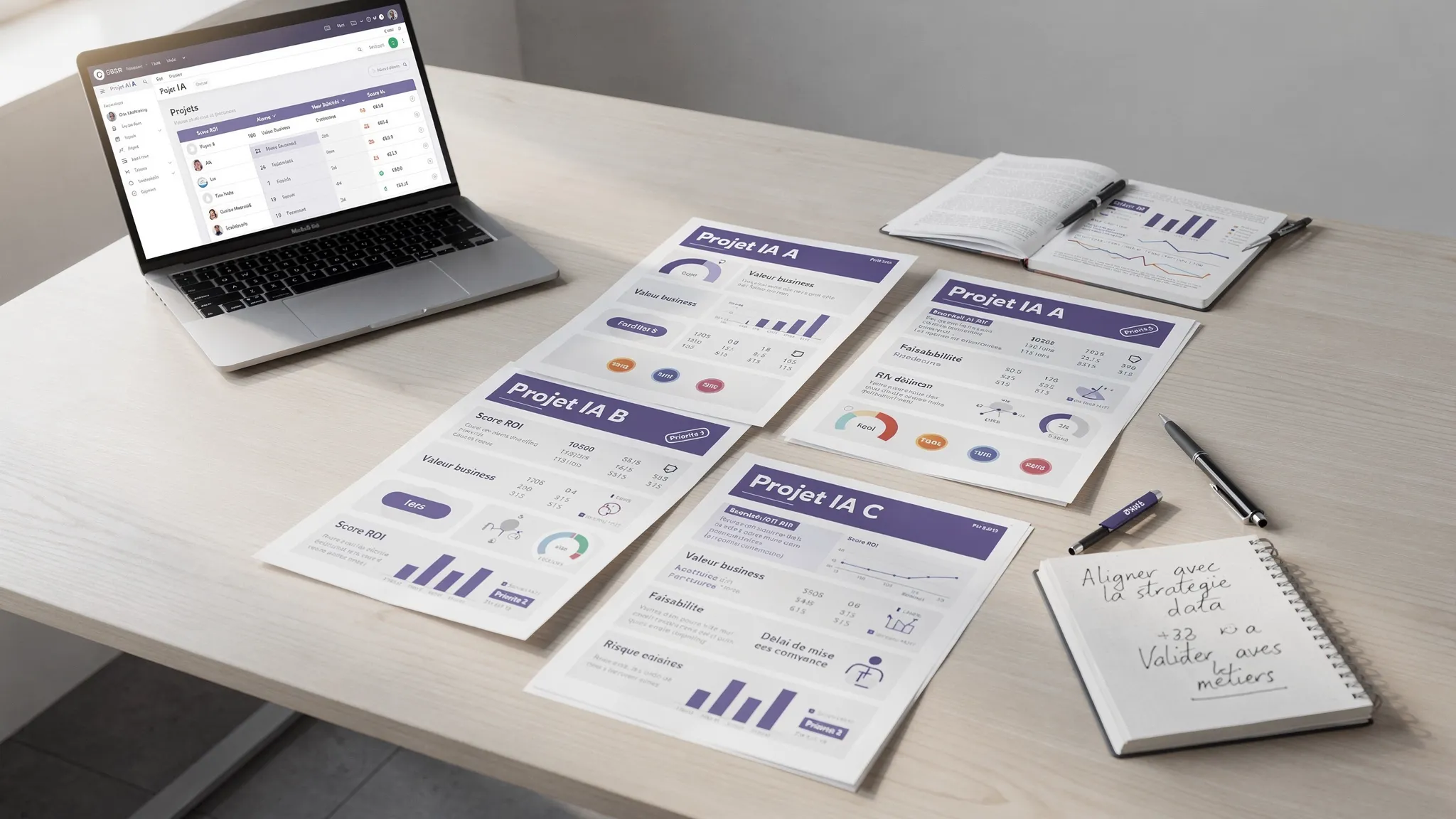
AI Portfolio: Prioritize Your Projects with an ROI Scorecard
Intelligence artificielle
Stratégie IA
ROI
Gestion de projet IA
AI projects are never in short supply. From chatbots to automated ticket routing and invoice data extraction, the problem is no longer finding ideas, but knowing which ones deserve budget, team time, and deployment. Learn how to prioritize them using an ROI scorecard.
mai 09, 2026·15 min de lecture
AI projects are never in short supply. An executive hears about a chatbot, a sales team wants to automate qualification, operations imagine an agent handling tickets, finance wants to extract invoice data. The problem is no longer finding ideas, but knowing which ones deserve budget, team time, and deployment to production.
This is exactly the role of an AI portfolio: transforming a wishlist into a sequence of arbitrated, measurable, and executable projects. For an SMB or a scale-up, the goal is not to have twenty POCs running in parallel. The goal is to choose the few projects that can create value quickly, without blowing up risks, integration costs, or operational workload.
The simplest method is to use an ROI scorecard. It allows you to compare very different use cases using the same criteria: business value, feasibility, risks, adoption, time-to-value, and readiness for production.
What is an AI portfolio?
An AI portfolio is a living register of your artificial intelligence initiatives. It gathers ideas, pilots, solutions in production, and the foundational work necessary to make AI function within the company.
It is not just a technical backlog. A good portfolio links each project to a clear business objective: reducing processing time, increasing conversion rates, improving service quality, decreasing errors, accelerating content production, or making decision-making more reliable.
In companies just starting out, AI ideas often arise opportunistically: a tool tested by an employee, a customer request, a demo seen on LinkedIn, or competitive pressure. This is normal, but dangerous if nothing structures the choices. Without a portfolio, three risks quickly emerge:
Attractive POCs that are never integrated into real workflows.
Hidden costs related to data, APIs, security, and maintenance.
Team dispersion across too many topics without measured impact.
A mature AI portfolio answers a simple question: if we can only fund three projects this quarter, which ones should we choose and why?
Why an ROI scorecard is more useful than a simple team vote
Asking teams to vote for their favorite projects can create engagement, but it is not enough for arbitration. The most visible ideas are not always the most profitable. Conversely, an unspectacular back-office project can generate a high ROI if it handles a large volume, reduces errors, and integrates easily.
The ROI scorecard introduces discipline. It does not replace judgment, but it makes decisions comparable. Each initiative is evaluated along the same dimensions, with a score and a weighting. The result is not an absolute truth; it is a decision support tool.
This approach is particularly useful when stakeholders do not speak the same language. Marketing thinks in leads and conversion, operations in processing time, IT in integration and security, and management in margin and payback. The scorecard creates common ground.
The structure of an ROI scorecard to prioritize your AI projects
An effective scorecard must remain simple. If it requires three weeks of analysis per use case, it becomes a bottleneck itself. For an SMB or scale-up, six criteria are generally enough to decide which projects to launch first.
Criterion
Recommended Weight
Question to Ask
How to Score from 1 to 5
Business Value
30%
Does the project reduce a cost, increase revenue, or mitigate a major risk?
1 = vague impact, 5 = direct and measurable financial impact
Volume and Frequency
15%
Does the problem repeat often enough to justify automation or AI integration?
1 = rare usage, 5 = daily or high-volume usage
Data & Integration Feasibility
20%
Is the data accessible, reliable, and connectable to existing tools?
Does the project expose sensitive data, critical decisions, or regulatory obligations?
1 = high risk, 5 = manageable risk with simple guardrails
Adoption and Ownership
10%
Is a business team ready to use, test, and champion the project?
1 = no owner, 5 = clear sponsor and available users
The formula is intentionally straightforward: weighted score = sum of (scores x weights). For each criterion, a score from 1 to 5 is multiplied by its weight. The final score can be scaled to 100.
This grid intentionally places a lot of weight on business value and feasibility. This is often where AI projects fail: they look interesting in a demo, but are poorly linked to a KPI or too complex to integrate into the existing environment.
Before scoring: standardize each idea with a project brief
A scorecard works poorly if projects are described inconsistently. Before scoring, each use case must be summarized in a short brief. One page is enough.
The brief must specify the problem, the target user, the workflow involved, the necessary data, the tools to connect, the main KPI, known risks, and the expected V1 deliverable. This step avoids comparing a vague idea like "put AI in support" with a precise project like "reduce incoming ticket triage time by 30% by automatically classifying requests by priority and category."
Here are the fields to include in your scoping brief:
Project Name: short, usage-oriented phrasing.
Business Owner: person responsible for value and adoption.
North Star KPI: main indicator that will tell if the project is working.
Current Baseline: time, cost, volume, error rate, or conversion before AI.
Data Sources: documents, CRM, helpdesk, ERP, website, knowledge base.
Integration Level: simple assistant, RAG, automation, agent with actions.
Guardrails: human validation, access control, logs, privacy rules.
If you cannot fill out this brief, the project is not ready to be scored. It should remain in the "to be clarified" category.
Calculating a credible ROI without falling into fiction
The ROI of an AI project must be simple enough to be used, but comprehensive enough to avoid misleading decisions. The most common trap is to only count the cost of the tool or API, forgetting integration, data preparation, training, monitoring, and maintenance.
A starting formula might look like this:
Gross Annual Gain = annual volume x average unit gain + incremental revenue + avoided costs
Net Annual Gain = gross annual gain - annual recurring costs
Year 1 ROI = (net annual gain - initial cost) / initial cost
Payback = initial cost / estimated monthly net gain
For a document automation project, the unit gain could be the time saved per document multiplied by the loaded hourly cost. For a pre-sales chatbot, it could be linked to an increased conversion rate or the number of qualified appointments. For an internal RAG assistant, the gain can come from avoided search time, but you must remain cautious and measure it on a pilot group.
The ROI must also integrate the TCO (Total Cost of Ownership). In an AI project, the TCO often includes: scoping, development, licenses, API calls, hosting, connectors, data cleaning, security, testing, training, support, maintenance, and the evolution of prompts or knowledge bases.
Let's take a B2B SMB with four ideas on the table: a knowledge base-driven support assistant, invoice processing automation, a quote preparation agent, and a marketing content copilot.
The scores below are illustrative. Above all, they show how the method helps compare projects of different natures.
AI Project
Value
Volume
Feasibility
Time-to-value
Risk
Adoption
Total Score
RAG Support Assistant
4
5
4
4
4
5
84 / 100
Invoice Automation
4
4
3
3
4
4
73 / 100
Quote Preparation Agent
5
3
3
3
3
4
72 / 100
Marketing Content Copilot
3
4
5
5
4
3
The marketing copilot gets a good score thanks to its feasibility and short timeframe. However, the support assistant may remain the priority if the volume is high, the support team is under pressure, and the knowledge base is already usable.
The quote agent has high potential value, but it likely touches on sensitive commercial data and customer commitments. It could be interesting, but as a pilot with human validation before sending. The scorecard doesn't say "no"; it indicates the right level of caution.
Categorizing the portfolio: quick wins, structural bets, and foundations
Once projects are scored, you must avoid a classic mistake: only choosing quick wins. Fast projects are useful for demonstrating value, but some less visible initiatives are necessary to make subsequent ones possible.
A balanced AI portfolio generally contains three categories.
Data governance, logs, connectors, AI charter, training
Fund if multiple projects depend on them
In a scale-up, a good rule of thumb is to fund a mixed portfolio: a majority of short-ROI projects, a few high-potential integrated projects, and targeted foundations. Foundations should not become an abstract transformation program. They must be justified by the projects they unlock.
For example, a knowledge base initiative is not just "documentation". It becomes a foundation if three projects depend on it: RAG support, internal onboarding assistant, and customer chatbot.
Integrating risk without blocking innovation
Risk should not be an automatic veto. It must be treated as a design factor. A project can be profitable and risky, but it must then be designed with proportionate guardrails.
The main risks to integrate into your AI portfolio are: personal data, confidential information, hallucinations, automated decisions, bias, connector security, cost overruns, and vendor lock-in.
The NIST AI Risk Management Framework offers a structured approach to identify, measure, and manage AI-related risks. In Europe, the regulatory framework of the AI Act also reinforces the importance of usage classification, documentation, and governance.
For an SMB, the challenge is not to create heavy bureaucracy. It is about implementing simple rules: data classification, human validation on sensitive actions, decision logs, coherent access rights, testing on real cases, and a shutdown procedure if quality drops.
If your project involves actions in business tools, such as modifying a CRM, sending a customer email, or creating a ticket, rely on robust integration patterns. We detail them in our guide on enterprise AI integration with APIs, RAG, and agents.
Defining decision thresholds: stop, park, pilot, scale
A scorecard only has value if it triggers decisions. After scoring, each project must receive a clear status.
Score
Recommended Decision
Interpretation
80 to 100
Priority Pilot
High potential, decent feasibility, identified owner
65 to 79
Conditional Pilot
Launch if a key hypothesis is validated quickly
45 to 64
Park
Interesting idea but too vague, too risky, or not profitable enough today
Under 45
Stop
Does not deserve short-term investment
The "park" status is important. It avoids killing an idea too quickly that could become relevant later, after data improvements, a tool change, or a drop in model costs.
Conversely, "priority pilot" does not mean "immediate global deployment." It means the project deserves an instrumented V1, with a clear scope, a limited user group, and a go/no-go decision at the end.
Building a 90-day portfolio roadmap
The scorecard is then used for sequencing. To avoid dispersion, select a maximum of two to three projects over a 90-day cycle. The right pace depends on your size, technical maturity, and the availability of business owners.
A realistic sequence looks like this.
Period
Objective
Expected Deliverables
Days 1 to 15
Inventory and score
AI register, project briefs, scorecard, shortlist
Days 16 to 30
Scope the pilots
KPI, baseline, V1 architecture, risks, test plan
Days 31 to 60
Build and integrate
Instrumented prototype, connectors, logs, guardrails, pilot training
This logic aligns with a broader execution plan approach. If you are looking for a complete method, you can read our roadmap Enterprise AI Plan: 30-60-90 Days.
Mistakes that distort AI prioritization
Even with a good scorecard, certain mistakes often recur.
The first is overestimating time savings. If an employee saves five minutes on a monthly task, the project is rarely a priority. If twenty people save fifteen minutes every day on a critical process, the potential changes completely.
The second mistake is ignoring integration. An AI that generates a good response in a chat is not yet an operational solution. Value appears when it plugs into the CRM, helpdesk, ERP, website, or internal tools, with the right permissions and the right events.
The third mistake is confusing adoption with one-off training. A team might find a demo impressive and never use it afterward. Adoption requires an owner, rituals, support, real-world examples, and rapid improvements.
The fourth mistake is measuring activity instead of impact. The number of prompts sent or conversations opened is not enough. You must track time saved, resolution rate, cost per request, response quality, conversion rate, or error reduction.
Finally, many companies keep projects alive too long out of inertia. Good portfolio governance must allow for quick shutdowns. Stopping an unprofitable pilot is a success if it frees up budget for a better project.
The minimal dashboard to manage your AI portfolio
Once the first projects are launched, the portfolio must be tracked with a simple dashboard. The goal is not to produce complex reporting, but to have a clear view of the decisions to be made.
Indicator
Why track it
Frequency
Number of projects by status
Avoid accumulating POCs without decisions
Weekly
Average ROI score of active projects
Ensure the portfolio remains value-oriented
Monthly
Committed vs. planned budget
Control cost overruns
Monthly
Measured vs. estimated gains
Recalibrate ROI hypotheses
Monthly
User adoption rate
Detect technically good but underused projects
Weekly during pilot
Quality or security incidents
Adjust guardrails before scaling
Continuous
The portfolio committee can be very lightweight. For an SMB, a 30 to 45-minute meeting every two weeks is often enough. Key participants are the sponsor, a business owner per active project, a technical lead, and a person responsible for risk or compliance if data is sensitive.
When should you do an AI audit before prioritizing?
A scorecard can be used internally, but an AI audit becomes useful in three situations.
First: you have many ideas, but no reliable baseline. In this case, the audit helps map processes, measure volumes, and identify true pockets of value.
Second: your projects depend on integrations or scattered data. The audit clarifies sources, access rights, technical constraints, and the real level of effort.
Third: you need to arbitrate a significant budget. If an initiative involves multiple teams, sensitive data, or a critical production deployment, it is better to scope the value, risk, and architecture before launching development.
At Impulse Lab, we approach this type of topic with a delivery-oriented logic: opportunity audits, ROI prioritization, custom web and AI solution development, process automation, integration with existing tools, and team training to foster adoption.
FAQ
What is an AI portfolio? An AI portfolio is a structured register of your artificial intelligence projects, including their business objective, owner, priority score, risk level, status, and KPIs. It is used to arbitrate investments and avoid dispersion.
What is the difference between an AI roadmap and an AI portfolio? The portfolio contains all candidate, active, or pending initiatives. The roadmap is the chosen execution sequence over a given period, for example, 30, 60, or 90 days.
How many criteria are needed in an ROI scorecard? Six criteria are generally enough: business value, volume, feasibility, time-to-value, risk, and adoption. Beyond that, the grid often becomes too heavy for quick decision-making.
Can you calculate the ROI of an AI project before the pilot? Yes, but it is an estimate. The pilot's very purpose is to validate the hypotheses: real time saved, quality of results, adoption, recurring costs, and maintenance effort.
Which AI projects should be prioritized first? The best initial projects combine a frequent problem, a measurable KPI, accessible data, manageable risk, and a motivated business owner. Internal assistants, augmented support, and document automation are often good candidates, depending on your context.
Should you prioritize quick wins or structural projects? Both. Quick wins prove value and build buy-in. Structural projects build sustainable advantage. A good portfolio funds fast gains without neglecting the foundations needed for what comes next.
Transform your AI ideas into a prioritized portfolio
If your company has already identified several AI avenues but is hesitating on the launch order, start with an ROI scorecard. In just a few workshops, you can go from a list of ideas to a clear, measurable roadmap that is defensible to management.
Impulse Lab supports SMBs and scale-ups in this step: AI audits, use case prioritization, ROI scoping, custom web and AI platform development, process automation, integration with your existing tools, and team training.
Contact Impulse Lab to build your AI portfolio, select the right pilots, and transform your most profitable projects into operational solutions.