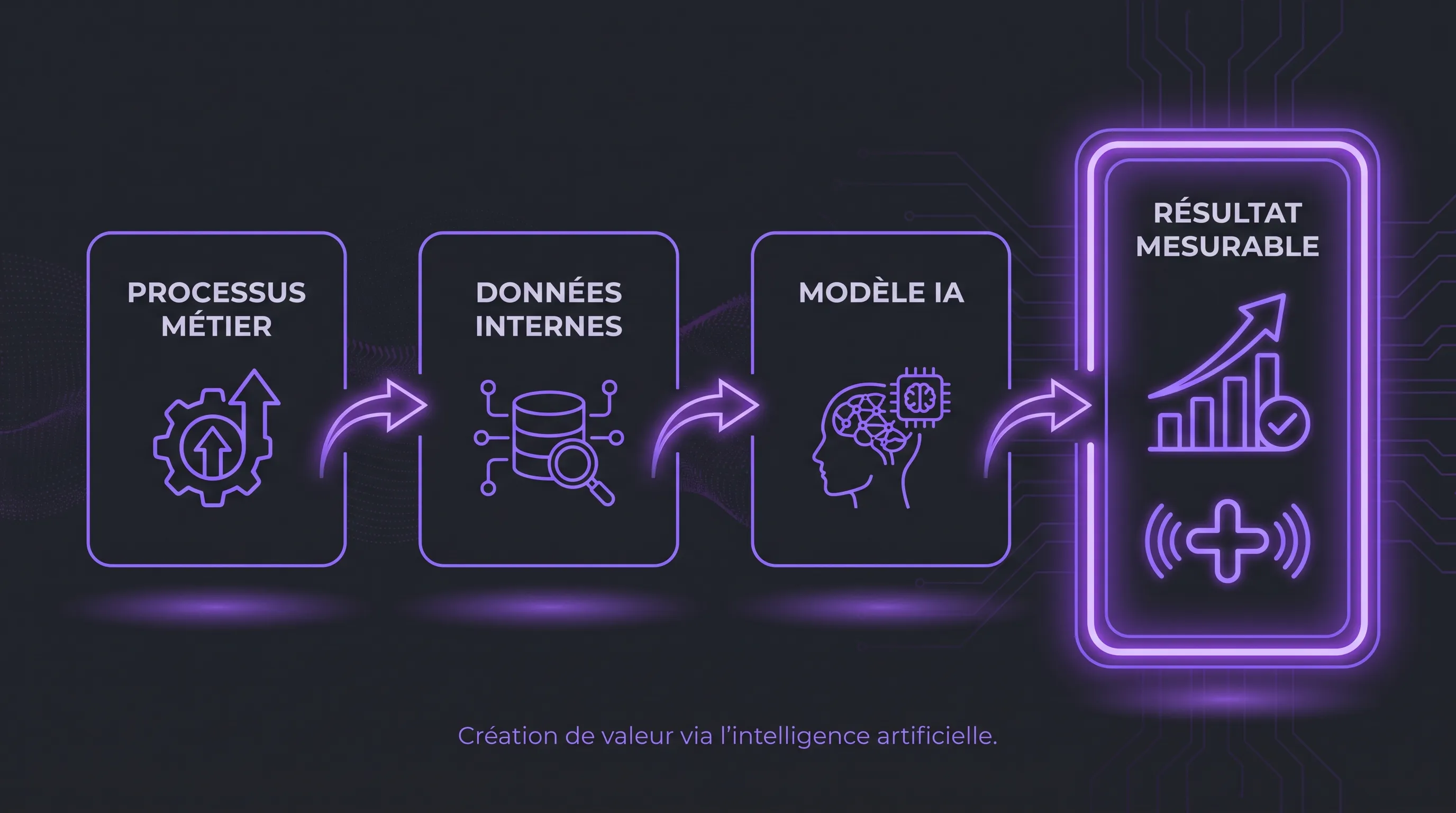
In 2026, the AI sector is no longer just about spectacular generative models or viral demos. The most interesting markets are those where artificial intelligence reduces recurring costs, speeds up decisions, secures processes, or allows teams to produce more without immediate hiring.
In 2026, the AI sector is no longer just about spectacular generative models or viral demos. The most interesting markets are those where artificial intelligence reduces a recurring cost, speeds up a decision, makes a process more reliable, or allows a team to produce more without recruiting immediately.
For an SMB, a scale-up, or a company in the structuring phase, the right question is therefore not just: "Which AI technology is going to explode?" The real question is: "Which AI markets will create a concrete operational advantage in my business?"
This distinction is essential. According to a McKinsey analysis, generative AI could add between $2.6 trillion and $4.4 trillion in annual value to the global economy, but this value only materializes when use cases are integrated into existing business lines, data, and processes. Simply put, the winners of 2026 will not necessarily be those who test the most tools, but those who industrialize the right use cases.
What is changing in the AI sector in 2026
The market is entering a more mature phase. After the enthusiasm of 2023 and 2024, followed by the first more structured deployments of 2025, 2026 marks a turning point: AI is becoming a matter of productivity, governance, and integration.
Three movements explain this evolution.
First, models are becoming more accessible. Companies are no longer forced to build a proprietary model to get results. They can combine existing models, internal document bases, automations, and business interfaces.
Second, differentiation is shifting toward usage. Two companies can use the same model but achieve very different results depending on the quality of their data, the clarity of their processes, and adoption by their teams.
Finally, compliance is gaining importance. The European AI regulation, or AI Act, entered into force in 2024, with progressive application depending on risk categories. For European companies, this creates a market around documentation, control, traceability, and training.
For a more comprehensive view of weak signals and operational priorities, you can consult our 2026 AI report on trends and actions for SMBs, which complements this market reading with a more tactical angle.
The priority AI markets to watch
Not all segments of the AI sector are progressing at the same pace. Some are still highly exploratory, while others are already mature enough to generate a return on investment in a few months.
Here is a synthetic reading of the markets to monitor in 2026.
AI Market
Why it is accelerating in 2026
Opportunity for SMBs and scale-ups
Maturity level
AI agents and business automation
Need to reduce repetitive tasks and operational costs
Generalist tools show their limits in specialized professions
Create assistants tailored to a sector, regulation, or workflow
Medium to high
Augmented search and RAG
Companies want to leverage their documents without losing control
Transform internal knowledge into a reliable assistant
High
Customer relations, sales, and marketing
Pressure on acquisition, personalization, and retention
Better qualify, respond, segment, and prioritize opportunities
High
AI trust, compliance, and cybersecurity
Rise in risks related to data, prompts, and automated decisions
Secure AI usages and document systems
Accelerating rapidly
AI training and adoption
Tools do not create value without changing practices
Train teams and anchor new business reflexes
High
1. AI agents and business automation: the most concrete market
The AI agents market is one of the most discussed, but also one of the most misunderstood. In 2026, truly useful agents are not fully autonomous systems that "do everything." Rather, they are software building blocks capable of executing a sequence of tasks within a specific framework, with rules, data, and often human validation.
For example, an AI agent can analyze incoming requests, enrich a CRM, prepare a meeting summary, classify documents, generate a draft response, or produce a weekly report. The value comes from repetition: if a task consumes several hours a week, it becomes a good candidate.
Agencies, consulting firms, sales teams, customer service, and support functions are particularly affected. In B2B agencies, specialized offerings like installing an AI ops layer to automate research, reporting, CRM, and content illustrate this trend well: AI becomes an operational layer that increases margins without immediately adding new roles.
For leaders, the key point is not to start by "creating an agent," but by mapping frictions. Where do teams copy information? Where are decisions waiting for a summary? Where are the same documents produced every week? It is in these areas that AI agents will have the greatest impact.
2. Vertical B2B AI: less noise, more business value
Generalist tools have democratized the use of AI, but they are not always sufficient in complex business environments. In 2026, one of the most promising markets is vertical AI: solutions designed for a specific sector, profession, or type of process.
In the legal field, AI can help analyze contracts, compare clauses, prepare summaries, or identify risks. In insurance, it can speed up claims processing and the analysis of supporting documents. In real estate, it can structure information from listings, diagnostics, or administrative documents. In manufacturing, it can assist quality, maintenance, or supply chain teams.
This market is important for a simple reason: context is valuable. An AI that understands business vocabulary, regulatory constraints, and specific document formats creates more value than a generic assistant.
For an SMB or a scale-up, this opens two paths. The first is to adopt vertical solutions that are already available. The second is to develop a custom AI layer when the process is a differentiator or too specific to be covered by a standard tool.
3. Augmented search, RAG, and knowledge capitalization
Augmented search, often associated with RAG (Retrieval-Augmented Generation), is one of the most solid AI use cases in business. The principle is simple: connect an AI model to reliable internal sources so that it can answer based on documents, procedures, knowledge bases, tickets, contracts, or meeting minutes.
This market is growing because it solves a universal problem: the information already exists, but it is scattered. It is found in shared folders, project tools, CRMs, Notion, Drive, emails, or support bases. Employees waste time searching, cross-referencing, and verifying.
A well-designed augmented search system does not replace human knowledge. It makes it more accessible. It can help a sales rep find a customer reference, a support agent respond faster, a manager understand an account's history, or a new hire get up to speed.
The potential is strong, but the conditions for success are clear: you need clean sources, well-thought-out access rights, a simple interface, and control over the answers. Companies that have already structured their knowledge will have an advantage.
If you want to distinguish the relevant tool families according to your size and maturity, our guide on useful AIs for SMBs in 2026 can help you sort through assistants, RAG, automation, and agents.
4. Customer relations, sales, and marketing: useful AI gets closer to revenue
The AI market applied to marketing and sales remains one of the most dynamic, but its nature is changing. The first waves were mainly about content generation. In 2026, value is shifting toward uses closer to revenue: qualification, personalization, scoring, conversation analysis, account prioritization, and follow-up orchestration.
For SMBs and scale-ups, the challenge is not to produce ten times more generic content. The market is already saturated. The challenge is to better understand intentions, adapt messages, and reduce leaks in the sales funnel.
Some examples of concrete use cases: analyzing sales calls to identify frequent objections, automatically enriching prospect profiles, summarizing exchanges before a meeting, generating a proposal from a validated brief, or detecting at-risk customers based on weak signals.
The difficulty is not only technical. It is also organizational. Marketing, sales, and customer success teams must agree on data, journey stages, and quality criteria. Without this, AI risks amplifying existing disorder.
5. AI trust, compliance, and cybersecurity: the market leaders can no longer ignore
As AI uses become more widespread, the risks become more visible. Leakage of sensitive data, unverified answers, misconfigured access rights, vendor lock-in, generation of non-compliant content, opaque automated decisions: these topics are no longer reserved for large enterprises.
In 2026, the AI trust market will therefore gain momentum. It covers several needs: auditing existing uses, classifying risks, documenting systems, securing data, framing prompts, training users, and implementing guardrails.
AI cybersecurity is also a subject in its own right. Companies must learn to protect their systems against new attacks, such as prompt injection, data exfiltration via chatbots, or the manipulation of documents used by an AI assistant.
For leaders, the right reflex is to treat governance as an accelerator, not a brake. Clear rules allow teams to use AI with greater peace of mind. Conversely, the lack of a framework often leads to two opposite problems: either employees do not dare to use the tools, or they use them without control.
6. Industrial AI, edge AI, and optimization of physical operations
The AI sector does not only concern service companies. In 2026, AI applied to physical operations continues to progress, particularly in manufacturing, logistics, energy, food processing, and physical retail.
Edge AI, meaning the execution of models directly on local equipment or close to the field, becomes interesting when latency, confidentiality, or connectivity are constraints. This can involve quality control by vision, predictive maintenance, anomaly detection, energy optimization, or flow planning.
This market is often more demanding than office AI. It requires sensors, reliable data, integration with existing systems, and a good understanding of field constraints. But the return on investment can be significant when AI reduces production downtime, scrap, preparation errors, or unnecessary interventions.
For an industrial SMB, the right entry point is not always the most ambitious project. It can be a pilot on a line, a piece of equipment, a type of anomaly, or an inspection step. The goal is to prove value before scaling.
7. Training, change management, and AI culture
The AI training market is sometimes underestimated, even though it conditions the success of all the others. Tools evolve quickly, but organizations evolve more slowly. In 2026, the difference between a company that "has access to AI" and a company that "knows how to work with AI" becomes very visible.
Training teams is not just about learning to write better prompts. It requires understanding the limits of the models, knowing how to verify answers, identifying the right use cases, protecting sensitive data, and integrating AI into work routines.
Growing companies face a particular challenge: they must structure replicable practices. If each team uses its own tools without a common method, the organization accumulates operational debt. Conversely, well-designed training creates a common language and accelerates adoption.
This is also where external support can be useful, particularly to frame priorities, produce the expected deliverables, and avoid scattered experiments. To better understand what a specialized profile can bring, you can read our article on the missions, deliverables, and rates of an AI expert in 2026.
How to prioritize AI markets for your company
Not all the markets mentioned deserve your immediate attention. A service SMB, an agency, an industrial company, and a SaaS scale-up will not have the same priorities. The right approach is to cross-reference the market's attractiveness with your own constraints.
Here is a simple grid to decide where to invest time in 2026.
Criterion
Question to ask
Why it is important
Business pain
Does the problem cost time, money, or quality every week?
AI must solve a real irritant, not add a gadget layer
Available data
Is the necessary information accessible and reliable enough?
Without usable data, even a good model will produce little value
Stable process
Is the workflow clear enough to be automated or assisted?
AI works better on an understood and documented process
Human validation
Can we maintain control over sensitive decisions?
This reduces risks and facilitates adoption
Measurable ROI
Can we measure the gain in time, cost, delay, quality, or revenue?
An AI project must be arbitrated like a business investment
This grid avoids two common traps. The first is choosing a market because it is trendy. The second is rejecting a simple use case when it could generate a quick win. In AI, the first successes often come from very concrete problems.
A 90-day method to test an AI market
For a company that wants to move forward without losing focus, a 90-day cycle is often sufficient to validate an opportunity.
Days 1 to 30: identify and frame. List repetitive processes, estimate the time lost, check available data, and choose a priority use case.
Days 31 to 60: prototype. Build a simple version, tested with real users, on a reduced scope, and with explicit success criteria.
Days 61 to 90: pilot and measure. Compare the results before and after, correct the limitations, document the rules of use, and decide if the project should be expanded.
This approach keeps things pragmatic. It avoids large, overly abstract AI programs and experiments that lead nowhere. It also forces you to connect the targeted AI market to a real business metric.
Warning signals to watch out for in 2026
The AI sector attracts many players, promises, and sales pitches. To avoid making the wrong choices, certain signals should alert you.
First, beware of solutions that promise total autonomy without explaining the guardrails. In business, useful automation is often gradual, controlled, and adapted to risk.
Also, be cautious with projects that start with the model rather than the problem. The technological choice comes after understanding the process, the data, and the expected result.
Finally, monitor the proliferation of tools. A company can lose productivity if each team adds its own assistant, its own subscription, and its own method. True value often comes from coherent integration with existing tools.
FAQ on the AI sector in 2026
What is the most promising AI market in 2026? For SMBs and scale-ups, the most immediately profitable market is often business automation with framed AI agents. It allows for the reduction of repetitive tasks in reporting, support, sales, administration, or document management.
Should you invest in a vertical AI solution or a generalist tool? A generalist tool is enough to explore and save time on simple tasks. A vertical solution becomes more relevant if your activity depends on business rules, specific documents, regulatory constraints, or complex workflows.
Is the AI sector still accessible to SMBs? Yes, because it is no longer necessary to build your own models to create value. SMBs can combine existing tools, automation, internal knowledge bases, and targeted support to deploy realistic use cases.
What risks should be anticipated before deploying AI? The main risks are data leaks, inaccurate answers, lack of human validation, vendor lock-in, and lack of adoption by teams. A clear usage framework strongly reduces these risks.
How do you measure the ROI of an AI project? Measure simple indicators before and after the pilot: hours saved, processing time, error rate, volume processed, customer satisfaction, conversion rate, or operational cost. The ROI must be linked to a specific business process.
Moving from market to action
In 2026, following the AI sector does not mean chasing every new trend. The most important markets are those that are already transforming daily work: business automation, vertical AI, augmented search, customer relations, compliance, physical operations, and training.
For an SMB or a scale-up, the advantage will not come from passive monitoring. It will come from the ability to identify the right use cases, prioritize measurable gains, integrate AI into existing tools, and support teams.
At Impulse Lab, we help companies transform these opportunities into concrete solutions through AI audits, custom web and AI platforms, process automation, integration with your existing tools, and adoption training. The goal is simple: make AI a real productivity lever, not just another item on the roadmap.
The Limits of AI (Artificial Intelligence) in Negotiation
In negotiation, AI can prepare arguments, compare offers, and simulate objections. But a convincing answer does not mean a price is fair or a concession is profitable. For an SME, the risk starts when the assistant decides what to promise without human oversight.