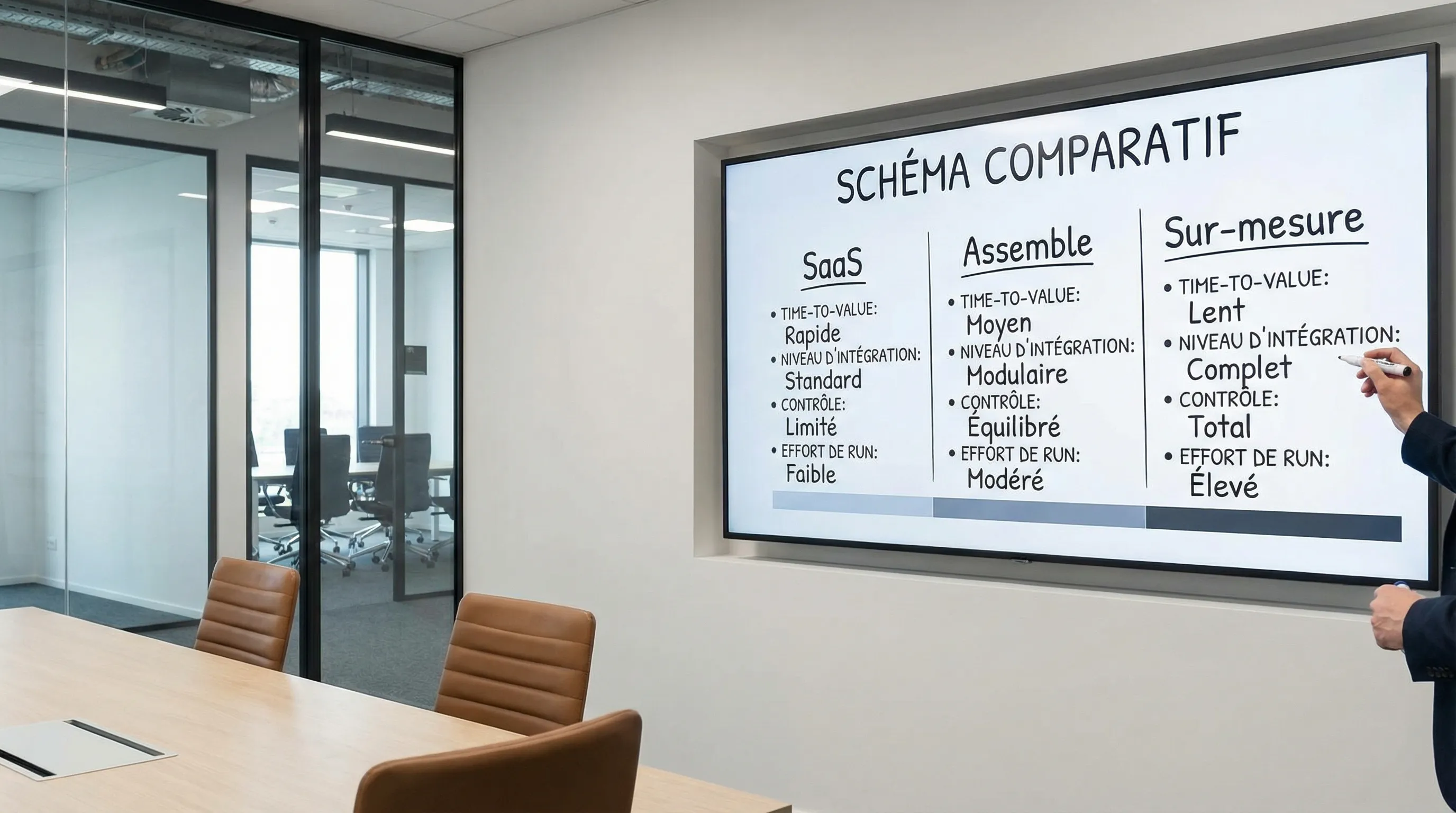
AI Solution: How to choose between SaaS, assemble, and custom
Intelligence artificielle
Stratégie IA
Outils IA
Gestion des risques IA
ROI
Choosing an **AI solution** in 2026 is no longer just about "picking the best model". The real question is almost always: **what product format and level of integration** to achieve a measurable ROI, without blowing up run costs, complexity, or risks (GDPR, AI Act, security)...
Choosing an AI solution in 2026 is no longer just about "picking the best model". The real question is almost always: what product format and level of integration to achieve a measurable ROI, without blowing up run costs, complexity, or risks (GDPR, AI Act, security)?
Between a ready-to-use SaaS, an assembly of building blocks, and a custom build, all three options can be "good". They are just not good for the same constraints.
The 3 options, explained without jargon
1) SaaS: a "ready-to-consume" AI
A SaaS (Software as a Service) is a packaged cloud tool sold by subscription. You buy a capability (e.g., writing assistance, support agent, document extraction) with an already designed interface and workflows.
Main advantage: fast time-to-value.
Main risk: you adapt your process to the tool, and not the other way around.
If you need a refresher, Impulse Lab has a clear definition of the SaaS model.
2) Assemble (assembly): connecting building blocks to deliver a workflow
"Assembling" means building your solution from existing components: AI APIs (LLM, vision, audio), orchestration, RAG, automation, connectors, knowledge base, security layer, plus a minimal interface.
It is not "magic" no-code. It is often a lightweight and integrated product, whose value comes from the complete chain (data → decision → action), not from a screen.
Some common building blocks (depending on the use case):
3) Custom: building an AI product tailored to your context
Custom-built consists of developing a specific solution, designed for your users, your constraints (data, security, processes), your UX, and your differentiation.
Main advantage: perfect control and alignment with the business.
Main risk: cost and time, but above all the obligation to operate (tests, observability, runbook, iterations).
The decision grid that avoids 80% of mistakes
Most "bad choices" come from a bias: comparing features instead of comparing constraints.
Here is a simple (and generally sufficient) grid to decide.
Criterion that really matters
SaaS
Assemble
Custom
Timeframe for a useful V1
Very fast
Fast to medium
Medium to long
IT system integration (CRM, ERP, helpdesk, SSO)
Variable, often limited
Strong (targeted)
Very strong
Business customization (rules, exceptions)
Limited
Good
Excellent
Control (security, logs, degraded modes, SLA)
Depends on the provider
Good if well designed
Very good (if industrialized)
Reversibility (changing blocks, avoiding lock-in)
Often low to medium
Good
Good (but you handle the run)
Total Cost of Ownership (TCO) at 12-24 months
Low at first, can rise
Often optimizable
Variable, depends on the run
Product/process differentiation
Low
Medium to strong
Strong
Quick read:
SaaS is a good choice if your need is standard and your goal is to execute fast.
Assemble is often the best ratio when the value comes from integration and workflow.
Custom makes sense when you are looking for differentiation, control, or a non-standard business UX.
8 questions to choose your AI solution, without the "demo effect"
1) Is your use case standard or specific?
If your need looks like that of 1,000 other companies (e.g., transcription, summaries, generic content generation), a SaaS is often sufficient.
If your use case has specific rules, exceptions, or its own repository (catalog, contracts, internal procedures), you quickly shift towards assemble (RAG + integrations) or custom.
2) Does the value come from an action in your tools?
If the AI must act (create a ticket, enrich a CRM, generate a quote, trigger a follow-up), integration becomes central.
In this case, isolated "chat" solutions tend to fail: they answer, but they do not close the loop.
3) What level of output risk do you accept?
Two simple questions:
What does an AI error cost (time, money, reputation, compliance)?
Do you need traceability (sources, logs, human validation)?
The higher the risk, the more you need architecture, guardrails, and validation. This pushes towards assemble or custom.
4) Are your data "red"?
If you process sensitive data (customer, financial, HR, health data, trade secrets), you must clarify:
where the data goes,
who has access to it,
how long it is kept,
how you audit its usage.
In France, trade-offs are often made with DPO and security teams according to GDPR principles. A useful resource from the regulator: CNIL, AI and data protection.
5) Do you need a "source of truth" (RAG)?
As soon as the AI needs to answer based on your documents (procedures, T&Cs, offers, knowledge base, specs), a RAG becomes the most frequent pattern.
If your teams have to use AI all day (support, ops, sales, finance), UX is an ROI factor. A SaaS might be enough if the interface fits their daily routine. Otherwise: assemble with a targeted interface, or custom.
7) What is your decision horizon (3 months or 24 months)?
The classic trap: choosing based on monthly cost (SaaS) without counting:
The right choice is not the one that minimizes a single area, it is the one that minimizes lost value (time, errors, opportunities) for an acceptable level of risk.
Security, GDPR, AI Act: how to integrate them into the choice (without blocking delivery)
In 2026, compliance is no longer an afterthought. It dictates the ability to deploy.
Three pragmatic principles:
1) Classify your data before choosing the tool
A simple classification (green, orange, red) is often enough to decide what can go into a SaaS, and what must be controlled via a gateway, a controlled assembly, or a custom build.
2) Demand "proof", not promises
Whether it is a SaaS or a custom project, ask for verifiable elements:
retention policies,
audit logs,
access control,
flow documentation,
evaluation protocol.
3) Treat AI like a mini-product
An AI assistant in production needs an owner, iterations, and a usage framework. Otherwise, you get a POC that works on Tuesday and fails on Thursday.
For the European framework, you can consult the European Commission's reference page on the EU AI Act.
A "no regrets" trajectory to decide in 2 to 4 weeks
If you are hesitating, here is a sequence that reduces risk without slowing down:
In practice, the right starting point is often a short scoping session: one hour to clarify constraints and KPIs, then a realistic test plan. You can discuss this directly via Impulse Lab.
Is an AI Use Case Registry Enough to Stay Compliant?
No. **An AI use case registry is a starting point, not sufficient proof of compliance.** It maps where AI is used, who owns it, and what risks to review. But a row in a spreadsheet neither proves data processing lawfulness nor fulfills AI Act requirements.