AI Strategy for Mid-sized Companies: Organizing the Project Portfolio
Intelligence artificielle
Stratégie d'entreprise
Stratégie IA
Gouvernance IA
Gestion des risques IA
In many mid-sized companies, AI starts with a pile of POCs and isolated tools. The result is often an AI "showcase" followed by a slowdown, as no one knows **what to prioritize**, **how to arbitrate** (ROI vs risk), or **how to industrialize**.
In many mid-sized companies, AI starts with an accumulation of POCs, isolated tools, and urgent business requests. The result is well known: an AI "showcase," a few local gains, and then a slowdown, because no one really knows what to prioritize, how to arbitrate (ROI vs. risk), or how to industrialize.
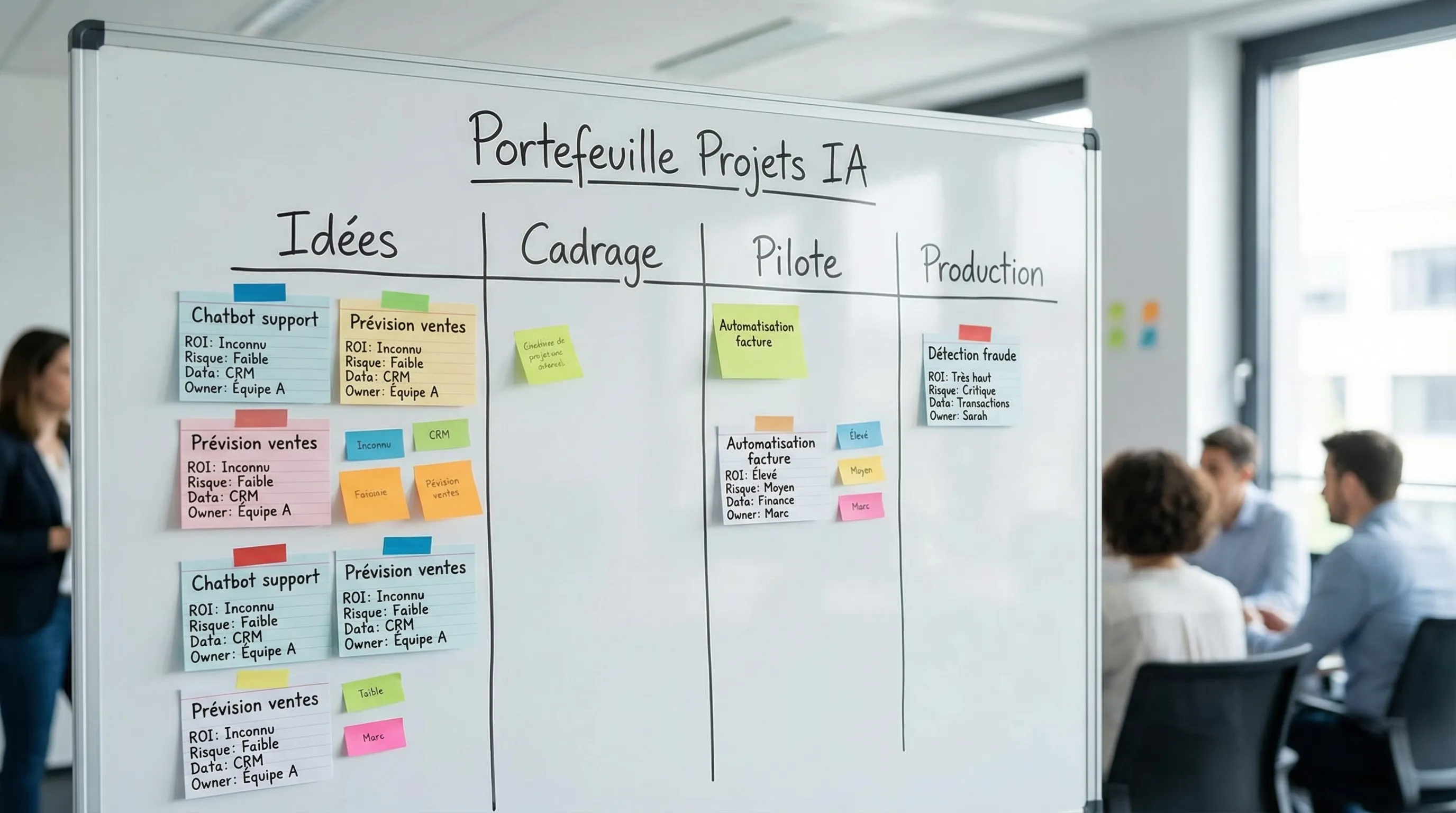
An AI strategy for mid-sized companies becomes truly executable when it translates into a project portfolio: a limited set of initiatives that are classified, funded, and delivered in waves, with common governance rules and KPIs.
This guide gives you a simple method to organize this portfolio, avoid the POC graveyard, and produce measurable gains without losing control (data, security, compliance, costs).
What "AI Project Portfolio" Actually Means
An AI project portfolio is not a list of ideas. It is a decision-making system that answers 5 questions in a repeatable way:
Where does AI create the most value within your actual processes (time, margin, cash, quality, risk)?
Which teams are ready to absorb the change (adoption, training, ownership)?
What data and integrations are necessary, and at what cost?
What risks (legal, security, reputation, bias, errors) are acceptable, and under what conditions?
How to measure and decide: go, iterate, scale, or stop?
The portfolio is therefore both a prioritization tool and a management tool.
Why Mid-sized Companies Often Fail to Organize Their AI Projects
The causes are rarely technical. They are structural.
1) Too many topics, not enough decisions
Without a framework, every department pushes "its" assistant, "its" agent, "its automation." The result is duplication, exploding integration costs, and non-existent standards.
2) No common foundation (data, security, evaluation)
AI in production requires a minimum of discipline: access to sources, traceability, input control (PII), logs, tests, monitoring. Without this foundation, every project reinvents the wheel.
3) No measurement before optimization
Many teams track usage metrics ("number of users," "number of conversations") but not impact: minutes saved, resolution rate, errors avoided, reduced cycle time.
To frame these dimensions, many organizations rely on risk management frameworks like the NIST AI Risk Management Framework and, in Europe, on requirements linked to the EU AI Act depending on the use cases.
Step 1: Build a Single Opportunity Register (the "Use Case Register")
Before scoring, you must make things comparable. A single opportunity sheet (1 page) is the most profitable artifact to get started.
A minimal sheet must contain:
Targeted process (where, who, volume)
Precise problem (friction, delays, errors, cost)
Value hypothesis (expected gain, in business units)
Data and systems required (sources, quality, rights)
Business Owner (responsible for the result, not just the project)
If you are starting from scratch, a good shortcut is to frame things via a short audit, then transform the result into a register. (See also: Strategic AI Audit).
Step 2: Adopt a Scoring Grid That Forces Arbitration
A scoring grid serves to avoid endless debate. It doesn't need to be perfect; it needs to be stable and usable.
Here is a pragmatic grid (to be adapted), designed for mid-sized companies that want results in less than 90 days on the first topics.
Criteria
Question to decide
Example scale (1 to 5)
Typical weighting
Business Value
What is the net impact if it works?
from low to high
30%
Time-to-impact
In how many weeks is a measured pilot possible?
from >12 to <4
20%
Data & Integration Feasibility
Accessible data, connectable IS, manageable costs?
from difficult to simple
20%
Risk & Compliance
What level of guardrails is necessary?
from high to low
15%
Adoption & Ownership
Will teams use it, and who operates it?
from fragile to solid
15%
Important recommendation: do not mix value and feasibility into a single score. Otherwise, "sexy but impossible" topics rise too high.
A good score is not a decision
The score is a filter. The final decision must integrate:
Your actual capacity (teams, time, budget)
Your sequence (foundation first or quick win first)
Your constraints (data, compliance, sovereignty)
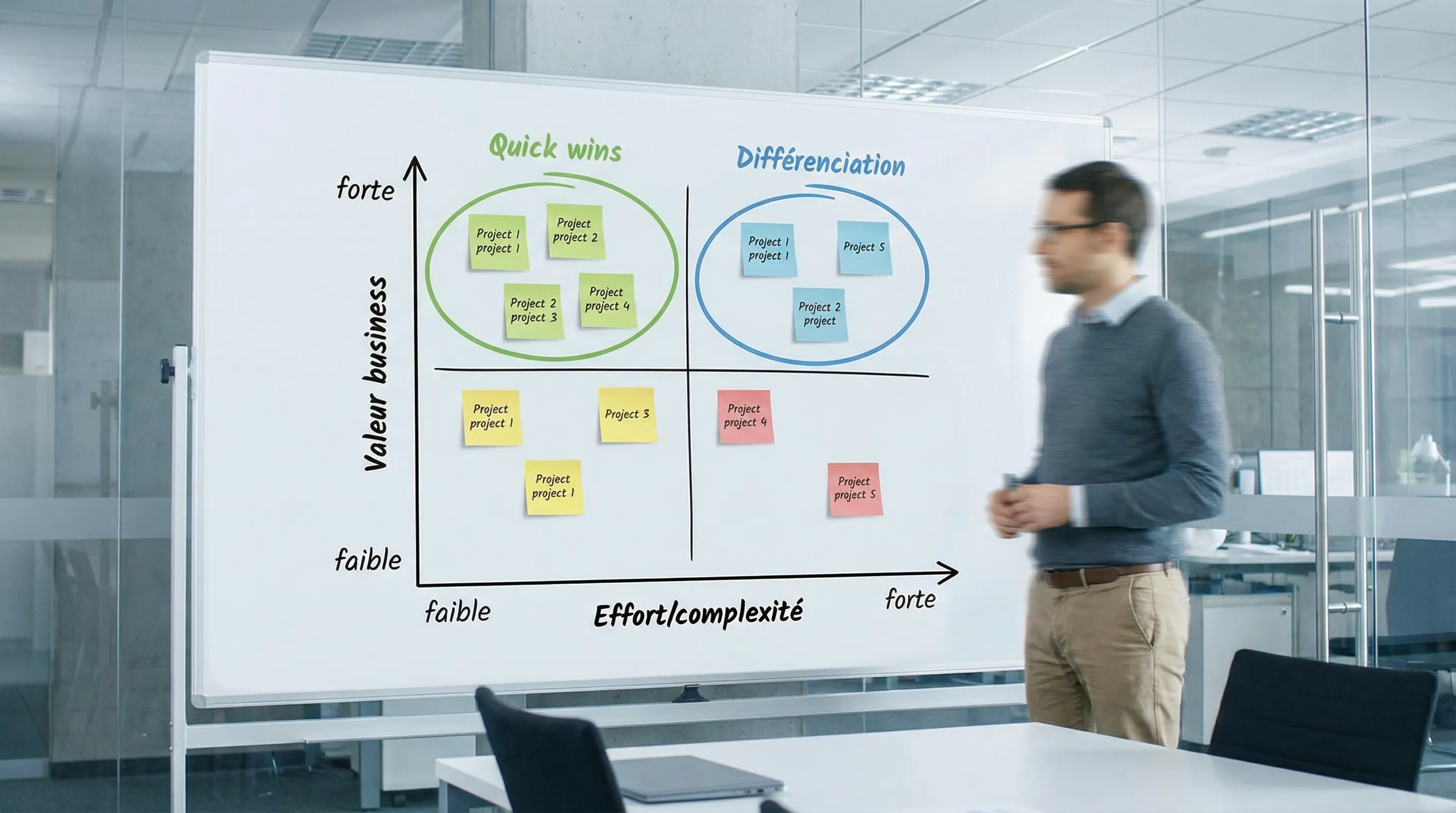
Step 3: Structure the Portfolio into 4 Categories (and Stop Treating Everything the Same)
Not all AI initiatives are managed with the same rhythm or the same requirements. A simple classification avoids many errors.
Category
Objective
Typical Examples
Management Rule
Quick wins
Rapid gains, close to the field
response assistance, extraction, triage, controlled drafting aid
short pilot, strict measurement, easy stop
Foundations
Reduce future costs and delays
knowledge access, connectors, AI gateway, logging rules
mutualized investment, standardization
Differentiators
Sustainable competitive advantage
AI integrated into product, end-to-end automation, agents on processes
product roadmap, long-term operation
Risk & compliance
Reduce risk and debt
usage charter, data classification, validation procedures
non-negotiable, proportionate to risk
A useful rule in mid-sized companies: at any given time, keep a balanced portfolio, for example 60% quick wins, 20% foundations, 20% differentiation/compliance, then adjust according to maturity.
Step 4: Plan in Waves, Not a "Grand Annual Plan"
The classic trap is to make a very detailed annual AI plan, which becomes incorrect after 6 weeks (models, costs, business needs).
To clarify the structure of roles and responsibilities, you can draw inspiration from an AI Organization model (sponsor, AI lead, business owner, data owner, security, legal).
Wave 1: 2 Measured, Integrated Pilots (4 to 8 weeks)
Objective: Prove impact, not just do a demo.
1 pilot "close to cash" (support, sales, operations, collections)
1 "foundation" pilot (knowledge, integration, evaluation)
Wave 2: Controlled Industrialization (8 to 12 weeks)
Objective: Move from "it works" to "it is operated."
Operations runbook
Monitoring (quality, costs, latency)
Targeted training "at the point of use"
Scale/stop decision
If your company wants a reference model to link strategy, data, and measurement, the framework presented in Business + AI: Aligning Strategy, Data, and ROI helps avoid management based on "gut feeling."
Step 5: Define a Portfolio Governance Model That Accelerates (Instead of Blocking)
The word "governance" is scary because people imagine a heavy committee. In an AI portfolio, the goal is the opposite: accelerate with clear rules.
The Minimum Viable Governance (Recommended for Mid-sized Companies)
A Sponsor (CEO, CFO, COO, BU Director) who arbitrates on value.
An AI Lead (or program manager) who facilitates the portfolio and standards.
A Business Owner per use case responsible for KPIs (and adoption).
Security + Legal in rapid review, triggered by risk level.
Simple rituals:
Portfolio committee (weekly or bi-monthly): decisions and blockers
Monthly review: KPIs, costs, risks, stop/go
Quarterly review: budget and capacity reallocation
Step 6: Fund the Portfolio Correctly (and Avoid the False "Model Cost")
Many mid-sized companies underestimate the AI budget because they only see the provider's invoice (API, licenses). However, real costs include:
IS integrations (CRM, ERP, helpdesk, DMS)
Preparation and maintenance of sources (knowledge, RAG)
Evaluation, tests, monitoring
Security, compliance, access management
Training, support, change management
To decide, think in terms of TCO per use case over 6 to 12 months, not in monthly "tool" costs. A use case that seems expensive can be profitable if it removes a frequent bottleneck.
Step 7: Manage the Portfolio with a Shared Dashboard
Without a shared dashboard, you are comparing incomparable projects. The idea is not to track 40 KPIs, but to have a shared baseline.
A portfolio dashboard can fit into 8 to 12 indicators, distributed across 3 levels:
Projects are chosen because a tool was bought, not because a KPI is targeted.
Most topics do not have an identified business owner.
You cannot answer in 2 minutes: "What are our top 3 priority AI use cases, and why?"
Pilots are not integrated into daily tools, so usage drops off.
Compliance arrives at the end of the project, with costly reworks.
Variable costs (APIs, tokens, infra) rise without a clear link to impact.
Template: The "Portfolio" Sheet You Can Copy
If you were to keep only one document, keep this one, one line per use case:
Use case
Owner
KPI North Star
Baseline
Gain Hypothesis
Data & Integrations
Risk (L/M/H)
Next Step
Decision Date
This format forces clarity and makes your strategy executable.
Frequently Asked Questions
What is the difference between an AI strategy and an AI project portfolio? An AI strategy sets a direction (business priorities, constraints, governance). The portfolio translates this direction into concrete decisions: which projects, in what order, with what budget, which KPIs, and when to stop.
How many AI projects should a mid-sized company launch in parallel? In practice, fewer but better is best: 2 measured pilots in parallel are often enough (one quick win, one foundation). Beyond that, the debt of integration, security, and adoption increases faster than the value.
Should AI be centralized in a single team? Not necessarily. Many mid-sized companies succeed with a hybrid model: mutualized standards and foundation (central), ownership and delivery as close to the business lines as possible (decentralized). The important thing is to have common rules (data, security, measurement) and a portfolio committee.
How to integrate compliance (GDPR, AI Act) without slowing down? By classifying data and use cases right from the scoping phase (low, medium, high risk), then applying proportionate guardrails. Security and legal reviews become faster because they are triggered by explicit criteria.
What is the best starting point if we already have several POCs? Do a "portfolio triage": put every POC in the register, add an owner and a KPI, then decide stop/continue/industrialize. Without an owner and without measurement, a POC must be stopped or reframed.
Moving from a List of Ideas to a Deliverable AI Portfolio
If you want to organize your portfolio without lengthening cycles, Impulse Lab supports mid-sized companies with an execution-oriented approach: AI opportunity audit, custom development and integrations, automation, and adoption training, with a weekly delivery logic and structured project tracking.
You can start with a short scoping phase (register + scoring + roadmap) then follow up with 1 to 2 measured pilots. To discuss it: impulselab.ai or start with our Strategic AI Audit method.
Should You Wait for Artificial General Intelligence Before Investing?
Should you put projects on hold while waiting for AGI? For an SME or scale-up, no—provided you invest in measurable outcomes rather than tech promises. A system doesn't need to do everything to reduce processing times or simplify access to internal documentation.