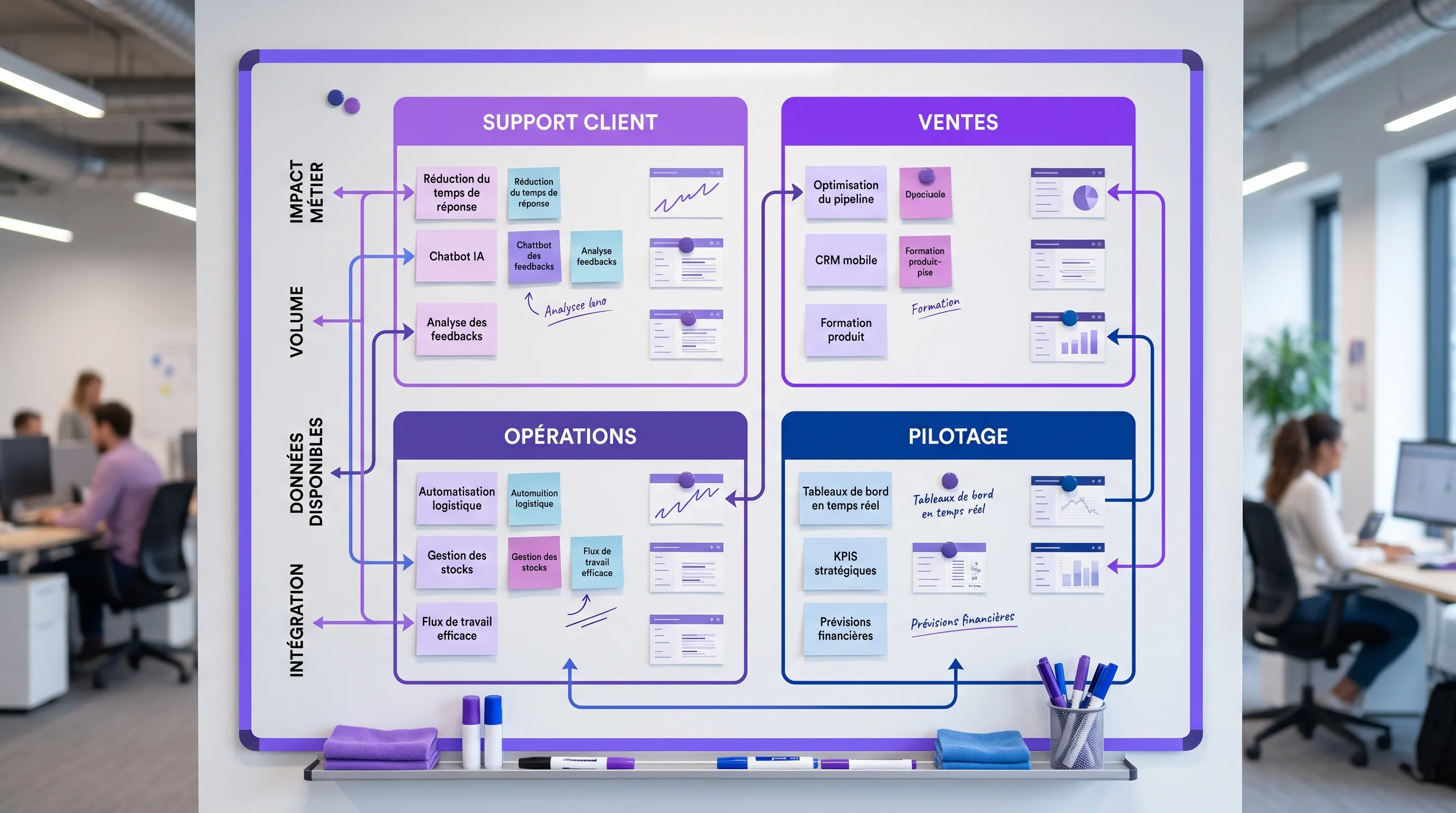
AI Technology: The Use Cases That Truly Create Value
Intelligence artificielle
Stratégie IA
ROI
Productivité
Optimisation
In 2026, the question is no longer whether AI is impressive. It is. The real question for an SMB or scale-up is simpler and more demanding: **where can AI technology create measurable gains in the company?**
July 11, 2026·13 min read
In 2026, the question is no longer whether AI is impressive. It is. The real question for an SMB or scale-up is simpler and more demanding: where can AI technology create measurable gains in the company?
The answer is almost never "put ChatGPT everywhere." The use cases that truly create value are those that fit into an existing business process, reduce an identifiable friction, use reliable data, and improve a metric the team is already tracking: processing time, conversion rate, response time, quality, margin, customer satisfaction, or the ability to scale without hiring too quickly.
According to the McKinsey State of AI 2024 study, AI adoption has strongly accelerated in organizations. But adoption is not enough. A company can multiply AI tools without transforming its results. Conversely, a single well-chosen use case, connected to the right tools and supported among the teams, can generate a lasting impact.
Why many AI projects fail to create value
Most failures do not come from the technology itself. They stem from a bad starting point. A company discovers a tool, tests a few prompts, gets encouraging results, and then looks for a problem to solve. This "tool-first" logic often produces enthusiasm, but little ROI.
A useful AI project starts the other way around: which process is expensive, takes too much time, relies too heavily on a few people, or slows down growth? Once the problem is clarified, technology becomes a lever, not an end in itself.
Three traps often come up:
Automating a poorly understood task: if the process is unclear, AI mostly accelerates the mess.
Creating an isolated assistant: a chatbot that doesn't read your data, doesn't connect to your CRM, and triggers no action remains limited.
Measuring usage rather than value: the number of prompts sent says nothing about the actual business gain.
This is why a structured approach to AI in business looks less like a software purchase and more like a product approach: understand the user, map the workflow, test quickly, measure, improve.
The criteria for a truly value-creating AI use case
A good AI use case rarely ticks all the boxes from the start, but it must validate several of them. Before investing, ask yourself these questions.
Value often arises at the intersection of three elements: a clear business irritant, sufficiently clean data, and integration into the teams' daily routines. Without this integration, even the best AI ends up as a forgotten tab in the browser.
This logic aligns with the "AI Plus" approach, which consists of integrating AI into existing processes, data, and governance rather than piling up tools. If you want to delve deeper into this vision, Impulse Lab's article on AI Plus in business details this difference very well.
The AI use cases that create the most value in SMBs and scale-ups
Not all use cases are created equal. Some are attractive in a demo but hard to make profitable. Others seem more modest but produce quick gains because they involve large volumes or highly repetitive tasks.
1. Augmented customer support
Support is often one of the first areas where AI creates tangible value. Teams answer recurring questions, search for information across multiple tools, and must maintain consistent quality, even as volume increases.
AI can help to:
automatically qualify incoming requests;
suggest answers based on the knowledge base;
summarize customer history before intervention;
detect urgent or at-risk tickets;
feed an FAQ or help center from frequently asked questions.
Value is measured fairly directly: time to first response, average resolution time, self-service rate, customer satisfaction, load per agent. The goal is not to replace all human relationships, but to reserve humans for complex, sensitive, or high-value cases.
For companies that already have a website with a lot of traffic or incoming requests, AI integrated into the web can also improve conversion and reduce unnecessary inquiries. This is notably the subject of this article on the concrete uses of web AI.
2. Sales and commercial qualification
In sales teams, the value of AI is rarely found in the massive generation of generic messages. Rather, it appears when it helps teams better prioritize, better prepare, and better follow up.
A useful application might involve automatically summarizing a lead, enriching a CRM profile, analyzing intent signals, preparing a call script, or identifying probable objections before a meeting. AI can also help transform call notes into a structured report, and then into the next action.
The metrics to track are concrete: conversion rate between stages, time spent on CRM data entry, follow-up time, number of opportunities handled per sales rep, value of the qualified pipeline. For a scale-up, a few minutes saved on each sales interaction can represent a significant lever when volume increases.
3. Automation of administrative and operational tasks
Many companies waste time on tasks that are not strategic but must be done correctly: copying information between tools, verifying documents, classifying requests, producing reports, extracting data from files, or triggering internal workflows.
AI becomes interesting when it combines language understanding, information extraction, and automation. For example, it can read an incoming request, identify its type, extract key information, create a task in the project management tool, and notify the right person.
This type of use case is often less visible than a chatbot, but it can generate very strong value. Gains are measured in hours saved, errors avoided, shortened deadlines, and the ability to absorb more volume without complicating the organization.
4. Internal search and knowledge capitalization
As a company grows, knowledge scatters. Information lives in documents, Slack messages, tickets, reports, a CRM, sales files, and sometimes in the heads of a few key people.
An internal search AI can help employees find a procedure, a technical answer, a customer reference, a proposal template, or a past decision more quickly. Here, the value doesn't just come from time saved. It also comes from reducing dependence on certain people and improving onboarding.
The critical point is the quality of the source. An AI connected to obsolete documents will produce obsolete answers. Before deploying this type of solution, you must therefore clarify reliable sources, access rights, and update rules.
5. Management, reporting, and decision support
SMB and scale-up leaders rarely need more dashboards. They need to understand faster what requires action. AI can help summarize metrics, detect anomalies, explain a variation, or generate an initial analysis from business data.
For example, a system can flag an unusual drop in the conversion rate at a funnel stage, summarize possible reasons based on available data, and suggest avenues for investigation. In a financial context, AI can help spot discrepancies, categorize expenses, or prepare recurring analyses.
Be careful, however: decision support requires a higher level of reliability than marketing text generation. Numbers must be traceable, assumptions explicit, and important decisions validated by a human.
6. Faster, but better-framed marketing production
Content creation is one of the most well-known uses of AI. Yet, it is also one of the most easily misused. Producing more mediocre texts does not create value. On the other hand, using AI to accelerate an already structured marketing process can be highly profitable.
The best uses are often found in research, adaptation, and iteration: analyzing customer feedback, generating campaign angles, adapting a message to multiple segments, preparing briefs, producing landing page variants, or summarizing campaign performance.
Value is measured by business metrics, not just editorial ones: conversion rate, acquisition cost, production speed, brand consistency, volume of tests launched. AI is useful if it increases the learning pace, not if it adds noise.
7. Product and software development
For product and tech teams, AI can accelerate programming, documentation, test generation, error analysis, or prototyping. But here again, gains mostly come from verifiable and well-segmented tasks.
A developer can use AI to explore an approach, write a first version, refactor a piece of code, or document an API. Control remains essential, as the generated code must be reviewed, tested, and maintained. AI does not eliminate technical requirements; it can reduce certain frictions in the development cycle.
In a growing company, this use case can also help turn a business idea into a testable prototype faster. The gain is not only in development time; it is also a better ability to quickly validate or abandon an initiative.
How to prioritize the right AI use cases
The right method is to compare ideas along two dimensions: potential value and feasibility. A high-value but highly complex use case might be relevant later. A simple but not very useful use case doesn't necessarily deserve to be launched. The best first projects are often somewhere in between: visible impact, manageable complexity, accessible data.
Type of use case
Potential value
Complexity
Typical priority
Automatic summary of meeting notes
Medium
Low
Good first test
Qualification of support tickets
High
Medium
High priority if volume is large
Internal search connected to documents
High
Medium to high
Relevant if knowledge is scattered
Content generation without editorial workflow
Low to medium
Low
Needs framing before scaling
Automated financial decision support
High
High
Must be secured with governance and human control
An effective approach is to select three to five use cases, then test them on a reduced scope. The goal is not to prove that AI "works" in general, but to verify that it works in your context, with your data, your constraints, and your teams.
This is precisely where an AI opportunity audit can save time: it prevents going in all directions and turns a desire for AI into an actionable roadmap.
Measuring the ROI of an AI technology
The ROI of an AI project must be defined before deployment, not after. Otherwise, the company risks confusing the impression of modernity with actual performance.
Start by establishing a baseline. How long does the task take today? How much does it cost? What is the error rate? What volume does the team handle? What is the consequence of a delay or a wrong answer?
Next, measure the gap after deployment. For some cases, the ROI is financial. For others, it translates into stronger operational capacity, better quality, or risk reduction.
Objective
Useful KPI
Measurement example
Save time
Hours saved per week
Average time before and after automation
Improve service
Time to first response
Average time on incoming tickets
Increase revenue
Conversion rate
Conversion by segment or funnel stage
Reduce errors
Manual correction rate
Number of cases reworked by a human
Accelerate execution
Cycle time
Time between request and delivery
Facilitate adoption
Active usage rate
Share of target users who use the tool every week
The most important thing is not to measure only the model's performance. An AI can be technically correct but useless if it is not adopted, too slow, poorly integrated, or hard to supervise.
For a read more focused on business gains, Impulse Lab has also published a guide on the concrete benefits of artificial intelligence, with an approach centered on productivity, revenue, quality, and execution speed.
Conditions for success: data, integration, adoption
Three conditions often make the difference between an interesting test and sustainable usage.
The first is data quality. You don't need a perfect database, but you must know which sources are reliable, who can access them, and how they are updated. An AI connected to the wrong information can amplify errors on a large scale.
The second is integration with existing tools. If AI forces teams to completely change their habits, adoption will be harder. Conversely, an AI that appears in the CRM, helpdesk, back-office, or internal portal already in use is much more likely to become a reflex.
The third is support. Training teams doesn't just mean teaching them how to write prompts. You must explain the limits, authorized use cases, validation rules, privacy risks, and good control reflexes.
The regulatory framework also matters, especially for sensitive uses like recruitment, healthcare, finance, or people evaluation. The European AI Act introduces a logic based on risk levels. For SMBs, this doesn't mean blocking all projects, but documenting uses, keeping human supervision when necessary, and avoiding opaque decisions on sensitive topics.
Where to start concretely?
If you are starting out, don't look for "the best AI tool." Look for the best problem to solve. Gather the people who know the field, list recurring irritants, and evaluate them according to their volume, cost, customer impact, and data availability.
A good first project should be important enough to interest management, but limited enough to be tested quickly. For example: reducing the processing time of level 1 tickets, automating the qualification of incoming requests, producing reliable sales summaries, or creating an internal search engine on a priority document base.
Next, build a prototype, test it with a small group, measure the results, and improve. Industrialization only comes afterward. This progression avoids large, abstract AI projects and allows teams to quickly see what the technology changes in their daily work.
FAQ
What is AI technology in business? The term refers to all artificial intelligence technologies used to automate, assist, or improve business processes. In a company, its value depends less on the model used than on its integration with data, tools, and workflows.
What are the most profitable AI use cases for an SMB? The most profitable use cases are often augmented customer support, administrative automation, sales qualification, internal search, and assisted reporting. Their value comes from the volume of repetitive tasks and the ability to quickly measure gains.
Should you start with an AI chatbot? Not necessarily. A chatbot can be useful if it answers a real need, relies on reliable data, and integrates into the customer journey. But in some cases, internal automation or an assistant for teams creates more value than a visible chatbot on the website.
How to avoid a gimmick AI project? You must start from a measurable business problem, define a KPI before testing, limit the scope, involve end users, and plan for human control. If no one can explain which metric should improve, the project is probably too vague.
Does AI replace teams? In most SMBs and scale-ups, the best uses consist rather of augmenting teams: reducing repetitive tasks, accelerating information retrieval, improving quality, and freeing up time for higher-value topics.
Transforming AI into measurable value
AI technology creates value when it becomes an operational lever, not when it remains an isolated experiment. The companies that reap the most benefits are those that choose their use cases methodically, connect AI to their tools, support their teams, and measure the results.
If you want to identify the most relevant opportunities for your organization, structure an AI roadmap, or develop a solution connected to your existing processes, Impulse Lab supports SMBs and scale-ups with AI audits, custom web and AI platforms, automation, and adoption training.