Artificial Intelligence Discussion: Tools and Team Rules
Intelligence artificielle
Stratégie IA
Confidentialité des données
Gouvernance IA
You've likely seen it: someone posts a "miracle" prompt on Slack, another tests a free tool "just to see," and two weeks later, you don't know who is using what, with which data, or if the results are reliable.
February 20, 2026·8 min read
You have probably already experienced the scene: someone posts a "miracle" prompt on Slack, another tests a free tool "just to see," and two weeks later, you don't know who is using what, with which data, or if the results are reliable.
In an SME or scale-up, the discussion on artificial intelligence is not a philosophical debate. It is a team discipline. It serves to align usage with measurable objectives, reduce risks (confidentiality, errors, compliance), and avoid tool chaos.
This guide gives you concrete tools and simple rules to organize these discussions, decide quickly, and deploy AI without losing control.
What a Team "Artificial Intelligence Discussion" Should Produce
A good AI discussion is judged by its deliverables, not the number of ideas.
Here are the minimum decisions to obtain, even if you start small.
Subject to decide
Question to ask
Simple deliverable (1 page)
Objective
Which KPI do we want to move, on which process?
Use case sheet (objective, scope, baseline KPI)
Authorized tools
Which tools and accounts are "OK"?
"Approved AI tools" list + access rules
Data
What are we allowed to send to a model?
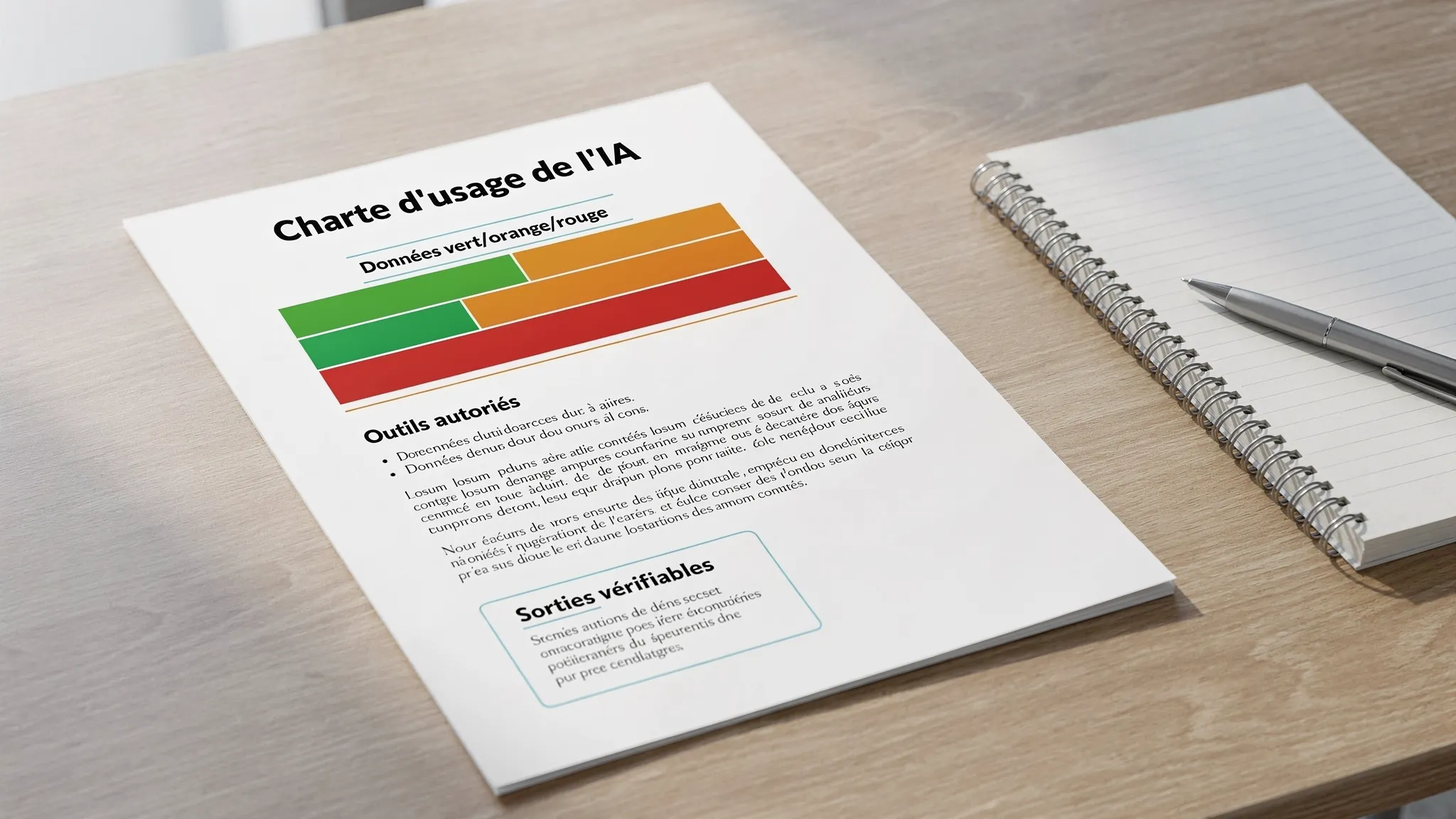
Data policy (green/orange/red)
Quality
How to avoid false and silent answers?
Guardrails (sources, human validation, tests)
Traceability
Can we audit and explain what happened?
Logging rules (logs, prompts, versions)
Adoption
Who trains whom, when, how?
Micro-training plan + referents
If you don't have these elements, the AI discussion quickly turns into a "permanent POC".
Tools That Facilitate the Discussion (Without Replacing It)
The goal is not to add yet another tool. It is to use your existing tools with a clear structure, then add one or two bricks if necessary.
1) A single space to centralize decisions and prompts
Choose a "source of truth" (Notion, Confluence, Google Docs, SharePoint). It must contain:
The AI usage charter (short)
The list of authorized tools and accounts (enterprise vs personal)
A register of use cases (idea, owner, status, KPI)
A library of validated prompts, with context and examples
If your teams already have a product/tech culture, you can also manage part of it in "version control" (Git) for critical prompts, especially when they power automations.
To structure the "prompts" part, you can rely on prompt engineering principles (clarity, context, iteration), but the challenge in a company is primarily reproducibility.
2) A dedicated discussion channel, with a mandatory format
Create a Slack/Teams channel like #ai-ops or #ai-usage. To avoid noise, impose a mini-template for every "new usage" message:
Objective (1 sentence)
Data used (green/orange/red)
Tool (and account used)
Observed result (examples)
Identified risk (if applicable)
Next step (test, doc, stop)
This format transforms a vague discussion into an actionable signal.
3) A decision tracking board (like an "AI register")
A simple table (Notion/Airtable/Sheet) is enough to start.
Useful fields: use case, owner, team, frequency (daily/weekly), data, tool, risk level, KPI, status (idea/test/pilot/prod), review date.
It is also a good entry point for an opportunity audit, as you quickly visualize high-leverage uses and those that should be stopped.
4) "Proof" tools: tests and evaluation, even basic ones
For uses that touch clients or important internal decisions, the discussion must be fueled by evidence.
On LLM topics, you can draw inspiration from risk frameworks and best practices like the NIST AI RMF (AI risk management) and the OWASP Top 10 for LLM Applications (LLM security risks). These are not "standards to apply to the letter" in an SME, but good reading grids.
Team Rules That Avoid 80% of Problems
Most issues come from two things: data and the illusion of reliability. Here are simple rules, applicable quickly.
Rule 1: Classify data (green, orange, red)
The AI discussion becomes much simpler when everyone speaks the same language regarding sensitivity.
Level
Examples
Usage Rule
Green (non-sensitive)
public content, generic internal templates, non-confidential procedures
Forbidden in non-validated tools, prioritize controlled solution (e.g., usage via framed API, secure environment)
In France, the CNIL regularly reminds us of the importance of data minimization, purpose, and personal data protection. Even without a "big compliance program," this classification avoids costly mistakes.
Rule 2: Separate "writing assistant" and "truth assistant"
The team discussion must clarify an essential distinction:
Writing: AI is very effective for rephrasing, structuring, proposing variants. The main risk is confidentiality.
Truth (facts, figures, legal, procedure): The main risk is error. Here, you need sources, guardrails, and often access to verified internal documents.
When you mix the two, you get deliverables that are "well-written but false."
Rule 3: Require verifiable output when it is critical
For any high-impact usage (client, finance, HR, legal, production), ask for an "auditable" output. For example:
In practice, this often pushes to connect AI to an internal document base (RAG approach) rather than "discussing in a vacuum." If you want to dig deeper, Impulse Lab has a sheet on RAG.
Rule 4: Ban personal accounts for work (or strictly frame them)
It is a sensitive point, but essential.
Explicitly decide:
authorized tools and enterprise accounts
prohibitions (orange/red data in non-validated tools)
storage rules (copy-paste, attachments, exports)
If you have a "testing" phase, formalize it: duration, scope, and authorized data. Without this, tests become invisible production.
Rule 5: One owner per use case, and a regular review
The AI discussion must translate into management.
An owner (business) responsible for the KPI
A referent (tech/data/sec) to validate constraints
A review every 2 to 4 weeks: continue, correct, stop
This is also an excellent way to reduce costs, because "infrequent" or "no KPI" uses disappear naturally.
A Simple Ritual: The Weekly "AI Review" (30 Minutes)
For an SME, the best format is often a light, but regular ritual.
Recommended format (30 minutes, 6 to 8 people max):
5 min: quick metrics (KPI, volumes, incidents)
15 min: 2 use cases reviewed (one that works, one that has issues)
10 min: decisions and actions (who does what, by when)
This ritual works very well if you use your AI register as support.
How to Avoid Sterile Debates (and Decide Quickly)
In AI discussions, three traps often recur.
Trap 1: Talking "models" instead of "process"
In a non-technical team, it is tempting to compare tools and models. Bring the discussion back to:
the actual task (frequency, variability)
the available data
the acceptable risk
the integration into the workflow
This aligns with a central idea: AI creates value when it is integrated. If you want a broader vision, you can read on Impulse Lab how to transform AI into concrete gains, in artificial intelligence advantages: concrete gains.
Trap 2: Confusing adoption and usage
"We use ChatGPT" is not a KPI. In the discussion, demand a baseline:
time spent before / after
error rate / returns
processing speed
resolution rate (support)
Even a simple measurement, over 2 weeks, is enough to decide.
Trap 3: Ignoring compliance until the day it blocks
In 2026, the AI Act and compliance become an operational subject, not a "later" subject. The right compromise in an SME is proportionate governance:
If you want to launch an AI discussion dynamic without spending a quarter on it, aim for this minimal pack.
An AI usage charter (1 page)
A green/orange/red data classification
A Slack/Teams channel with a mandatory template
An AI register (table) with owner and status
A weekly "AI review" ritual of 30 minutes
Only then do you invest in integrations or custom work.
When to Call for an Audit, Training, or Custom Development
If your discussions are going in circles, here are concrete signals:
lots of ideas, few deployments, no KPI
use of unmastered tools with sensitive data
first incidents (false answers sent, leaks, rising costs)
need to integrate AI into a CRM, helpdesk, ERP, internal tool
In these cases, an agency can accelerate by framing, training "at the point of use," and building an integrated V1.
Impulse Lab supports SMEs and scale-ups via AI opportunity audits, adoption training, and custom development with integration and automation. If you want to transform your discussions into an execution plan (prioritized cases, rules, measured prototype), you can start with a conversation on impulselab.ai.