Executives no longer need a lecture on artificial intelligence; they need a plan. This 2025 quick guide helps you frame priorities, secure risks, and start a useful pilot in less than 90 days.
Executive Summary in 5 points
Start with 2 to 3 measurable high-impact business cases, not a technology.
Bet on business copilots, process automation, and RAG-augmented search, where gains come quickly.
Frame governance from the start: access rights, GDPR and AI Act compliance, logging, and performance evaluation.
Avoid "build everything" or "buy everything." Assemble proven building blocks around your data.
Measure value continuously: cycle time, cost per transaction, error rate, user satisfaction.
Why 2025 is a turning point
The value is tangible. Analyses estimate that text and image generation applied to business functions can create significant productivity gains in client functions, marketing, support, and software development. See, for example, the McKinsey 2023 study on [The economic potential of generative AI](The economic potential of generative AI).
The framework is clarifying. The European AI Act introduces a risk-based approach, transparency obligations, and governance, with a progressive deployment of requirements between 2025 and 2026. Useful reference: the [Commission page on the AI Act](Commission page on the AI Act). For a risk management approach, also rely on the NIST AI Risk Management Framework and the CNIL recommendations on AI.
Where AI creates value quickly in 2025
Business Copilots. Drafting assistance, document summarization, response preparation, meeting minutes analysis, sales support—gains in time and quality.
Process Automation. Data extraction from documents, categorization, first-level customer service responses, synchronization between tools.
RAG-Augmented Search. Instant access to internal knowledge, policies, contracts, procedures, with citations and access control.
Coding and Quality Aid. Test generation, guided reviews, documentation. Velocity gains and defect reduction.
Augmented Analytics. Natural language querying, query generation, alerts, and explanations.
How to prioritize in 30 minutes
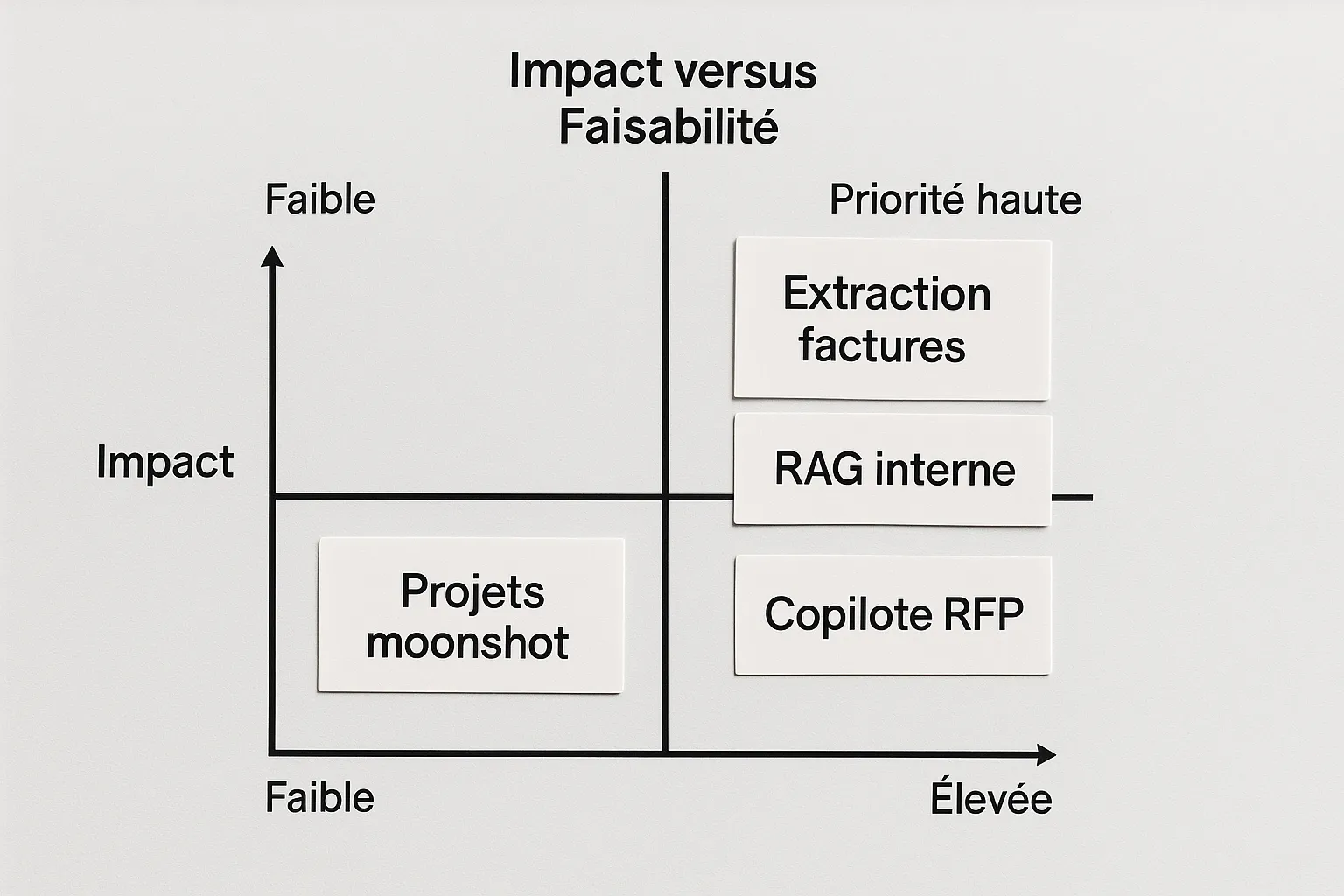
Evaluate each idea based on Impact, Feasibility, and Time-to-Value. Score 1 to 5, then rank by combined score. Example for a medium-sized company.
Use Case | Expected Impact | Technical Feasibility | Time-to-Value | Comments |
|---|
Automated customer FAQ + human escalation | 5 | 4 | 4 | Decrease in simple ticket volume, measurable satisfaction |
Internal RAG search on procedures | 4 | 4 | 4 | High adoption if SSO and reliable sources |
Data extraction on invoices | 4 | 5 | 5 | Immediate gains, reduced errors |
Sales copilot for RFP responses | 4 | 3 | 3 | Requires organized corpus and validations |
Marketing idea generation | 3 | 5 | 5 | Quick to deploy, perceived value variable |
Tip: start with 1 external client case and 1 internal back-office case. You diversify risks and prove value on two fronts.
2025 Reference Architecture: The 5 bricks to assemble
Data and access. Source quality, access rights, PII, retention, encryption. Avoid massive copying; prioritize connectors and on-demand filtering.
Models. General and specialized models, closed or open source. Choose based on usage costs, latency, security, and performance on your actual tasks, not generic benchmarks.
Orchestration. Prompt chains, RAG, agents, workflows, and business rules. Prefer observable and testable components.
Security and compliance. SSO, PII masking, logging, content policies, human approvals. Trace data, prompts, and outputs.
Product and adoption. Clear UX, in-app feedback, targeted training, support, and continuous improvement.
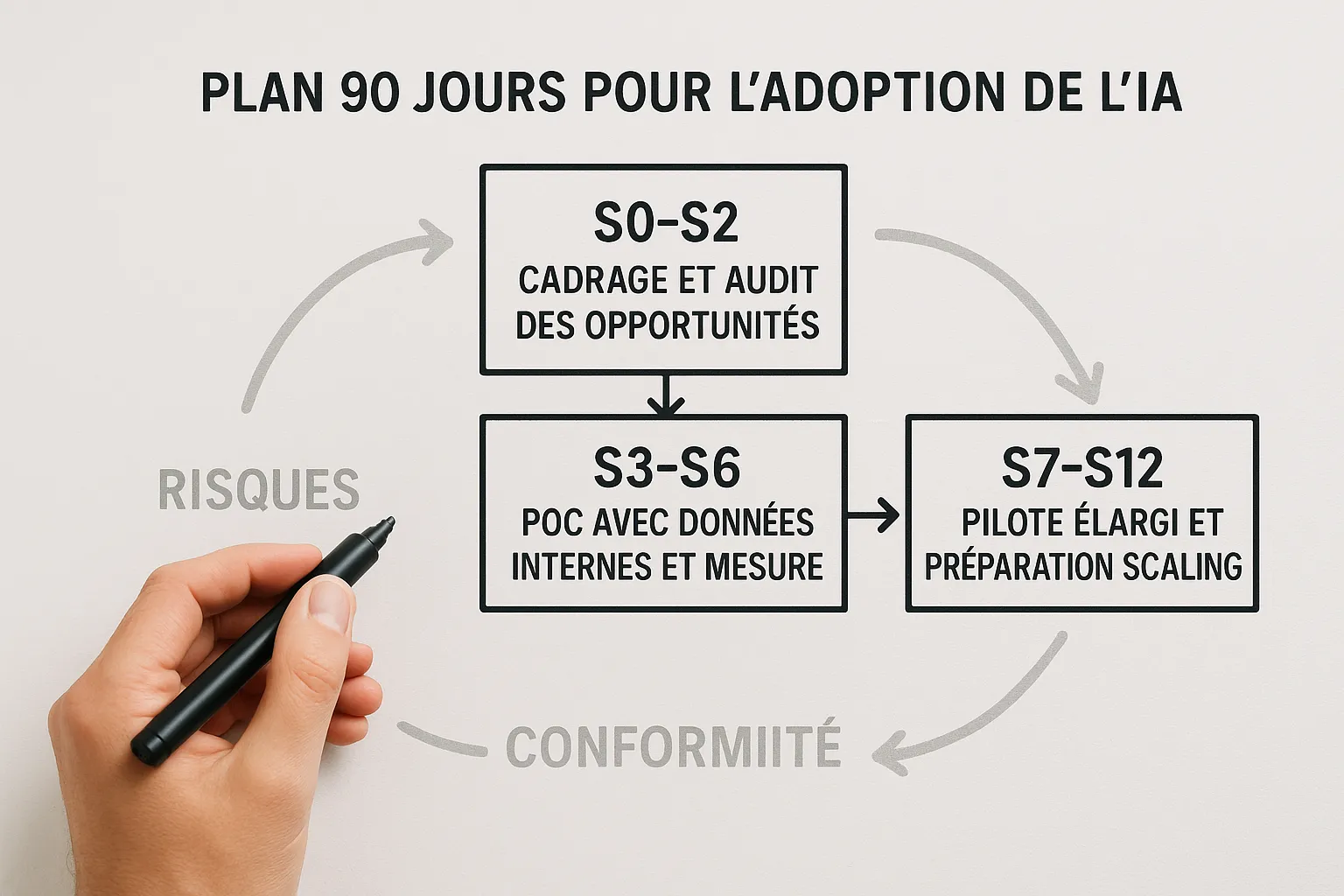
Ready-to-use 90-Day Plan
Week 0 to 2, Scoping
Define 3 target value metrics, e.g., processing time, error rate, NPS.
Select 2 to 3 use cases and necessary data. Assess data sensitivity, GDPR, and supplier clauses.
Prepare the environment: secure access, sandbox, light governance, validation committee.
Week 3 to 6, Measured POC
Assemble a first flow, connectors, RAG if relevant, human escalation rules.
Set up logging and weekly evaluation: accuracy, time, costs.
Test with 10 to 30 pilot users, structured feedback collection.
Week 7 to 12, Expanded Pilot
Integrate with existing tools: CRM, ITSM, DMS, Slack, Microsoft 365, as needed.
Reinforce quality: prompts, grounding data, guardrails, targeted red teaming.
Prepare for scaling: unit costs, API limits, training, support, and a compliance file.
Governance, Risks, and Compliance in 2025
AI Act: adopt a risk-based approach. Document purpose, data, tests, human intervention. Anticipate increased obligations for higher-risk cases. Reference: AI Act, European Commission.
GDPR and privacy: minimize personal data, apply clear legal bases, encrypt in transit and at rest, limit retention. The CNIL publishes useful benchmarks on artificial intelligence.
NIST AI RMF: structure identification, bias management, and alignment. See NIST AI RMF.
Continuous evaluation: set up quality metrics, accuracy, appropriate refusals, drift, and costs, with logging and regular reviews.
Build, Buy, or Assemble
Build: Strong control and differentiation, but high initial cost and longer time-to-value.
Buy: Rapid deployment, but partial coverage of needs and vendor dependence.
Assemble: Best of both worlds for many companies; proven components connected to your data and processes.
Option | When to choose | Points of attention |
|---|
Build | Core differentiating business case | Product team, MLOps, security, recurring budget |
Buy | Standard need, compliance and vendor support | Vendor lock-in, data protection |
Assemble | Rapid value, IS integration, reasonable customization | Connector quality, observability, usage costs |
Budget, ROI, and KPIs that convince an EXCOM
Cost centers: integration and engineering, connectors and licenses, model usage costs, storage and vector search, governance and security, training and change management.
Simple ROI calculation: net annual gains (hours saved, errors avoided, additional sales) divided by total costs. Target an observed return over 6 to 12 months.
Example tracking table
Indicator | Baseline | Pilot Target | Measurement Method |
|---|
Average ticket processing time | 12 min | 6 min | Tool logs and sampling |
First-level automation rate | 0 % | 35 % | Ticket classification |
Document extraction error rate | 6 % | 2 % | Weekly audits |
Pilot user satisfaction | 6.5/10 | 8/10 | In-app surveys |
Unit cost per interaction | €0.90 | €0.40 | API and infra costs |
Preparation Checklist
Data: which sources, what sensitivities, what access rights.
Security: SSO, PII masking, encryption, retention.
Compliance: processing register, DPIA if necessary, logs.
Product: business owner, acceptance criteria, feedback.
Measurement: 3 target KPIs and a simple dashboard.
Common Mistakes to Avoid
Steering by technology alone instead of business value.
Absence of guardrails and logging.
Internal data not ready; insufficient access and quality.
No change plan; users abandon it.
Underestimating usage costs at scale.
FAQ, 7 Quick Answers for Executives
Do I need a lot of data to start with artificial intelligence? No, for copilots, RAG, or document extractions, a structured corpus and correct access are sufficient. Quality matters more than volume.
Open source or proprietary models? Both options are valid. Decide based on performance on your tasks, total cost, confidentiality, latency, and contractual constraints.
What risks must I document from the pilot stage? Personal data, biases and errors, access security, intellectual property, hallucinations. Describe your mitigations and keep logs.
How to avoid factual errors from models? Anchor generation on your verified sources via RAG, impose citations, and plan for human validation for sensitive actions.
What skills need to be mobilized? A product, business, and data pair, plus a software engineer. Depending on the case, a security specialist and a GDPR lawyer.
How long to see results? A well-scoped pilot shows measurable gains in 8 to 12 weeks on 1 to 2 use cases.
How to choose the right indicators? Prefer metrics close to the P&L: cycle time, error rate, unit cost, NPS, or CSAT.
Take Action
If you wish to accelerate AI adoption, frame governance, and deliver quickly without compromising quality, the Impulse Lab teams can assist you with AI opportunity audits, custom web and AI platform development, process automation, integration with your existing tools, and adoption training. We work in weekly delivery cycles, with a client portal and continuous involvement of your teams, from scoping to production deployment.
Speak to an expert and transform artificial intelligence into operational value, https://impulselab.ai


