ASI AI is entering board discussions. Amidst promises of disruption and ethical warnings, SMEs struggle to distinguish plausibility from fantasy. This post separates myth from reality, offers concrete benchmarks, and outlines actionable steps for leaders to create value today.
January 01, 2026·7 min read
ASI AI is making its way into board and innovation committee discussions. Between promises of disruption and ethical warnings, it is difficult for an SME or scale-up to distinguish the plausible from the fantasy. This clarification separates myth from reality, proposes concrete benchmarks, and describes what a leader can do starting today to create value without giving in to the buzz.
Why are we talking so much about superintelligence now?
Giant language models have crossed thresholds visible to the general public, with useful capabilities in writing, code, and analysis.
Investments and computing power have seen explosive growth, a trend documented for years by the industry, for example, OpenAI's "AI and Compute" post which shows an exponential leap in compute dedicated to AI since 2012 source.
Work on "agentic AI" and the use of tools, browsers, or APIs by models fuels the idea of increased autonomy.
This cocktail feeds the public debate around AGI, then ASI. But spectacular capacity does not mean general intelligence, let alone superintelligence.
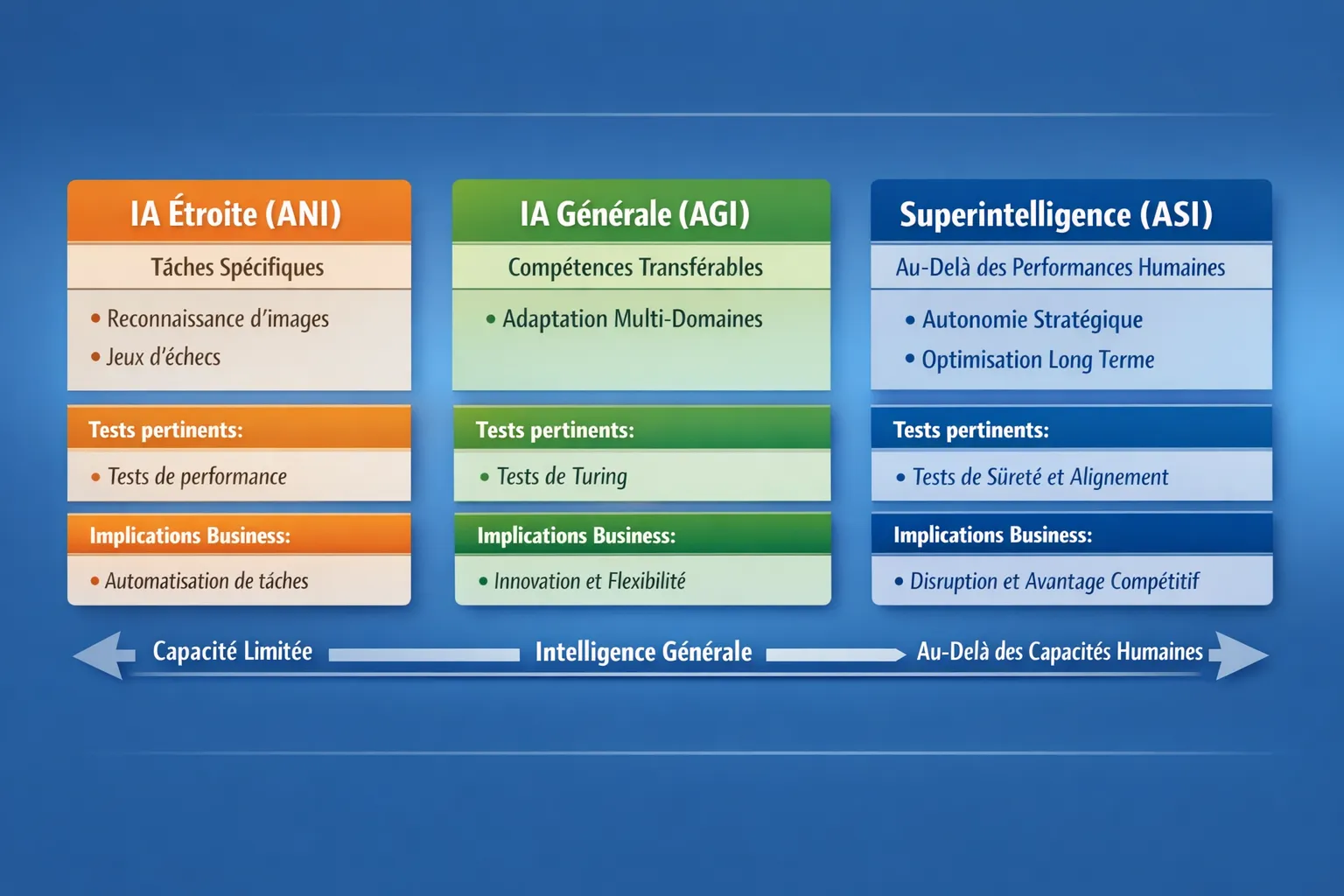
ASI AI, what exactly are we talking about?
Term
Synthetic Definition
Reasonable Test
Business Implications
ANI, Narrow AI
Systems performing well on a specific task
Dedicated benchmarks, A/B tests in production
Rapid ROI on targeted cases, productivity gains
AGI, General AI
Transferable skills, rapid learning of new tasks, robustness out-of-distribution
Solid performance on heterogeneous batteries, generalization, limited autonomy
Deeper automation of complex processes, strong organizational impacts
ASI, Superintelligence
Strategic and optimization capabilities lastingly surpassing humans in most relevant domains
Original scientific or technical results obtained autonomously and reproduced, reliable long-horizon planning
To contextualize the vocabulary, see our sheet on LLMs and approaches like RAG which improve precision without claiming general intelligence.
Conceptually, ASI popularized by Nick Bostrom refers to an artificial intelligence surpassing humans in most domains, which would be capable of rapid self-improvement and strategic optimization. It is a theoretical horizon, not an available technology.
Where do we really stand in 2026?
The most advanced models obtain excellent scores on certain academic benchmarks, for example, MMLU for multi-disciplinary general knowledge MMLU. But the correlation with robust and reliable general intelligence remains debated.
Other tests focused on "reasoning" and concept composition, like ARC-AGI ARC, remain difficult for current systems, a sign that abstract generalization is not "solved".
Chain autonomy, via agents capable of planning, calling tools, and executing long-horizon tasks, is progressing but remains fragile in real-world conditions, with silent errors and failure loops if guardrails are insufficient.
Pragmatic conclusion: on the 2026 horizon, there is no public and reproducible proof of ASI. Current systems are powerful but specific, and require framing, supervision, and instrumentation to create ROI.
The technical barriers holding back ASI
Out-of-distribution robustness and causality: models often generalize by correlations rather than by understanding underlying mechanisms.
Memory, tools, and long horizon: one must orchestrate context, access to knowledge bases, and actions spread out over time.
Alignment and interpretability: we still struggle to reliably explain why a model produced a given output, which complicates trust and compliance.
Energy cost and compute: gains follow "scaling laws" but run up against economic and infrastructure constraints Scaling laws, Chinchilla.
These limits do not forbid rapid progress, but they force companies to adopt an approach that is tooled, measured, and driven by value.
Myth or reality, how to decide operationally?
Rather than speculating on an arrival date for ASI, observe "verifiable" signals. Here is a useful grid for your investment committees.
Signal to follow
Why it matters
Where to look
Validated breakthroughs in scientific or technical autonomy
Proof that systems can explore, hypothesize, experiment, and discover reliably
Publications with independent replication, scientific competitions
Sustainable progress on composable generalization benchmarks
Reduction of test-specific overfitting, better robustness
Public dashboards, methodological reviews, meta-analyses
Major drop in inference and fine-tuning costs
Democratization of capabilities, new business models
Week 1 to 2, framing: align business objectives and constraints, choose 2 short-ROI use cases and 1 low-risk agentic AI bet.
Week 3 to 6, framed prototyping: set up connectors, RAG, guardrails, and metrics.
Week 7 to 10, pilot in real conditions: open to a user segment, collect feedback, and compare to starting indicators.
Week 11 to 12, decision: generalize what performs, park the rest, prepare for scaling and governance documentation.
If you are starting from scratch, this protocol is exactly what we implement in our audits and adoption sprints, with a weekly cadence, a client portal, and continuous involvement of your teams.
How to stay lucid regarding ASI without missing immediate value
Distinguish speculation from decision. Reserve ASI for scenario and monitoring discussions. Base your decisions on proofs, measurements, and prototypes.
Prepare for uncertainty. Your architecture must tolerate model swapping, scaling, and cost variation.
Diversify bets. Accumulate gains on well-mastered ANI and keep a pocket of exploration for agentic AI.
Stay aligned with regulation. The AI Act will structure adoption in Europe; anticipate rather than suffer.
In summary
To date, ASI is a useful concept for thinking about extreme risks and trajectories, not an operational reality.
Current systems, well-designed and well-governed, already generate considerable gains.
Winning companies are those that instrument, secure, and iterate, rather than those waiting for a magic disruption.
You want an independent look at your AI roadmap, to identify quick wins and frame agentic AI with concrete guardrails? Contact us for an audit or a prototyping sprint. At Impulse Lab, we combine opportunity audits, clean integrations, custom platforms, and training to transform AI into value, week after week.
Useful external resources to go deeper, without claiming exhaustiveness: