Autonomous Agents in the Enterprise: A Guide to Production Deployment
Intelligence artificielle
Stratégie IA
Gouvernance IA
Gestion des risques IA
Automatisation
An autonomous agent might impress in a demo but fail with real tools, sensitive data, and compliance constraints. Going into production isn't about "plugging in a better model," but **transforming a prototype into an operable system**.
An autonomous agent might impress in a demo and yet fail as soon as it has to act on real tools, with sensitive data, under cost and compliance constraints. Going into production therefore does not consist of "plugging in a better model," but rather transforming a prototype (often conversational) into an operable, measurable, auditable, and reversible system.
This guide is for SMEs, scale-ups, and teams structuring their stack. The goal is to give you a clear path to put autonomous agents into production without creating a new operational risk.
What "going into production" means for an agent
In an enterprise context, "in production" means the agent:
Runs in a controlled environment (identities, secrets, network, logs) and not on a personal browser.
Has a business owner and a clear decision-making process (when to let it act, when to validate, when to stop).
Is continuously evaluated (quality, costs, success rate) with alert thresholds.
Has a degraded mode (fallback, human escalation, "kill switch").
The classic trap: confusing "it answers well" with "it delivers a reliable result in a workflow."
Step 1: Choose a truly "agent-ready" use case
An agent is relevant when it needs to chain multiple steps and act on tools, not when a simple FAQ or RAG is enough.
The good signals
A use case is generally agent-ready if:
The request is frequent (multiple times a week minimum).
The result is defined and testable (observable success/failure).
The actions are reversible or controllable (draft, preview, validation).
The necessary data exists in a source of truth (CRM, helpdesk, knowledge base).
The bad signals (to avoid for a V1)
Vague objective ("optimize support") without metrics.
Too many exceptions, too many edge cases.
Irreversible actions from the start (cancellations, payments, deletions).
Dependency on unreliable information (unmaintained documents, obsolete procedures).
For a first production deployment, favor cases like: ticket triage, response preparation, CRM enrichment, draft quote generation, "soft" follow-ups, weekly reporting.
Step 2: Write the agent contract (1-page document)
The "agent contract" serves to align business, IT, and security, and to make the agent testable. It prevents scope creep like "we'll see as we go."
A good agent contract specifies:
Objective: expected result and scope.
Inputs: what information triggers the agent.
Authorized sources: documents, databases, APIs (and those forbidden).
Authorized actions: create a ticket, draft an email, modify a record, etc.
Level of autonomy: suggestion, execution with validation, automatic execution.
Failure criteria: when the agent must stop and escalate.
Traceability: what must be logged (decision, source, action, identity).
KPIs: 1 "North Star" KPI + 2 to 4 steering KPIs.
This document becomes the foundation for tests, guardrails, and the runbook.
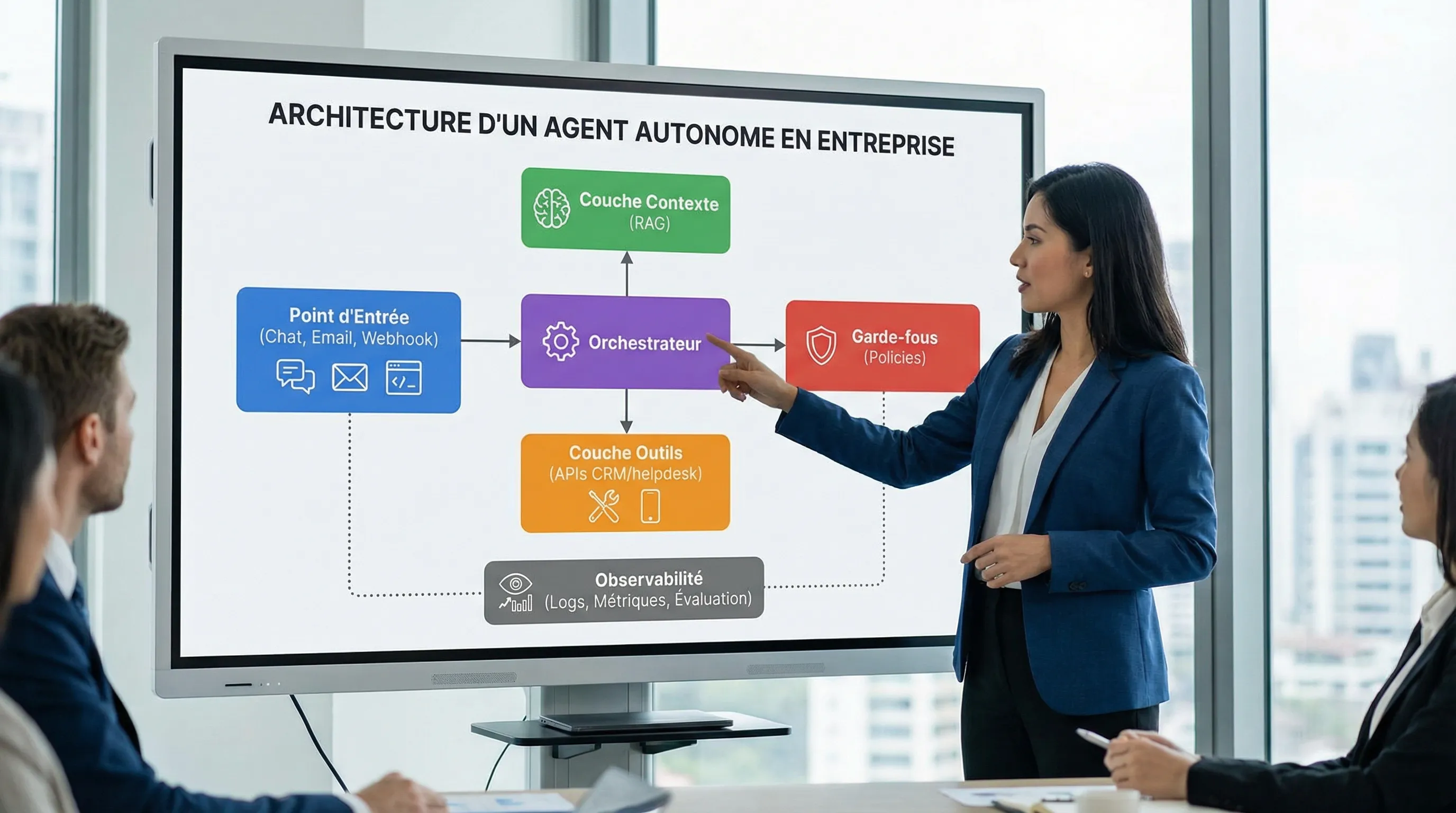
Step 3: Design a minimal "production-grade" architecture
An agent in production looks more like a small product than a conversation. You need a clear execution chain, access control, and an observability system.
Who can trigger the agent, and how to authenticate?
Orchestrator
Manages state, steps, retries, timeouts
Where does the state live, and how to replay cleanly?
Context (often RAG)
Connects the agent to a source of truth
Which sources, what freshness, which citations?
Tools layer
Tool-calling to internal/external APIs
What rights, which reversible actions?
Guardrails
Policies, validations, filters, limits
What is blocking, what is for "review"?
Observability
Logs, metrics, traces, continuous evaluation
What do we measure, and who is looking?
Two "production-first" decisions that change everything:
Idempotency: if the agent replays a step (timeout, retry), it must not create two tickets or send two emails.
Preview: at the beginning, prefer "draft + validation" over "direct send."
Integrations: avoid the Rube Goldberg machine
You don't need to connect 10 tools for a V1. A good rule of thumb: 1 source of truth + 1 action tool.
If you need to connect multiple tools, a standard like the Model Context Protocol (MCP) can reduce custom work, but you still have to handle security, rights, and logs.
Step 4: Security and compliance, treat the agent as a "power" user
An acting agent is an operational identity. You must therefore secure its access just as you would for a service account.
Key points:
Authentication and authorizations
Use robust authentication mechanisms and limit permissions (principle of least privilege).
Separate roles: read (context) vs. write (actions).
Avoid shared keys and manage secrets via a vault.
Logging and audit
Log: request, consulted sources, decision, actions, requesting user, and IDs of modified objects.
Define a GDPR-compliant log retention policy.
GDPR, AI Act, and risk management
Depending on your use case, you may need to conduct an impact assessment (DPIA) and document your risk management.
HITL, policies, monitoring, ROI measurement, feedback
Achievable KPIs, risks under control
Progressive production (1 to 2 weeks)
Runbook, SLOs, degraded modes, light governance
Go to expand the scope or stop
The key point: you must be able to say "we cut it" if the V1 does not reach the KPIs or if costs explode. This is a sign of maturity, not a failure.
When to get help
You will save a lot of time (and avoid invisible debt) if you seek a partner when:
you have multiple data sources, but no clear "source of truth,"
you need to connect the agent to critical tools (CRM, billing, helpdesk),
compliance and security are non-negotiable,
you want a V1 in production with measurement and a runbook, not a demo.
Impulse Lab supports this type of transition to production through opportunity audits, custom development, integrations with your tools, and adoption training. If you want to scope an "agent-ready" agent and deliver a V1 in short cycles, you can start with a chat on impulselab.ai.