A B2B sales funnel doesn't need 12 steps, 4 tools, and 30 KPIs to be manageable. Instead, it needs a shared minimal model (marketing, sales, management) and a few non-negotiable metrics to answer 3 very concrete questions.
April 06, 2026·8 min read
A B2B sales funnel doesn't need 12 steps, 4 tools, and 30 KPIs to be manageable. Instead, it needs a shared minimal model (marketing, sales, management) and a few non-negotiable metrics to answer 3 very concrete questions:
Are we attracting the right companies?
Where are we losing opportunities in the process?
Is the pipeline sufficient to hit the quarterly target?
In this article, we propose a minimal B2B sales funnel (ready to copy) and the essential KPIs to track to gain clarity, velocity, and predictability.
Why a "minimal" model works better in B2B
In B2B, complexity rarely comes from the funnel itself. Rather, it comes from the reality on the ground: multiple decision-makers, longer cycles, multiple channels, and a mandatory passage through tools (CRM, calendar, emailing, tracking) that must remain consistent.
An overly detailed funnel creates two perverse effects:
No one updates it (statuses no longer reflect reality).
KPIs become debatable (more time is spent debating definitions than optimizing).
A minimal model aims for the opposite: few steps, but well-instrumented, with clear conversion points.
Note: For several years, Gartner has emphasized the importance of the "buying group" (multiple stakeholders) in B2B purchases. This reinforces the need for a simple funnel, based on observable events (meeting held, opportunity created, quote sent), rather than subjective micro-statuses. (See Gartner's resources on the B2B buying journey: Gartner).
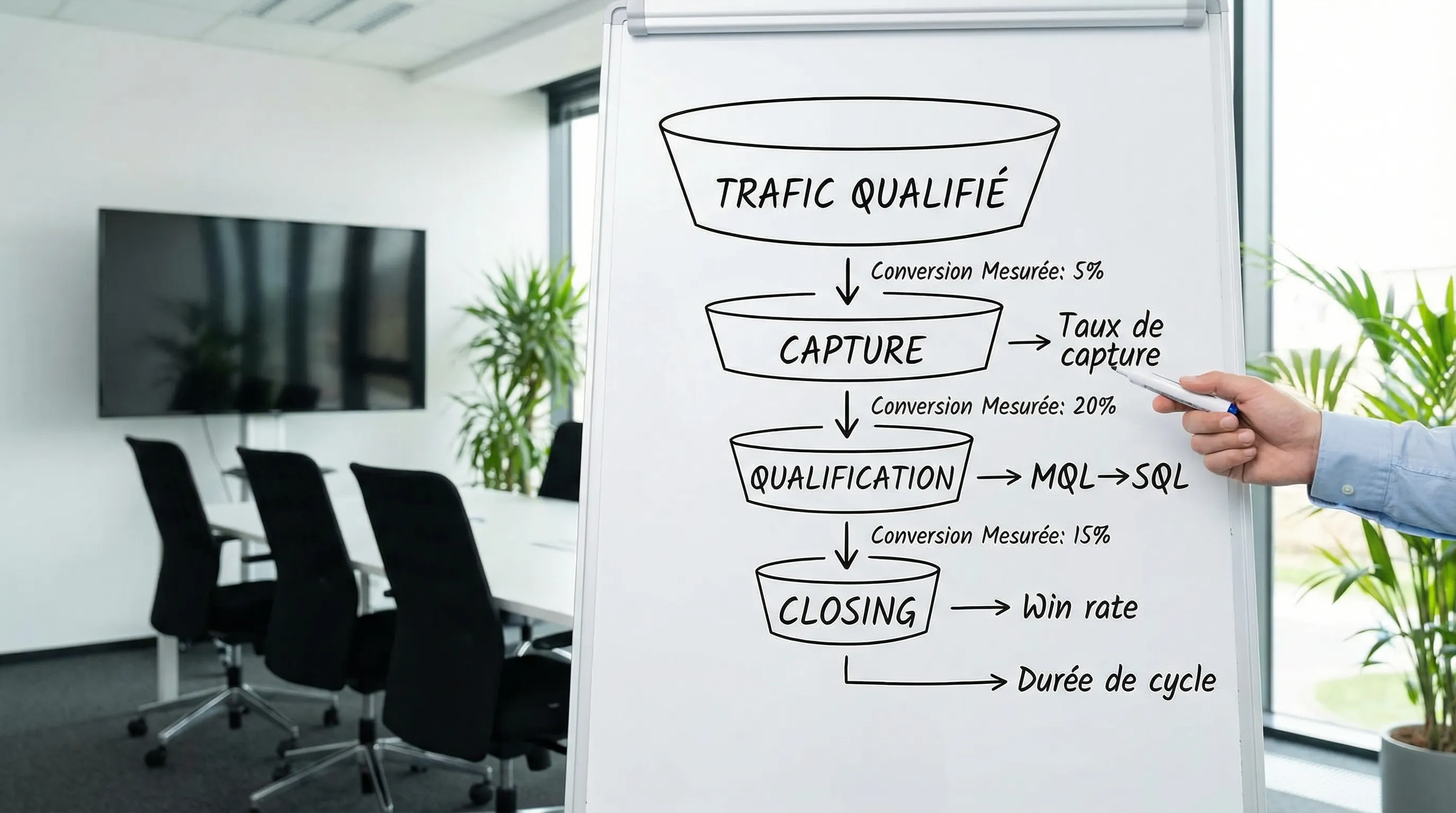
B2B sales funnel: the minimal 4-step model
This model is intentionally compact. It separates what is measurable (events) from what is useful but secondary (nurturing details, micro-segments, overly granular marketing "stages").
The 4 steps
Step
Objective
Measured event (conversion)
Expected output
1. Qualified traffic
Attract companies close to the ICP
Qualified visit (source, page, intent)
Actionable audience
2. Capture
Turn anonymous visitors into contacts
Form submit, demo request, signup, inbound
Identified lead
3. Qualification
Decide if Sales should invest time
Lead becomes SQL (or qualified meeting)
Meeting held or opportunity
4. Closing
Turn the opportunity into revenue
Deal won (or lost)
Signed revenue + learnings
If you already use MQL/SQL concepts, keep them, but do not multiply statuses. The key is that everyone knows exactly what an MQL and an SQL are, and how a lead moves from one to the other.
Where does nurturing fit in?
Nurturing is not a step; it's a mechanism that helps move a lead forward between Capture and Qualification.
In practice, you manage it with engagement KPIs (response rate, click rate, webinar attendance, reply after follow-up), but your minimal funnel remains clear.
KPIs to track (without drowning): 3 levels of management
For a B2B sales funnel, it is useful to classify KPIs into 3 categories:
Conversion (where is the bottleneck?)
Velocity (how fast is it moving?)
Value and predictability (is it enough to hit the target?)
1) Conversion KPIs (the ones that reveal leaks)
KPI
Formula
Why it's critical
Common mistake
Capture rate
Leads / Qualified visits
Measures the ability to turn traffic into demand
Counting all visits, not just "ICP" ones
MQL rate
MQL / Leads
Measures the quality of capture and targeting
MQL defined too loosely (artificial volume)
MQL → SQL
SQL / MQL
Measures marketing-sales alignment
Vague handoff, no SLA
Meeting held rate
Meetings held / Meetings booked
Measures the strength of qualification and follow-up
Failing to distinguish "booked" vs "held"
Win rate
Deals won / Deals created
Summarizes sales efficiency
Mixing SMB, mid-market, and atypical deals
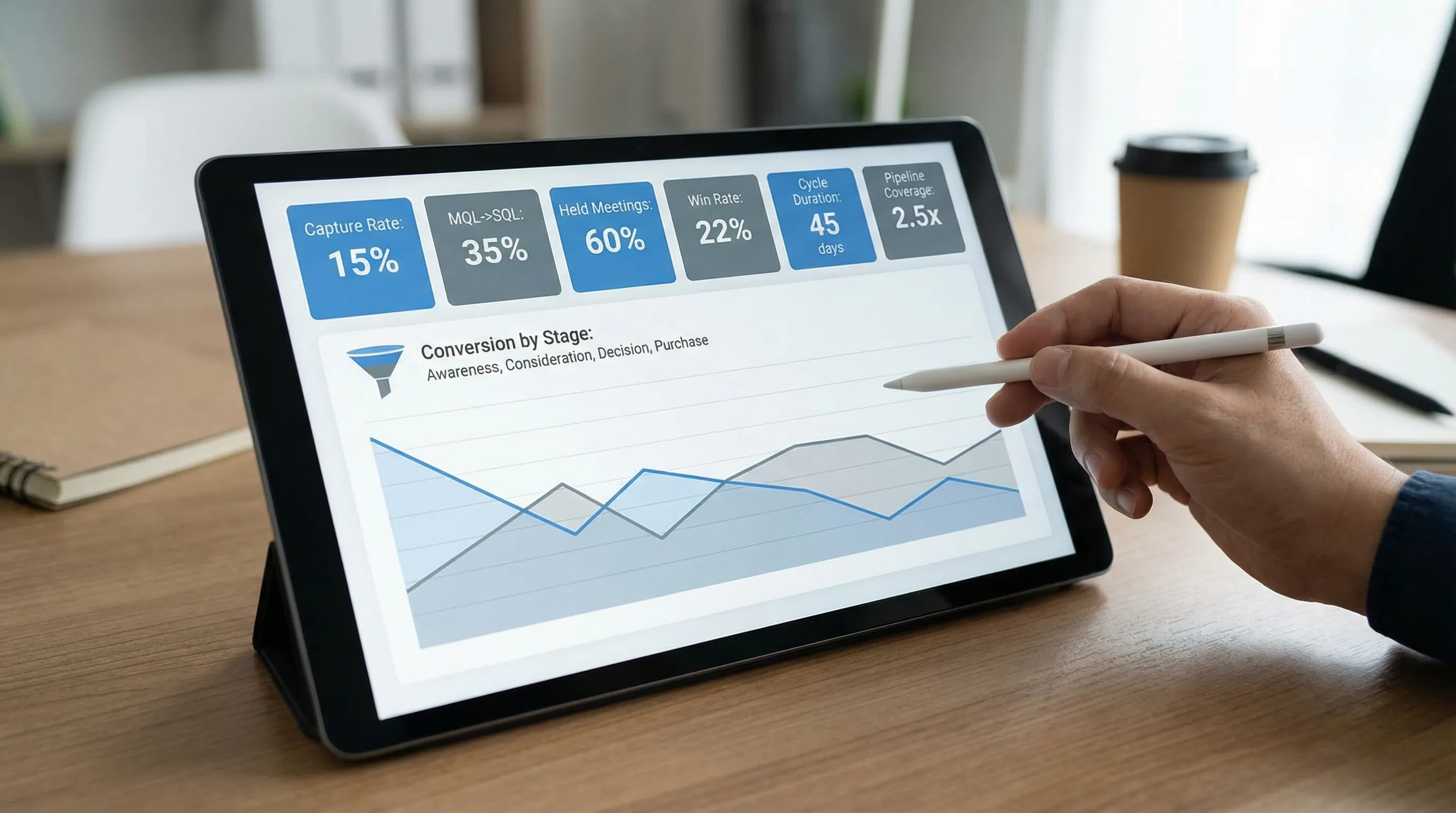
If you only have one day to "straighten out" your tracking, start with: capture rate, MQL→SQL, meetings held, win rate.
2) Velocity KPIs (the ones that impact cash flow)
Conversion isn't enough. Two funnels can convert at the same rate, but one takes 20 days to close and the other 90 days.
KPI
Formula
Use case
Warning signal
Sales cycle length
Close date - SQL date (or opp created)
Forecasting, staffing, cash flow
Huge variance among sales reps
Time-to-first-response
1st reply - inbound request
Improves meetings held and win rate
Response > 24h on warm leads
Pipeline velocity
(Number of opps x Win rate x ACV) / Cycle length
Summary metric for prioritization
Calculation based on unreliable CRM data
Operational tip: "velocity" is often gained through process rules (SLAs, follow-ups, sequences, checklists), rather than through a new channel.
3) Value and predictability KPIs (the ones that reassure management)
The issue that causes 80% of dashboards to fail: vague definitions
Two companies can track the "same KPIs" and reach opposite decisions, simply because:
"Lead" doesn't mean the same thing.
"SQL" is sometimes a booked meeting, sometimes a held meeting.
An "opportunity" is created too early (as soon as a form is submitted), which destroys the win rate.
Recommended minimal definitions
Lead: identified contact + way to recontact + source.
MQL: lead meeting a minimum level of fit/intent (document it, even if it's simple). See also: Lead scoring.
SQL: lead validated by sales as "workable" (explicit qualification criteria). See: SQL.
Meeting held: calendar event actually completed (not just "booked").
Opportunity: a deal with a dated next step, an estimated amount, and an owner.
If you have to choose just one RevOps discipline to implement, it's this one: an internal glossary + entry and exit rules per step. (Resource: RevOps).
Minimal instrumentation: what you absolutely must capture in your CRM
A B2B sales funnel becomes manageable when it is linked to clean data, usually in a CRM.
Here is the minimal foundation (no need for a 3-month project):
A source field (at a minimum: inbound, outbound, partners, events, ads).
UTM fields if you do digital marketing.
Timestamps (lead creation date, MQL date, SQL date, opp date, close date).
A Meeting booked vs Meeting held status.
For each deal: estimated amount, probability (if you use weighted pipelines), target close date, closed-lost reason.
The goal isn't perfection, it's consistency. A well-instrumented minimal model almost always beats a poorly documented complex model.
Recommended management cadence (weekly and monthly)
Without a ritual, a dashboard becomes decorative. Here is a simple cadence, suitable for SMBs and scale-ups.
Ritual
Duration
KPIs reviewed
Expected decisions
Weekly pipeline review
30-45 min
Meetings held, opps created, next steps, velocity
Prioritize follow-ups, unblock deals
Monthly funnel review
60-90 min
Conversions per step, cycle length, win rate, coverage
Correct targeting, entry offer, process
At this stage, you don't need "more analytics". You need a decision system.
Automation and AI: where it truly helps, without breaking measurement
Once the minimal funnel is instrumented, automation can accelerate velocity and improve quality, especially on:
Enrichment (ICP, size, industry, tech stack) and CRM cleanup.
Routing and assignment (the right sales rep, at the right time).
Call summaries and automatic task creation in the CRM.
More relevant nurturing (content and follow-ups based on signals).
What is the best B2B sales funnel? The best one is the one your teams actually use and that you can measure. A minimal 4-step model (Qualified traffic, Capture, Qualification, Closing) is sufficient for most SMBs and scale-ups.
Which KPIs should be prioritized in a B2B sales funnel? As a priority: capture rate, MQL rate, MQL→SQL conversion, meetings held rate, win rate, cycle length, pipeline coverage.
What is the difference between a funnel and a pipeline in B2B? The funnel describes the overall progression (anonymous → customer). The pipeline describes ongoing opportunities on the sales side (deal stages, next steps, forecast).
How do you define an SQL without creating marketing-sales friction? Document 3 to 5 simple criteria (fit + intent + timing) and formalize a clear handoff. The definition should be stable over a quarter, then adjusted.
Is a CRM absolutely necessary to manage a B2B funnel? From the moment you want predictability and a growing team, yes. The CRM becomes the source of truth for statuses, timestamps, and amounts.
Need a truly manageable (and cleanly automated) B2B funnel?
Impulse Lab helps SMBs and scale-ups that want to structure their B2B sales funnel with solid foundations: shared definitions, CRM instrumentation, automations, and integrations with your existing tools, followed by rapid iterations (weekly delivery) to improve conversion and velocity.
If you want a quick diagnosis of leak points and automation opportunities, you can discover the agency at Impulse Lab.