Yes, robotic intelligence can help a small warehouse, especially when teams spend a lot of time moving goods or repeating simple checks. But buying a robot solves neither inaccurate inventory nor disorganized picking. For an SME, the key is identifying genuinely avoidable physical work.
Yes, robotic intelligence can help a small warehouse, especially when teams spend a lot of time moving goods or repeating simple checks. But buying a robot solves neither inaccurate inventory nor disorganized order picking. For an SME, the right question is to identify genuinely avoidable physical work, and then verify whether automating it remains cost-effective under the facility's specific conditions.
A warehouse of a few hundred square meters may have a repetitive workflow that is worth automating. Conversely, a larger facility may have no pathway stable enough to justify equipment. Task consistency, traffic constraints, and volumes matter more than floor area alone.
Before comparing machines, three solutions must be distinguished: improving organization, automating data exchange between software systems, or delegating a physical task to a robot. They do not address the same problem.
What Robotic Intelligence Really Delivers
Robotics enables a machine to act in the physical world: transporting a tote, grasping an item, or moving a pallet. Artificial intelligence can provide it with perception and adaptation capabilities, such as recognizing a parcel despite variations in orientation.
An automated robot does not necessarily use AI. Equipment that follows a programmed trajectory can operate using deterministic rules. Even autonomous navigation alone does not prove the presence of machine learning.
Historically, robotic installations primarily developed around repetitive tasks in structured environments. Advances in sensors, embedded computing, and perception software then expanded the accessible scenarios. This does not mean a robot knows how to improvise when faced with any unexpected event.
In a warehouse, three functions must be examined separately: perceiving the environment, deciding on an action, and executing it. Ask the vendor which one actually uses AI, with what limitations, and how it responds when an object or obstacle is not recognized.
Which Equipment for Which Task?
Robotic intelligence is not a single hardware category. The choice depends on the movement or action required, the loads handled, and the working environment.
Solution
Feasible Use
Point of Caution
Automated Guided Vehicle (AGV)
Transport along defined paths
Adaptation required if workflows change
Autonomous Mobile Robot (AMR)
Transporting totes or carts between zones
Traffic, obstacles, and floor quality
Robotic arm
Picking, placing, or palletizing
Object variability and gripper selection
Collaborative robot (cobot)
Assisting with a handling operation
Safety of the complete application
Camera with computer vision
Visual inspection or recognition
Lighting, occlusions, and item diversity
An AMR can transport a tote without being able to pick the items inside it. An arm capable of gripping a rigid box is not necessarily suitable for flexible pouches. Therefore, the demonstration must focus on your containers and goods, not just the vendor's.
The word "collaborative" also calls for caution: it does not guarantee that an arm can operate without guarding in every configuration. The payload, tooling, and motion can create hazards independently of the robot itself.
Identifying Useful Use Cases in a Small Warehouse
For an SME, robotic intelligence is best explored on a frequent, measurable, and low-variability workflow. Internal transport is often a simpler starting point to evaluate than picking highly diverse items.
Imagine order pickers who regularly leave their zone to drop off totes at packaging. A transport robot could handle some of these trips. The targeted benefit would then be reducing walking time and interruptions, without claiming to automate the entire picking process.
Another possibility: visual inspection at a fixed workstation. A camera can help verify the presence of a visible component before closing a package. However, it does not guarantee the complete conformity of an order if SKUs are hidden or visually identical.
Conversely, automating transport provides little value if parcels subsequently wait for administrative approval. Our analysis of why AI does not always reduce lead times shows why it is essential to examine the entire workflow rather than an isolated task.
Start by observing several representative days: walking time, queues, errors, and manual re-work. The most relevant initial investment may simply be better item slotting or automated data exchange between software systems.
Verifying Prerequisites Before Contacting Vendors
A robotic intelligence project depends as much on real-world facility conditions as on advertised performance. Measure clear aisle widths, doorways, thresholds, and areas where pedestrians and mobile machinery cross paths.
Also observe operational fluctuations. An aisle that is clear during a demonstration may be obstructed during receiving. Overhanging pallets, plastic wrap on the floor, and temporarily staged goods must be included in evaluation scenarios.
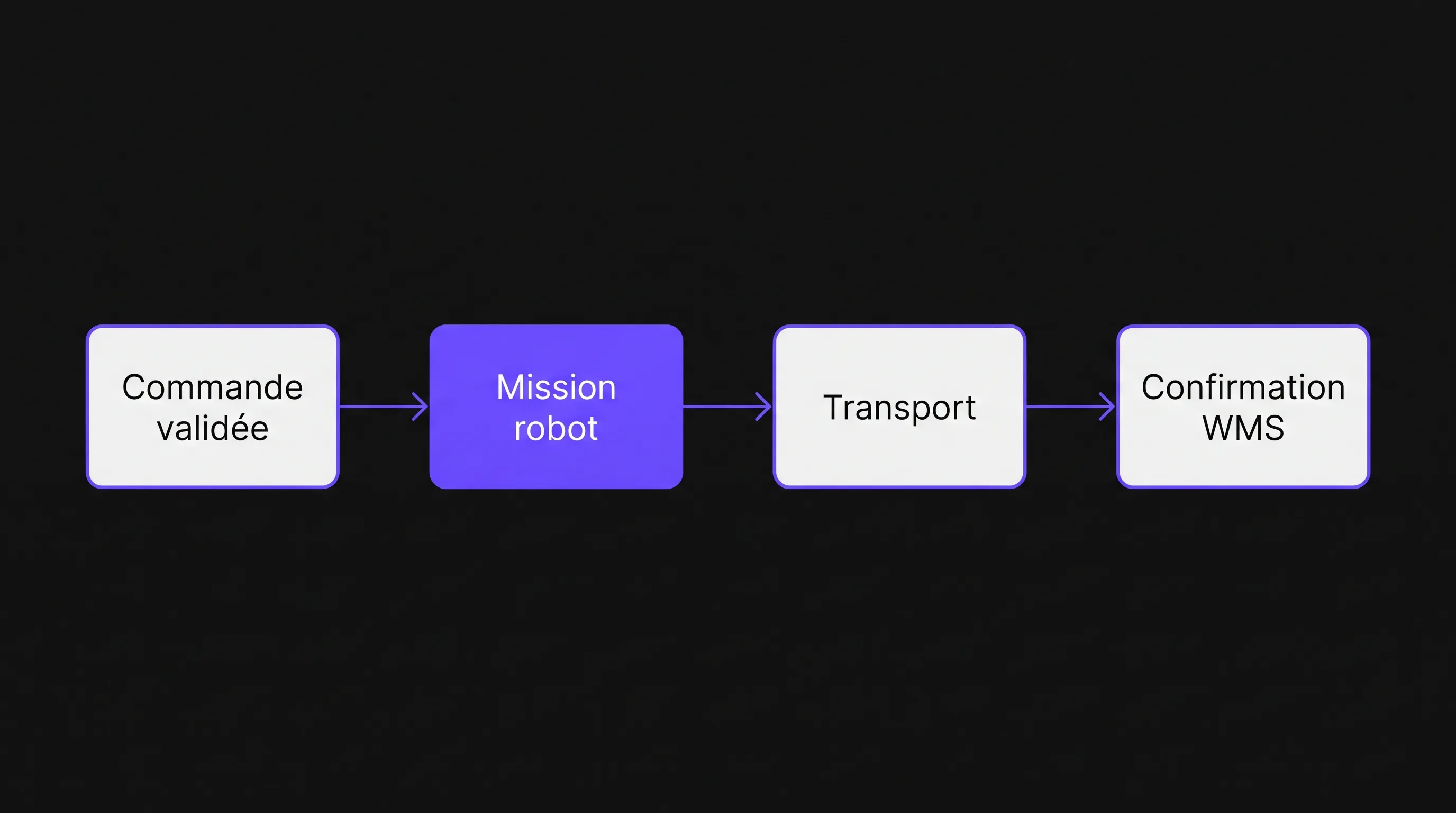
On the data side, bin locations and identifiers must be reliable. The Warehouse Management System (WMS) and Enterprise Resource Planning (ERP) software must be able to dispatch an actionable mission and receive its completion status. Without this integration, operators risk replacing walking with manual data entry.
Reliability of access, equipment, and network connectivity is also a prerequisite, as in any project aiming to modernize IT infrastructure with AI.
Finally, appoint an operational lead. Someone must be empowered to arbitrate route changes, monitor incidents, and keep procedures up to date. In a small team, this workload should not become an invisible responsibility tacked onto the warehouse manager's daily duties.
Calculating Total Cost, Not Just the Robot
The ROI of robotic intelligence is calculated based on total cost of ownership (TCO). Hardware represents only a fraction: integration, site preparation, maintenance, training, and incident handling must all be factored into the equation.
Here is a purely illustrative scenario, not a formal quote: a lease with maintenance at €1,500 per month, €300 in monthly operating costs, and €9,000 in integration spread over 36 months. The monthly economic cost then reaches €2,050.
With an hourly labor rate valued at €30, roughly 69 productive hours per month would need to be freed up to cover this cost through recovered labor capacity alone. Across 22 working days, that equates to just over three hours per day.
Freed-up time is not automatically cash savings. If headcount and scheduled hours remain unchanged, the gain may materialize as added throughput capacity, reduced overtime, or improved working conditions. This distinction must be made explicit rather than treating every saved minute as an immediate expense reduction.
Next, test a conservative scenario: lower volumes, reduced availability, and more frequent human intervention. Also check commitment terms, modification fees, and exit conditions. A business case that only works during seasonal peaks is not enough to justify an annual commitment.
Choosing Between On-Premises Computing and Cloud Dependency
Robotic intelligence can rely on onboard compute, remote cloud services, or a hybrid approach. This architectural choice affects operation during network outages, data privacy, and maintenance requirements.
Local processing can limit network dependency for certain functions. However, it introduces constraints regarding compute power, software updates, and edge hardware management. The cloud can facilitate centralized processing, but introduces a dependency on connectivity and third-party service uptime.
Ask for a clear answer to this question: what happens if Wi-Fi or the remote service becomes unavailable? Depending on the design, the robot may finish an authorized action, wait, or halt immediately. This behavior must be planned and tested, not discovered during live operations.
Safety functions must be designed and validated for their intended use, independent of AI performance claims. Also specify which images or data leave the site, their retention period, and who is authorized to access them.
Managing Safety and Responsibilities
Deployment begins with a risk assessment of the actual installation. It must address collisions, crushing hazards, falling loads, battery charging, and interactions with other industrial vehicles. Degraded operating conditions matter just as much as normal operation.
Resources from INRS on machinery risks provide a solid starting point for structuring this approach. A CE marking on a piece of equipment does not eliminate the need to evaluate the hazards created by its integration into the warehouse.
The presence of robotic intelligence does not automatically transfer liability to the vendor. Manufacturers, integrators, and employers each have distinct obligations based on their role. The contract must clarify who installs, validates, maintains, and authorizes modifications, without overriding each party's legal responsibilities.
As of publication date, the European regulatory framework is also in transition: the EU Machinery Regulation 2023/1230 will largely apply starting January 20, 2027. For projects delivered around that timeframe, have the applicable regulatory regime verified by the vendor and a qualified compliance expert.
On the floor, establish a manual override procedure, emergency stop protocols, and trained personnel. Freeing a stranded robot should never rely on improvisation between two urgent orders.
Testing a Single Workflow Before Scaling Up
A valuable pilot focuses on a tightly defined scope: one origin, one destination, and known payloads. Avoid simultaneously testing transport, picking, and a revised inventory layout, as the results will become difficult to interpret.
Measure a baseline before installation. It must capture normal operational swings, not just an average that masks congestion peaks. Then compare conditions that are similar enough to distinguish real gains from simple volume shifts.
To evaluate robotic intelligence, track a few key operational indicators:
Human time actually dedicated to the workflow, including robot assistance.
The percentage of missions completed without intervention.
Lead time between transport request and tote availability.
Recorded incidents, near-misses, and unexpected stops.
Include exception tests agreed upon with the integrator: blocked destination, missing load, or lost connection. These tests should be conducted safely without creating hazardous situations.
Finally, define acceptance criteria prior to the pilot, including measurement methods and next steps if performance falls short. A successful vendor demo is not the same as production validation. Scaling up is only justified if the workflow also runs smoothly during peak periods and remains intuitive for staff.
What May Improve, Without Justifying Waiting for a Silver Bullet
Advancements in computer vision, gripping technologies, and automated planning will expand reachable tasks. But a capability demonstrated on a few items does not guarantee support for an entire product catalog.
For a small warehouse, the future viability of robotic intelligence will also hinge on less visible factors: ease of integration, maintenance responsiveness, and the ability to modify paths without extensive engineering.
A conversational AI assistant might make it easier to query system status or submit a request. That alone does not justify granting it direct, unsupervised control over physical actions. Permissions, validations, and physical safety interlocks remain essential.
Therefore, invest in proven performance on your current workflow rather than promises of future versatility. Also ask how to extract your data and switch providers if your needs evolve.
Frequently Asked Questions
Should a small warehouse start with a mobile robot? No. If the root cause stems from poorly routed orders, inaccurate bin locations, or inefficient layout, organizational or software improvements will deliver higher returns. Robots become relevant when physical movement remains a major time drain after these operational issues are resolved.
Does it take high order volume to make robotic intelligence cost-effective? There is no universal threshold. Trip frequency, travel time, load consistency, and the total system cost matter far more than raw order counts. Two warehouses processing identical volumes can have drastically different automation needs.
Can you deploy a robot without a WMS? It is possible for certain simple use cases, such as manually triggered transport between two workstations. However, prioritizing missions, confirming deliveries, and managing exceptions still need to be handled. As volume grows, integration with existing software tools becomes essential.
Does the robot replace a job? Not necessarily. It typically absorbs specific tasks within a role, while operators continue handling picking, inspection, and exception management. Financial calculations must distinguish between reclaimed labor capacity, improved ergonomics, and realized cash savings.
Starting by Qualifying the Need
Before consulting hardware vendors, document a workflow, measure its current cost, and identify what belongs to software automation versus physical transport.