Can You Trust Artificial Intelligence with Your Math Calculations?
Intelligence artificielle
Stratégie IA
Outils IA
Validation IA
Audit IA
Can you trust AI with math calculations? Yes, provided you distinguish suggested reasoning from actual computation. Discover how to inspect, verify, and ground AI-driven calculations into reliable business decisions.
October 16, 2026·9 min read
Searching for "AI math" leads to tools capable of explaining equations, generating Excel formulas, or analyzing spreadsheets. Can you trust them with calculations? Yes, provided you distinguish the proposed reasoning from the calculation actually executed. When verifying a margin, preparing a quote, or building a forecast, a convincing answer is not enough.
The challenge is therefore not deciding whether AI is "good at math" in absolute terms. You need to know which tool it uses, what data it receives, and how to verify its output. Here is how to benefit from its assistance without turning a calculation error into a business decision.
Why a Well-Explained Answer Can Still Be Wrong
A language model generates text based on the provided context. It can leverage reasoning capabilities, suggest a relevant method, and yet make a mistake in a multiplication, a sign, or an underlying assumption.
The difficulty also lies in presentation: a smooth step-by-step demonstration easily gives an impression of reliability. Yet a correctly written formula may answer the wrong question. For instance, calculating a percentage on the purchase price rather than the selling price produces two different metrics—not two interchangeable versions of the same result.
Some assistants can, however, call a computation engine or run code. Their operation is then no longer limited to generating a text response. In its documentation on data analysis with ChatGPT, OpenAI notably describes using Python for certain analyses.
The decisive point is knowing what was actually executed. An assistant that displays code hasn't necessarily run it. And a program executed without errors can still apply the wrong formula.
AI for Math: Which Tool to Choose Based on Your Needs?
To choose the right tool, start from the expected outcome: understanding a method, obtaining a numerical value, manipulating an expression, or exploring data. These needs do not all call for the same tool.
Need
Appropriate Tool
Required Verification
Understanding an equation or formula
Conversational assistant
Verify the steps and conditions of application
Calculating an invoice or margin
Spreadsheet or program applying explicit rules
Verify data, formulas, and rounding
Symbolically solving an equation, differentiating, or integrating
Symbolic computation engine
Verify the domain of definition and assumptions
Analyzing a data file
Assistant connected to an execution environment
Examine the processing performed and intermediate results
Building a forecast
Appropriate statistical model
Test predictive quality on out-of-sample data
For symbolic computation, a library like SymPy allows you to manipulate mathematical expressions in Python. It does not replace an understanding of the problem: a solution may depend on an assumption regarding permissible numbers or parameter values.
A Concrete Example: Checking the Profitability of a Sale
The value of AI in math becomes clearer with a concrete numerical case. Consider a fictional example: a company sells 100 units at €200 excluding tax (VAT), incurs €150 in variable costs per unit, and must cover €3,000 in fixed costs over the period.
We assume here that all units are sold and that fixed costs do not vary with volume. The result is simplified, before taxes and excluding any other potential expenses.
Indicator
Calculation
Result
Revenue (excl. tax)
100 × €200
€20,000
Contribution margin
100 × (€200 − €150)
€5,000
Simplified operating income
€5,000 − €3,000
€2,000
Break-even volume
€3,000 ÷ (€200 − €150)
60 units
The assistant can explain the formulas, build the table, and simulate a discount. But verification uncovers the critical information needed for decision-making: with a 10% discount, the price drops to €180 excl. tax. Assuming volume and costs remain unchanged, the contribution margin drops to €3,000 and the simplified income falls to zero.
A 10% price cut completely wipes out the estimated profit here. This is not a general rule, but the consequence of the assumptions in this example. An answer that merely stated "revenue decreases by 10%" would be accurate, yet insufficient for decision-making.
Four Checks Before Reusing a Result
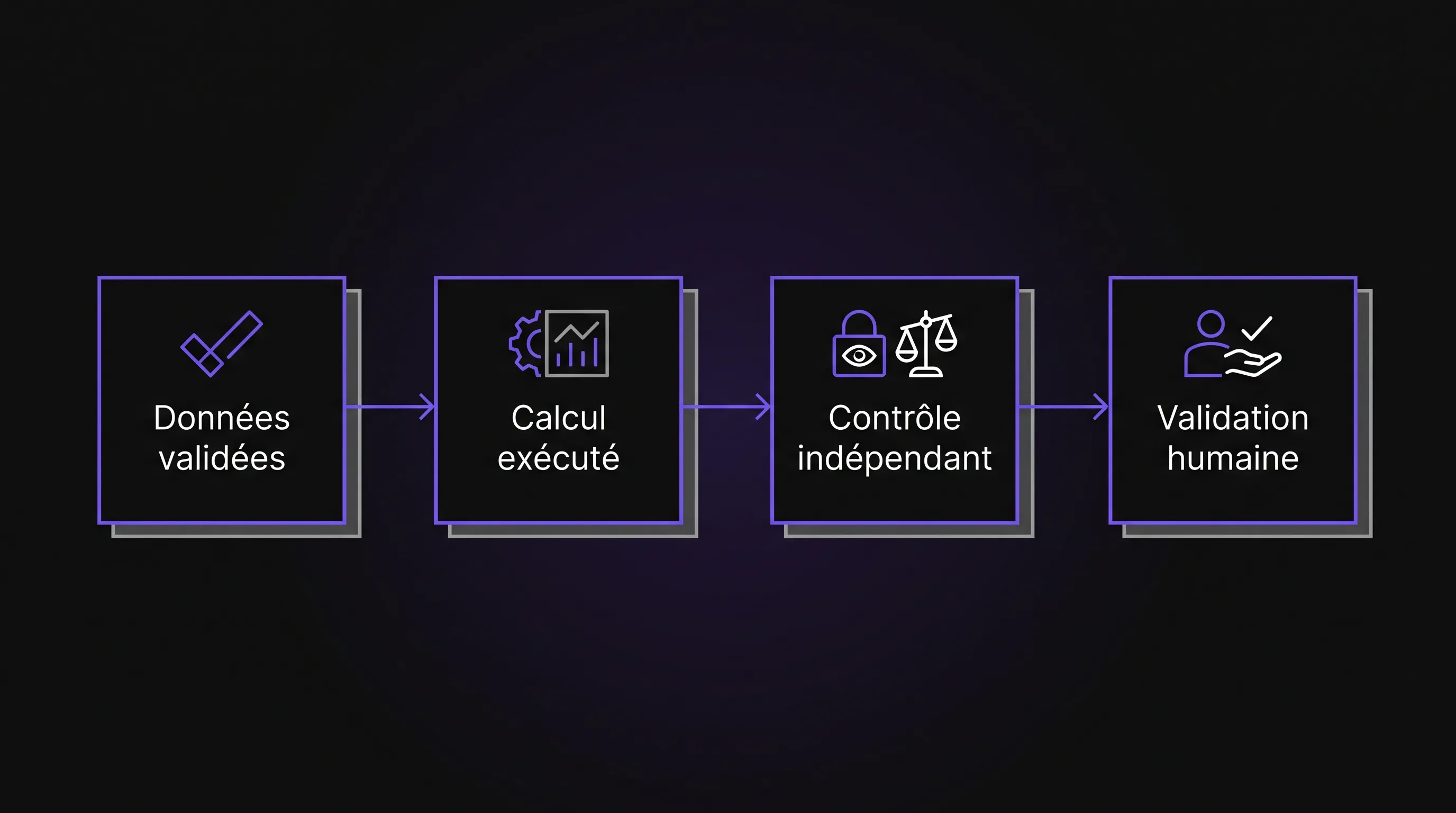
A solid procedure should make it possible to trace input data, applied rules, and proof of verification. It can remain lightweight for an ad-hoc estimate and become more formal for recurring calculations.
1. Define Data and Conventions
Specify units, time periods, currency, and tax handling. A monthly figure cannot be directly compared to an annual one. Data expressed in thousands of euros might be correctly read but incorrectly applied.
With AI in math, domain ambiguities matter just as much as arithmetic operations. A "30% margin" can mean a markup on cost or a percentage of the selling price. Therefore, write the expected formula explicitly rather than letting the tool decide.
For files, also specify how to handle missing values, duplicates, and negative amounts. A blank cell does not necessarily mean zero.
2. Identify the Engine Performing the Calculation
Check whether the result comes from a text response, a spreadsheet formula, a symbolic engine, or executed code. If the tool does not allow you to verify this, consider the calculation unverified.
For recurring use, keep the validated formula or script rather than asking for a fresh interpretation of the problem every month. This makes the rules easier to test and maintain.
However, deterministic calculation does not guarantee everything is correct. Floating-point numbers, currency conversions, and rounding rules require careful attention. For financial amounts, specifically define whether rounding occurs on each line item or only on the total.
3. Verify Through an Independent Method
The most effective check is not asking the same assistant three times. Instead, take a small sample in a spreadsheet or calculator, then verify a simple relationship: do subtotals match the total? Do percentages use the right denominator?
To make AI math reliable, also test boundary cases: zero quantity, negative values, division by zero, or missing data. A solved equation can be verified by substituting the proposed solution back into the unknown variable.
Order of magnitude serves as another sanity check. If a discount increases the amount payable, a rule or a sign definitely warrants review.
4. Adapt Validation to the Impact of an Error
An exploratory estimate can tolerate a quick check. A calculation intended for payroll, tax reporting, contracts, or equipment sizing requires rigorous validation by a qualified professional.
Define who approves the result and which artifacts to keep: input data used, formulas, program versions, and processing timestamps. In an automated workflow, also plan what should halt processing and trigger human review.
The confidence level displayed by an assistant does not replace any of these safeguards. It is not a verified measure of calculation accuracy.
A Useful Prompt to Get a Verifiable Result
A precise prompt reduces ambiguity. It does not guarantee a correct answer, but it makes verification much easier. Using the previous example, you could write:
Analyze the profitability of 100 units sold at €200 excl. VAT, with a variable cost of €150 per unit and €3,000 in fixed costs over the period. Do not add any missing data without flagging it. State all assumptions, formulas, and intermediate results. Indicate whether you actually executed a calculation tool. Then calculate the effect of a 10% discount, keeping volume and costs unchanged. Provide a spreadsheet formula to verify each result.
The real value of AI in math here lies in its ability to structure the problem and make the calculation inspectable. Simply asking to "check carefully" is far less effective than requiring explicit formulas, units, and assumptions.
Do not confuse transparency with verbosity either: multiple pages of explanations can easily hide an error. A compact table with verifiable intermediate results is often far more actionable.
Before Automating: Protect Data and Test the Process
A margin calculation can expose supplier pricing. A payroll spreadsheet contains personal data. Before transferring any data to an AI service, check processing terms, access controls, and your company's internal policies. For initial experimentation, use synthetic or properly anonymized data.
Automation must then be tested on benchmarks with known outcomes. Include typical situations alongside edge cases, then compare outputs to expected values. Also measure the time required to correct errors: an apparent time-saver can vanish if verification becomes overly cumbersome.
Before choosing and integrating an artificial intelligence solution, identify what truly requires a model. To apply a stable formula weekly, a well-designed spreadsheet or an audited script may suffice. AI remains valuable for interpreting requests or explaining discrepancies.
Frequently Asked Questions
Can ChatGPT do math? Yes. It can explain concepts, suggest problem-solving steps, and, depending on the available tools, execute calculations. However, its accuracy depends on the specific problem and the runtime environment. For critical results, verify the data, methodology, and execution rather than trusting the phrasing of the response.
Can you solve a math problem from a photo? Some assistants can interpret an image and propose a solution. First, you must verify the OCR/transcription of the problem statement—especially exponents, fractions, and signs. A single misread character invalidates everything that follows, even if the subsequent operations are mathematically correct.
Are there free tools for mathematical calculations? Yes, particularly open-source software like SymPy for symbolic math. Free tiers of commercial assistants may come with varying limitations. Choose based on the required operation and verification capabilities, rather than just free access.
What math problem has an AI already solved? In 2024, DeepMind unveiled AlphaProof and AlphaGeometry 2, which jointly solved four out of six problems from that year's International Mathematical Olympiad, achieving a silver-medal equivalent score. This breakthrough was achieved by specialized research systems. It does not guarantee the reliability of a general-purpose assistant on an accounting spreadsheet.
Making Your First Use Case Reliable with Impulse Lab
For an SME or growing business, the ideal starting point is a recurring calculation with identifiable rules and verifiable results: quote reviews, margin tracking, or reporting preparation.
Impulse Lab supports businesses with AI opportunity audits, custom developments, integration with existing tools, and team training. The goal is not to replace every formula with AI, but to build a workflow where data, calculations, and validations remain fully controlled.