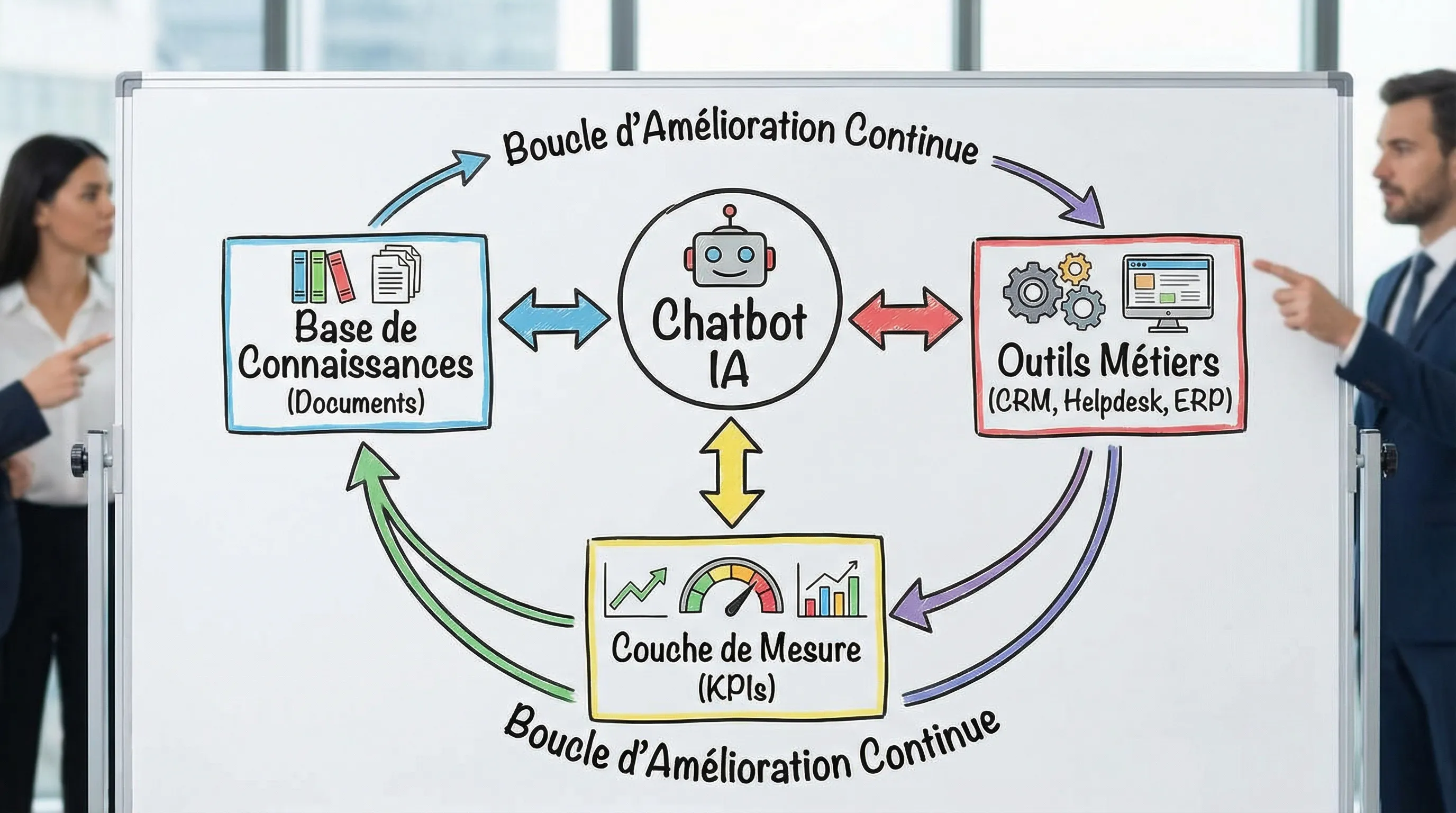
In 2026, a chatbot and AI is no longer just a "nice widget" added to a site. For an SME, it is primarily a margin lever if (and only if) the bot reduces a recurring cost or increases measurable revenue , while remaining controllable (data, security, compliance, quality).
The most frequent mistake seen on the SME side is starting with the tech ("we want an AI chatbot") instead of starting with an economic unit ("we want to reduce cost per ticket" or "increase appointment booking rate"). In this article, we focus on profitable use cases, their prerequisites, and a simple method to decide what to launch first.
When an AI chatbot becomes profitable (and when it doesn't) A conversational use case is profitable when it checks four conditions.
1) A frequent and standardizable demand A bot wins when it processes volumes. The best "jobs" are repetitive, with a stable vocabulary (support questions, quote requests, order tracking, internal procedures).
Conversely, if every conversation is a unique and sensitive case (complex disputes, individual HR, medical), value is harder to capture, and risks rise.
2) A measurable result, linked to a business KPI A "useful" chatbot is not necessarily profitable. Profitability is steered with a few simple indicators, even before talking about models:
Support : autonomous resolution rate, cost per ticket, first response time.
Sales : qualification rate, appointment booking rate, conversion by source.
Ops : time saved, error rate, cycle times.
If you want a complete measurement framework, Impulse Lab has published a dedicated guide: AI chatbots: Essential KPIs to prove ROI .
An AI chatbot that "invents" loses trust and can cost dearly. In practice, you need:
a usable knowledge base (FAQ, docs, procedures, T&Cs, catalog, after-sales policies),
simple versioning (who changes what, when),
and often a RAG approach (search in your content, then answer with sources) rather than a "freewheeling" model.
To dig deeper: RAG (Retrieval-Augmented Generation) .
4) An integration that allows action (not just answering) The profitability leap comes when the bot:
creates a ticket in your helpdesk,
retrieves an order, a status, a history,
proposes a slot in a calendar,
generates a draft email, quote, or report,
or triggers a workflow.
Without integration, you are paying for a "verbose" assistant that redirects to a form. With integration, you create an execution channel .
6 profitable chatbot and AI use cases (SME) The cases below are intentionally "profit" oriented. For each, the goal is to link the bot to a cost or revenue line.
1) Customer support: triage + resolution + clean escalation Rather than a bot that "answers everything," look for a bot that:
identifies intent (delivery, invoice, return, bug, access),
resolves simple requests with your rules and knowledge base,
collects missing information (order number, email, screenshot),
and escalates to a human with a structured summary.
Why it's profitable : reduction in manually processed volume, lower average time per ticket, better availability outside hours.
Typical integrations : helpdesk, email, CRM, knowledge base, e-commerce/ERP.
KPIs to track : autonomous resolution rate, time saved per agent, reopening rate, post-interaction CSAT.
For a "24/7 customer service" focus: Intelligent 24/7 customer service with AI chatbots .
On a B2B site, an AI chatbot can do better than a form if it:
qualifies (size, need, timeline, indicative budget if relevant),
detects intent signals (pricing, comparison, use case),
routes to the right person (sales, support, partner),
and proposes an appointment or a targeted resource.
Why it's profitable : increase in "visitor → conversation → qualified lead" conversion rate, and reduction of off-target leads.
Typical integrations : CRM, calendar, enrichment, analytics, emailing tool.
KPIs to track : qualification rate, appointments booked, no-show rate, SQL conversion.
3) Semi-automated quote (services, construction, maintenance, agencies) A very profitable case in "service" SMEs: the bot collects needs, applies simple rules (zones, options, urgency), then:
prepares a pre-quote (or a range),
creates an opportunity in the CRM,
and triggers a follow-up.
The key is to limit : the bot does not "fix" a final price if your grid is complex. It prepares 80% of the work.
Why it's profitable : less sales friction, shorter cycles, fewer back-and-forths.
Typical integrations : CRM, quoting/invoicing tool, calendar, email/SMS.
KPIs to track : "request → quote" delay, conversion rate, incomplete quote rate.
4) Internal knowledge assistant (onboarding + procedures) This isn't the "sexiest" use case, but it's often the fastest to make profitable: an internal bot (Teams/Slack/portal) answers on:
procedures (quality, safety, production),
offers and sales pitches,
HR policy (leave, expense reports),
operating modes.
Why it's profitable : fewer interruptions, accelerated onboarding, reduction of "silly" errors.
Typical integrations : document drive, wiki, SSO, directory, internal tools.
KPIs to track : search time, self-service rate, reduction in requests to experts, adoption rate.
Many SMEs don't have a large IT team. An AI chatbot can handle:
access requests (with a validation process),
simple diagnostics (Wi-Fi, VPN, reset),
ticket creation and classification.
Why it's profitable : decrease in time spent on repetitive tickets, better traceability.
Typical integrations : IT helpdesk, SSO, directory, IT knowledge base.
KPIs to track : tickets avoided, average resolution time, escalation rate.
6) Invoicing and collection: intelligent and framed follow-up Here, AI is not there to "negotiate." It serves to:
generate personalized reminders according to rules (days overdue, amount, history),
propose payment methods, transmit proofs,
route to a human when there is a dispute.
Why it's profitable : cash improvement, reduction in admin time, decrease in oversights.
Typical integrations : invoicing tool/ERP, CRM, email.
KPIs to track : DSO, payment rate at D+X, time spent per reminder, dispute rate.
Prioritization table: value, prerequisites, KPI This table serves to decide "where to start" without spreading yourself too thin.
Use Case
Main Value
Minimum Prerequisite
"North Star" Business KPI
Main Risk
Customer Support (triage + resolution)
Lower support cost
Knowledge base + helpdesk
% autonomous resolution
Incorrect answers (quality)
Pre-sales (qualification)
Higher conversion
Clear ICP + CRM + calendar
Qualified meetings / 1000 visits
Poorly routed leads
Semi-automated quote
Shorter sales cycle
Options grid + CRM
Request → quote delay
Bad estimation
Internal knowledge assistant
Productivity
Clean internal docs + access
Reduced search time
Unauthorized access
IT helpdesk level 0
Lower tickets
IT KB + ITSM process
Tickets avoided
Security (actions)
Framed invoicing follow-up
Cash improvement
Which architecture to choose (without overinvesting) In SMEs, profitability rarely comes from a "perfect" architecture. It comes from an architecture adapted to risk and instrumented .
Approach
When to use it
Advantages
Limits
Deterministic flow (rules + FAQ)
Simple requests, strong compliance
Predictable, few surprises
Limited coverage
Generative AI with guardrails
Varied questions, need for natural language
Good UX, fast to iterate
Risk of hallucination without control
RAG (AI + search in your docs)
Answers based on your knowledge
Traceability, better accuracy
Depends on document quality
"Action-oriented" bot (tool calling / integrations)
When creating/updating in tools is needed
High ROI, real automation
Governance and security indispensable
On security and risk aspects, two useful references:
Estimating ROI, without lying to yourself (simple method) For an SME, the ROI of an AI chatbot is most often calculated with a "time saved + conversion gain" equation, minus actual costs.
ROI "time saved" (support, ops, IT) Measure a monthly volume (tickets, requests, emails).
Estimate the current average time.
Estimate the time saved per interaction (or % of cases avoided).
Multiply by a fully loaded hourly cost.
Example (illustrative): 600 requests/month, 6 minutes each, 30% resolved automatically.
ROI "conversion" (pre-sales) Here, the calculation is simple, but you need a baseline.
The trap: counting leads, not signed clients . The "north star" KPI is not "number of conversations," it is "pipeline and revenue."
GDPR, security, and compliance vigilance points (SME version) A chatbot and AI quickly touches personal data (emails, orders, messages). Three reflexes limit 80% of problems:
Data minimization and partitioning Only give the bot what it needs.
Separate "public base" (FAQ) and "private base" (contracts, client data).
For the GDPR framework and recommendations, you can rely on resources from the CNIL .
Transparency and human escalation Logging and right to investigate In production, you must be able to answer: "what did the bot see, what did it answer, and why?"
This is indispensable for quality, internal support, and compliance (especially with requirements structuring around the European AI Act).
Pragmatic 30-day deployment plan (SME) The goal is not to deliver "a perfect bot," but an instrumented V1 that proves value.
Week 1: KPI-oriented scoping 1 use case, 1 north star KPI, 2 guardrails.
A clear perimeter of knowledge and authorized actions.
If you want a quick method to identify good quick wins: AI Audit: Express checklist for quick wins .
Week 2: Knowledge base and conversational flows Week 3: Minimal integrations + security Connection to CRM/helpdesk/ERP depending on the case.
Management of access, secrets, logs, cost limits.
Week 4: Controlled pilot + measurement Small-scale deployment (1 channel, 1 team, or 10% of traffic).
Weekly review: errors, costs, success rate, impact on KPI.
How Impulse Lab can help you (without vague promises) If you want to move from "we would like an AI chatbot" to a profitable use case , Impulse Lab generally intervenes at three levels:
AI Opportunity Audit : prioritize use cases and estimate value and risks.
Custom design and development : platform, chatbot, automations, and integrations with your existing tools.
Training and adoption : helping teams use, control, and improve the system.
To go further on the execution side, you can also read: Building a chatbot: steps, costs, errors to avoid .
The right starting point, especially in an SME, is a short, scoped, instrumented pilot , which is then iterated. This is exactly where chatbot and AI projects become profitable, because they become manageable.