A good chatbot is not a gadget; it is a silent profit center. For an SME, it can capture more prospects, reduce support costs, secure appointments, and accelerate invoicing, all without hiring. The challenge is not to automate everything, but to target a few high-leverage use cases...
décembre 07, 2025·9 min de lecture
A good chatbot is not a gadget; it is a silent profit center. For an SME, it can capture more prospects, reduce support costs, secure appointments, and accelerate invoicing, all without hiring. The challenge is not to automate everything, but to target a few high-leverage use cases and connect them cleanly to your business tools.
What Really “Pays Off” with a Chatbot in 2025
Before listing the use cases, let’s set the financial compass. A chatbot pays off if it improves at least one of these indicators:
Lower cost per customer contact, via the deflection of simple tickets and self-service.
Higher conversion rate, thanks to instant qualification and 24/7 appointment booking.
Average basket and additional sales, via intelligent recommendations and contextual follow-ups.
Time saved for teams, reallocated to higher-value tasks.
Express ROI formula: ROI = (Net Annual Gains − Annual Costs) ÷ Annual Costs. Also track the payback period, the number of months required for cumulative gains to exceed the investment.
Practical tip: start with measurable hypotheses, not generic promises. Cost of a human ticket, monthly volume, target deflection rate, average opportunity value, no-show rate—everything must be explicit.
8 Chatbot Use Cases for SMEs That Generate ROI
1) 24/7 Customer Support, Deflection of Recurring Questions
Problem solved: The majority of contacts concern simple questions—delivery conditions, delays, return policies, order status. A conversational assistant responds instantly, offers self-service links, and escalates to a human when necessary.
Financial impact: Lower cost per contact, improved CSAT and response times. Agents focus on complex cases.
Typical integrations: Knowledge base, ticketing system, order tracking. The assistant can read the status of an order and propose the right action.
KPIs to track: Deflection rate, average resolution time, escalation rate, post-conversation satisfaction.
Numerical example: If you handle 1,500 tickets per month at an internal cost of €5 per ticket and the bot deflects 30%, the gross saving reaches approximately €2,250 per month. Adjust with bot costs to get the net gain.
2) Lead Qualification and Appointment Booking
Problem solved: Classic forms capture intent poorly and generate friction. A chatbot engages in dialogue, qualifies in a few questions, and books a slot in the team’s agenda.
Financial impact: More qualified leads, fewer back-and-forths, better conversion.
Typical integrations: Calendar, CRM, lead scoring.
KPIs to track: Visit-to-lead conversion rate, appointment booking rate, cost per lead, no-show rate.
Numerical example: 10,000 monthly visits, 2% form conversion, 4% via chatbot. With 200 additional leads, a sales conversion rate of 15%, and an average value of €400, this represents €12,000 in additional monthly revenue.
3) Instant Quote and Product/Service Config
Problem solved: Your prospects want a quick ballpark figure. The assistant asks 3 to 5 questions, calculates an indicative quote, and proposes a meeting to finalize.
Financial impact: Acceleration of the sales cycle, reduction of time spent on pre-qualification, better experience.
KPIs to track: Rate of quotes generated, quote turnaround time, quote-to-order conversion rate.
4) Order Tracking and Simplified Returns
Problem solved: Order tracking mobilizes your team for repetitive requests. The chatbot finds the order, gives the status in real-time, initiates a return or exchange, and sends the label if necessary.
Financial impact: Reduction in ticket volume, better customer loyalty.
Typical integrations: E-commerce, WMS, carrier.
KPIs to track: Self-service rate, resolution time, post-service repurchase rate.
5) Quote Follow-ups and Soft Collection
Problem solved: Follow-ups pile up and teams lack time. The chatbot sends contextualized follow-ups, answers simple objections, and directs towards secure payment.
Financial impact: Improvement in conversion rate and reduction in outstanding receivables.
Typical integrations: Invoicing, payment, CRM.
KPIs to track: Recovery rate at D+30, average payment delay, amount recovered.
6) Recommendations and Cross-selling
Problem solved: On an e-commerce site, the visitor hesitates between references. The assistant asks a few questions and proposes the right products, with relevant cross-sell.
Financial impact: Increase in average basket, better conversion.
KPIs to track: Assisted conversion rate, average basket, revenue per visitor.
7) Internal HR Assistant, Onboarding, and Internal Policy
Problem solved: HR teams constantly answer the same questions—leave, expense reports, health insurance, IT procedures. An internal assistant provides compliant answers and directs to the right forms.
Financial impact: HR time saved, faster onboarding, fewer errors.
KPIs to track: Internal resolution time, volume of HR requests, employee satisfaction.
8) Knowledge Assistant for Sales and Support Teams
Problem solved: Finding product info, a contractual clause, or a price sheet hinders fluidity during meetings. The assistant answers in natural language, cites its sources, and proposes documents to share.
Financial impact: Shorter cycles, less back-and-forth, reinforced image of expertise.
KPIs to track: Info search time, first-contact response rate, closing rate.
Summary of Use Cases and Their Levers
Use Case
Business Objective
Automation Example
Primary KPI
Estimated Complexity
24/7 Support
Reduce cost per contact
Answer FAQs, create ticket if complex
Deflection rate
Low to medium
Lead Qualification
Increase conversion
Ask 3 to 6 questions, book a slot
Visit-to-lead conversion rate
Low
Instant Quote
Accelerate sales
Conversational configurator, PDF quote
Quote time, quote-to-order rate
Medium
Order Tracking & Returns
Decrease support tickets
Order status, return initiation
Self-service rate
Medium
Follow-ups & Collection
Improve cash flow
Contextualized follow-up with payment link
DSO, recovery rate
Medium
Recos & Cross-sell
Increase average basket
Product advisor, bundle
Note: complexity varies according to your existing systems and the quality of your content.
Choosing the Right Technical Approach
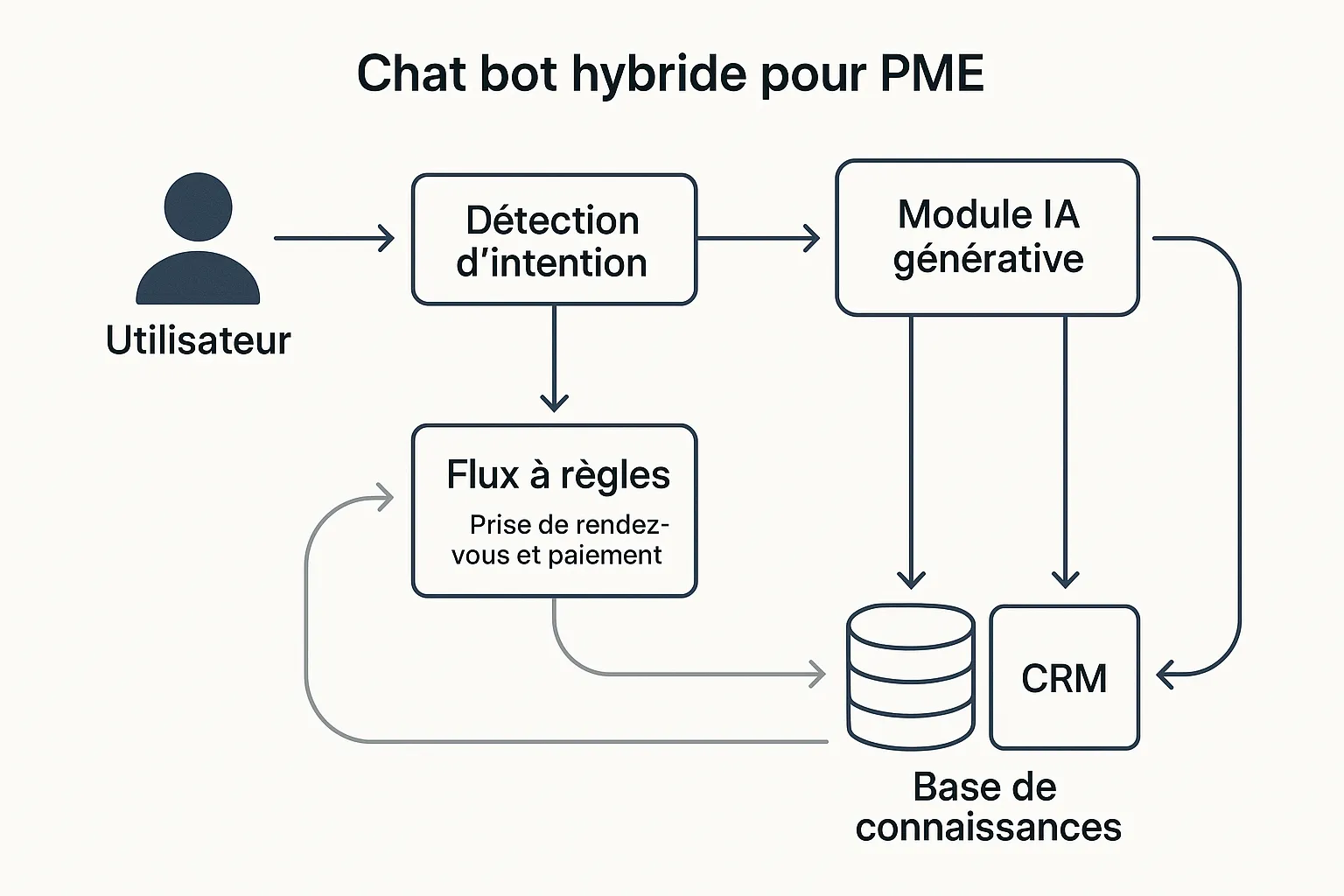
You don’t have to oppose button-based bots and generative AI. The best results often come from a hybrid approach.
Deterministic flows: For critical paths, appointment booking, collecting an order number, payment. Rules guarantee compliance and reduce errors.
Generative AI: To understand free-form phrasing, summarize policies, rewrite messages, propose an answer that cites its sources. Coupled with search in your document base, this is the RAG approach (Retrieval Augmented Generation), useful for remaining factual. See the technical explanation on the NVIDIA developer blog, Retrieval Augmented Generation.
Hybrid: The bot chooses the right block according to the user's intent and switches to a human in one click if necessary.
Governance, Quality, and GDPR Compliance
A profitable chatbot is a governed chatbot.
Data: Centralize an approved source of truth—knowledge base, product sheets, procedures. Update via a clear workflow.
Security and Privacy: Minimize personal data, encrypt in transit and at rest, and set retention periods. The CNIL offers useful benchmarks on GDPR; consult the CNIL website.
Guardrails: Whitelist of authorized actions, security filters, answers with citations and source links, confidence thresholds, and fallback to human.
Continuous Measurement: Track escalation rates, comprehension failures, satisfaction scores, and correct every week.
For the business approach, sector reports confirm the trend towards self-service and support automation. For example, the Customer Experience Trends reports from Zendesk highlight customer appetite for fast and personalized answers, especially on simple questions. Use these trends as benchmarks, then measure your own impact locally.
How to Quickly Calculate Your ROI, with 3 Typical Scenarios
Average basket, assisted conversion, revenue per session
Measure the real impact of recommendations
Internal Efficiency
Time saved per team, info search time
Validate productivity
Compliance
Rate of conversations with PII, respect for deletion SLAs
Control risk
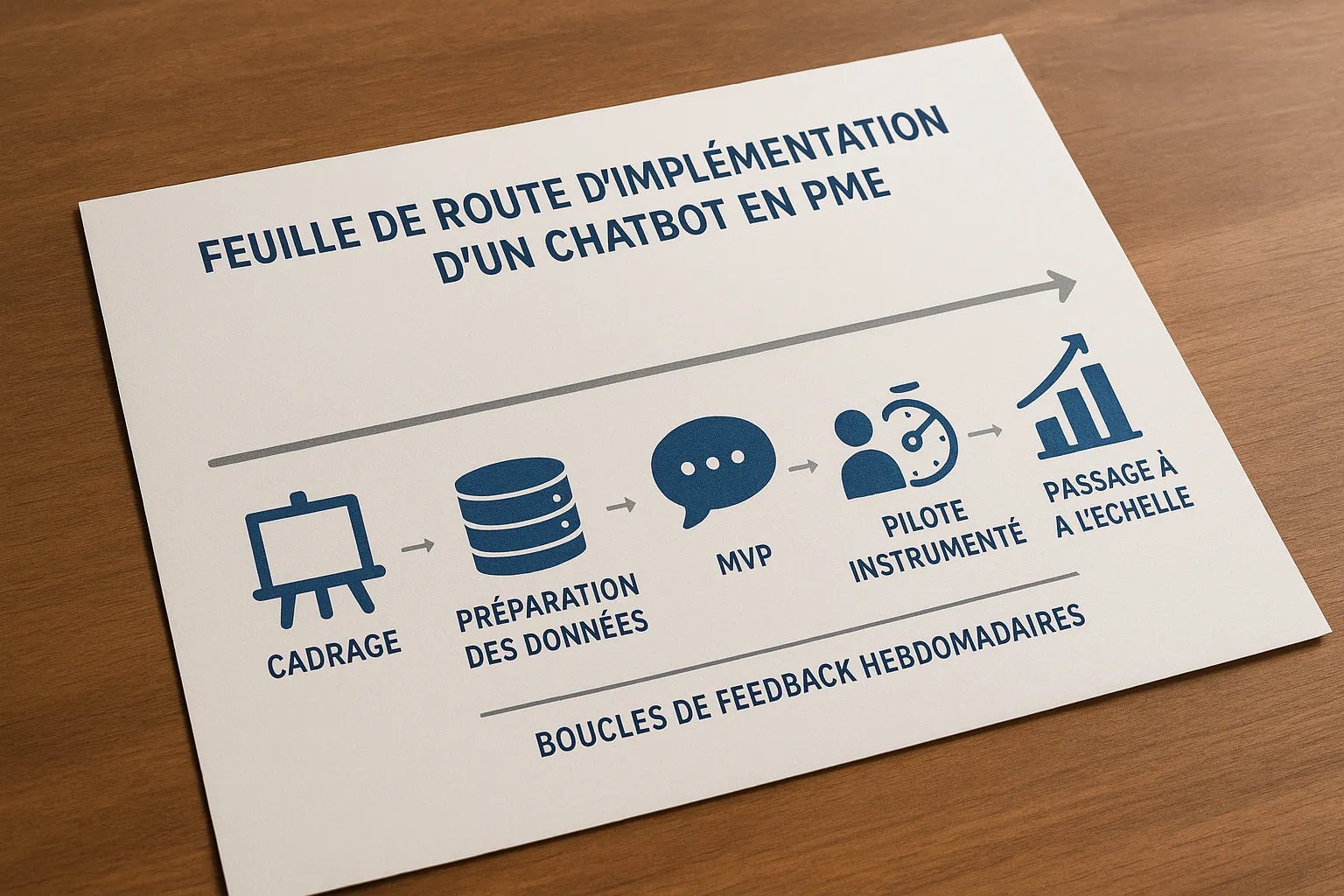
Pragmatic Roadmap for an SME
Scoping: List max 2 use cases, quantified objective, integration scope, escalation rules to human.
Data: Clean your source content—FAQs, procedures, product sheets. Without reliable data, no good answers.
MVP in 2 to 4 weeks: One path per use case, measurements activated, user feedback.
Pilot 30 to 60 days: Weekly adjustments, continuous improvement.
Scaling: New channels, more intents, automation of transactional actions.
Why Work with a Specialized Partner
Success depends less on the AI model than on end-to-end engineering: data, integrations, security, conversational experience, and governance.
Opportunity Audit: To prioritize use cases that pay off and avoid the "showcase" effect.
Custom Development: To connect the bot to your tools and workflows.
Automation and Integration: To go beyond simple answers and perform real actions.
Adoption and Training: To onboard your teams and establish the right habits.
Iterative Steering: Demonstrations and weekly deliveries, tracking in a client portal, to keep the pace and transparency.
Impulse Lab is a product-oriented AI agency specialized in audits, custom development, and adoption training. We deliver projects in weekly iterations, with a dedicated client portal and strong involvement from client-side teams.
Take Action
You have identified 1 or 2 use cases that could pay off quickly. Let’s start with a framed pilot, with quantified objectives, minimal integrations, and measurements in place from the first week.
You want an express scoping, audit, and plan of attack? Talk to an expert.
You wish for an operational prototype? Let’s define an MVP scope together.
Contact us, we will get back to you within 24 business hours, via the dedicated form: contact us.
Resources to explore further: Generative AI and productivity by McKinsey, The economic potential of generative AI. Customer experience trends by Zendesk, Customer Experience Trends. GDPR framework and best practices, CNIL.
By targeting 1 or 2 well-chosen use cases, a chatbot can become one of the best investments for your SME. The key: measure, iterate, integrate. And aim for profitability starting from the pilot.