E-commerce AI: Reduce Returns and Increase Margins
Intelligence artificielle
Stratégie d'entreprise
ROI
Automatisation
E-commerce returns aren't just an operational “irritant.” They are **direct costs**, **hidden costs**, and often a **symptom**: poorly framed product promises, difficult choices, preparation errors, overly permissive return policies, or fraud.
February 21, 2026·10 min read
E-commerce returns are not just a simple operational “irritant.” They are direct costs (transport, processing, refunds), hidden costs (customer support, stock immobilization, markdowns, loss of value), and often a symptom: poorly framed product promises, difficult choices, preparation errors, overly permissive return policies, or fraud.
AI is not a magic wand. However, used where returns originate (before purchase) and where they cost the most (after), it becomes a very concrete margin lever: fewer refunds, more exchanges, better resale, fewer support tickets, better data quality.
To contextualize the issue, the National Retail Federation estimated returns at hundreds of billions of dollars in the United States. Even if your volumes are more modest, the logic is identical: a return “eats” your margin faster than many marketing optimizations create it.
Why returns destroy margin (and where AI really acts)
A return does not have a single cost. It combines several P&L lines.
Segmentation and guardrails (without discriminating), rules + AI
Objective: be able to say, by category, what generates 80% of your returns and what is “manageable” in 30 to 60 days.
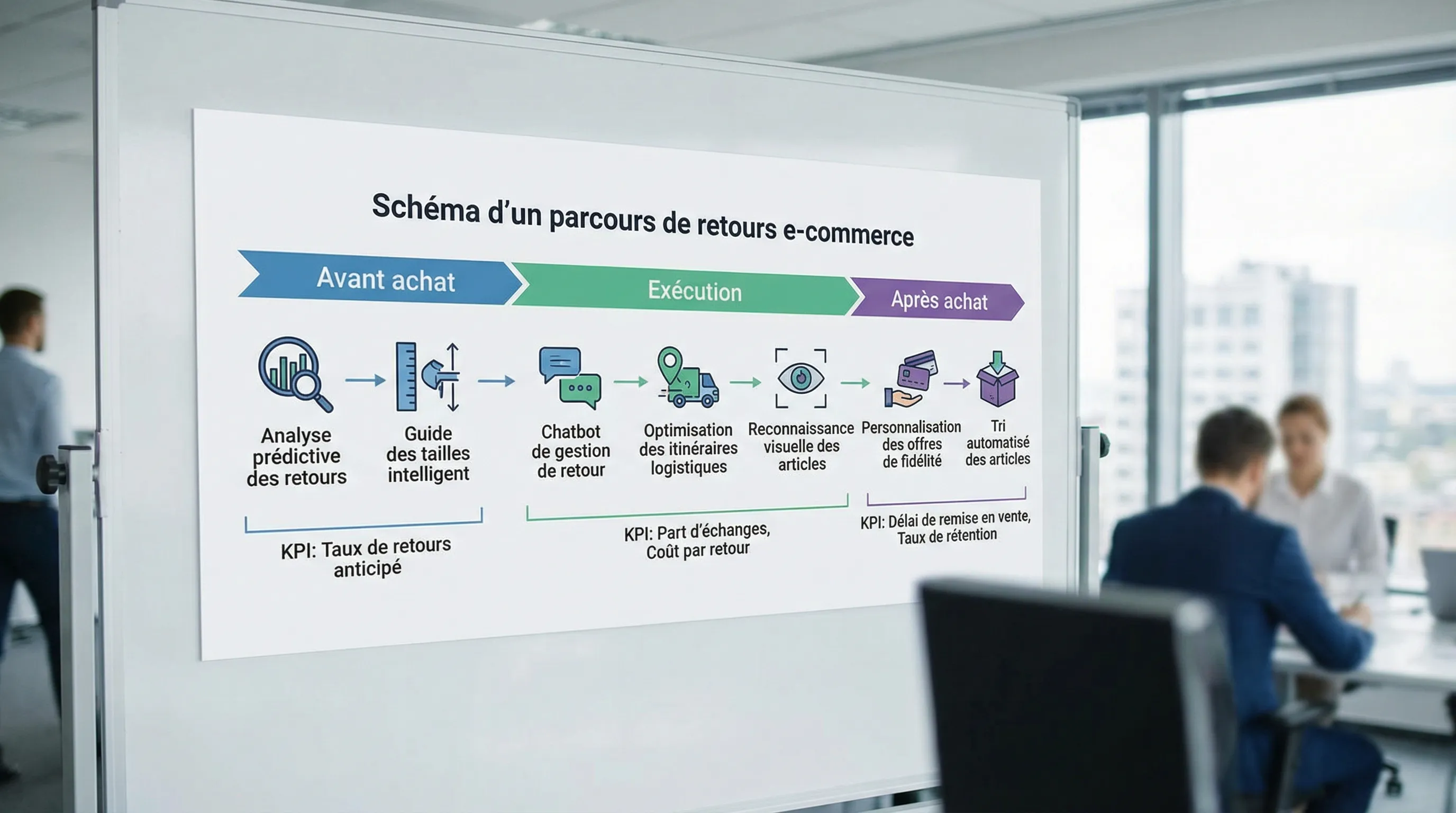
7 e-commerce AI levers to reduce returns and increase margin
The frequent mistake is launching a generic “AI assistant.” Returns are won with precise mechanisms, often hybrid: rules + AI + integrations.
1) Size assistance and “fit guidance” (lever #1 in fashion)
If you sell products where size is a major source of returns, the ROI can be rapid.
Typical approaches:
Size recommendation based on: purchase/return history, measurements (if consented), brand, cut, elasticity, reviews.
Risk alert (“This model runs small”) displayed at the right moment.
Short questions (2 to 4) to guide without slowing down checkout.
KPIs to track:
Return rate “size/fit” by SKU, by brand, by guide.
Share of exchanges vs refunds.
Conversion rate and impact on average basket (watch out for the “friction” effect).
2) Return prediction per order (to prioritize, not to punish)
A model can estimate the probability that an order will be returned (or the probability of a partial return). The value is rarely to “block” a customer. The value is to trigger actions.
Examples of useful actions:
Proactive post-purchase message (“need help choosing the size”, “installation guide”).
On fragile products: reinforced packaging, additional check.
On multi-variant baskets: propose a “smart try-on” alternative (facilitated exchange, simplified return) to foster trust while orienting towards exchange.
Important point: to remain ethical (and acceptable), we prioritize:
explainable features (category, product type, aggregated return history, delivery context),
and a final “business” decision (rules) rather than an automatic sanction.
3) Automatic QA of product sheets (LLM + rules) to reduce “disappointed expectations”
Many returns come from an unsaid detail: material, transparency, rigidity, compatibility, actual size, usage.
An LLM can help industrialize the quality of sheets, but only with a framework:
Checklist of mandatory fields by category (material, care, dimensions, compatibilities, included in the box, tolerances).
Detection of contradictions between title, description, PIM attributes, and variants.
Extraction of vague areas (e.g., “comfortable”, “premium”) and suggestion of factual clarifications.
KPIs:
Return rate “does not match description”.
Pre-purchase contact rate on the same questions.
Production and update time for sheets.
4) Intelligent analysis of return reasons (SKU, batch, supplier)
Most e-merchants have the data, but not the time to exploit it.
AI can:
group textual reasons (emails, comments, RMAs) into stable families,
detect abnormal spikes on an SKU, a size, a color, a batch,
cross-reference returns + reviews + support to prioritize actions.
Expected result: fewer “quality” returns and fewer negative reviews (thus an indirect margin effect via conversion).
KPIs:
Returns per SKU/variant (normalized by volume sold).
Time to detect a problem (days).
Refund vs replacement rate.
5) Proactive post-purchase (assistant + automations) to convert “return” into “exchange”
A portion of returns is not a rejection of the product, but a lack of reassurance, a usage problem, or a wrong variant.
With an augmented self-service logic:
Order tracking and instant answers (reduction of tickets).
This lever is often more profitable when it is integrated (helpdesk, OMS, CRM), rather than an isolated chat.
If you already have an AI support dynamic, you can link this topic to your setup (see for example Impulse Lab's approach on AI chatbots for customer service).
KPIs:
Share of exchanges vs refunds.
Resolution time.
“Containment” rate (resolution without agent) on return journeys.
Resale pricing (if you have a B-stock channel): rule + adjustment according to condition, season, demand.
Even without computer vision, you can already gain via:
better categorization of conditions,
faster routing,
stock update automations.
KPIs:
Return → resale time (days).
Restock vs markdown rate.
Average recovered value per return.
Pragmatic method: a pilot in 30 days, margin-oriented
The right format is rarely a “big AI project.” It is an instrumented pilot on a category or a country, with a baseline, a measurement, and an industrialization plan.
Here is a simple (adaptable) framework that works well in SMEs and scale-ups.
or you industrialize (deeper integration, monitoring, governance),
or you stop (if the cause was poorly chosen).
This “measured test then scale” logic is consistent with an audit and prioritization approach. If you want a broader framework, you can rely on an approach like strategic AI audit (opportunities, risks, data, adoption), then execute a returns pilot.
Data and integrations: the minimum viable (without fantasizing about a data lake)
For a first returns lever, you don't need “big data.” You need accurate data and stable joins.
CRM / email (for proactive messages and exchange follow-up).
If you work with LLMs (for sheet QA, text reasons), put production guardrails in place (sources, rules, traceability). On assistants powered by your knowledge base, a RAG-type design helps limit invented answers, with adapted evaluation practices (see a reference approach on robust RAG in production).
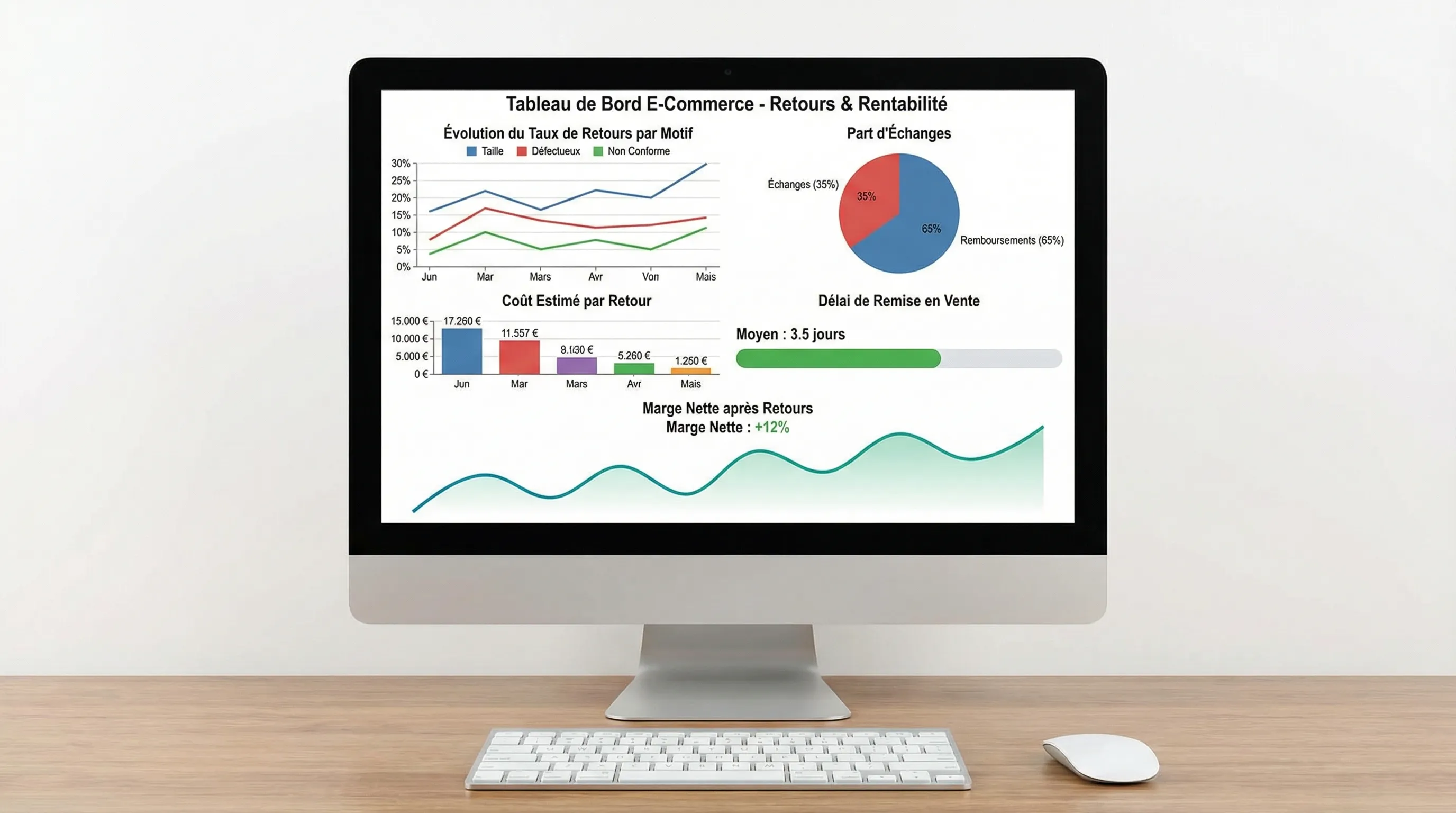
The “margin after returns” dashboard (the one that avoids vanity metrics)
Reducing the return rate is good. Protecting the margin is better. Your dashboard must link returns and real economics.
Recommended indicators:
Return rate (global + by reason + by category).
Share of exchanges vs refunds.
Cost per return (even estimated at the start, by ranges).
Return → resale time.
Recovered value (average resale price, average markdown).
Support impact (return tickets, processing time).
A useful formula, even simplified:
Net margin after returns = gross margin - (return costs + markdowns + additional support)
The goal of an AI pilot is not to “do better than humans” on an abstract benchmark. It is to move an economic KPI without degrading the experience.
Watchpoints (to avoid losing money with a “good AI idea”)
Do not optimize one KPI to the detriment of another
Classic example: reducing returns by adding too much friction (long quiz, anxiety-inducing messages) and losing conversion. Hence the interest of a pilot with guardrails.
Avoid “black box” AI on sensitive decisions
On fraud and return policy, keep:
an explainable logic,
an escalation path,
and compliance rules (data, retention, transparency).
Care for UX and wording
The best prediction is useless if it arrives at the wrong moment, or if it is not formulated in a useful way. Work on the micro-copy (“This model runs small, choose a size up”) rather than a raw score.
Conclusion: choose a lever, instrument it, and turn it into a product
“E-commerce AI” is a broad term. To reduce returns and increase margin, it must be translated into concrete mechanisms: size guidance, sheet QA, reason analysis, proactive post-purchase, reverse logistics, and margin steering.
If you want to move quickly from diagnosis to a measured pilot, Impulse Lab typically accompanies:
an opportunity audit oriented towards returns and margin,
the construction of an MVP integrated into your tools,
the training of teams for adoption,
and progressive industrialization (measurement, monitoring, governance).
Recommended starting point: select a category with high return volume, define 3 to 5 KPIs, and launch a pilot in 30 days with a clear baseline. To discuss your context (stack, data, dominant causes), you can start via the Impulse Lab site.