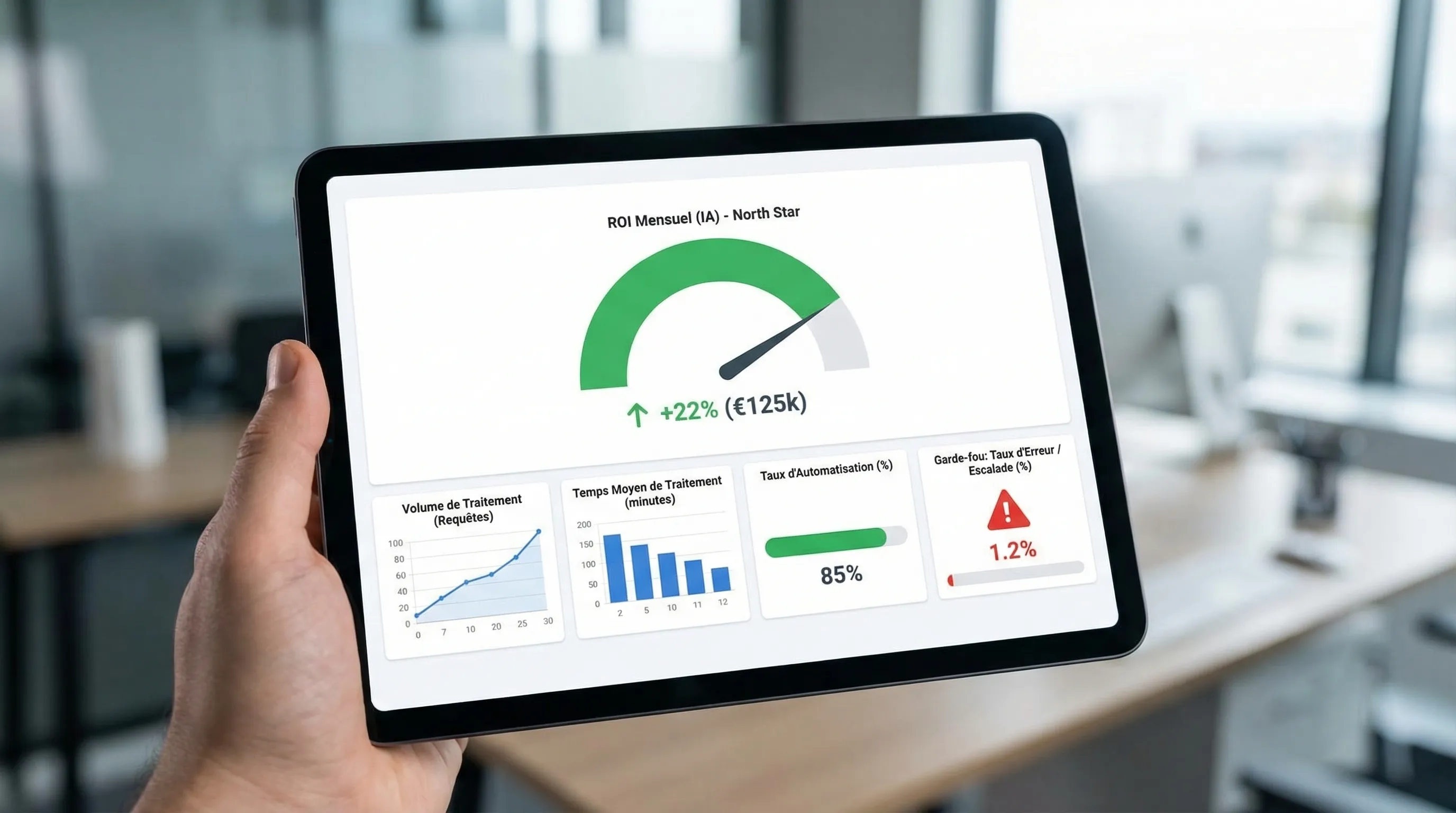
In 2026, the goal isn't just testing AI, but **proving ROI** without endless POCs. For SMBs and scale-ups, gains come from grounded, repetitive use cases integrated into existing tools (CRM, helpdesk, ERP) that are quickly measurable. This guide lists 12 use cases with simple KPIs.
In 2026, the problem is no longer about “testing AI”, but proving ROI without falling into endless POCs. The good news is that in an SMB or scale-up, gains often come from very grounded, repetitive use cases that are already equipped with tools (CRM, helpdesk, ERP, Google Workspace), and are therefore quickly measurable.
This “Enterprise AI” guide lists 12 ROI use cases and, most importantly, simple KPIs that you can track from V1. The goal is to help management, a Head of Ops, or a Lead Product choose 1 to 2 topics, launch an instrumented pilot, and then decide to scale.
Before the use cases: the golden rule for achieving ROI
A profitable AI use case in a company generally checks these criteria:
High frequency: many tickets, requests, documents, identical actions.
Clear unit value: time, money, risk, conversion.
“Actionable” integration: the AI shouldn't just “answer”; it must feed into a workflow (tag, route, create a draft, pre-fill an object, trigger a task).
Measurable: baseline before, metrics after, ideally a small control group.
To frame this quickly (and avoid demo syndrome), you can rely on an ROI-first method like in our article on the strategic AI audit or on the principles detailed in Transforming AI into ROI.
Simple KPIs: the minimum viable (without complexity)
For each use case below, aim for 3 to 5 KPIs maximum:
1 North Star KPI (business value): euros, hours, conversion rate, cash days.
1 to 3 Process KPIs: volume processed, cycle time, automation rate.
1 Guardrail: error rate, human escalations, compliance, satisfaction.
Important point: field studies show that generative AI creates the most value when it augments an existing process and a baseline is measured. For example, an NBER study on a contact center observed a productivity improvement (measured) thanks to an AI assistant, particularly for less experienced agents (Brynjolfsson, Li, Raymond, 2023).
Summary Table: 12 Enterprise AI Use Cases and their KPIs
Use Case (ROI)
North Star KPI (simple)
Monitoring KPIs
Guardrail
Realistic Time-to-Value
1. Triage + assisted support responses (copilot)
Hours saved / month
AHT, tickets/agent, suggested article rate
Reopening rate
2 to 6 weeks
2. Self-service Chatbot (RAG) site or helpdesk
Deflection rate
Useful conversations, intent coverage
Human escalation, CSAT
2 to 8 weeks
3. Lead qualification (chat, voice, enriched form)
% MQL→SQL (or qualified meetings)
Contact rate, booking speed
No-shows, false positives
2 to 6 weeks
4. Call summaries + automatic CRM actions
Data entry time saved
% calls summarized, tasks created
CRM field quality
1 to 3 weeks
5. Assisted quotes / sales proposals
Quote→signed conversion rate
Quote sending delay, # of iterations
Excessive discounts, inconsistencies
3 to 8 weeks
1) Support triage + assisted responses (copilot agents)
Here, the AI does not need to be “autonomous”. It must help agents go faster and be more accurate: propose a response, summarize history, suggest macros, identify intent, pre-fill fields.
Simple KPIs:
North Star: Hours saved = (AHT before – AHT after) x volume.
Self-service becomes profitable when it answers based on verified sources (knowledge base, product docs, policies) and when it knows how to hand over.
Simple KPIs:
North Star: Deflection rate = (conversations resolved without ticket) / (total conversations).
Monitoring: Intent coverage (coverage of main intentions), first response time.
Guardrail: Escalation rate, answers without citation/source.
To secure reliability, a well-designed RAG is often the key building block. If you are interested in the production side, see: Robust RAG in Production.
3) Lead qualification (chat, voice, enriched forms)
When a team grows, loss rarely comes from lead volume, but from qualification speed and routing. An AI assistant can: ask 3 to 6 questions, detect the need, enrich the lead, propose a slot, push to the right pipeline.
Simple KPIs:
North Star: Qualified meetings / week (or MQL→SQL rate).
Monitoring: Average booking delay, contact rate, completion rate.
This use case is often a “quick win” because it fits into a tool already in use (Meet, Teams, Zoom, CRM). The AI generates: summary, next steps, objections, CRM fields, follow-up email.
Simple KPIs:
North Star: Data entry time saved per salesperson per week.
Monitoring: % calls summarized, % tasks created automatically.
Guardrail: Error rate on key fields (amount, date, pipeline stage).
5) Assisted quotes and sales proposals
ROI comes from two levers: speed (send faster) and quality (fewer back-and-forths, better scoping). AI can assemble a proposal from a template, call notes, and your offer catalog, then propose a “ready to send” version.
Simple KPIs:
North Star: Quote→signed rate (or win rate).
Monitoring: Average quote sending delay, number of iterations before signature.
Routing is an underestimated goldmine: a poorly routed request costs time and degrades the experience. AI can classify intent, detect urgency, extract info, then route to the right team, the right SLA, the right playbook.
Simple KPIs:
North Star: Total processing time (from request to resolution).
Monitoring: % correct routing, backlog per queue.
Guardrail: Routing error rate and time lost in transfers.
7) “Internal knowledge” assistant (RAG) for teams
In SMBs and scale-ups, the hidden cost is searching: “where is the latest version of the doc”, “what is the pricing rule”, “how do we do this process”. An internal assistant connected to sources (Notion, Drive, wiki, tickets) reduces this friction.
Simple KPIs:
North Star: Hours gained = (search time before – after) x # of queries.
Monitoring: Queries/day, usage rate per team.
Guardrail: % answers with source, acceptable “I don't know” rate.
8) Supplier invoices and expense reports (extraction + control)
This use case is profitable when doing two things:
Monitoring: Auto-validation rate, average processing time.
Guardrail: Accounting error rate, rejection rate.
9) Assisted follow-ups and collections (without degrading relationships)
The value is direct: accelerate cash flow without creating disputes. AI helps personalize follow-ups according to context (invoice, history, payment promise), proposes messages, prioritizes accounts.
Simple KPIs:
North Star: DSO (Days Sales Outstanding) or overdue receivables.
Monitoring: % follow-ups sent on time, payment promises obtained.
10) Demand forecasting and “light” stock (to reduce overstock and stockouts)
Without aiming for heavy data science, a “light” model can already exploit historical sales, seasonality, promos, supplier delays. The goal isn't statistical perfection, but reducing costly cases: stockouts, dormant overstock.
Simple KPIs:
North Star: Value of avoided stockouts (or reduced overstock).
Monitoring: Forecast error (MAPE or average error), decision time.
Guardrail: Impacts on margin (forced promos, losses).
11) Dev Copilot: PR review, tests, documentation, migrations
Profitability on the IT side comes when AI is integrated into the flow (PR, CI, backlog) and used to accelerate what actually slows things down: understanding legacy code, writing tests, documentation, guided refactoring.
Simple KPIs:
North Star: Delivery lead time (idea → prod).
Monitoring: PR cycle time, number of review returns, time spent on boilerplate.
Guardrail: Incidents in production, critical bugs.
If you need to structure industrialization (guardrails, measurement, run), a “mini-product” framing is often the difference between a nice tool and a real gain.
12) Document compliance control (GDPR, clauses, sensitive data)
Without replacing legal, AI can perform a pre-check: detect presence of personal data (PII), verify a checklist of clauses, flag discrepancies, produce a review report.
Simple KPIs:
North Star: Incidents avoided (or review time saved).
Monitoring: % documents scanned, average review time.
Guardrail: False positives, % of cases escalated to legal.
How to choose your first 2 use cases (in 30 minutes)
If you are hesitating, take a sheet of paper and score each idea out of 10:
Volume (frequency),
Value (time, euros, risk),
Integration effort (access to tools, API, data quality),
Risk (sensitive decision, bias, compliance),
Measurability (baseline available, easy KPIs).
Then keep 1 “foundation” (e.g., internal knowledge, routing) and 1 “ROI showcase” (e.g., support, qualification). This is often the most effective duo to build trust and fund what follows.
Starting without mistakes: instrumented pilot, then decision
A good “Enterprise AI” pilot is not a technical POC, it is a value test.
Baseline: 2 to 4 weeks of data before (AHT, delays, conversion rates).
Integrated V1: in the right tool, on a real workflow.
Measurement: weekly dashboard, and a “scale / stop / fix” scorecard.
At Impulse Lab, we typically intervene in three ways, depending on your maturity level: opportunity audit, adoption training, and custom development/integration. If you want to transform these use cases into a prioritized and measured backlog, the simplest way is to start with a short framing via the strategic AI audit, then follow up with a V1 delivered in short cycles.
Artificial intelligence in business raises a question beyond tooling: who actually owns it? The executive funding it, the team using it, the vendor, or the provider? The answer changes depending on whether we discuss ownership, governance, or liability.