How a Data Catalog Powers Your Artificial Intelligence
Intelligence artificielle
Stratégie IA
Outils IA
Gouvernance IA
A data catalog provides a practical framework for data and AI projects: it clarifies what data exists, what it means, and how your AI can use it. While it doesn't make models smarter on its own, it ensures they are powered by suitable, verified, and controlled sources.
October 27, 2026·10 min read
A data catalog provides a concrete framework for your "data and artificial intelligence" projects: it lets you know what information exists, what it means, and under what conditions your AI can use it. It does not make a model smarter on its own. Above all, it helps supply it with suitable, identified, and controlled sources.
For an SME or a growing company, the challenge is highly operational. Before connecting an assistant to your documents or building a forecasting tool, you need to distinguish actionable data from obsolete, incomplete, or confidential files. The catalog makes this selection possible without requiring everything to be centralized.
A Catalog Describes Data; It Does Not Replace It
A data catalog is an organized inventory of a company's informational assets: database tables, files, documents, metrics, or APIs. It describes these resources using metadata—that is, information about the data itself.
For example, a database contains your orders. The catalog indicates where to find this database, how to interpret the "order date" field, who can access it, and whom to contact when an amount appears inconsistent.
This distinction prevents a common misconception: cataloging does not mean copying all data or automatically feeding it to an AI. Storage, transformation, and data usage remain handled by other components. Some catalogs feature advanced connectors and governance capabilities, but these features are not universal.
What a Catalog Brings to a "Data and Artificial Intelligence" Project
The value of a catalog lies less in the number of referenced resources than in the quality of the answers it provides. A list of file names is not enough. To connect data and artificial intelligence, you must make the meaning of the information, its origin, and its usage limits explicit.
Metadata
Concrete Example
Value for AI
Business definition
"Active customer" means at least one paid order within twelve months
Avoid conflicting interpretations
Source and location
Invoicing table from the accounting software
Retrieve the reference data
Owner
Person responsible for validating refund rules
Obtain business arbitration
Version and freshness
Approved procedure, known last review date
Discard an outdated version
Sensitivity and access
Document restricted to a specific team or client
Define restrictions to apply
Quality rules
Mandatory identifier, amount expressed in euros
Validate data before use
The catalog can also document transformation tracking, often referred to as data lineage. It helps you understand how a metric was calculated and which sources contributed to the result. This information becomes invaluable when a forecast or an answer needs to be explained.
How the Catalog Concretely Powers Your AI
The catalog acts upstream of operations: it helps select resources, prepare checks, and document context. Technical integration then executes the required operations. Two scenarios illustrate this separation.
For a Forecasting or Classification Model
Imagine a model designed to forecast order volumes. The team needs to identify usable historical data, understand status changes, and distinguish a canceled sale from a collected payment.
The catalog documents these rules and the relationships between tables. Data preparation pipelines can then apply controls: removing duplicates, standardizing units, or flagging incomplete periods.
In this synergy between data and artificial intelligence, the catalog also makes it possible to document what was known at the time of the decision. Using information that was only available after the order could skew model evaluation. The catalog helps spot this data leakage risk, even though it does not detect it automatically on its own.
It remains essential to test datasets, maintain their versions, and evaluate model performance on examples distinct from those used during training.
For a Document Assistant Using RAG
RAG, or Retrieval-Augmented Generation, involves retrieving information from a knowledge base before asking the model to generate an answer. On its own, it does not require retraining the model on your documents.
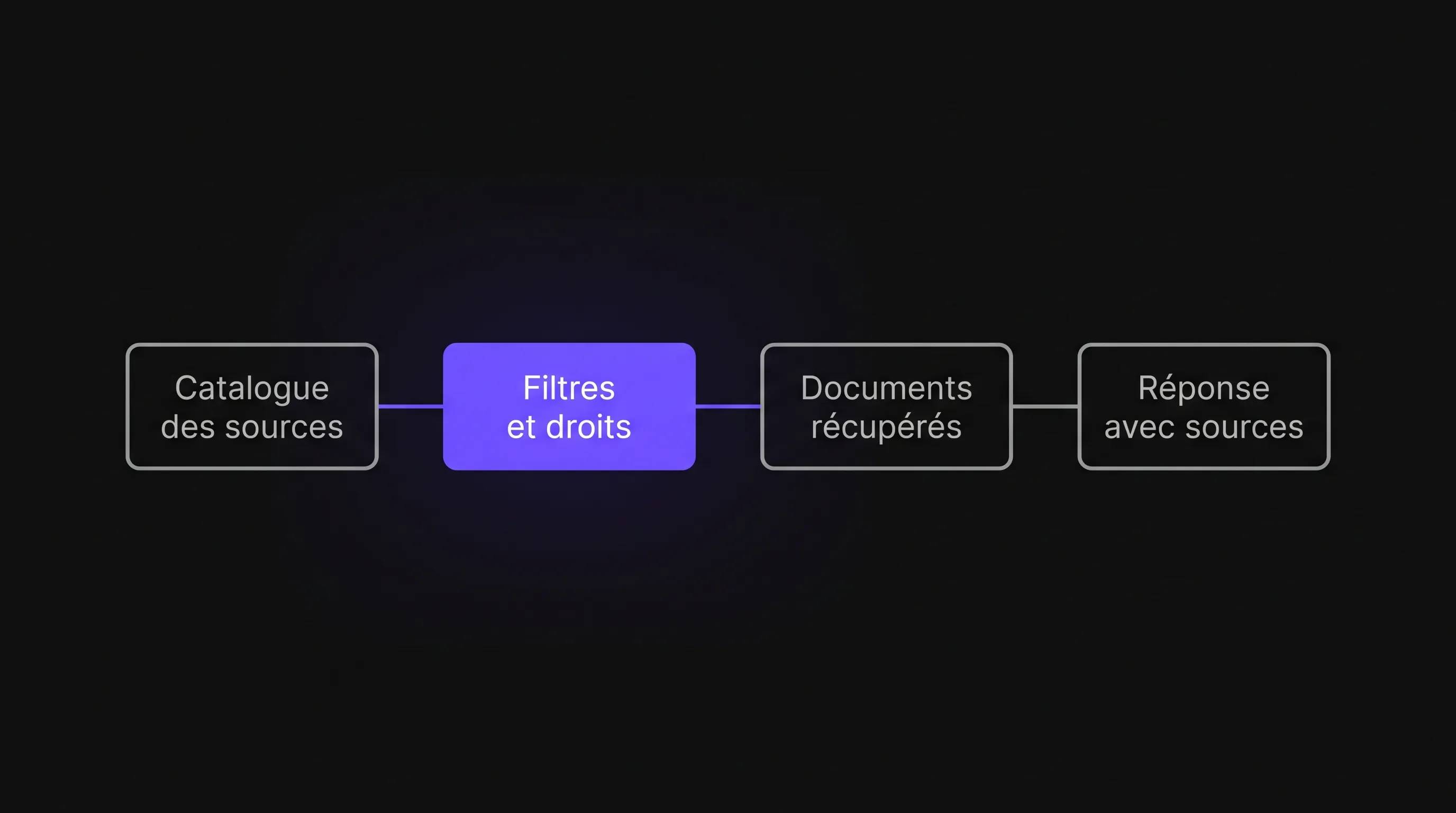
The catalog helps define the authorized corpus: approved procedures, published product documentation, or contracts accessible to the user. A pipeline then retrieves the content, chunks it, and indexes it for search.
With every query, the system must select relevant excerpts while respecting the permissions of the person querying the assistant. A "confidential" metadata tag offers no protection if the search engine ignores this restriction.
The catalog must therefore be tied to access and update mechanisms. A retired procedure must be excluded from search queries. A new version must trigger the scheduled pipeline. The model can then receive the correct excerpts, complete with citations allowing the user to verify the answer.
Example: A Support Assistant That Distinguishes the Right Procedures
Let's look at an illustrative case. A company has help articles, internal procedures, and commercial terms that vary by contract. It wants to assist its support team.
Without prior work on the sources, the search engine might pull up an old refund policy simply because it matches the keywords in the prompt. The answer will sound convincing, but it will be inapplicable to the contract in question.
For this use case combining data and artificial intelligence, the catalog can reference the document's approval status, validity period, target product, and authorized user categories.
The integration layer then uses this information as filtering criteria. If the customer's contract is not identified, the assistant asks for clarification rather than arbitrarily picking a rule. If no valid source is found, it escalates the request to a human.
The expected gain is not just better search. It is the ability to set a clear boundary: the AI either answers from an eligible source or states that it cannot reach a conclusion.
Building a Useful First Catalog Without an Oversized Initiative
A company just starting to structure its data does not necessarily need a dedicated platform on day one. A shared registry can serve as a starting point, provided it remains focused, maintained, and tied to a specific use case.
Start from a Decision or Business Task
First, choose an outcome: finding an applicable procedure, preparing a forecast, or verifying product information. Then, identify only the sources required for that task.
An initial scope might be limited to a single team's approved procedures. Attempting to inventory all company files immediately would make validation harder without necessarily improving the initial use case.
The right question to bring data and artificial intelligence together is: "What information do we need to be able to find, understand, and authorize for this task?" This provides a concrete criterion for deciding what enters the catalog.
Appoint an Owner Capable of Validating Meaning
Every source must have an identifiable owner. Their role does not necessarily involve managing infrastructure: they must be able to confirm the business definition, decide whether a version remains valid, and resolve discrepancies.
The technical team manages connectors, pipelines, and rule enforcement. This separation avoids asking a developer to decide alone which commercial policy is authoritative.
A label stating "reliable data" is not a control. Specify acceptance criteria and the expected behavior when they are not met.
For an initial document scope, a few rules are enough to define the framework:
A source without an owner or approval status stays out of the production corpus.
A change in permissions triggers an access update across systems using the content.
A superseded version is removed from search within a defined timeframe.
An answer lacking an eligible source triggers a request for clarification or escalation to a human.
These rules must be tested within the application, not just recorded in the catalog. At this stage, the relationship between data and artificial intelligence becomes a controllable operational reality rather than mere intent.
Manage Access and Personal Data
The catalog can help identify personal data, its intended purposes, and applicable restrictions. On its own, however, it does not constitute proof of compliance.
The GDPR, particularly Articles 5 and 25, governs principles such as data minimization, accuracy, and data protection by design. For your project, this means checking which information is truly necessary, on what legal basis it is processed, and how long it is retained.
An assistant explaining a refund procedure does not necessarily need access to customer bank details. Removing these fields early reduces exposure without degrading the use case.
Also consider data copies: search indexes, caches, logs, and content sent to third-party providers. Revoking access in the catalog does not automatically remove it everywhere. The propagation of changes must be planned and verified.
Finally, the catalog itself deserves protection. Its descriptions can reveal the existence of confidential projects or contain sensitive examples. Avoid copying personal data into it when neutral descriptions suffice.
Measure What the Catalog Truly Changes
The number of cataloged resources measures the inventory effort, not the reliability of the AI. To evaluate the combination of data and artificial intelligence, observe performance across a set of scenarios representative of real work instead.
Indicator
How to Verify It
Source relevance
Have business teams validate the documents retrieved for each test query
Access control enforcement
Test the same prompt using multiple access profiles
Change management
Update, remove, or replace a source and verify that changes take effect
Response quality
Check accuracy, citations, and the refusal to conclude without evidence
Also record instances where the system fails: conflicting documents, missing context, or inaccessible sources. These help distinguish a data issue from a search or generation issue.
Before expanding scope, confirm that these tests remain satisfactory after an update. A successful demo does not replace a repeatable control.
Frequently Asked Questions
Do you need a catalog to start an AI project? Not necessarily in the form of dedicated software. A limited use case can begin with a simple registry. However, you must identify sources, their owners, their validity, and access rules. The need for specialized tooling grows with volume, change frequency, and user diversity.
What is the difference between a data catalog and a data dictionary? A dictionary primarily describes the structure and meaning of fields: format, unit, definition, or allowed values. A catalog covers resource discovery, business context, data lineage, and terms of use more broadly. It can incorporate a dictionary.
Does a catalog prevent hallucinations? No. It improves source selection and understanding, but a model can still misinterpret an excerpt or generate an unsubstantiated claim. You must also constrain search, require citations, and provide a fallback response when uncertain.
Can data remain in existing tools? Yes, a catalog can reference assets without centralizing them. However, AI processing may require extractions or search indexes. These copies must be identified, secured, and kept up to date according to project rules.
Scope Your First Use Case with Impulse Lab
To structure your data and artificial intelligence projects, start with a clear task, a defined set of sources, and validation criteria. You will then know which metadata to document and which integrations to build.
Impulse Lab supports organizations with AI opportunity audits, custom developments, and adoption training. An audit can help scope your use case and data prerequisites before committing to solution development.