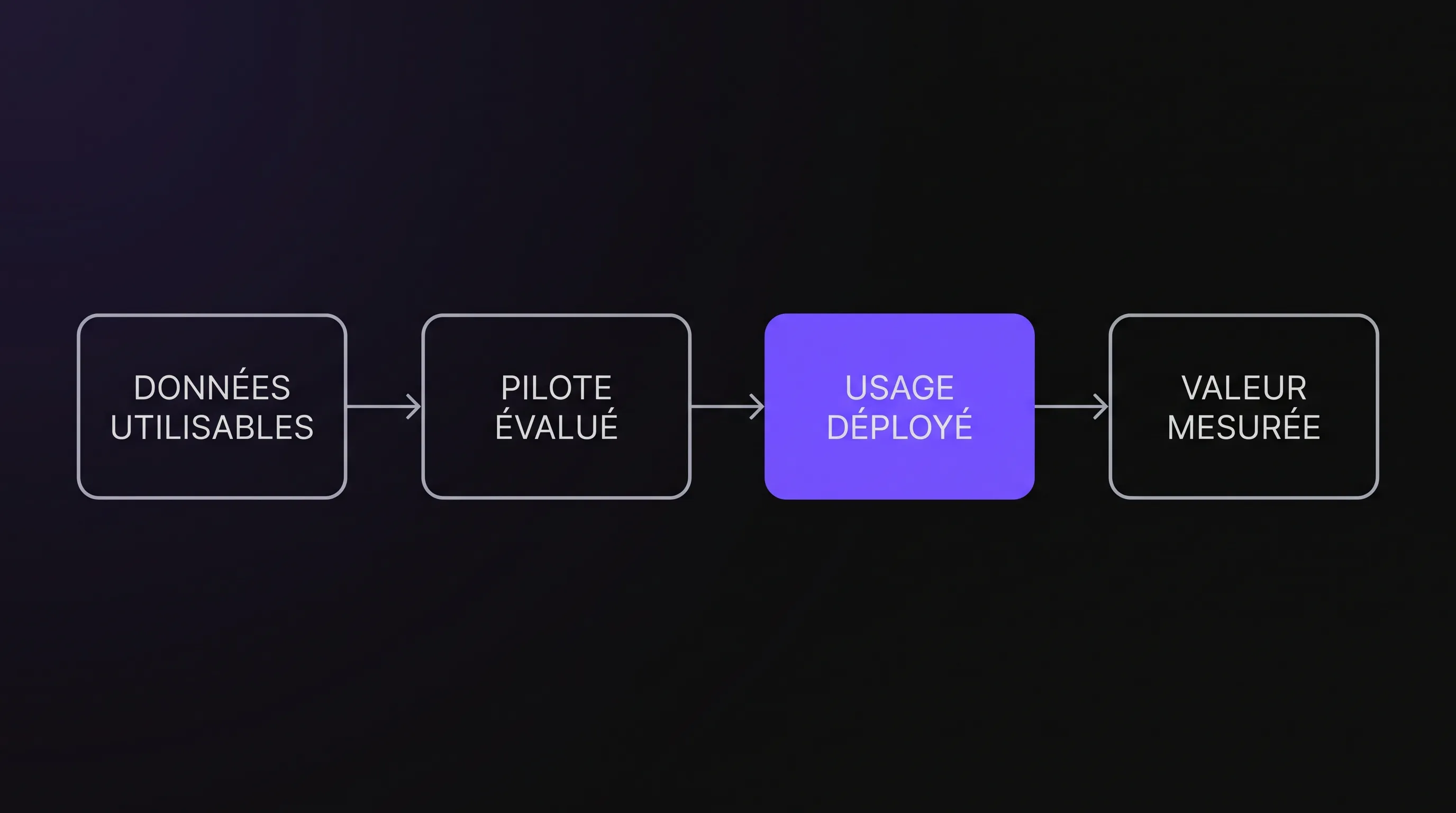
Allocating a data & AI budget in an SMB isn't about choosing clean data over AI tools. As a baseline, allocate 35% to data foundations, 45% to AI use cases, and 20% to adoption and risk management. Fund both across their full lifecycle to achieve measurable returns.
November 12, 2026·10 min read
Allocating a data and AI budget in an SMB is not about choosing between clean data and an intelligent assistant. You need to fund both in the right order, without overlooking integration, teams, and day-to-day operations. As a starting baseline, an SMB with accessible data can allocate 35% to data foundations, 45% to AI use cases, and 20% to scoping, adoption, and risk management. These proportions are a working framework, not a market mandate.
The right breakdown primarily hinges on one question: what is currently preventing your business from turning a specific use case into measurable gains?
Break Down Expenses Before Setting Percentages
Data Foundations: Making Information Usable
This budget line funds data access, quality, and circulation. It includes, for instance, cleaning customer records, connecting to the CRM, deduplicating data, or structuring internal documentation.
An SMB does not necessarily need a comprehensive data platform. For an assistant tasked with retrieving procedures, a reliable knowledge base and well-defined access rights may suffice. To forecast sales, you would instead need to examine historical sales records, stockouts, and product reference consistency.
AI Use Cases: Producing an Operational Outcome
This second line covers licenses or APIs, configuration, testing, business process integration, and ongoing maintenance specific to the solution. Buying a software subscription represents only a fraction of the total cost.
The boundary between data and AI should remain an accounting distinction, not an organizational barrier: each expense is allocated once, even if it benefits both.
Cross-Functional Expenses: Making the Project Adoptable
Scoping, security, training, and user time must not become hidden costs. Also include a contingency reserve for identified risks, such as a connector that turns out to be more complex than planned.
Calculate your total cost of ownership over twelve months, distinguishing between external purchases, capitalized internal time, and recurring operating costs. This approach enables a fair comparison between ready-to-use software and custom development without masking ongoing operational expenses.
Tailor the Allocation to Your Starting Point
The following three scenarios are budget modeling proposals. They do not represent observed industry averages or vendor rate cards.
Accessible data, uneven quality, targeted initial use case
35%
45%
20%
Reliable data, connected tools, validated use case
20%
60%
20%
A company whose quotes are spread across multiple spreadsheets will likely start by standardizing part numbers and structuring permissions. Conversely, a support team with an up-to-date knowledge base can commit more resources directly to the assistant, testing, and system integration.
Your data and AI allocation should therefore target the primary bottleneck to results, not a preference for the trendiest technology. If your roadblock stems from conflicting internal procedures, switching AI models will not fix it.
Before allocating your budget, settle on a primary use case. The methodology for prioritizing profitable AI use cases helps evaluate their business impact. Here, the goal is to properly fund the one you have selected.
Audit Your Data Without Launching a Company-Wide Overhaul
Evaluate a representative sample of real-world workflows, including edge cases. For invoices, check for missing fields and formatting discrepancies. For documents, review their accuracy, readability, and access controls.
Define what constitutes an acceptable baseline with the business lead: which fields are mandatory, which errors require human correction, and which documents must remain excluded? A file that is technically available is not necessarily legally usable or sufficiently reliable.
This audit leads directly to a budgetary decision: clean only the data required for the pilot, reduce its scope, or postpone the project. It avoids funding a complete overhaul of your entire IT system before demonstrating the value of an initial use case.
Example: Allocating a €60,000 Data & AI Budget
Consider an illustrative economic envelope of €60,000 over twelve months, covering external purchases (excluding tax) and internalized staff time. In this example, the company has accessible data but needs to clean it for a first operational use case.
Budget Item
Illustrative Amount
Share of Budget
Expected Deliverable
Scoping & baseline measurement
€3,000
5%
Scope, business owner, and KPIs defined
Data quality, preparation & access
€21,000
35%
Usable targeted data and verified access rights
AI pilot & evaluation
€9,000
15%
Outcomes tested across real-world scenarios
Integration & deployment to production
€6,000
10%
Solution embedded into the business process
Operations, licenses, APIs & support
€12,000
20%
Operations and monitoring over the period
Training & security
€6,000
10%
Staff prepared and appropriate controls in place
Contingency reserve
€3,000
5%
Buffer accessible upon formal sign-off
These figures do not represent a quote. Depending on your scope, using an off-the-shelf software product can reduce integration effort, whereas connecting to a legacy system can significantly increase it.
The reserve is not an automatic spending allowance; it remains distinct from predictable recurring costs. Similarly, the time of an operational lead dedicated to the project belongs in the overall project economics, even if it does not generate an external invoice.
Release Funds in Milestones
Avoid committing the entire budget upfront. A data and AI budget is much easier to manage when each funding tranche depends on concrete proof: data feasibility, output quality, and real-world adoption.
First Decision: Greenlighting the Pilot
The scoping phase must establish a clear baseline: task volume, time spent, error rates, and current costs. It must also verify data access and assign ownership to a business lead responsible for the outcome.
Without these inputs, a pilot may deliver an impressive demo without providing any means to evaluate its financial return. In that scenario, narrow the scope rather than immediately expanding the budget.
Second Decision: Approving Production Rollout
Before starting the pilot, define the go/no-go criteria for production. For a document assistant, criteria might include answer accuracy, the presence of verifiable sources, and compliance with permissions. For invoice data extraction, evaluate critical fields and the time required for manual corrections.
Include a clear off-ramp. If errors remain costly or if users must manually review every single output, further funding should not be granted. Reviewing the stages of developing an artificial intelligence solution helps clarify the deliverables to require before each milestone commitment.
Anticipate Costs That Escalate After the Pilot
A prototype used by three employees will not expose the full operating costs of an enterprise-wide rollout. Your data and AI budget must account for future volume, exceptions, and the ongoing responsibility of maintaining service levels.
For a usage-billed tool, estimate the number of active users, transactions per user, and the fully loaded cost per transaction. A single transaction may involve multiple model calls, document vector searches, and retry attempts upon failure.
Prepare three consumption scenarios: low, baseline, and high. Add licenses, hosting, monitoring, and technical support. The true unit cost is that of a successfully processed record, not merely an isolated API call.
Plan for Maintenance and Data Privacy
A connector can break after a software update. Documentation can quickly become outdated. A previously accurate prompt response can degrade following an underlying model update. Assign a clear owner and dedicated time to oversee these checks.
If personal data is processed, GDPR obligations apply. Pay close attention to data purposes, access levels, retention policies, and processor agreements. CNIL's resources on artificial intelligence provide a helpful starting point to navigate these topics.
Additionally, clarify with your vendor how data is used, where it is processed, and how it can be exported or permanently deleted. These factors can influence your technical choices and shift your budget allocation.
Calculate Value Without Confusing Time Saved with Cash Flow
When evaluating your data and AI budget, distinguish between three types of outcomes: freed-up capacity, actual cost reductions, and net new margin. One hour saved does not automatically equal one hour of payroll eliminated.
Consider this illustrative, non-guaranteed model: a process yields a potential 300 hours saved per month at full adoption, after factoring in time spent on reviews. The company values internal time at €40 per hour, assumes a 60% adoption rate, and estimates that half of the reclaimed time will be genuinely repurposable for productive tasks.
With €12,000 in annual recurring operational expenses, the net estimated contribution after operations reaches €2,600 per month. If €48,000 was invested upfront, the simple payback period is approximately 19 months once usage stabilizes—potentially longer if adoption ramps up gradually.
This calculation does not reflect direct cash flow. To declare actual cash savings, pinpoint an eliminated line-item expense, such as outsourced contracting. To claim revenue growth, measure the additional gross margin directly attributable to the new capability. If freed time simply absorbs increased customer volume with existing headcount, classify the benefit as operational capacity.
Structuring Trade-Offs Over the First 90 Days
Days 1 to 30: Confirm Scope and Costs
Select a single process, benchmark its current performance, and assess the underlying data required. Build a twelve-month budget separating implementation from operations, explicitly accounting for internal staff time.
At this stage, your data and AI budget must primarily answer three questions: what target value are you pursuing, which obstacle must be cleared first, and what is the minimum expenditure required to validate the core hypothesis?
Days 31 to 60: Test with Real Users
Restrict the pilot to an engaged group capable of reporting anomalies and recording the time spent correcting errors. Intentionally incorporate difficult edge cases, not just optimal scenarios.
Compare outputs to the baseline workflow and calculate the cost per successful task. If the pilot demands more data preparation than anticipated, make an explicit decision: clean the data, narrow the scope, or halt the project.
Days 61 to 90: Decide on Expansion
Leadership approves further rollout based on actual adoption, quality metrics, and total ownership costs. A phased expansion helps validate real-world usage and cost assumptions before rolling out the tool across the entire organization.
Review budget allocations quarterly. An initial data investment may benefit subsequent use cases, but each new initiative must justify itself on its own merits. Avoid crediting a new project with cost savings that have already been booked elsewhere.
Frequently Asked Questions
What is the minimum budget an SMB should plan for? There is no universal minimum for a data and AI initiative. A narrow use case leveraging off-the-shelf software and accessible data requires far less investment than custom integrations. Start by scoping your volumes and internal time commitments, then ensure long-term operational costs remain sustainable.
Should we invest in our data before testing AI? Yes, if data quality, access restrictions, or usage rights prevent an accurate test. Otherwise, prepare only the specific subset needed for the pilot. A comprehensive data overhaul is not an automatic prerequisite.
Is it better to buy off-the-shelf software or build a custom solution? Compare total cost of ownership, process fit, integrations, and exit flexibility. Standard software is often ideal for common workflows. Custom development is justified when specific business constraints create enough proprietary value to warrant funding ongoing maintenance.
Who should approve the budget? Executive leadership oversees financial commitments, paired with a business lead accountable for measurable results and a technical lead evaluating feasibility. Depending on the data processed and associated risks, include security and data privacy officers.
Building a Budget Tailored to Your SMB
Before purchasing software licenses or launching custom development, evaluate a use case across its entire lifecycle: data preparation, pilot, integration, user adoption, and ongoing operations. Demand explicit assumptions and predefined off-ramp criteria.
Impulse Lab supports businesses with AI opportunity audits, custom developments, integrations, and training. An audit helps you structure your data and AI budget around your specific workflows and operational constraints, rather than relying on generic percentages.