How to Choose a Web Development Partner for an SME
Stratégie d'entreprise
Développement logiciel
Outils internes
Gestion de projet
Choosing a web development partner for an SME means entrusting external experts with part of your operations. A well-framed tool streamlines daily work, but poor planning leads to unexpected costs and technical lock-in. Here is how to define requirements, compare offers, and secure your project.
November 08, 2026·10 min read
Choosing a web development partner for an SME means entrusting an external team with a critical part of your commercial or operational workflow. A client portal, an internal tool, or a CRM-connected website can streamline daily work. Poorly framed, however, the same project can generate unexpected costs and create dependencies that are difficult to undo.
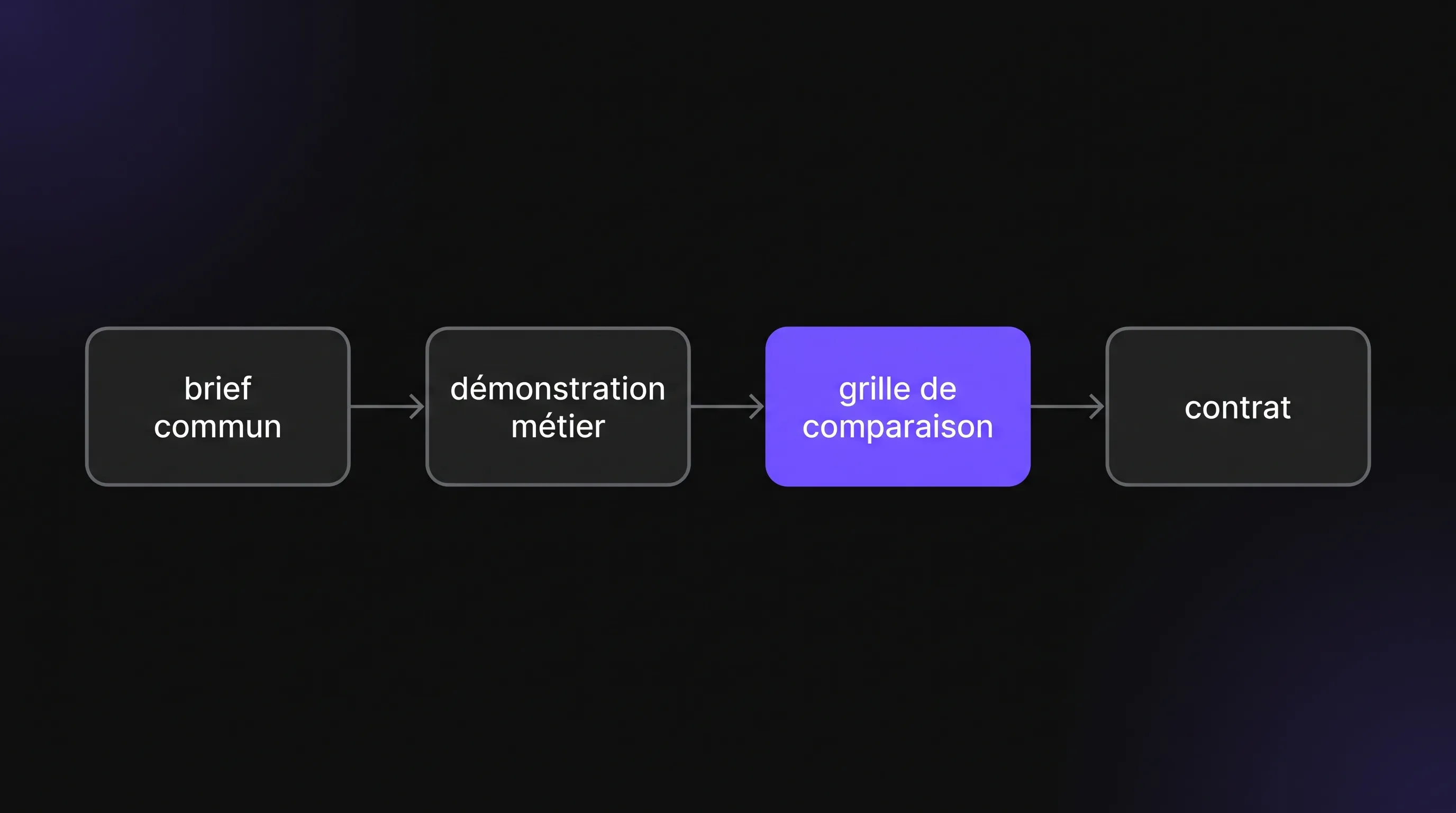
The right partner is not the one who promises the most features. It is the one who makes their commitments verifiable. To select them, compare candidates against a shared set of requirements, ask for tangible proof, and evaluate what happens after delivery.
Define the Expected Outcome Before Reaching Out
Before contacting service providers, summarize the problem to solve in a single sentence. "We want a modern portal" is too vague. "Our clients must be able to retrieve their documents without calling our team" immediately opens a concrete discussion about users, data, and expected outcomes.
Next, pick a metric you can measure: file processing time, number of duplicate data entries, support requests, or form completion rates. Record your current baseline, even if imperfectly. You will then have a clear benchmark for comparison.
Finally, appoint a designated decision-maker on the SME side. While a provider can suggest trade-offs, they cannot decide your business priorities for you. Without an available decision-maker, approval bottlenecks often become the main obstacle to project progress.
Which Type of Web Development Partner Fits Your SME?
Choosing between a freelancer, an agency, and an in-house team primarily depends on the required continuity and your capacity to manage the work.
A freelancer can be a great fit for a well-defined scope if you have an internal point of contact capable of specifying requirements and validating deliverables. However, be sure to check how absences, maintenance, and complementary skill sets—such as UI/UX design or infrastructure—will be handled.
An agency brings together diverse disciplines and handles their coordination. Ask specifically who will be working on your project, their availability, and their level of seniority. A firm's advertised headcount does not guarantee that your account will benefit from a dedicated, stable team.
Hiring in-house makes sense if your business requires continuous development and you have the technical leadership to manage the role. A hybrid setup can also work well: internal product management paired with external technical execution and expertise.
Choose the model your organization can realistically support. An SME without a technical director must especially verify who will make architectural decisions and how those choices will be explained to stakeholders.
Send the Exact Same Brief to All Candidates
To compare web development proposals accurately, start with an identical document. Otherwise, one estimate might include data migration while another leaves it out, without the discrepancy being immediately noticeable.
A concise brief is sufficient for an initial consultation, as long as it includes key details:
The business problem and success metric: What must tangibly change for the company.
Users and priority journeys: Who will use the tool, and to accomplish which tasks.
The existing ecosystem: Software, data, available access, and known integration constraints.
Project boundaries: Budget envelope, justified deadlines, and out-of-scope items.
Comparison terms: Expected deliverables, assumptions to clarify, and requirements regarding ongoing maintenance.
Ask candidates to distinguish between what they know, what they assume, and what still needs investigation. An estimate tied to explicit assumptions is far more actionable than a fixed-price bid built on unknowns.
If requirements remain too uncertain, consider a paid scoping phase before committing to development. In that case, insist on reusable deliverables: user journeys, a prioritized scope, risk assessments, and a revised estimate. This work should empower you to make an informed decision, rather than merely set up a quote with a single vendor.
Compare Proposals with a Weighted Scorecard
A selection scorecard prevents you from choosing a vendor based solely on sales polish. For a web development project, you can start with the weighting below and adapt it to your specific risk profile. This is a recommended decision tool, not a rigid industry standard.
Criterion
Suggested Weight
Evidence to Request
Business Understanding
25%
Rephrasing of requirements and proposed trade-offs
Delivery Methodology
20%
Demo example and acceptance testing procedure
Maintainability
20%
Planned documentation, testing strategy, and maintenance setup
Security & Data
15%
Access management, hosting, and identified sub-processors
Total Cost of Ownership
10%
Itemized upfront, recurring, and variable costs
Reversibility
10%
Procedures for transferring code, data, and access credentials
Score each criterion from 0 to 5, then apply the weights. Have the business lead and the project manager score candidates independently, then discuss discrepancies.
Certain items should remain immediate deal-breakers regardless of an otherwise strong overall score: refusing to clarify intellectual property rights, lacking a backup strategy, or an inability to identify the core team. A solid average score should never conceal an unacceptable operational risk.
Validate Promises Against Your Own Scenario
A portfolio proves that a vendor has completed projects; it does not prove they can solve your specific challenges. During interviews, present web development candidates with a real-world scenario from your business operations.
For example: a sales rep enters an order, the CRM detects a duplicate record, and the invoicing tool stops responding. Ask how the team would analyze the issue, what decisions they would require from you, and how the end-user would be notified. You are assessing their problem-solving methodology here, not their ability to improvise a complete architecture on the fly.
Also clarify the provider's exact contribution on comparable case studies. Did they design the entire product, build a single feature, or take over legacy code? If a reference call with a former client is possible, ask about scope changes and post-launch incidents, not just the initial launch.
If major technical uncertainties persist, a small, paid proof-of-concept is often better than trusting promises. Its objective, deliverable, and success criteria must be agreed upon beforehand.
Assess the Total Cost of Ownership Over a Shared Timeline
Two proposals are only comparable if they cover the same cost items over the same time horizon. Choose a two-year timeframe, for instance, and request an itemized breakdown across design, development, hosting, licensing, maintenance, and future enhancements.
Factor in internal staff time as well: workshops, data preparation, user acceptance testing, and team training. This time may not appear on an external quote, but it demands internal resources. Also make sure to identify variable costs tied to usage volumes, third-party services, or paid APIs.
Do not confuse a low daily rate with a low final cost. A more expensive proposal may include testing or data migration that others omitted. Conversely, a high fixed price does not guarantee superior quality: every price difference should correspond to a clearly identifiable deliverable or responsibility.
Finally, ask how change requests will be handled and priced. Who estimates their impact? Who signs off on them? What can be cut from the existing scope to keep the budget balanced? Financial control depends just as much on this change management process as it does on the initial quote.
Secure the Contract and Project Handover
A web development agreement must establish clear responsibilities during the build, but also after delivery. Specify acceptance testing criteria in detail: which workflows will be tested, by whom, and within what timeframe? A smooth live demo is no substitute for formal acceptance testing conducted under agreed conditions.
Next, clarify intellectual property rights for all deliverables. Gaining access to source code does not automatically transfer the necessary legal ownership rights. The contract must distinguish between custom-built code, pre-existing proprietary components, and open-source or third-party tools, along with their respective licenses. Have critical clauses reviewed by legal counsel.
Regarding personal data, clearly define each party's role. When the vendor acts as a data processor, Article 28 of the GDPR mandates a formal data processing agreement. Check user access controls, sub-processors, and conditions for data retrieval or secure erasure.
Lastly, ask one essential question: "If we switch partners down the road, what assets do we retrieve, and how quickly?" The response should cover repository access, deployment guides, data exports, and administrative accounts. Ensure that credentials and secrets are transferred securely. Strategic assets—especially domain names and cloud accounts—must always remain under your company's ownership.
Plan for Post-Launch Support Before Signing
A launched application continues to evolve: software dependencies require updates, bugs need fixing, and business processes shift. Clarify who will handle support tickets and how issues will be prioritized. Differentiate response time, target recovery time, and resolution time—each represents a very different operational commitment.
Also verify backup procedures. Their mere existence is not enough; ask who monitors backup health and how restoration routines are tested. For an SME dependent on its internal tools, a proven recovery process often matters more than an extra launch feature.
Your web development partner should also outline how future features will be prioritized and deployed. Regular check-ins help review real-world adoption, troubleshoot issues, and plan upcoming releases.
Make a Clear, Documented Decision
Following interviews, ask short-listed finalists for a revised proposal incorporating the clarifications discussed. Avoid selecting a vendor based on initial proposals that have become outdated during discussions.
Next, write a one-page decision memo detailing the expected outcome, the rationale behind the selection, outstanding risks, and prerequisites before kickoff. Attach the comparison scorecard and budget assumptions. This document ensures continuity and clarity if internal stakeholders change.
If none of the candidates adequately address your requirements, narrow your scope or resolve key uncertainties before running a new search. Rushing to sign off on an ill-defined project does not remove risk; it simply pushes it into execution, where it becomes far harder and more expensive to manage.
Frequently Asked Questions
Should you hire a local partner? Geographic proximity can simplify in-person workshops, but it guarantees neither quality nor availability. Pay closer attention to overlapping working hours, communication frequency, and direct access to the developers doing the actual work.
How many vendors should you consult? Two or three qualified candidates are usually enough for a thorough comparison. The goal is not to collect numerous quotes, but to obtain in-depth, thoughtful responses on an identical project scope.
Should you impose a specific tech stack on the partner? Only if justified by genuine internal constraints, such as existing team competencies or legacy integrations. Otherwise, ask candidates to justify their technical recommendations, present alternatives, and explain the long-term maintenance implications.
How do you choose between two closely matched proposals? Look back at tangible evidence: the rigor of their assumptions, the team directly assigned to your account, change management procedures, and offboarding terms. An extra working session focused on your single biggest operational risk will reveal more than another generic sales presentation.
Does AI need to be part of the project? Not necessarily. A solid API integration or conventional automation is often all that is needed. Only incorporate AI capabilities if their practical utility, operational limits, and recurring costs are clearly defined.
Scope Your Project with Impulse Lab
Impulse Lab supports businesses with custom web and AI platforms, workflow automation, and seamless integration with existing tools. Our delivery model features weekly milestones and continuous client collaboration.
To prepare an introductory call with the Impulse Lab team, gather your business problem, relevant systems, and operational constraints. We will help you define an actionable scope and identify key risks to evaluate before you commit.