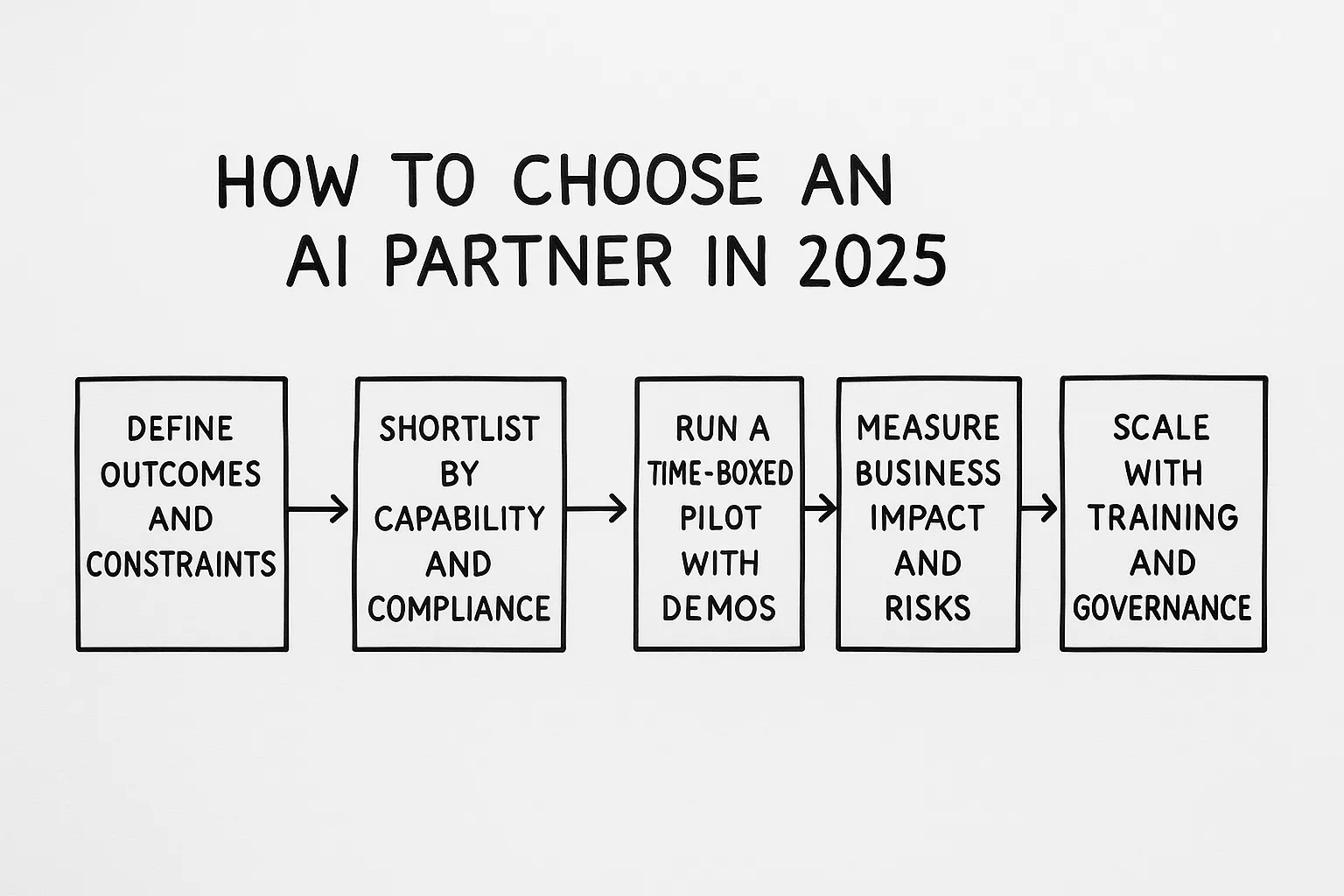
Choosing the right partner for AI projects in 2025 is less about flashy demos and more about predictable value, security, and rapid iteration. Amidst new regulations, fast-evolving model ecosystems, and growing stakeholder expectations...
December 07, 2025·8 min read
Choosing the right partner for AI projects in 2025 is less about flashy demos and more about predictable value, security, and rapid iteration. Between new regulations, fast-evolving model ecosystems, and growing expectations from business stakeholders, the agency you select will determine whether AI becomes a cost center or a competitive advantage.
This guide offers a practical, vendor-agnostic playbook for evaluating agencies, de-risking pilots, and industrializing solutions that actually move business metrics.
Start with results, not algorithms
Before looking at portfolios, write down three things:
Business outcomes. Define the metric you want to improve, e.g., reduce average handling time by 20%, increase qualified leads by 15%, decrease manual document processing by 60%. Associate each result with an owner and a baseline value.
Constraints. Data availability and quality, compliance requirements, privacy and retention rules, integration scopes, SLAs, change management, and budget.
Adoption plan. Who will use the solution, how workflows evolve, and how success will be measured at the first 30, 60, and 90 days.
Teams aligned on the destination choose better partners and write better specifications.
What a modern AI agency must bring in 2025
Product mindset, not just prototypes. Look for teams that ship to production, instrument results, and iterate weekly. Delivery cadence and measurable impact matter more than research brilliance.
Full stack capabilities. Data engineering and governance, systems integration, frontend and backend web development, MLOps or LLMOps, experimentation, and analytics. High-value projects usually cross these boundaries.
Integrations and automation. Real value is created where AI meets your systems. Ask for examples of integration with your stack, e.g., Microsoft 365, Google Workspace, Salesforce, HubSpot, Slack, ServiceNow, Zendesk, Snowflake, BigQuery, Databricks.
Human change management. Usability, training, and documentation determine adoption. Agencies that offer onboarding, playbooks, and workshops outperform those that just ship code.
Transparent collaboration. Weekly demos, shared backlog, and client portal to close feedback loops quickly and avoid surprises.
The evaluation checklist and questions that reveal true capability
Use these questions during discovery calls and RFPs. Good answers are specific, measurable, and tied to production results.
Question to ask
Why it matters
What a good answer looks like
What business results have you delivered in production over the last 12 months, and how were they measured?
Distinguishes demos from real deployed value
Concrete metrics, baselines, and timelines, e.g., 32% triage time reduction in 8 weeks
How do you arbitrate between Retrieval-Augmented Generation and fine-tuning?
Avoids over-engineering
Clear decision tree, cost and data trade-offs, examples of successful usage for each approach
How do you estimate and manage unit economics per task?
Maintains predictable costs at scale
Forecast of cost per document or conversation, caching or batch processing strategies, fallback models, monitoring
What is your evaluation and testing approach?
Ensures quality and reduces regressions
Offline and online evaluations, reference datasets, human review loops, continuous evaluation in CI/CD
How will you integrate with our systems?
Integration is often the critical path
Named connectors, API limits, authentication methods, data flow diagrams, error handling strategy
How do you manage data privacy, PII, and retention?
Compliance and trust
Data minimization, masking, data residency by region, secrets management, documented retention policies
What is your security posture?
Reduces risk
Technical signals that distinguish the best partners
Architecture choices explained in business terms. Teams must articulate why a simple RAG system might beat a fine-tuned model for your use case, or vice versa, with clear cost and accuracy trade-offs.
Thoughtful LLMOps. Versioned prompts and datasets, reproducible experiments, CI for prompts and chains, offline metrics plus production feedback loops, observability with trace capture, and automated rollback plans.
Cost control from day one. Prompt optimization, response truncation, retrieval filtering, hybrid search, caching, batch inference, and fallback to smaller or open-source models when quality permits.
Security and abuse management. Input validation, jailbreak resistance, content filtering, and red teaming based on OWASP LLM risks.
Maintainability. Clear repositories, modular services, environment parity, infrastructure as code, and handover documentation.
Pricing models in 2025 and how to de-risk them
Discovery and roadmap, fixed price. Useful for scoping complexities, capturing ROI hypotheses, and defining data readiness. Deliverables must include architecture options, a backlog, and a value model.
Time-boxed pilot, billing per sprint. Two to six weeks, weekly demos, a targeted KPI, and a go/no-go decision. This limits risk while proving integration paths and real costs.
Time & Materials or build by sprints, prioritized backlog. Relevant once the approach is validated when you want predictable velocity.
Outcome-based components. In certain contexts, small bonuses for hitting agreed objectives can create alignment. Keep them simple and well-measured.
Red flags: large upfront commitments before a discovery phase, vague acceptance criteria, lack of transparency on model and infra costs, proposals that prioritize novelty over business impact.
Proof of value, then scale
Pilot success criteria. Define a metric that matters, e.g., document classification accuracy above 92% on your data, or average processing time reduced by 20% on a specific queue, with confidence intervals.
Production readiness. Security reviews, data privacy approval, logging, alerting, fallback plans, and runbooks for incident management.
Incremental deployment. Start with a small cohort, collect feedback, iterate weekly, then expand. Plan training and create a tip sheet for end users.
Compliance is not optional
Regulators and clients expect governance. Ask how the agency maps risks against the following:
NIST AI RMF, govern, map, measure, manage functions
The EU AI Act, risk categories and obligations starting to phase in between 2025 and 2026
Your sector-specific rules, e.g., HIPAA, GDPR, CCPA, PCI DSS, or FINRA
Security frameworks, e.g., AICPA SOC 2, ISO 27001, and the emerging ISO/IEC 42001 standard
The right partner won't just pass audits; they will help you build repeatable governance that accelerates deployments instead of slowing them down.
A practical scoring matrix to copy
Rate each shortlisted partner from 1 to 5 on the following categories. Weight the categories according to your priorities.
Named systems, realistic constraints, error handling
Delivery cadence and transparency
15 %
Weekly demos, shared backlog, environment access
Technical depth, LLMOps
15 %
Evaluation frameworks, versioning, observability
Change management and training
10 %
User enablement, documentation, rollout plans
Commercial clarity
10 %
Clear scope, acceptance criteria, predictable cost model
Total the weighted score for each provider and choose the pilot partner with the highest score and the clearest path to value in under a quarter.
Frequently Asked Questions
What budget should be planned for an initial AI pilot? It varies by scope and integrations. Many organizations start with a fixed-price discovery to clear up uncertainties, then follow with a time-boxed pilot over a few sprints. The key is to define a business metric and frame the timeline to make a clear go/no-go decision.
How long before seeing value? Well-scoped pilots often bring measurable impact in 4 to 8 weeks if data access and integrations are ready. Look for weekly demos and incremental production releases rather than a big final reveal.
Should we choose open source or proprietary models? Choose based on data sensitivity, cost, and quality. Open models reduce vendor lock-in and sometimes costs, while proprietary models may offer better performance on certain tasks. A good partner will compare options on your data and plan fallback models.
RAG or fine-tuning, which is better? Retrieval-Augmented Generation is generally suitable when you have dynamic or private knowledge bases and need to ground sources. Fine-tuning helps with style, structured outputs, or domain specificity when you have quality labeled examples. Many production systems combine both.
How to manage privacy and compliance? Start with data minimization, clear retention policies, encryption at rest and in transit, regional data residency when required, and human-in-the-loop for sensitive actions. Align with the NIST AI RMF and your sector rules.
What internal roles should be assigned? An executive sponsor, a product owner, a technical lead for integrations, and a security or compliance point of contact. Clear governance accelerates decisions and maintains scope.
How to avoid vendor lock-in? Contractually secure ownership of code, prompts, evaluation datasets, and infrastructure as code. Prioritize portable components and document deployment steps. Ask for a handover plan.
How Impulse Lab can help you
If you are looking for a partner focused on measurable results and rapid iteration, Impulse Lab is here for you. We offer AI opportunity audits, custom web and AI platforms, process automation, and integration with your existing tools, all accompanied by AI adoption training to make your teams succeed. Our delivery model emphasizes weekly progress, a dedicated client portal, and end-to-end development with your team involved at every step. We also operate a referral commission program for partners and clients who recommend us for new opportunities.
Ready to evaluate opportunities, launch a controlled pilot, or scale an existing initiative?