How to Prepare for an AI Consulting Engagement on the Client Side
Intelligence artificielle
Stratégie d'entreprise
Stratégie IA
Gestion de projet IA
An AI consulting engagement begins before the first workshop. For the client, it means making a problem observable, rallying the right people, and setting the conditions to apply recommendations. Without this, the consultant risks working on assumptions your team will have to correct later.
November 15, 2026·12 min read
An AI consulting engagement begins well before the first workshop. On the client side, the work involves making a problem observable, rallying the right stakeholders, and establishing the conditions under which recommendations can actually be implemented. Without this groundwork, the consultant risks operating on assumptions that your team will eventually have to correct.
You do not need to arrive with a technical architecture or a pre-selected solution. However, you must be able to explain what is currently blocked, grant access to relevant information, and clarify who holds decision-making authority. Here is how to assemble this initial briefing pack without turning preparation into a full-scale project of its own.
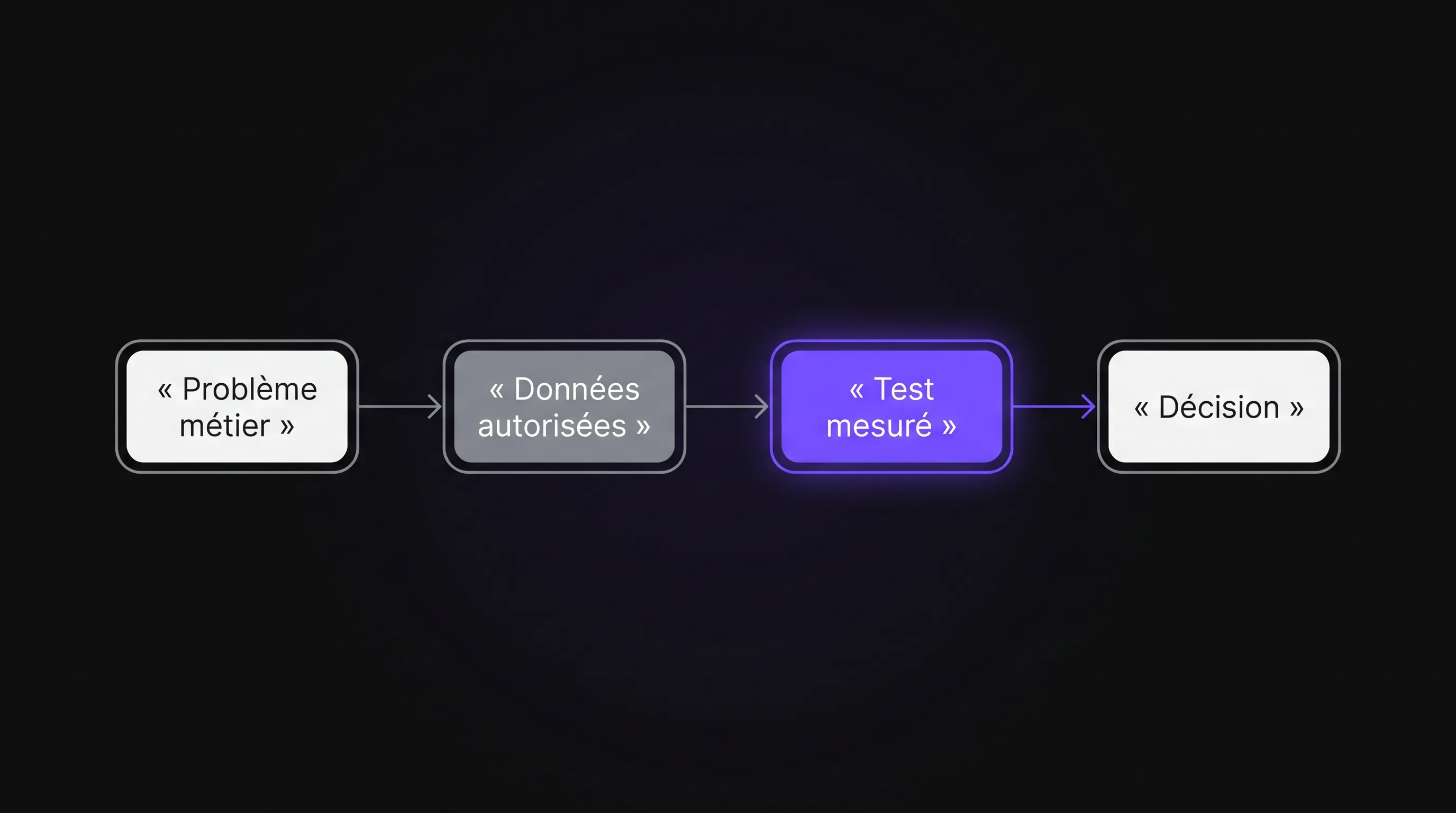
Start from a business problem and document the current state
"We want to use AI in customer support" expresses an intention, not yet an actionable requirement. A much more useful framing would be: "Our agents spend too much time searching for information across three different tools before answering straightforward requests."
Describe a real-world workflow, from its trigger to its outcome. Specify the people involved, the tools used, volumes, and frequent exceptions. Include a few anonymized examples: a routine ticket, an ambiguous inquiry, and an edge case that requires escalation.
Next, document a baseline metric, even if imperfect. Handling time, rework volume, response latency, or error rate: choose an indicator that you can reliably measure again later. Note its source and its limitations. A rough estimate provided by team members does not carry the same weight as data extracted from real service logs.
For an AI consulting engagement, this description is far more valuable than a wish list of desired features. It also helps verify whether conventional automation, better documentation search, or a simple process adjustment might suffice on its own.
Conclude with the expected decision: are you looking to prioritize opportunities, test a hypothesis, or prepare for full deployment? These objectives correspond to fundamentally different missions. Mixing them up from day one makes consulting proposals hard to compare and outcomes difficult to validate.
Designate the people who can truly move the project forward
An available contact person is no substitute for a decision-maker. Conversely, an executive who signs off on the budget may not understand daily operational edge cases. Preparation involves bringing these two perspectives together, even within a smaller organization where one person wears multiple hats.
Client-side role
Expected contribution
Point to clarify before launch
Sponsor
Arbitrates priorities, budget, and project continuation
Who breaks ties if multiple departments disagree?
Business Lead
Explains the workflow and evaluates output quality
How much dedicated time can they spend on workshops and testing?
Technical Lead
Confirms access rights, integrations, and IT system constraints
Who can authorize integrations or spin up a test environment?
Data & Compliance Lead
Verifies authorized usages and mandatory safeguards
When should the DPO, legal, or infosec teams be consulted?
Avoid setting up a permanent steering committee for every minor topic. Instead, designate an operational project lead empowered to pull in the right specialists at the right time.
In AI consulting projects, roadblocks often stem less from technical hurdles than from decisions without clear owners. Make sure names, responsibilities, and validation processes are explicitly documented in the kickoff brief.
Also make sure to reserve time for end users. Their involvement should not be restricted to an introductory discovery interview: they will need to review edge cases, evaluate pilot outputs, and identify situations where the AI tool ends up creating more work instead of eliminating it.
Prepare a data inventory, not a massive data dump
Start by mapping out where the necessary information lives: CRM, ERP, shared mailboxes, file drives, or internal knowledge bases. For each source, identify its owner, data format, update frequency, and known governance restrictions.
Then categorize your data into three buckets: data that exists and is accessible, data that exists but requires approval/access setup, and data that is not currently collected. This distinction prevents stakeholders from treating a use case as immediately feasible when its foundational raw material is still missing.
Preparing data for AI consulting does not mean exporting your entire archive. Start by gathering a small, representative sample once permissions and security guidelines are checked. It should include typical records, missing-field examples, and tricky edge cases—not just clean, easy-to-process files.
Include the business rules that give documents their context. An outdated internal guideline, a rarely completed field, or a status tag used inconsistently across teams can distort an AI model's analysis without triggering any visible technical errors.
Do not open production environments by default. Define authorized individuals, access durations, and revocation procedures. Depending on the context, a sandbox environment or synthetic data is often preferred for initial discovery.
If sharing actual samples is not yet possible, provide data schemas and a few realistic, clearly labeled dummy records. This enables the consultant to identify structural unknowns without exposing sensitive business information.
Draft an AI consulting brief that enables a clear yes or no
A good starting brief can easily fit on two pages, supplemented with appendices for technical constraints and concrete examples. Its purpose is not to lock in a solution prematurely, but to make expectations and boundaries fully transparent.
You can structure it around this framework:
Observed problem: Affected process, teams impacted, and current operational consequences.
Engagement goal: Specific business decision to be made or technical hypothesis to test.
Initial scope: Targeted teams, types of files/tickets, tools in scope, and explicit exclusions.
Available materials: Baseline metrics, process documentation, sample records, and data sources.
Constraints: Scoping budget, target deadlines, security standards, and team availability.
Deliverables: Expected work products, acceptance criteria, and designated reviewers.
Distinguish vendor commitments from the hypotheses to be tested. A consultant can commit to delivering a prioritized opportunity map and an evaluation framework. They cannot credibly guarantee a specific operational efficiency gain before examining your real-world data and workflows.
When detailing deliverables, avoid vague terms like "complete AI strategy." Ask instead for a prioritized list of use cases, underlying business case assumptions, technical dependencies, and a reasoned recommendation on next steps.
Our overview of AI consultant missions and deliverables can help you distinguish between diagnostic work, rapid prototyping, and production development. This distinction should be clearly mirrored in both the proposal and the acceptance criteria.
Clarify responsibilities regarding data and outputs
A standard commercial contract rarely settles all operational data-handling questions. Before authorizing data processing, identify the exact data involved, where it is transmitted, and who can access it.
During an AI consulting project, clarify which third-party APIs or cloud services will be utilized, whether data will be retained, and whether using your data to train vendor models is contractually excluded where required. Review technical logging policies, backup mechanisms, subprocessors, and potential data transfers outside the European Economic Area.
When personal data is involved, GDPR roles (controller vs. processor) must be clearly established based on actual operations. Hiring an external consultancy does not exempt your business from its compliance obligations. The CNIL on artificial intelligence guidelines provide a practical framework to prepare discussions with your DPO or legal counsel.
Also evaluate obligations under the EU AI Act, depending on the system's intended purpose, deployment model, and your organization's role. Different projects fall under different risk classifications and compliance tiers.
Finally, determine who audits outputs and who has the authority to pull the plug. Whether generating client communications, financial summaries, or HR recommendations, define mandatory validation checkpoints and explicitly prohibited automated actions. "Human-in-the-loop" supervision must be an assigned operational responsibility, not just an empty bullet point in a project slide.
Build a comprehensive budget and distinguish freed-up capacity from actual cost savings
Factor in the internal work remaining on your side
The consulting invoice represents only a fraction of the total cost. You must also factor in internal time spent on interviews, data curation, testing, and reviews. Later, account for integration overhead, software license/API usage, ongoing maintenance, and change management training.
When comparing external AI consulting against building capabilities entirely in-house, evaluate both options across the same scope and timeframe. A consulting project that delivers operational system integration cannot be compared strictly against the monthly salary of an internal hire who would still need to research, architect, build, and support the tool from scratch.
A hybrid model is often effective: the consultant guides the scoping, architecture, or early build, while an internal technical lead is trained to manage and evaluate the solution long-term. Ensure that explicit documentation and knowledge transfer are included deliverables rather than assumed outcomes.
Quantify a hypothesis without promising immediate cash returns
Consider this illustrative example: 600 monthly requests with two minutes saved per request yields 20 hours of freed-up capacity. Valued at an internal baseline of €35 per hour, this represents €700 in theoretical monthly capacity.
If operating the system costs €150 per month, €550 in theoretical value remains before amortizing upfront setup costs. However, this capacity does not automatically translate into bottom-line cash savings. You must determine how that recovered time will actually be reinvested, while accounting for residual manual reviews and corrections.
Build three scenarios—conservative, baseline, and optimistic—and identify the single assumption that most heavily swings the business case. That critical assumption is usually the very first hypothesis your pilot should test.
Organize the final days before kickoff
Preparation should never turn into an unguided internal audit. Its purpose is simply to ensure a productive kickoff and surface dependencies before they turn into blockers.
Here is an example timeline, adaptable to your organization's size:
Timing
Client-side action
Expected outcome
Two weeks before
Select priority problem and appoint executive sponsor
Shared alignment on project focus
Week before kickoff
Assemble baseline metrics, samples, and documentation
Accessible briefing folder for authorized team members
A few days before
Confirm attendees, technical access, and constraints
Blockers identified and assigned to owners
Kickoff meeting
Validate scope, deliverables, and decision milestones
Agreed-upon project roadmap
To prevent AI consulting from turning into an endless series of scoping workshops, share the documentation pack ahead of the kickoff. Dedicate synchronous meeting time to resolving disagreements and clarifying unknowns, rather than reading files together in silence.
Agree on a lean communication rhythm: a recurring status check-in, a dedicated channel for quick questions, and a single source of truth for key decisions. Any scope change requests should immediately be evaluated alongside their impact on budget, timelines, or resources.
Track external dependencies in a lightweight register: requested deliverable/access, designated owner, and required completion date. If IT access takes longer than expected, the right reaction is not to bypass security protocols, but to decide which analytical tasks can advance in parallel and which must be rescheduled.
Decide now how you will evaluate what comes next
Even if the initial engagement is purely diagnostic, clarify the evidence required before approving an investment in a pilot. This might include proven data accessibility, a realistic business case, or confirmation of a critical API integration.
If a pilot is already planned, define its evaluation framework before looking at early outputs. Test against representative hold-out cases that were not used during prompt engineering or model tuning. Compare the AI-assisted process directly against the legacy manual workflow across equivalent tasks, factoring in human review time and rework.
At the end of an AI consulting phase, a constructive decision generally takes one of three forms: proceed to implementation, iterate and retest, or stop. Shutting down an initiative that shows insufficient ROI or excessive risk is a completely successful outcome if backed by verifiable evidence.
Establish threshold metrics tailored to your operational realities rather than relying on abstract benchmark accuracy scores. A misplaced document tag and an incorrect legal clause carry drastically different consequences. Focus on net time gained, acceptable error tolerance, and critical incident conditions that would mandate immediate suspension.
To prepare for this phase, our guide on launching an enterprise AI pilot breaks down the path from initial hypothesis to structured live testing.
Finally, define your required handover package: measured benchmark results, documented system limitations, operational requirements, and technical handover assets. An impressive live demo is never a substitute for documented findings and an executive decision record.
Frequently Asked Questions
Must we choose a specific use case before reaching out to an AI firm? No. You can start with a well-documented business pain point and a few potential directions. If identifying and prioritizing use cases is part of the consulting scope, state this upfront rather than anchoring prematurely on a specific tool.
Can we begin if our data isn't perfectly clean? Yes, especially during feasibility and discovery stages. However, known data quality issues must be flagged transparently, and data cleanup may become a necessary first milestone. Without access to representative data, technical conclusions will remain purely hypothetical.
How much internal time should the client team allocate? This varies based on scope, technical integrations, and the number of departments involved. When scoping an AI consulting engagement, ask the provider for an estimated time commitment broken down by role and project phase. Secure these calendar commitments before finalizing timelines.
How can we verify that projected performance claims are realistic? Ask specifically how performance metrics were measured, against what dataset volumes, and with what level of ongoing human intervention. For your own internal pilots, require direct comparisons against your legacy baseline and demand full visibility into observed failure modes, rather than just curated success stories.
Preparing an initial discussion with Impulse Lab
Gather a concise process overview, a few shareable sample records, baseline performance indicators, and the name of the project sponsor. Note your unresolved questions as well—you do not need to have all the answers figured out before seeking external expertise.
Impulse Lab conducts AI opportunity audits, builds custom production AI solutions, and delivers enterprise enablement programs. Share your core business challenges and operational constraints, and let's define an effective, tailored scope together rather than forcing an off-the-shelf solution.