In business, choosing between IA and AI seems anecdotal. In reality, this choice influences message comprehension, brand consistency, SEO, compliance, and even internal adoption. In 2025, as the AI Act gradually comes into force in Europe, defining a stable terminology...
December 17, 2025·7 min read
In business, choosing between IA and AI seems anecdotal. In reality, this choice influences message comprehension, brand consistency, SEO, compliance, and even internal adoption. In 2025, as the AI Act gradually comes into force in Europe, defining a stable and contextualized terminology becomes a matter of editorial governance, not just style.
IA or AI: What Each Term Conveys
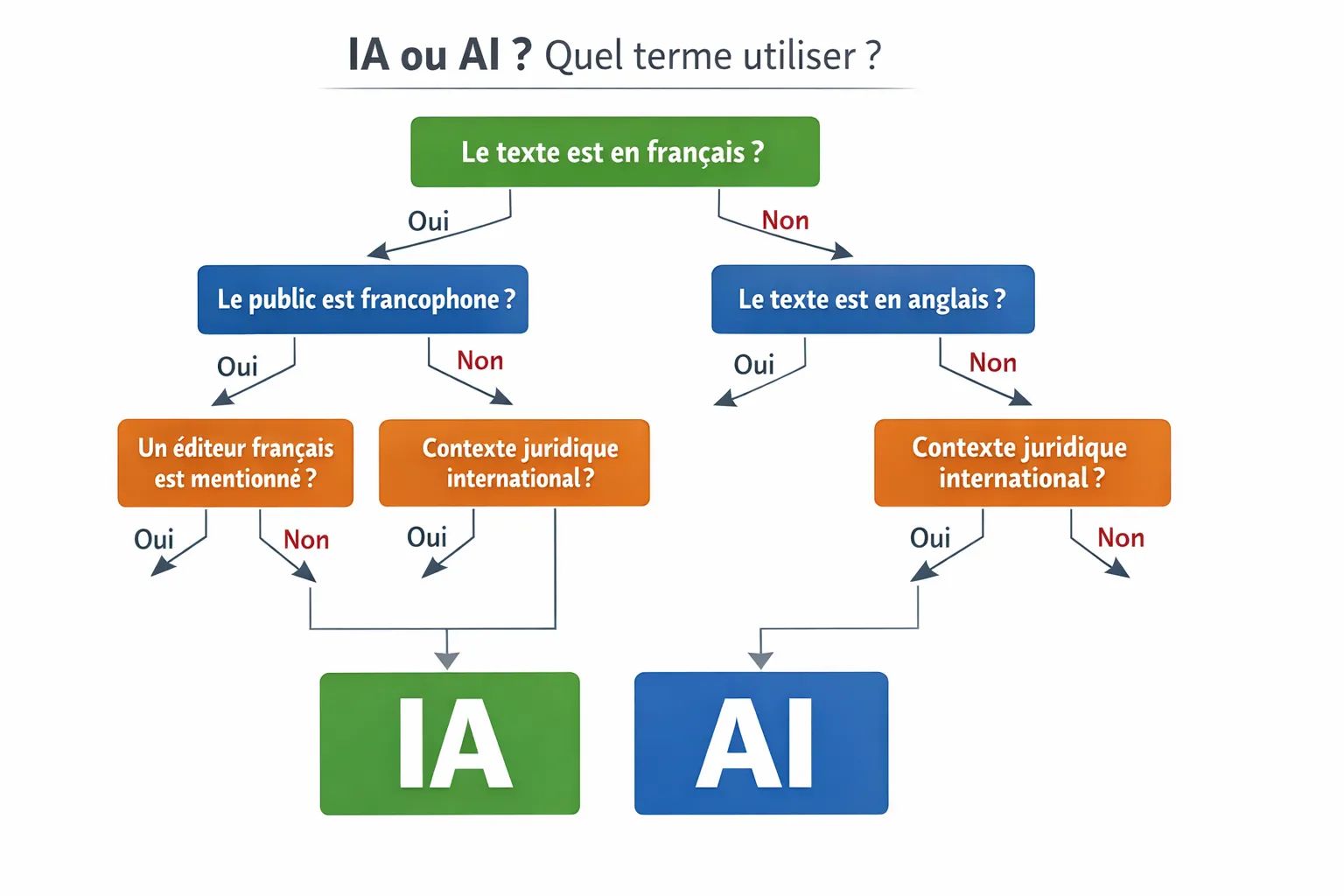
In a Francophone context, IA refers immediately to intelligence artificielle (artificial intelligence), regulation, and local institutions. In a global context, AI is the dominant convention driven by vendors, technical documentation, and dev communities.
IA: Native reading for a Francophone audience, harmonized with the recommendations of the Commission for the Enrichment of the French Language, available on FranceTerme (FranceTerme).
AI: International standard, omnipresent in tech and anchored in vendor product names like Azure AI, Google AI, or Vertex AI.
On the compliance side, the European Union speaks of a Regulation on artificial intelligence, better known by its English title, the AI Act. The text ratifies a common framework, but local usage remains decisive for the accessibility of regulatory content for your teams and clients (AI Act, official EU site).
SEO Impact and Acquisition: How Not to Go Wrong
In France, the majority of informational queries are made using IA and the fully spelled-out variants. AI remains searched for, but often in technical or brand contexts. To capture demand while avoiding keyword stuffing, adopt simple rules.
On your French pages, prioritize IA in titles and H1s, use intelligence artificielle in the text, and keep AI only for product names, citations, or established expressions.
On your English pages, use AI. Avoid mixtures that confuse the algorithm and user perception.
Regarding structure, align your slugs and hreflang tags by language. For example, /fr/solutions/ia-automatisation and /en/solutions/ai-automation. Do not play the duplicate card with IA and AI on the same URL.
Measure with Search Console and Google Trends by country. Track the performance of IA, intelligence artificielle, IA générative, and English equivalents on .en versions.
A Style Guide in 5 Rules for the Whole Company
Define one main term per language: IA in French, AI in English. Note authorized synonyms and discouraged terms.
Do not translate brands. Keep Azure AI, Google AI, OpenAI, even in French.
Prefer complete French forms when needed: intelligence artificielle, apprentissage automatique (machine learning), vision par ordinateur (computer vision), and keep machine learning and computer vision for technical contexts or citations.
Align content, URL, meta, and data schemas. What the page says must reflect what the slug, title, and JSON-LD say.
Create a list of documented exceptions: AI Act, GenAI in certain LinkedIn posts, vendor feature names, code repositories, and variables.
When to Write IA, When to Write AI: At a Glance
Context
Main Audience
Recommended Term
Example
FR Site, marketing pages
Decision makers, buyers
IA
Plateforme d’IA pour l’automatisation documentaire
EN Site, global
International markets
AI
AI platform for document automation
Vendor product names
Tech, procurement
AI unchanged
Azure AI Search, Google AI Studio
Compliance in FR
Legal, DPO
IA, with AI Act mention
Conformité au Règlement IA, AI Act
Recruitment FR
Candidates
IA, or mixed titles
Ingénieur IA, MLE, Data Scientist
Dev docs, code
Engineers
AI, for technical consistency
ai_pipeline.py, ai_inference_job
Special Cases to Clarify from the Start
IA générative or GenAI. In French, IA générative remains the clear and accessible form. The acronym GenAI can be used occasionally to align with vendor ecosystems and technical audiences, without replacing the French expression in titles and H1s.
Machine learning, deep learning. Prefer apprentissage automatique and apprentissage profond in non-technical materials. Keep the English terms in implementation documentation or code snippets.
Legal and contracts. Reference the text in French, Règlement sur l’intelligence artificielle, and mention the international designation, AI Act, in multilingual contracts.
Sector Examples: Why Terminology Influences Value
Financial services and travel agencies. Back-office operations speak the language of local teams. Using IA and the right business terms increases understanding and workflow adoption. As an illustration, this guide explains how to accelerate and automate reconciliation for airline tickets with smart matching rules, file identifiers, and sector connectors; see how to reconcile BSP and ARC faster with proven methods.
Industry and quality. On the lines, vision par ordinateur speaks more to quality managers than computer vision. In Franco-French specifications, staying with IA clarifies expectations and criteria, while keeping AI for vendor technical references and models.
Implementation: The Operational Checklist
Map your materials. Site, blog, offers, brochures, training, contracts, sales scripts, technical documentation. Spot IA and AI inconsistencies.
Decide by audience and channel. For example, IA for everything FR, AI for product feeds and multilingual technical docs.
Update templates. Titles, H1s, design system components, SEO snippets, conversion pages. Add editorial control to your approval workflows.
Align URLs. If you rename /ai to /ia on the FR site, configure 301 redirects, and update sitemaps and hreflang tags.
Manage data naming conventions. In the CRM or CDP, unify campaign fields and tags, for example campaign_topic = IA_FR or AI_EN.
Train teams. Marketing, sales, product, legal. A memo sheet, two validated examples, a list of exceptions, and you're set.
Measure and iterate. Track organic traffic, CTR, and perceived understanding in user tests. Adjust exceptions if necessary.
Editorial Governance Best Practices
Centralize the terminology repository in your internal portal. Shortcuts, examples, exceptions, FR and EN versions.
Add automatic checking. Editorial linting in the CMS, search rules to avoid unwanted shifts from AI to IA and vice versa.
Maintain a list of sensitive terms. AI Act, GenAI, LLM, copilots, hallucination, red teaming. Provide a validated FR version and authorized English use cases for each term.
Re-evaluate every 6 months. Vendors and ecosystems evolve their naming conventions; your rules must follow.
Avoiding Common Pitfalls
Mixing IA and AI without logic, which dilutes the signal for users and search engines.
Translating brands. Write Azure AI, not Azure IA.
Trying to revive two identical pages, IA and AI, in the same language. Prioritize a single version per language, with redirects and canonicals.
Overusing GenAI on a generalist FR site. Keep it for tech audiences; prefer IA générative in titles.
Concrete Examples of Application in Your Content
France Homepage. H1 with IA, paragraphs with intelligence artificielle, exact mention of vendor products in AI when necessary.
Landing pages by sector. Use French business vocabulary. For example, extraction de données de factures rather than invoice extraction in FR.
Blog posts. Titles in IA, subheadings with synonyms, technical passages that may cite AI if the source or library is in English.
Job offers. Clear titles in French, for example Responsable IA, with the secondary English title in parentheses if useful for international contexts, e.g., Head of AI.
FAQ
Should IA or AI be used on an exclusively French site?
IA in titles and navigation, intelligence artificielle in the body text. Keep AI only for vendor product names or citations.
And for a bilingual site?
Use IA on the FR version and AI on the EN version, with hreflang, distinct URLs, and consistent redirects. Avoid mixing them on the same page.
Can GenAI be written in French?
Yes, occasionally for technical audiences. For general public pages, prioritize IA générative in titles and H1s.
What to do with the AI Act in French legal documents?
Reference the French text, Règlement sur l’intelligence artificielle, and mention the designation AI Act at the first occurrence to avoid any ambiguity.
Must technical teams always write AI?
For code, documentation, and variable names, AI remains the international standard. This facilitates integration with ecosystems and maintenance.
Can changing IA to AI improve my SEO in France?
Rarely. Target IA and intelligence artificielle in FR first. AI may attract technical traffic, but it is less relevant for the majority of non-technical Francophone queries.
Need a Clear and Actionable Framework for Your AI Content and Products?
Impulse Lab accompanies marketing, product, and IT teams to put AI at the service of performance, opportunity audits, integrations, automation, and adoption training. We can formalize an IA and AI style guide with you, align your content and journeys, and quickly deliver proof of value thanks to our weekly delivery cadence and a dedicated client portal. Let's talk about your objectives and transform AI into concrete results.