Predicting Industrial Equipment Failures with Artificial Intelligence
Intelligence artificielle
Stratégie IA
Automatisation
Optimisation
For an SME, industrial AI truly proves its value by preventing breakdowns rather than enduring production downtime. But installing sensors and training models is not enough: an alert is only valuable if maintenance teams have time to act.
October 11, 2026·10 min read
For an SME, industrial artificial intelligence makes complete sense when it helps anticipate a breakdown rather than suffer unexpected production downtime. But installing sensors and training a model is not enough: an alert is only valuable if the maintenance team can act in time.
Predictive maintenance involves leveraging the real-time condition of equipment to detect degradation and prepare an intervention. Here is how to select a first use case, gather the right data, and verify that the system truly improves your operations.
Industrial Artificial Intelligence: What Can Actually Be Predicted
An AI does not know the exact date of every breakdown in advance. It analyzes signals that may precede certain faults: unusual vibrations, temperature drift, motor current surges, or pressure fluctuations.
Three approaches must be distinguished:
Preventive maintenance: intervening according to a schedule or operating hours, even without signs of degradation.
Condition-based maintenance: intervening when a measured parameter exceeds a threshold or indicates a defect.
Predictive maintenance: leveraging evolving trends in measurements to estimate failure risk or an intervention window.
Anomaly detection can support the latter two approaches, but an anomaly is not necessarily an impending breakdown. A change in line speed or raw material can also alter sensor readings.
The best candidates exhibit gradual, observable degradation. A wearing bearing can provide warning signs. A sudden structural failure without measurable precursor signals remains far more difficult to anticipate. The realistic goal is therefore to predict specific failure modes, not eliminate all downtime.
Choosing One Machine Rather than Monitoring the Entire Factory
Start with an asset whose unavailability causes a clear impact: line stoppage, production loss, scrap, or emergency technician call-outs. An expensive piece of equipment is not automatically the best choice if a backup machine can step in immediately.
To define the initial scope, assess four factors: equipment criticality, incident frequency, data availability, and the feasibility of taking action following an alert.
A pump regularly halted due to identifiable wear can be a better starting point than an entire fleet of diverse machines. The initial scope then becomes: one equipment family, one targeted defect, and a clear maintenance decision.
In manufacturing and industry, artificial intelligence delivers value primarily when the lead time of an alert aligns with an actionable response. If sourcing a spare part takes several days, an alert received minutes before a breakdown solves nothing.
Define the decision before building the model: inspect during the next shift handover, order a part, or schedule maintenance during an already planned shutdown.
What Data Is Needed to Anticipate a Breakdown?
Relevant data is often scattered across multiple systems. PLCs and SCADA systems track machine operations. Sensors measure physical conditions. CMMS (Computerized Maintenance Management System) platforms record work orders, maintenance logs, and observed defects.
Vibration analysis can help detect specific mechanical flaws. Temperature, electrical current, pressure, or flow rates provide additional clues depending on the equipment. Their relevance must be confirmed by the personnel who know the machine best.
Operational context is equally crucial: rotational speed, load, product recipe, start-up phases, or steady-state operation. A reading that is normal under full load might indicate an anomaly at idle.
Before deploying AI in an industrial setting, verify timestamp synchronization, units of measurement, and asset tagging. Data sampling frequency must also match the observed phenomenon: an hourly average may hide brief transient events.
An abundant history poorly linked to actual maintenance logs will be far less usable than a shorter, well-documented dataset.
How to Start When Breakdowns Are Rare?
With few failure examples, a supervised model risks learning accidental quirks rather than genuine failure signatures. Furthermore, you must avoid classifying all past operations as "healthy" simply because no incident was logged.
A sensible first step is to model normal operating regimes and detect persistent deviations. These deviations trigger inspection requests, not automatic definitive diagnoses.
Each inspection then enriches the historical dataset: confirmed defect, false positive, replaced part, or alternative cause. This ground-truth feedback loop clarifies which alerts are genuinely useful.
Which Model to Choose for Predictive Maintenance?
The right choice depends more on the data and the targeted defect than on algorithmic complexity. A well-designed business rule should serve as a benchmark: if it solves the problem, adding AI may not be cost-effective.
Approach
Relevant Use Case
Main Limitation
Thresholds and business rules
Monitoring a known limit or simple drift
May miss complex interactions between multiple signals
Anomaly detection
Spotting unusual behavior with few documented failures
Does not prove that a failure is imminent
Supervised model
Recognizing a defect from reliable historical examples
Heavily dependent on the quality of labeled incidents
Remaining Useful Life (RUL) estimation
Estimating time-to-failure for tracked degradation
Requires extensive historical run-to-failure data and explicit uncertainty handling
An anomaly score must not be presented as a failure probability without appropriate validation. Similarly, remaining useful life estimates must include confidence intervals rather than be displayed as deterministic deadlines.
Industrial AI can also help summarize maintenance reports. However, this documentation task is distinct from physical sensor prediction: a chatbot cannot replace a model validated on actual machine telemetry.
Building a Pilot Usable by Technicians
Defining the Defect, Horizon, and Expected Response
A pilot must address a verifiable question. For instance: can we detect bearing wear early enough to allow an inspection before an unplanned shutdown?
The maintenance manager defines the target failure mode and actionable lead time. The production team outlines scheduling constraints. The data specialist verifies that the required telemetry is accessible.
Establish acceptance criteria before starting trials: maximum acceptable false-alarm rate, percentage of detected events, and minimum action lead time. These criteria must reflect team capacity, not merely technical ambition.
Testing in Shadow Mode Without Disrupting Operations
Begin with an observation period where the system generates alerts in shadow mode without directly controlling machinery. Technicians compare these alerts against sensor data, physical inspections, and real events.
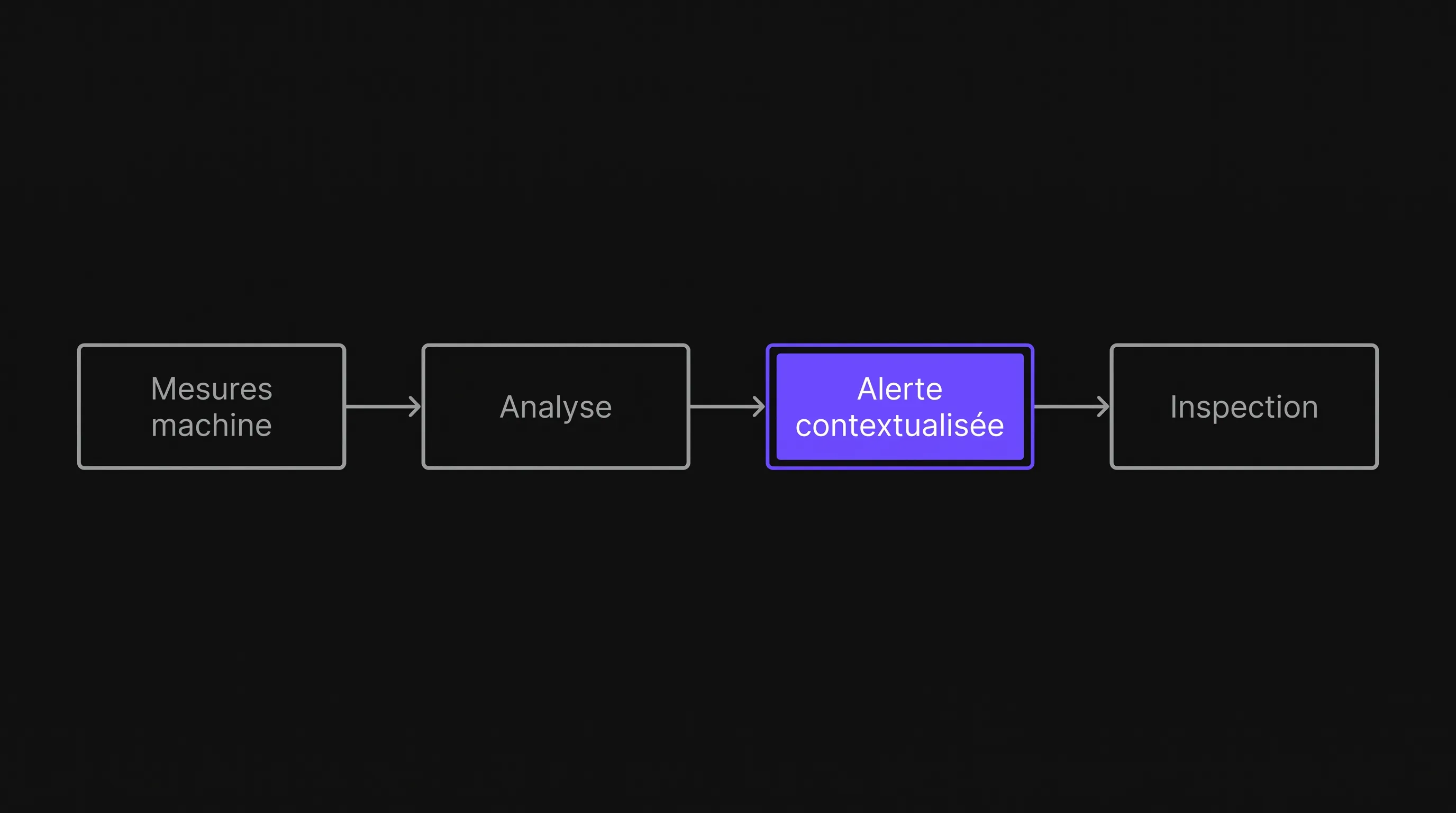
An actionable alert specifies the affected equipment, the deviating signals, the operating state, and a proposed course of action. A standalone label like "High Risk" is insufficient to schedule an intervention.
Designate an owner and a handling procedure. Depending on your organization, this could mean an email notification or an automated inspection ticket in the CMMS. The integration must avoid creating yet another inbox that no one monitors.
For industrial AI to remain useful day-to-day, every alert requires feedback: confirmed, irrelevant, or unverified. This tracking enables model tuning and measures the operational workload it actually introduces.
Measuring Results Without Being Misled by a High Score
Evaluating Events, Not Just Rows of Data
Because breakdowns are rare, a model can achieve a stellar overall accuracy score while missing every single incident. The percentage of correctly classified data points is therefore misleading on its own.
Instead, track recall on targeted failures, false alert rates per machine and time period, and lead time before failure events. Factor in technician time spent investigating alerts: this burden is part of the system's operational cost.
Multiple notifications triggered by the same underlying degradation must be consolidated into a single event. Otherwise, the system may artificially appear to detect numerous defects when it is merely repeating the same alert.
Evaluation must respect chronological splits: train on past history, then validate on a subsequent timeframe. Randomly shuffling time-series data can produce artificially optimistic results. Any data leakage—information that would not have been available at the moment of the alert—must also be rigorously excluded.
Finally, distinguish a confirmed defect from an avoided shutdown. To evaluate AI in industry, each alert record should link the initial signal, inspection, maintenance action taken, and the ultimate outcome.
Calculating ROI with Explicit Assumptions
Economic return goes beyond theoretical revenue losses from an idle line. Lost volume can sometimes be made up, and not all fixed costs vanish when downtime is prevented. Use an hourly downtime cost validated by both production and finance.
Here is a hypothetical example, intended solely to illustrate the calculation. It does not reflect an actual client result or Impulse Lab pricing.
Annual Assumption
Illustrative Amount
20 hours of downtime prevented at €750/hour
€15,000
Additional cost of inspections and interventions
€4,000
Recurring system cost
€3,000
Net annual gain before initial investment
€8,000
With a hypothetical initial investment of €16,000, the simple payback period would be two years, provided the savings materialize and persist. This calculation must be tailored to your actual costs and observed performance.
Factor in sensor procurement, software integration, hosting, model monitoring, and internal team hours. Also evaluate the project against simpler alternatives: improved lubrication, targeted preventive replacements, or faster access to spare parts.
Moving to Production Without Disrupting the Shop Floor
Connecting to industrial infrastructure demands as much diligence as developing the machine learning model. The NIST Operational Technology Security Guide addresses the safety, availability, and reliability constraints unique to these OT environments.
For an initial deployment, favor read-only data ingestion and tightly govern network access between operational networks and analytics platforms. An alerting tool should never inadvertently control machinery.
You must also monitor the monitoring system itself: disconnected sensors, flatlining data, clock drifts, or mismatched units. The absence of an alert is not proof of machine health, especially if telemetry stops streaming.
Whenever a machine, speed setting, or manufacturing process changes, re-evaluate model performance. New operational baselines may trigger false positives on an outdated model, or new failure modes may go undetected.
Deploying industrial AI therefore requires a dedicated owner, a fallback procedure to standard operations, and accessible documentation. The enterprise AI risks and controls framework provides further guidance on access management, data governance, and human-in-the-loop oversight.
Frequently Asked Questions
Can we start without adding new sensors? Yes, provided existing signals from PLCs, SCADA, or historians sufficiently capture the target defect. Maintenance logs alone help understand past downtime, but they rarely suffice for predicting real-time physical degradation.
How long does it take to validate a pilot? It depends on failure frequency and operating variability. A few weeks without a breakdown do not prove the model works. The trial must cover representative operational scenarios and allow accurate measurement of false positives.
Can AI automatically shut down a machine? A maintenance alert is not, by default, a certified safety system. Any automated control over physical equipment requires strict engineering validation. For an initial project, keep intervention decisions within a structured human workflow.
When should a project be reconsidered or shelved? When the degradation yields no measurable advance signal, alerts arrive too late to act, or the cost of handling alerts outweighs the financial benefit. In such cases, strengthening conventional preventive maintenance may be the wiser choice.
Identifying a First Use Case with Impulse Lab
Before investing, gather the downtime history of a critical asset, available sensor streams, and maintenance operating constraints. These elements verify whether predictive maintenance addresses an observable and economically viable challenge.
Impulse Lab provides AI opportunity audits, custom solution development, seamless integration with existing tools, and adoption training. Our initial discovery call focuses on a practical question: which defect should be monitored, with which data, and to enable what maintenance decision?