Responsible AI: 7 Rules to Move from Charter to Action
Intelligence artificielle
Stratégie IA
Culture IA
Gouvernance IA
Gestion des risques IA
A responsible AI charter can fit on one page, but its impact is measured in daily decisions: allowed uses, protected data, validation, and automation limits. For an SME or scale-up, the key is turning principles into operational reflexes.
A responsible AI charter can fit on a single page, but its impact is measured in everyday decisions: which use cases are allowed, which data is protected, who validates results, and when an automated process should be stopped. For an SME or scale-up, the real challenge is no longer about displaying principles, but turning them into operational reflexes.
In 2026, AI is no longer just tested by a few curious individuals. It is entering sales, support, operations, HR, finance, and product. This widespread adoption makes productivity gains more accessible, but it also increases the risks of data leaks, automated errors, bias, or dependence on poorly mastered tools.
Here, responsible AI refers to a practical way of deploying artificial intelligence without slowing down innovation: scoping use cases, securing data, maintaining clear human accountability, and measuring real impact. Here are 7 rules to move from a well-written charter to genuinely implemented practices.
Why an AI Charter Is No Longer Enough
An AI charter is useful because it establishes a common language. It defines what the company accepts, rejects, and values. The problem arises when it remains disconnected from projects, tools, and business trade-offs. In this scenario, teams continue experimenting in silos, often with good intentions, but without a shared methodology.
Moving to action requires a lightweight framework, not bureaucracy. Employees must know what to do before pasting data into an assistant, automating a customer response, or connecting a model to internal software. Managers need to make quick decisions. Leadership must see whether these use cases create value without exposing the company to unnecessary risk.
Charter alone
Operational implementation
General principles
Decision rules per use case
Ethical commitment
Designated owners and visible controls
Broad bans
Risk levels and documented exceptions
One-off awareness sessions
Training, monitoring, and continuous improvement
Intent of compliance
Evidence, logs, evaluations, and governance
A good rule can be understood by a sales rep, a support lead, a product manager, and an executive alike. It shouldn't depend on having a legal expert in every meeting. It should help quickly answer three questions: can we use AI here, under what conditions, and who owns the decision?
The 7 Rules of Operational Responsible AI
The following rules are designed for organizations looking to move fast without creating governance blind spots. They work equally well for an internal assistant, a business process automation, an agent connected to existing tools, or a custom AI platform.
1. Link Every AI Use Case to a Measurable Business Objective
A responsible AI initiative begins with a simple question: what business problem are we trying to solve, for which user, and with what success metric? Without a precise answer, the use case risks becoming a novelty or, worse, an automation that merely shifts the problem without solving it.
Before developing or adopting a tool, define the use case in a single sentence: “reduce support ticket handling time by 30%,” “help sales reps prepare for meetings,” or “detect discrepancies in vendor invoices.” Then, connect it to a KPI, an expected usage frequency, and an acceptable level of risk.
To avoid rushing into development, you can rely on a scoping checklist before launching an AI project. Proper scoping doesn't prevent experimentation; above all, it keeps you from spending too long testing a vague use case.
2. Classify Use Cases by Risk Level
Not all AI use cases require the same level of oversight. Drafting an internal email doesn't carry the same impact as automating an HR decision, analyzing medical data, or influencing a credit decision. To remain sustainable over time, responsible AI must manage risks proportionally to their actual impact.
Create three simple categories: low risk, moderate risk, and high risk. A low-risk use case can be managed with training and basic guidelines. A moderate-risk use case requires testing, human validation, and documentation. A high-risk use case calls for a formal review—often involving legal, security, or compliance teams.
This approach aligns with the spirit of the European AI Act, which classifies certain systems based on their risk level. You don't need to replicate all regulatory complexity within your SME, but you must be able to recognize sensitive use cases before they are deployed.
3. Designate an Owner for Each Use Case
Charters often fail because everyone supports the principles, but no one is accountable for enforcing them. Without a named owner, responsible AI remains a diffuse intention. Every use case needs a business owner, a technical lead if necessary, and a point of contact for data or compliance questions.
The owner isn't there to do everything alone. They ensure that the use case stays aligned with its objective, tests are executed, incidents are reported, and rules remain up to date. They also become the natural point of contact when the scope changes or when moving from testing to production.
In a growing organization, this clarity eliminates gray areas. If you want to structure these responsibilities without introducing heavy governance, the guide on AI roles, governance, and responsibilities provides a practical framework for delegating decisions.
4. Protect Data Before Choosing the Tool
AI discussions often start with choosing a model or an interface. They should start with data. What data is required? Is it personal, confidential, strategic, or regulated? Where is it sent? Is it retained by the vendor? Can it be used to train models?
Responsible AI requires strict data minimization: only provide necessary data, anonymize wherever possible, and prohibit specific sensitive content in unvetted tools. A simple rule can prevent significant risk: no sensitive customer data, no trade secrets, and no personally identifiable HR data should be sent to unapproved AI tools.
The CNIL (French Data Protection Authority) publishes valuable resources on AI, personal data, and GDPR. For businesses, the challenge isn't merely legal. A data leak in a misconfigured tool can erode customer trust, complicate security audits, and stall internal adoption.
5. Test Outputs Like a Business Deliverable, Not a Demo
An AI demo is easy to find impressive. Production use, however, must be tested against real scenarios, edge cases, and expected errors. A team practicing responsible AI doesn't just ask if the answer looks good; they verify whether it is reliable within the workflow where it will be used.
Build a representative test suite: ambiguous customer queries, incomplete data, unusual phrasing, regulatory corner cases, different languages, or frequent exceptions. Benchmark outputs against a human reference and document errors. Hallucinations, omissions, and biases don't vanish just because the interface feels smooth.
The NIST AI Risk Management Framework emphasizes continuous risk management rather than one-off assessments. This perspective is vital for businesses: a model might perform acceptably today yet become less reliable tomorrow if data, prompts, users, or the environment change.
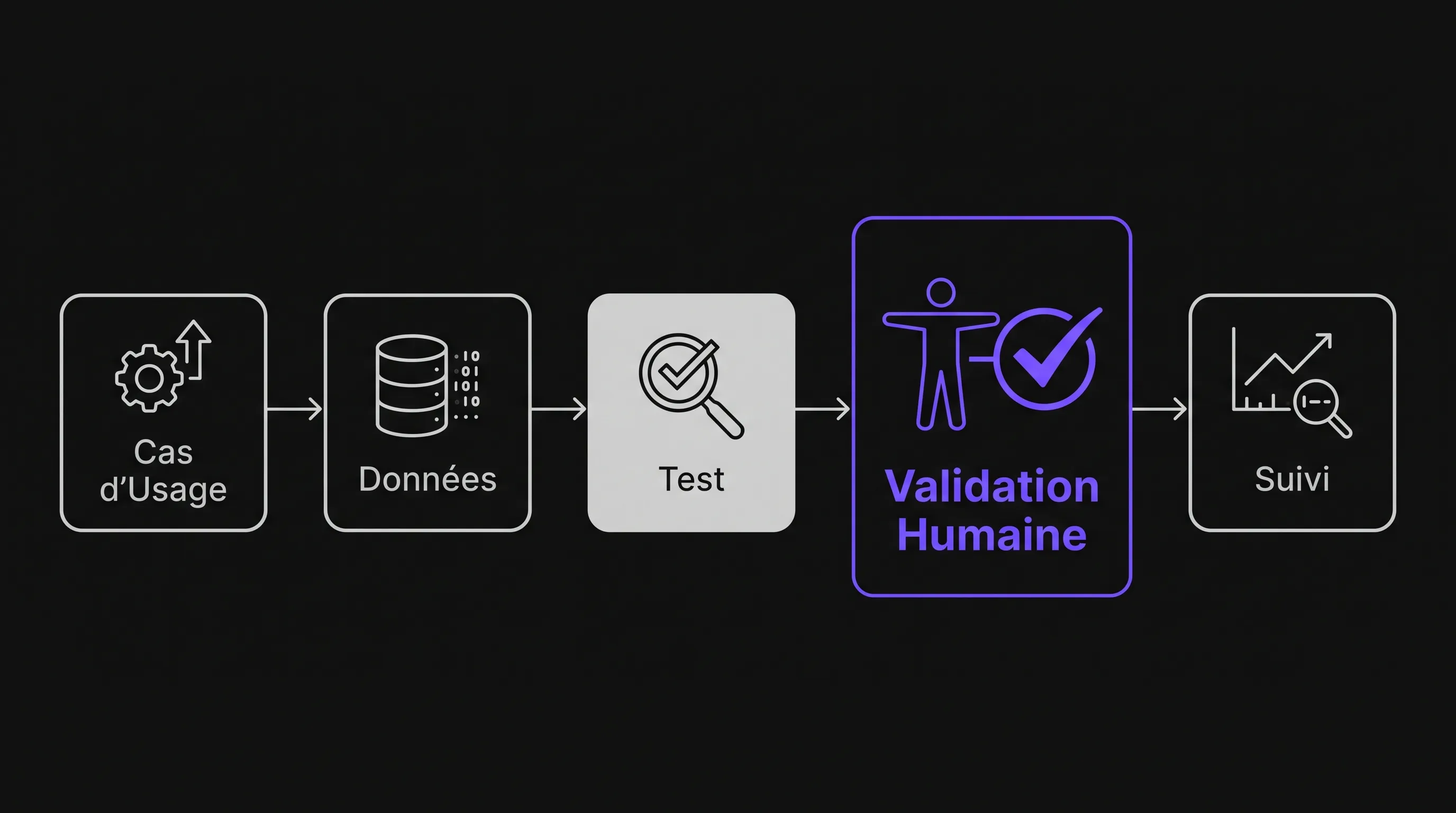
6. Maintain Human-in-the-Loop Validation Where Impact Is Significant
Automation is not meant to eliminate human judgment entirely. In a responsible AI framework, the greater the impact on a customer, employee, or financial decision, the more explicit human validation must be. This applies to customer-facing replies, sensitive sales recommendations, HR decisions, and financial controls.
Human validation must not be symbolic. If the user cannot understand, challenge, or correct the recommendation, they do not truly control the system. Therefore, incorporate checkpoints: approval before sending, confidence thresholds, fallback to manual workflows, and escalation procedures for anomalies.
This rule also protects adoption. Teams embrace AI more readily when they know they retain control over critical decisions. Conversely, forced automation without clear oversight often breeds distrust, even if the technology works as intended.
7. Train Teams on Concrete Actions, Not Just Principles
A charter can talk about caution, transparency, or confidentiality. But in daily work, employees need actionable habits: how to rephrase a prompt, verify a source, withhold certain data, request validation, report an error, and spot an overly confident answer.
In the long run, responsible AI relies more on these habits than on a document stored in a shared drive. Training must therefore stem from specific roles: how a sales rep uses AI without fabricating customer commitments, how support accelerates responses without losing brand voice, or how HR explores data without introducing discrimination.
An effective training program distinguishes three tiers: a shared foundation for everyone, role-specific workshops, and coaching for AI champions. To transition from curiosity to reliable usage, the plan must remain practical, as outlined in this approach to AI training to upskill your teams.
Moving from Charter to Action in 30 Days
The goal of responsible AI isn't to stall every project, but to create a clear path from idea to test and to controlled deployment. For a company starting out, 30 days is often enough to establish an initial, lightweight governance framework.
Period
Priority Action
Expected Deliverable
Week 1
Inventory existing and planned AI use cases
List of use cases, tools, data, and teams involved
Week 2
Classify use cases by risk and business value
Simple value, risk, and effort matrix
Week 3
Select 1 to 3 supervised pilot cases
Project sheets with KPIs, owners, data rules, and tests
Week 4
Formalize usage rules and train teams
Operational guide, review ritual, and Q&A channel
This format avoids two common traps: attempting to govern everything before testing, or letting everyone test without any guardrails. The right balance lies in selecting a few priority use cases, proving value, documenting risks, and then expanding gradually.
If you are starting with an already extensive backlog of AI ideas, an AI audit with an ROI scorecard can help prioritize use cases based on their impact, feasibility, and risk exposure.
Mistakes That Derail AI Charter Implementation
Most failures don't stem from a lack of principles. They stem from a disconnect between the charter and daily working realities. Teams turn to AI because it helps them move faster. If the framework is too abstract, too slow, or detached from operational tools, it will be bypassed.
Here are warning signs to watch for:
Employees use AI tools without knowing what data is permitted.
Use cases enter production without a business owner.
Outputs are eyeballed without test suites or error tracking.
Leadership talks about compliance but tracks zero usage metrics.
Rules are drafted once and never updated after initial field feedback.
The solution is not to pile on bans. A robust approach pairs concise rules with decision rituals and straightforward documentation: use case sheets, incident logs, quality assessments, and user feedback. Responsible AI then becomes an operational steering system rather than an afterthought moral constraint.
FAQ
What is responsible AI for an SME? It is a practical way of using artificial intelligence with clear rules regarding data, accountability, testing, human oversight, and risk tracking. The goal is to generate value without exposing the business, its customers, or its teams to unnecessary risks.
Do you need to create an AI committee to enforce a charter? Not necessarily. An SME can start with an AI lead, an executive sponsor, use case owners, and a monthly review of sensitive initiatives. A committee becomes useful as the number of use cases grows or when regulatory and business risks increase.
How do you know if an AI use case is too risky? Look at the potential impact on people, finances, confidential data, and compliance. If the use case influences a critical decision, handles sensitive data, or could cause direct harm, it warrants closer scrutiny and explicit human-in-the-loop validation.
Does an AI charter need to be long? No. A short charter is often more effective when tied to operational rules. Ten well-understood and applied rules are better than a 30-page document that nobody consults before using a tool.
Transforming Your AI Principles into Reliable Practices
Moving from charter to action requires a framework, solid technical choices, and team enablement. Impulse Lab helps companies identify AI opportunities, automate processes, build custom solutions, and train teams on reliable practices.
If your organization wants to structure its AI usage without stifling innovation, start by mapping out your use cases, data, and risks. From there, you can decide where AI should assist, automate, or remain under close human supervision.
Intelligence artificielle responsable : le guide PME
L’intelligence artificielle responsable n’est pas un luxe réservé aux grands groupes. Pour une PME, c’est une façon concrète d’utiliser l’IA sans perdre le contrôle sur les données, les décisions, les coûts ou la relation client. En 2026, les dirigeants n’ont plus seulement à se demander si l’IA peu...