Finding an AI book is one thing; turning it into a team learning experience is another. In an SME or scale-up, a book club helps teams understand artificial intelligence, challenge perspectives, and frame key questions without turning it into a lecture or hype contest.
November 01, 2026·10 min read
Finding a book with an "AI book" search is one thing; turning it into a collective learning experience is another. In an SME or scale-up, a book club can help teams understand artificial intelligence, compare perspectives, and better formulate their questions—provided the session doesn't turn into a technical lecture or an enthusiasm contest.
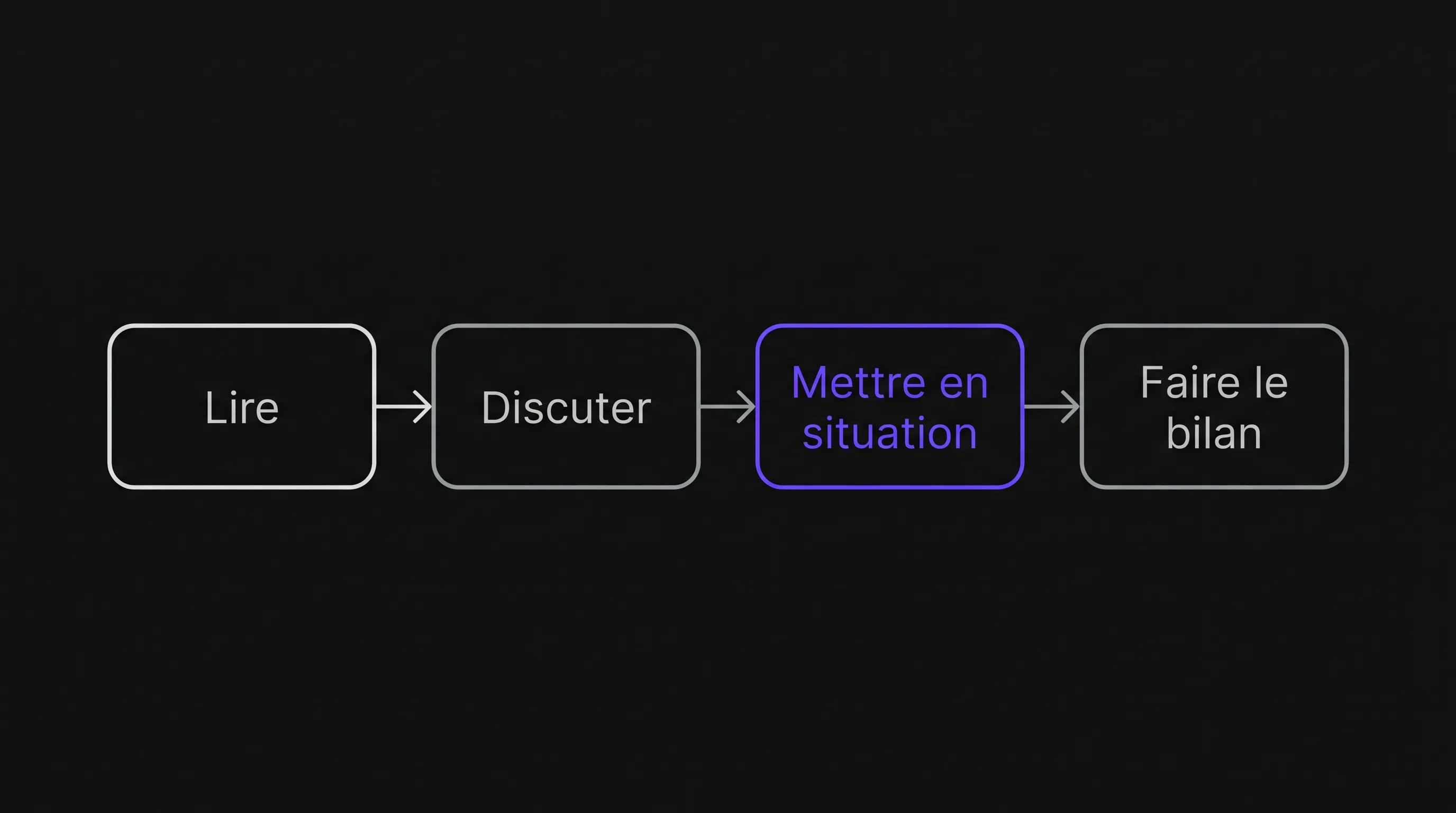
The suggested format: a small group, three one-hour sessions, and short reading assignments between meetings. The goal is not to become an expert, but to build common reference points from a book and then test them against real-world work scenarios.
Defining a Shared Question Before Choosing the Book
"Understanding AI" is too broad a goal to guide a productive discussion. Instead, start with a question multiple roles are already asking: How do we spot an unreliable answer? What tasks do we want to delegate to a machine? What must remain under human control?
For a first edition, pick a single core question. It will help you select excerpts, reignite discussions, and evaluate the value of the cycle.
An AI book becomes much easier to discuss when everyone can relate it to their daily work. A support team member will think of customer replies, a sales manager about proposals sent, and a developer about reviewing generated code. These differences enrich the reading experience without forcing a single consensus.
Also clarify what the club will not do: evaluate individual skills, mandate a tool, or unilaterally decide on a rollout. Participation should never feel like an AI endorsement test.
Searching for an "AI Book": Choosing One That Sparks Discussion
The best choice isn't necessarily the most recent or exhaustive book. For a diverse group, favor accessible language, relatively self-contained chapters, and a central thesis that can be analyzed without advanced math skills.
Check the publication year and skim an excerpt before ordering. A book can remain valuable for its conceptual framework even if it mentions tools or benchmarks that are now outdated.
Four Possible Starting Points
Book
Value for the Group
Point of Caution
L’Intelligence artificielle n’existe pas, Luc Julia
Questioning what "intelligence" actually covers and discussing common representations of AI
Distinguishing the author's thesis from the current capabilities of modern tools
Des robots et des hommes, Laurence Devillers
Exploring human-machine interactions and ethical challenges
Connecting examples to situations the team actually encounters
Le Mythe de la singularité, Jean-Gabriel Ganascia
Examining narratives around superhuman AI
Allocating extra time to discuss conceptual arguments
I, Robot, Isaac Asimov
Using fiction to explore rules, responsibilities, and their contradictions
Avoiding treating the stories as technical descriptions of real-world systems
These suggestions open up different discussions; they are not a definitive ranking. Pick a single entry point, not an entire library.
To choose between two AI books, have two colleagues from different departments read a few pages. Ask them what they understood, where they got stuck, and what question they would like to ask the group. This small test is far more reliable than deciding based solely on author prestige.
Organizing a Lightweight Three-Session Cycle
To start, gather four to eight people across different functions. This format gives everyone space to speak without requiring heavy moderation. Also, carve out a short reading slot during work hours: an activity framed as professional development shouldn't rely entirely on participants' personal time.
Session
Reading to Prepare
Expected Outcome
Understand
An excerpt defining or explaining a concept
A shared definition and two points to clarify
Debate
An excerpt arguing a thesis or highlighting a risk
Key arguments retained, challenged, or marked for verification
Apply
An excerpt tied to the starting question
A group analysis of a fictional use case
Designate one person to moderate and another to take notes. The moderator doesn't need to know all the answers: their role is to clarify ideas and ensure balanced participation.
Before each session, share the chosen excerpt, the central question, and a simple prompt: bring one takeaway, one objection, or one point of confusion. Incomplete reading shouldn't prevent anyone from joining. For accessibility needs, verify available formats and offer tailored prep.
Moderating a 60-Minute Session Without Lecturing
An AI book discussion works best when participants speak before the moderator shares their own interpretation. Start with a few minutes of silent individual writing: this prevents the first speaker from dominating the entire debate.
Here is a reusable agenda:
Time
Sequence
Moderation Prompt
0 to 5 min
Silent reflection
Write down one key takeaway and one question
5 to 15 min
Roundtable
Share a single point, without interruptions
15 to 30 min
Back to the text
Examine a statement and its supporting arguments
30 to 50 min
Work scenario
Test this statement against a fictional case study
50 to 60 min
Wrap-up
Identify one key takeaway, one open question, and potential next steps
When the conversation drifts, bring it back to specifics: "Which passage supports that idea?" or "How could we verify that claim?" On the board, distinguish between what the author says, what the group deduces, and what remains an assumption.
If one person monopolizes the floor, thank them and invite input from others before passing the mic back. To maintain these habits outside the club, you can adopt team AI discussion rules.
Asking Questions That Go Beyond "I Liked It"
A simple book review isn't enough to foster meaningful dialogue. The moderator needs to guide the group from subjective reactions to evaluating arguments, and finally to real-world application.
Keep this quick framework handy:
Understand: What core claim is the author defending in this passage?
Examine: What evidence, examples, or assumptions do they rely on?
Challenge: Under what circumstances might this claim no longer hold?
Apply: How does this connect to a task within our team?
Verify: What information is missing before we can make a decision based on this?
Don't try to cover every question in every session. Two in-depth questions yield far more value than rushing through a long checklist.
Welcome disagreements without pushing for immediate consensus. If one person believes a tool is reliable while another doesn't, ask them to clarify the task, available data, and acceptable margin of error. They might be thinking of completely different contexts.
Wrap up the section by reframing the disagreement: "We disagree" becomes "We need to verify if this answer holds up when the source document is incomplete."
Connecting the Reading to a Fictional Case Study (Without Starting a Project)
A simulated scenario reveals whether discussed concepts are practically usable. It requires neither software subscriptions nor real company data. A paper-and-pencil exercise is more than enough for a first session.
Imagine a group that just read an excerpt about errors in AI systems. Give them a fictional sales brief: an offer includes a training session, but no dates or availability are listed. Beside it is a draft reply generated, for the exercise, by an AI tool, promising two sessions starting next week.
Ask the group to identify what is confirmed, invented, or impossible to verify. Then, have them specify who should review the response before sending it and what information is needed to correct it.
The expected outcome isn't a better prompt, but explicit reasoning. For example: fluent wording doesn't guarantee accuracy; every commercial commitment must be backed by accessible data.
Grounding concepts in reality prevents an AI book from remaining an abstract discussion. It also highlights distinct learning needs: some people need to practice source verification, others need to spot sensitive data or establish human review workflows.
Take note of questions raised during the exercise. They can inform future training without turning every club idea into an internal development project.
Managing Sources, Data, and AI Assistance
A book isn't an up-to-date manual for every topic. When a claim concerns specific software features, consult the tool's latest documentation. For personal data, regulatory resources like CNIL’s guidance on artificial intelligence offer a much better foundation than vague recollections from a book.
During the club, rely on fictional scenarios or dedicated practice materials. Do not upload client documents, HR data, or confidential company information into unapproved AI assistants.
AI can help brainstorm discussion prompts, but an AI-generated summary is no substitute for reading the actual passage. Check any quotes directly in the book and disclose AI assistance: "Questions drafted using an AI assistant, then reviewed and refined by the moderator."
Finally, ensure legitimate text access for participants. Do not scan entire chapters to feed into a tool or distribute across the team without verifying copyright laws. A summary written by the moderator along with page references is often enough to prepare for discussion.
Conducting a Useful Retrospective (Without Grading Participants)
After three sessions, revisit the initial question. Can the group now answer it with greater clarity and depth? Can they illustrate a limitation with a concrete example and pinpoint what needs to be validated before using an AI-generated output?
To gauge what the AI book contributed, present another short scenario similar to the first one. Evaluate the quality of their reasoning, not how much technical jargon they use.
Summarize everything in a one-page brief: the opening question, key takeaways, ongoing disagreements, and identified learning needs. Avoid lengthy meeting minutes that no one will ever read.
If recurring challenges point to practical skills—such as verifying outputs or protecting sensitive data—the logical next step is AI training built around real-world tasks. A book club establishes a shared cultural foundation; it does not replace hands-on operational practice.
You can also simply choose to wrap it up there. A short cycle that resolves a few questions is much better than an endless recurring meeting without a purpose.
Frequently Asked Questions
Which AI book should you pick for a beginner team? Choose an accessible title with an excerpt that directly answers a shared question. Test a few pages with colleagues from different roles before deciding. Ease of discussion matters far more than comprehensiveness.
Does everyone need to read the entire book? No. To get started, selected excerpts are plenty. Share page references in advance and explain how they connect to the group's question. Purchasing a book shouldn't become an obligation to read every page cover to cover.
Can you host this club remotely? Yes. Use a shared document, set aside time for silent writing, and establish clear speaking turns. Have someone monitor written chat comments so they aren't drowned out by verbal discussions.
Is a book club enough to train teams on AI? No. It fosters comprehension and critical thinking, but it won't teach anyone how to master a tool, verify outputs, or apply internal data governance policies on its own.
Moving from Reading to Targeted Learning
Your first step can be simple: one question, one excerpt, and a date. Once the cycle wraps up, you'll have clearer insights to decide whether the team needs formal training or if a specific use case warrants further study.