A sales funnel, also called a conversion funnel, is a simple representation of the steps that turn a stranger into a customer, then a loyal customer. It serves to visualize where you gain prospects, where you lose them, and what to improve first. If you must remember one idea, it is...
décembre 31, 2025·7 min de lecture
A sales funnel, also called a conversion funnel, is a simple representation of the steps that turn a stranger into a customer, then a loyal customer. It serves to visualize where you gain prospects, where you lose them, and what to improve as a priority. If you must remember one idea, it is this: a funnel is not just another marketing report, it is the map of your growth.
Simple Definition
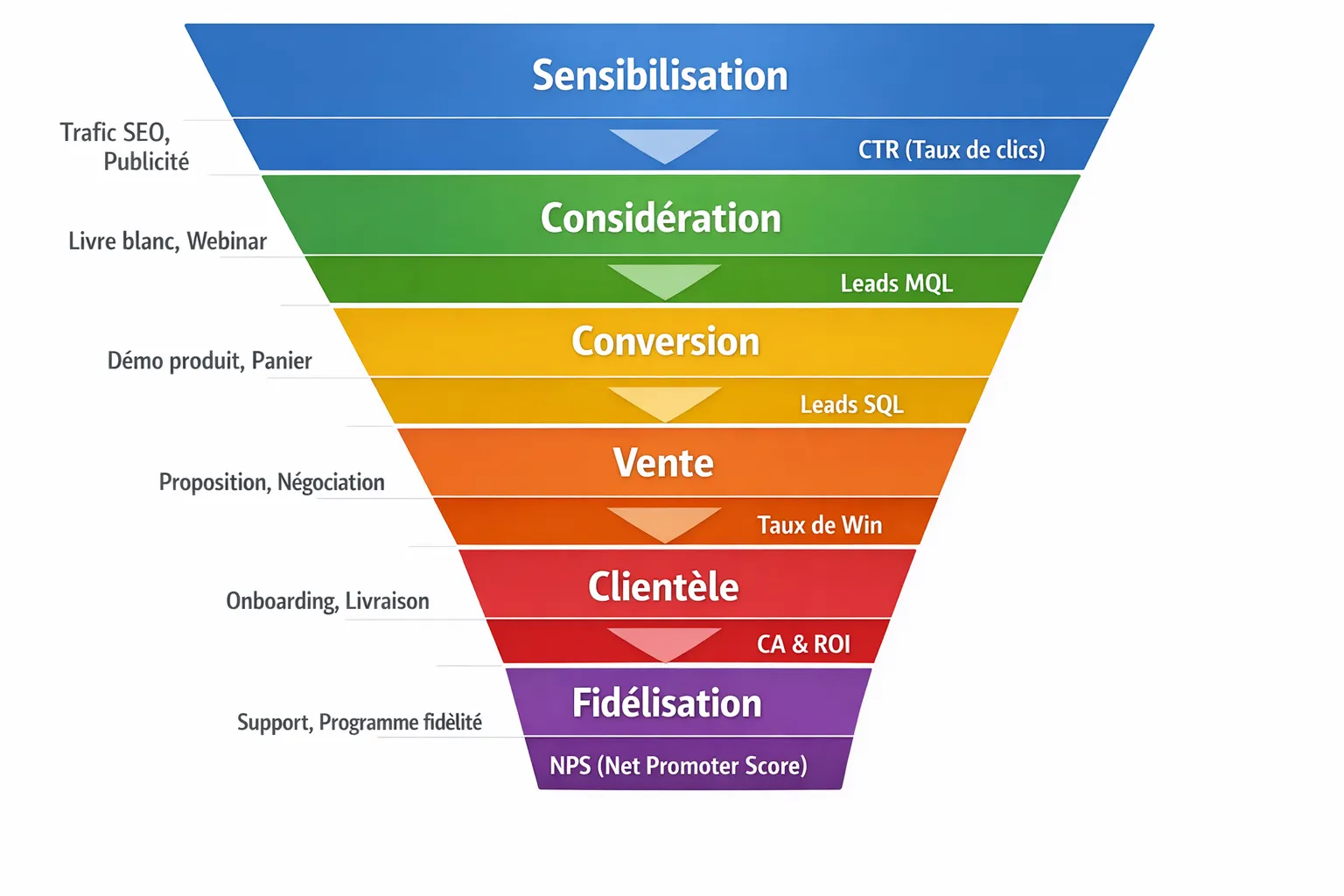
The sales funnel describes the steps traversed by an audience, from discovering your offer to purchasing, then loyalty. It is schematized as a funnel because many enter at the top, fewer exit at the bottom. The value of the model is twofold: it structures the customer experience and makes the performance of each step measurable to prioritize high-impact actions.
For a neutral introduction to the concept, you can consult the Wikipedia entry on the conversion funnel.
Funnel, Pipeline, Flywheel: What's the Difference?
Sales funnel: represents the steps traveled by prospects, with volumes and conversion rates per step. This is the end-to-end marketing and growth vision.
Sales pipeline: represents current opportunities, with negotiation steps specific to sales. This is the daily tool for Sales teams in a CRM.
Flywheel: this model emphasizes the snowball effect of customer experience and word-of-mouth. In practice, your funnel benefits from including loyalty and expansion to reflect this dynamic.
Key Steps, Without Jargon
Names matter less than consistency. Here is a simple version, mapped to the most used B2B terms.
Awareness: you attract attention. Examples: SEO, social, advertising, word-of-mouth.
Interest: the audience explores. Examples: service pages, comparisons, case studies.
Soft conversion: a non-commercial value action. Examples: newsletter signup, guide download. This is often where MQLs are born with the help of lead scoring.
Evaluation: commercial exchange. Examples: demo request, discovery call. Leads qualified by sales become SQLs.
Decision: proposal, negotiation, signature. This is the classic Sales pipeline.
Loyalty and expansion: satisfaction, renewal, additional sales, recommendations.
You will often see TOFU, MOFU, BOFU. This corresponds to Top of Funnel, Middle, Bottom. To keep it simple, map your content and actions to these three zones, then break down the steps that make sense for your business.
A Funnel Only Has Value If Measured
Measure little, but well, and repeatably. Here is a concrete canvas to start.
Locate the bottleneck: look for the largest gap between expected volume and realized conversion, or the longest delay between two steps.
Test an improvement: dedicated landing page, social proof, better call-to-action, proactive follow-up, then measure again.
Tip: start with steps close to revenue, for example appointment setting and lead processing, as they often offer the best immediate ROI.
Common Mistakes That Derail a Funnel
Confusing channel and step: the channel is how you bring traffic, the step is where the person is in their decision.
Skipping the definition of MQL and SQL: this prevents marketing and sales from speaking the same language. Clarify with explicit and behavioral criteria, see MQL and SQL.
Optimizing a step without instrumentation: you won't know if you improved conversion or moved the problem.
Ignoring retention: a modern funnel includes loyalty and expansion. The RevOps function aims precisely for global alignment.
Chasing vanity KPIs: prioritize indicators close to revenue and pipeline velocity.
Where AI and Automation Really Help
The goal is not to replace strategy, but to augment your execution capacity and tracking quality.
Top of funnel: personalization of pages and messages based on context, dynamic segmentation, AI-assisted content and SEO, see SEO.
Conversion on key pages: a contextual chatbot guides and qualifies, directs to a resource or appointment booking, see our guide on the intelligent landing page and chatbots for SMEs.
Qualification: a lead scoring model prioritizes what the sales team should treat first. MQL and SQL definitions become measurable.
Responsiveness: automatic routing of requests and immediate callback; response speed strongly influences conversion.
Post-purchase: AI assistants for 24/7 support, reduction of response time and improvement of satisfaction, see KPIs to prove chatbot ROI.
B2B Go-to-market: ABM campaigns personalized by account and integrated into your CRM.
Impulse Lab designs and integrates these bricks into your ecosystem: AI opportunity audit, automations, integrations with your tools, custom platforms, and adoption training. The goal is unique: transform AI into measurable value for your funnel.
15-Minute Checklist to Map Your Funnel
Write your steps on a sheet, from first contact to loyalty.
Assign 1 KPI per step, no more, and a source of truth for the data.
Note the conversion rate and average delay between each step.
Highlight the step with the biggest drop or longest delay.
Choose 1 action to test on this step for 2 weeks, then measure.
This checklist is not magic, it forces discipline. Repeat the cycle every month and document results.
Clear Model to Align Your Teams
A good funnel makes definitions and responsibilities explicit; it is the basis of sustainable marketing, sales, and customer success alignment. Document at a minimum:
Criteria for passing between steps, for example, what constitutes an MQL for you, then how it becomes an SQL.
Major channels feeding each step: organic traffic, paid, partnerships, outbound.
Internal SLAs: who does what, in how much time, with which tool.
Regular reviews, weekly or monthly, to decide on experiments to launch and priorities.
If you have a revenue-oriented organization, your practices join those of RevOps: processes, technologies, and data aligned on a common goal, sustainable growth.
In Summary
The sales funnel is the simple and measurable map of your growth.
Choose steps that reflect your customers' reality, align MQL and SQL definitions, instrument the useful minimum.
Treat bottlenecks close to revenue first, then move to the top of the funnel.
Use AI and automation as execution levers, not as substitutes for strategy.
Want to move from theory to an action plan? We can audit your funnel, recommend priorities, and put into production the automations that will make the difference, integrated into your existing stack and delivered week after week. Tell us about your context, meet us at Impulse Lab.