Shadow AI: Regaining Control Without Blocking Your Teams
Intelligence artificielle
Stratégie IA
Gouvernance IA
Productivité
Shadow AI stems from teams wanting to move faster, not defiance. Discover how to regain control of AI usage without slowing business velocity, through practical governance, vetted alternatives, and a 30-day action plan.
September 22, 2026·12 min read
Shadow AI rarely appears out of defiance. It takes root because a sales team wants to reply faster, a manager needs to synthesize twenty meeting notes, or a developer is looking to speed up a repetitive task. The problem is not that teams are using AI, but that the company no longer sees where, how, and with what data it is being used.
For an SMB, a scale-up, or a growing business, the goal is not to block every tool. An outright ban often pushes usage toward personal accounts, manually copied files, or invisible automations. The right approach involves bringing Shadow AI into a clear, practical, and proportionate framework, preserving operational speed without sacrificing security, compliance, or decision quality.
Why Shadow AI Emerges as Companies Grow
Shadow AI is the AI counterpart to Shadow IT: tools, prompts, browser extensions, agents, or automations used outside the framework validated by the organization. It can take the form of an individual chatbot subscription, an automated meeting summarizer, an AI-enhanced spreadsheet, or an undocumented connector between two business applications.
The Gap Between Business Needs and Internal Capacity
As a company grows, business needs outpace processes. Teams want to produce more, respond faster to customers, analyze more data, and reduce manual tasks. If the IT infrastructure does not keep up, they look for shortcuts.
This behavior is rational. A marketing manager generating email variants with an AI tool isn't deliberately bypassing governance—they are solving a concrete problem. An operations lead copying data into an assistant to reformat a spreadsheet is trying to save an hour, not create a vulnerability.
Shadow AI becomes dangerous when these initiatives remain invisible. Without an inventory, the company has no visibility into what data is leaving the perimeter, which outputs inform key decisions, which tools retain prompts, or what terms of service govern their use.
The Real Signal to Listen To
Hidden adoption often highlights operational friction. If multiple employees use AI to proofread sales proposals, it may signal a need for document templates, a shared knowledge base, or a more efficient approval workflow.
Treating Shadow AI as individual misconduct wastes this insight. Treating it as a signal helps identify the exact processes where AI is already creating value. That is where an organization can build useful AI solutions—integrated into existing systems and far safer than makeshift individual workarounds.
The Real Risks to Manage, Without Dramatizing
Shadow AI does not present a single, uniform risk. A team using AI to rephrase public copy does not expose the company in the same way as a team copying customer records, contracts, or proprietary code into an unapproved service.
The CNIL reminds us that artificial intelligence projects must remain compliant with the GDPR, especially regarding purpose limitation, data minimization, and data subject information. The NIST AI Risk Management Framework also provides leaders with a practical model: govern, map, measure, and manage AI risks on an ongoing basis.
Risk
Common Example
Potential Consequence
Data Leak
Pasting a customer database into a public tool
Exposure of personal or confidential information
Unverified Error
Using an AI output as a final analysis
Decision based on a hallucination or false assumption
Non-compliance
Processing sensitive data without a clear legal basis
GDPR, contractual, or reputational liability
Loss of Traceability
Automating an action without logging or accountability
Difficulty explaining, auditing, or correcting a decision
Tool Dependency
Building a process around an individual account
Business continuity disruption if the employee leaves or the tool changes
To dive deeper into the controls to implement around data, security, and compliance, our guide on key artificial intelligence risks in business details the critical checkpoints to prioritize.
Mapping Usage Without Launching a Witch Hunt
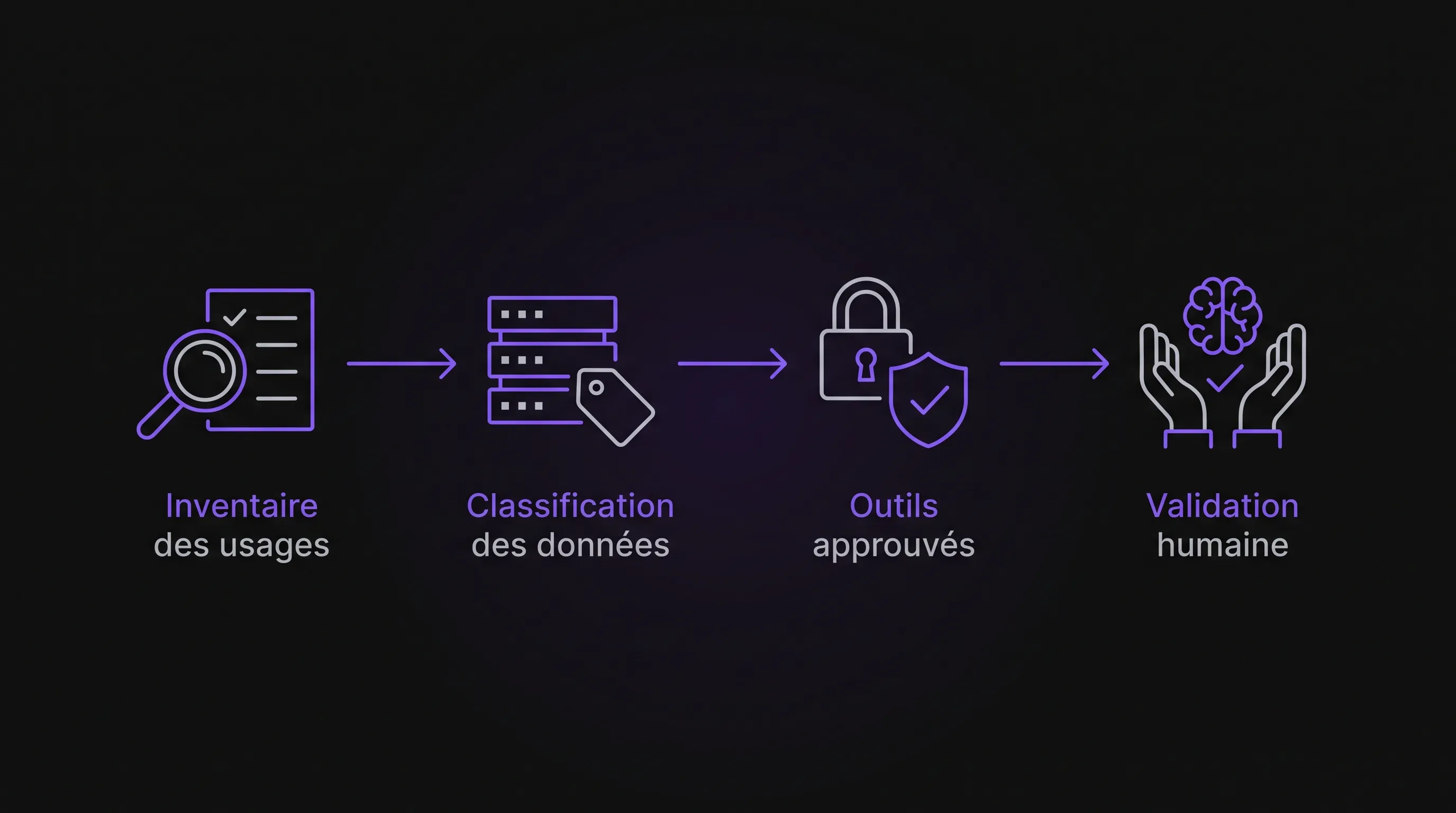
The first mistake is starting with an alarmist message: any undeclared usage will be penalized. This approach only pushes teams into silence. A far better strategy is to announce a straightforward initiative: understand existing practices, clarify what is acceptable versus what is not, and provide vetted alternatives.
A practical AI audit for Shadow AI should be highly operational. It is not an abstract theoretical report, but a map of actual day-to-day practices: tools used, types of data processed, tasks handled, perceived gains, risks, and business pain points.
The most valuable sources of information are often simple: brief team interviews, an anonymous survey, a review of SaaS subscriptions, an audit of installed browser extensions, manager discussions, and an inventory of existing automations.
Signal to Gather
What It Reveals
Precaution to Take
Tools used by department
Where AI already addresses a real need
Do not confuse discovery with disciplinary action
Data pasted into prompts
Actual level of risk
Classify data before defining rules
Automated tasks
Potential productivity gains
Verify human-in-the-loop oversight
Outputs used in production
Impact on customers, finance, or operations
Require auditability and quality control
This phase should result in a concise, highly readable set of deliverables: a usage map, a risk classification matrix, and an initial backlog of use cases to secure or industrialize.
Shadow AI: Regaining Control with Lightweight Governance
Regaining control over Shadow AI does not mean creating a committee for every prompt. Governance must be clear enough to protect the organization, yet lightweight enough for teams to actually follow.
Classify Uses, Not Just Tools
The same tool can be completely acceptable in one context and prohibited in another. Asking an AI to rephrase a public web page does not carry the same risk level as feeding it a prospect database, HR records, or sensitive source code.
This framework must be written in language employees understand. A fifteen-page AI policy will rarely be read; a single clear page with concrete business examples will be far more effective.
Define Three Clear Statuses: Allowed, Regulated, Prohibited
The framework should answer a simple question: can I use AI for this task? Three tiers work well.
Allowed uses cover low-risk tasks such as ideation, rephrasing public content, or drafting task outlines. Regulated uses require an approved tool, authorized data, and sometimes managerial sign-off. Prohibited uses encompass sensitive data, trade secrets, credentials, non-anonymized personal data, or automated decisions without human oversight.
This simplicity empowers managers. They do not need to become machine learning experts to handle routine cases. They just need an understandable rule, a few examples, and a clear channel to escalate borderline cases.
Replacing Bans with Approved Paths
An AI policy only succeeds if it provides a credible alternative. If a company rejects all external tools without offering a viable solution, shadow adoption will simply persist underground.
The right approach is to pave approved paths. This can take several forms: an enterprise-grade AI assistant for general tasks, curated prompt libraries by role, secure connectors to existing tooling, an internal platform for specific workflows, or an expedited request process for new tools.
The real challenge is lowering the cost of compliance. If requesting a tool takes three months, teams will find workarounds. If the rule is clear and the turnaround is fast, they will play by the rules.
For higher-value use cases, a custom solution is often preferable to stacking subscriptions. For instance, a lead qualification workflow, ticket triage process, or proposal generation engine can be integrated directly into your CRM, ERP, or support software. This is where web development, process automation, and tailored AI integration prove far more reliable and secure than fragmented consumer chatbots.
Moving from Individual Tinkering to Secure Processes
Shadow AI is often an initial phase of exploration. One person tests a tool, demonstrates a tangible gain, and others follow suit. The company's role is to spot these signals and turn the best use cases into robust, structured processes.
Consider a common scenario: a support team uses an assistant to draft customer responses. Initially, this might start as a regulated use with a strict prohibition on pasting sensitive customer records. If the productivity gain is proven, the next step is to build a secure workflow: an approved internal knowledge base, suggested responses, mandatory human review prior to sending, and full change logging.
This approach avoids two extremes. The company avoids blocking a concrete operational gain, while ensuring customer-facing workflows do not depend on personal accounts, undocumented prompts, and inconsistent verification standards.
To structure this transition, launching a focused pilot can be very effective. Our guide on how to launch an enterprise AI program in 30 days outlines a practical methodology to scope a use case, its data requirements, KPIs, and governance without waiting for a multi-year roadmap.
A 30-Day Action Plan to Regain Control
Bringing Shadow AI under control does not have to be an overwhelming endeavor. Within a single month, leadership can mitigate the most obvious risks while establishing healthy momentum.
Timeline
Objective
Concrete Deliverable
Week 1
Understand existing practices
Survey, interviews, initial usage map
Week 2
Classify risks
Data, use cases, and control-level matrix
Week 3
Define rules
AI policy page, approved tools list, prohibited cases
Week 4
Deploy alternatives
Request intake channel, brief training, priority pilot
The key is to manage the initiative like an internal product, where employees are the users. Success is not measured solely by the number of blocked tools, but by how many valuable use cases successfully transition into a visible, documented, and secure framework.
A great rule of thumb to start with: every recurring AI use case must have an owner, approved data boundaries, a defined validation level, and a tracking method. This single standard quickly clears up gray areas.
Training Teams Without Getting Bogged Down in Theory
Training is essential, but it must stay tied to day-to-day operations. Employees don't just need to understand what an LLM is; they need to know what data to never paste, how to verify an output, when to request validation, and how to report a promising use case.
Impactful training can be delivered through short, role-specific workshops. Sales teams focus on proposals and meeting summaries; operations focus on spreadsheets, tickets, and SOPs; developers focus on code, documentation, and tests; managers focus on decision-making, verification, and traceability.
To prevent the AI policy from becoming a forgotten document, maintain an ongoing space for dialogue. A dedicated internal channel, a live FAQ, or a monthly review of use cases helps clarify evolving questions. To guide these conversations, you can rely on our guide to structuring team discussions around AI tools and rules.
Measuring Control Without Excessive Surveillance
Regaining control does not mean monitoring every single prompt. Intrusive surveillance erodes trust and can trigger legal or labor relations issues. It is far more effective to track governance and value metrics.
Effective KPIs combine risk management with adoption: number of declared use cases, percentage of classified uses, count of approved tools, requests handled, security incidents prevented, time saved across pilot workflows, and team satisfaction.
The OWASP Top 10 for Large Language Model Applications serves as an excellent technical reference for advanced initiatives, particularly when integrating LLMs into internal applications. It addresses critical risks such as prompt injection, sensitive data leakage, and unvalidated outputs.
Measurement should always encourage the right behavior. If a team proactively declares a high-risk practice, they should not face punitive action; they should be supported in securing it or finding a better alternative.
Frequently Asked Questions
What is Shadow AI in a business context? Shadow AI refers to AI tools, scripts, or automations used without the knowledge, approval, or governance of the company. This includes chatbots, browser extensions, autonomous agents, connectors, or platforms handling company data outside official oversight.
Should we ban all unapproved AI tools? An outright ban is rarely effective. It typically drives usage toward personal accounts that are even harder to monitor. It is much better to explicitly prohibit high-risk scenarios, set boundaries for sensitive use cases, and provide vetted tools for everyday tasks.
What is the first step in addressing Shadow AI? Begin by mapping existing practices without a punitive mindset. Identify which tools are being used, what data is involved, which tasks are handled, and what benefits teams are seeing. This baseline allows you to prioritize risks and implement targeted alternatives.
How should confidential data be handled with AI? Confidential data must only be used within an approved framework: a vetted tool, enterprise agreements ensuring data privacy, strict access permissions, logging where appropriate, and mandatory human review of outputs. For personal or sensitive data, a GDPR compliance review and DPO sign-off may be required.
When should a company build a custom AI solution? A custom solution becomes valuable when a use case is recurring, impacts a critical business process, involves proprietary internal data, or delivers measurable ROI. In these situations, integrating AI directly into existing workflows is significantly safer and more efficient than relying on scattered consumer tools.
Turning Shadow AI into a Controlled Competitive Advantage
Shadow AI is not merely a risk to mitigate—it is proof that your teams already recognize where AI can drive value. The difference between an exposed company and a high-performing one lies in the ability to turn isolated experiments into secure, scalable, and embraced workflows.
Impulse Lab supports organizations looking to transition from informal experimentation to structured AI adoption: opportunity audits, process automation, integration with existing tech stacks, custom AI platforms, and practical team training. The goal is simple: sustain team velocity while putting the right guardrails in place.
If you want to regain control without slowing your business down, start with a quick assessment of your current AI landscape. Explore Impulse Lab to identify the first use cases to frame, secure, and scale.