Should You Wait for Artificial General Intelligence Before Investing?
Intelligence artificielle
Stratégie d'entreprise
Stratégie IA
ROI
Optimisation
Should you put projects on hold while waiting for AGI? For an SME or scale-up, no—provided you invest in measurable outcomes rather than tech promises. A system doesn't need to do everything to reduce processing times or simplify access to internal documentation.
Should you put your projects on hold while waiting for artificial general intelligence? For an SME or scale-up, no—provided you invest in measurable outcomes rather than a technological promise. A system does not need to know how to do everything to reduce case processing times or facilitate access to your internal documentation.
The real risk is two-fold: waiting for a breakthrough whose arrival date no one can guarantee, or rushing to purchase an expensive solution that solves no priority problem. Between these two options, a more sound approach consists of funding targeted, measurable, and reversible improvements.
We are talking here about operational investment: tools, integrations, data, and skills. The goal is not to predict the next foundation model, but to decide where to commit your budget today without locking yourself into a specific technology.
Why Artificial General Intelligence Is Not a Prerequisite
AGI, or Artificial General Intelligence, generally refers to an AI capable of transferring its skills across numerous domains and performing a wide variety of intellectual tasks. Its precise definition and the criteria used to determine when it has been achieved remain widely debated.
This concept should not be confused with the versatility of an assistant. A tool can write, code, and analyze documents without being reliable in every situation or capable of autonomously running an entire business process.
For a company, the right question is much narrower: does the system complete this specific task with an acceptable level of quality and at a controlled cost? A verified data extraction or a meeting summary preparation can deliver real value without general autonomy.
Conversely, a spectacular demonstration does not justify an investment if the output demands too many corrections. The model's apparent capability matters less than the end-to-end performance of the process, including human oversight. Drawing this distinction allows you to invest without having to resolve the debate over when AGI will arrive.
Waiting Has a Cost, but Not All Delays Are Equal
Waiting for artificial general intelligence can postpone two distinct benefits: accessible operational gains and the learning curve required to leverage future tools.
Take a team that manually re-enters the same information between documents and business software every week. If this work is frequent, stable, and verifiable, deferring its improvement maintains a known burden. In fact, traditional automation might suffice, with or without an AI component.
Organizational learning also matters. Building a representative dataset of files, defining an acceptable error rate, and training users takes time. These acquired skills remain valuable even if the vendor or model changes. Our overview of AI use cases in SMEs helps identify relevant activities without starting from a technology you need to buy.
Yet waiting can also be rational. If a process is slated for a complete overhaul in three months, automating it immediately risks creating throwaway work. The same caution applies if volumes are low or if errors would be difficult to catch.
The cost of waiting must therefore be calculated against an actual problem. The fear of falling behind is not, on its own, a valid business case.
Funding What Remains Useful Even When Models Change
A resilient investment does not depend on the arrival date of artificial general intelligence. It improves your organization today and remains useful even if technical capabilities progress rapidly.
Before committing to a heavy platform, prioritize the foundations that support multiple use cases: accessible data, clear responsibilities, and an evaluation methodology. These are not always the most visible expenses, but they prevent costly rework.
Investment
Immediate Utility
What It Preserves for the Future
Structured business documentation
Retrieve and leverage the right information
A reusable foundation for different tools
Representative test dataset
Compare quality, errors, and processing time
A methodology to evaluate new models
Documented integrations
Reduce manual steps between software systems
The ability to replace a component
Team training
Better utilize tools and oversee their outputs
Transferable skills
Reversibility should also be part of conversations with service providers. Can you export your data? Who controls the connections to your software? Is the business logic documented, or hidden inside an inaccessible configuration?
You do not need to build a complex architecture for every small project. Above all, demand an exit path proportionate to the risk: data retrieval, clear responsibilities, and a rollback procedure to return to the previous workflow.
Finally, comparing models based on your needs is far more valuable than systematically picking the latest release. The best trade-off can vary depending on expected quality, confidentiality, or processing volume.
Calculating Value Without Confusing Time Saved with Money Saved
The prospect of artificial general intelligence does not change a fundamental management rule: a project must be evaluated on its observable benefits, after subtracting its total costs.
Here is a hypothetical example, carrying no pricing value or performance guarantee. A team processes 600 files per month. The average time drops from five to three minutes per file, including verification. The time gained reaches 20 hours per month.
Assuming a fully loaded hourly cost of €40, this capacity represents €800 per month. If running the system costs €350 per month, a theoretical value of €450 remains. For an upfront investment of €1,800, the theoretical payback period would be four months—provided this value actually materializes and the assumptions hold steady.
Twenty hours freed up does not automatically equate to €800 in saved cash flow. If operating expenses do not decrease, the benefit may take the form of extra capacity, shorter turnaround times, or avoided overtime. That outcome must be measured, rather than merely relying on the time savings advertised by the tool.
Also factor in maintenance, training, exceptions, and corrections. A project that accelerates routine handling but increases rework can degrade overall performance. Compare the before-and-after picture using comparable files and the same standard of quality.
Projects to Postpone, Even When the Demo Is Impressive
Certain investments require stronger proof than others. The more severe, hard to detect, or irreversible an error is, the less a simple demo suffices.
Be particularly cautious with any system that commits expenditures, modifies sensitive data, or makes decisions affecting individuals without adequate oversight. Adding human validation does not solve everything: the responsible party still needs the time, information, and authority required to review the output properly.
A postponement is justified if you cannot measure errors, control data access, or halt the system. You can nonetheless prepare the data and test outside of production.
The potential emergence of artificial general intelligence would not eliminate the need for these controls. Broader capability guarantees neither confidentiality, nor compliance, nor alignment with your business rules.
Moving Forward in Stages Rather Than Making a Tech Bet
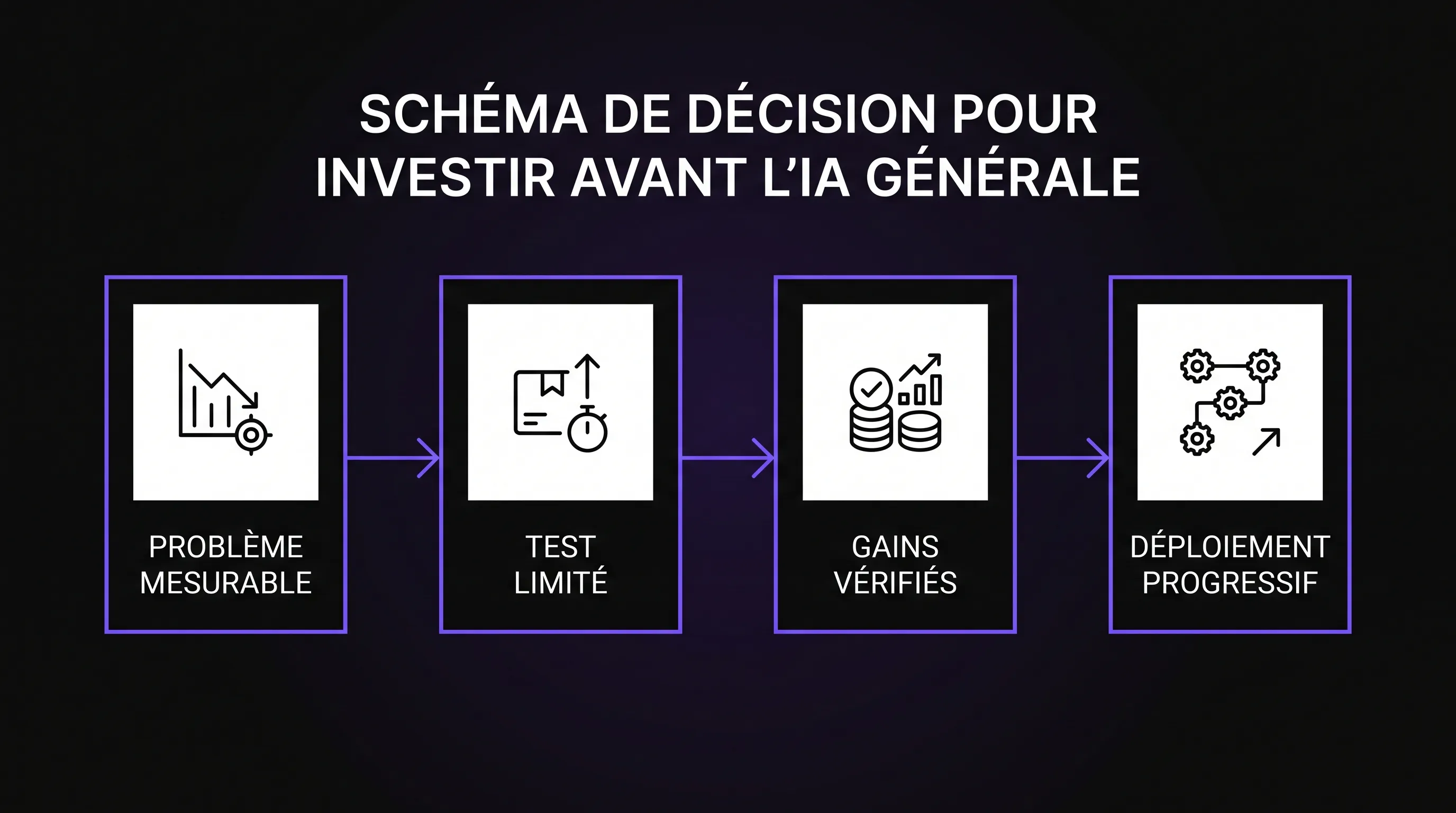
For a growing organization, releasing budget incrementally limits risk without stifling learning. A three-month cycle can serve as a framework, adaptable to the complexity of the project.
Month 1: Establishing the Baseline
Choose a frequent process with an identified owner. Measure its volume, cost, turnaround times, and error rates. Set success thresholds and stop triggers before testing begins. Also check whether simplifying the process or using traditional automation would better meet the need.
Month 2: Testing on a Limited Scope
Use representative cases, including edge cases. Measure review time and corrections, not just generation speed. Users must be able to report issues and roll back to the previous method without halting business operations.
Month 3: Deciding Based on Results
Expand the rollout if gains are confirmed, adjust if flaws can be corrected, and stop if the economics do not add up. The next budget allocation must fund additional proof, not automatically extend the project.
This discipline prevents your strategy from hinging on a forecast about artificial general intelligence. You purchase proven improvements while preserving the flexibility to change course.
Frequently Asked Questions
Do we need to develop our own model to get started? No. An off-the-shelf tool, an integration, or traditional automation may well be sufficient. Custom development is justified when a specific business need, data constraint, or integration requirement demands it—not to show off technological prowess.
How can we prevent an investment from quickly becoming obsolete? Prioritize exportable data, documented integrations, and reusable test suites. Do not assume switching vendors will be free, but identify upfront what would need to be replaced and what would remain usable.
Would artificial general intelligence make current projects obsolete? It might alter the value of certain components, but it will not automatically eliminate business needs, tool integrations, or oversight rules. Hence the advantage of funding capabilities that are useful today rather than an infrastructure sized for a hypothetical scenario.
Deciding What to Fund Now
Your next decision does not have to be an expansive transformation initiative. It can focus on a single process, backed by a baseline measurement, a capped budget, and an explicit stop criterion.
Impulse Lab supports organizations through AI opportunity audits, custom development, and adoption training. An initial scoping exercise helps clarify what is worth testing today, what requires groundwork, and what is better left for later.