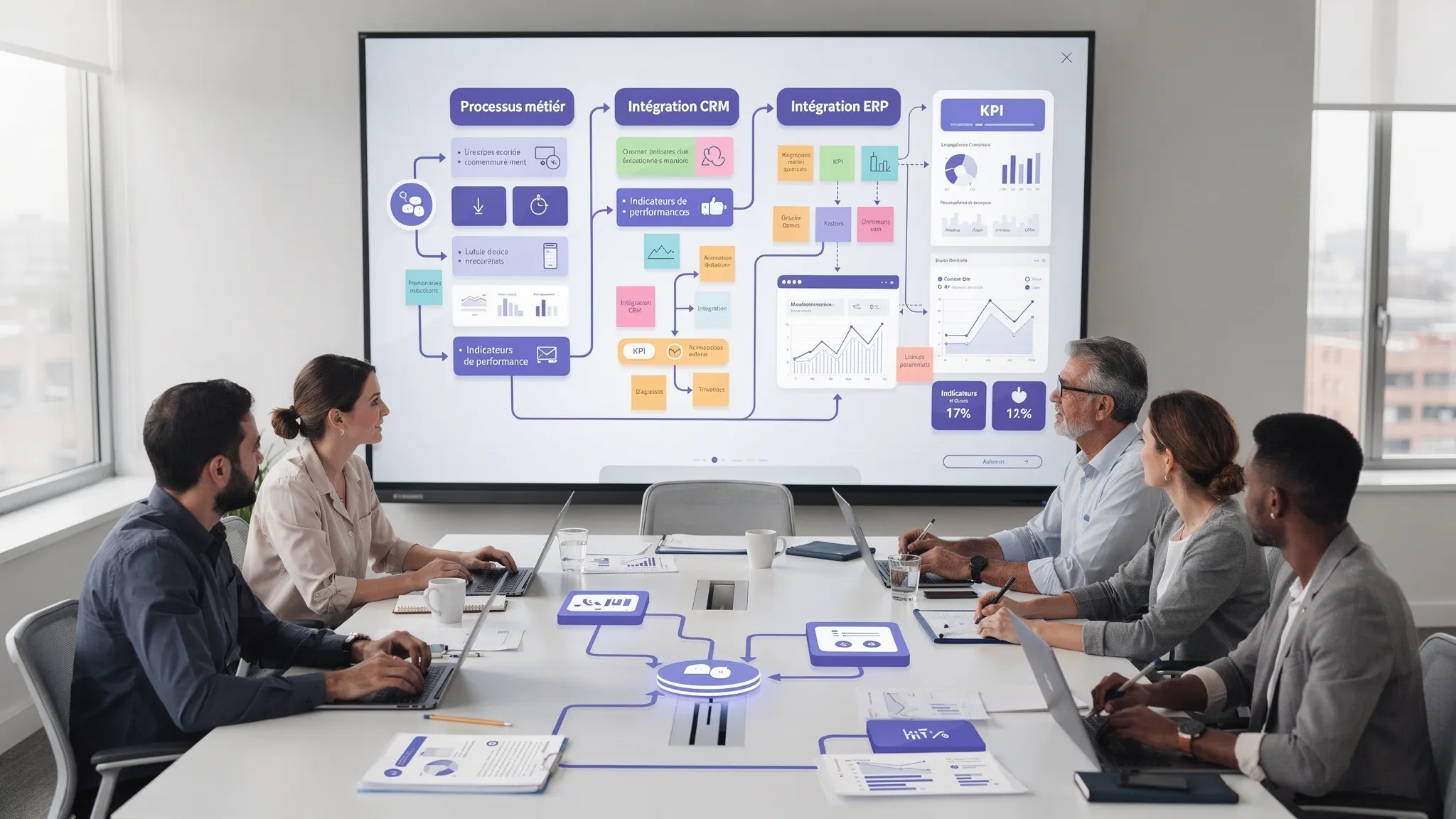
In 2026, successful **custom software development** is no longer about starting from scratch and coding in isolation for months. For SMEs and scale-ups, the goal is pragmatic: transforming a growth-blocking business process into a reliable, adopted, and integrated tool...
May 16, 2026·14 min read
In 2026, successful custom software development is no longer about starting from a blank page and coding in isolation for months. For an SME or a scale-up, the challenge is more pragmatic: transforming a business process that hinders growth into a reliable, adopted, integrated, and measurable tool.
Custom software isn't always the right answer. A well-configured SaaS, a no-code tool, or simple automation can sometimes suffice. But as soon as your operations become highly specific, your data is scattered, your teams bypass tools using Excel files, or AI needs to be integrated into your actual workflows, custom development can become a strategic lever.
The question is therefore not: should we build? The real question is: which business problem deserves a dedicated solution, with what KPIs, what safeguards, and what delivery trajectory?
Why Custom Software is Changing Roles in 2026
For a long time, developing custom software mostly meant replacing a standard tool with an internal application. In 2026, the logic is different. Most companies already have a stack: CRM, ERP, marketing tools, spreadsheets, customer support, business tools, SaaS platforms, and AI solutions.
Custom development is increasingly used to connect, secure, and automate this stack. It can take the form of a customer portal, a business back-office, a workflow engine, a reporting tool, a web platform, a connector between systems, or an AI layer integrated with company data.
This evolution changes the criteria for success. A successful application is not just delivered. It is used, maintained, secured, connected to existing tools, and capable of scaling with the business.
Three trends explain this evolution.
First, AI accelerates certain development stages, but it doesn't eliminate the need for architecture, testing, security, and business understanding. A quickly generated prototype might impress, but a production solution must handle errors, permissions, data, edge cases, and operations.
Second, companies want fewer isolated tools. They are looking for systems that integrate with their CRM, support, databases, billing tools, and dashboards. Custom software often becomes an orchestration layer.
Finally, the pressure on ROI is increasing. Executives want to know what the project will improve: time saved, conversion rate, margin, quality, processing time, error reduction, or better operational visibility.
When to Choose Custom Software Development?
Custom development becomes relevant when a standard tool can no longer absorb the real complexity of your operations, or when this complexity constitutes a competitive advantage.
If your need is generic, for example, managing contacts, sending newsletters, or scheduling appointments, a SaaS tool is often preferable. The SaaS model reduces maintenance costs and speeds up deployment.
However, if your sales, production, support, or reporting process is specific, highly integrated, and critical for growth, custom development is worth considering.
Situation
Standard tool often sufficient
Custom development relevant
KPIs to track
Simple and common process
CRM, ERP, business SaaS
Rarely necessary
Cost per user, adoption
Differentiating business process
Advanced configuration possible
Yes, if the standard forces too many workarounds
Processing time, quality, margin
Data scattered across multiple tools
No-code automation possible
Yes, if rules are complex or critical
Errors, delays, data completeness
Specific customer experience
Portal tool or CMS
Yes, if the journey is strategic
Conversion, satisfaction, retention
AI integration needed in workflows
Generic Copilot
Yes, if AI must access your sources and act within your tools
Resolution rate, time saved, reliability
Strict compliance or permission constraints
Compliant SaaS if suitable
Yes, if access and audit rules are specific
Incidents, traceability, compliance
A good warning sign: your teams spend more time working around tools than using them. Copy-pasting between platforms, parallel tracking files, manual follow-ups, duplicates, uncertain reporting, and information loss are often symptoms of a need for a better-integrated solution.
For a specific case like a CRM, the question isn't necessarily about replacing everything that exists. A hybrid approach may suffice. The article Custom CRM: when the standard is no longer enough details these scenarios.
Decisions to Make Before Writing a Single Line of Code
The biggest risk in a software project isn't technical. It is often linked to overly vague scoping. Successful custom software development starts with explicit decisions.
The Business Problem Must Be Measurable
A need like "improve our internal tool" is too vague. The problem must be formulated in observable terms: reduce the processing time of a file from 45 to 20 minutes, decrease data entry errors by 30%, increase the conversion rate after qualification, or automate 70% of recurring requests.
The KPI doesn't need to be perfect. Above all, it must allow for a before/after comparison. Without a baseline, the project risks being judged on intuition rather than impact.
V1 Must Be Intentionally Limited
A common mistake is turning the specifications into an inventory of all the frustrations accumulated over three years. This produces projects that are heavy, expensive, hard to test, and slow to adopt.
A useful V1 must solve a priority flow from end to end. It is better to quickly deliver a critical path, with 80% of cases well managed and exceptions accepted, than to promise a comprehensive platform that never reaches production.
Users Must Be Involved Early
Executives see the goal, managers see the constraints, users see the details that cause adoption to fail. All three levels are necessary.
Involving users doesn't mean asking them for an endless list of features. You must observe their actual work, identify pain points, test mockups, measure understanding, and adjust the workflow before freezing the architecture.
Integrations Must Be Scoped from the Start
In 2026, very few business applications live alone. A portal often needs to talk to the CRM. A production tool must retrieve data from the ERP. An AI platform must access reliable sources. A back-office must trigger notifications, create tasks, or update statuses.
This is often where projects go off track. A missing API, poorly structured data, an unforeseen access right, or fragile synchronization can cost more than a visible feature.
A 6-Step Method to Deliver Without Scope Creep
A custom project must advance through successive proofs. Each step must produce a concrete deliverable and a clear decision.
Step
Objective
Expected Deliverable
Passing Criterion
Scoping
Define problem, users, KPIs, and scope
Project brief, target workflow, ROI score
The sponsor and business owner validate the V1
UX Prototype
Test the user journey before heavy development
Mockups, user flows, user feedback
Users understand the flow without lengthy explanations
Architecture
Prepare data, permissions, integrations, and security
Technical diagram, data model, API strategy
Critical dependencies are identified
V1 Development
Build a complete, usable flow
Application, tests, instrumentation
The priority flow works end-to-end
Pilot
Test on a real but controlled scope
Dashboard, feedback, fixes
KPIs improve and risks are managed
Industrialization
Stabilize, document, and prepare for run
Documentation, monitoring, runbook
The team knows how to operate and scale the solution
This method avoids two extremes: the long development tunnel with no feedback, and the permanent prototype that never goes into production.
Short cycles are essential. At Impulse Lab, projects are structured with weekly deliveries and regular client involvement, to reduce the gap between what is imagined and what is actually useful.
Architecture: Build to Scale, Not Just to Launch
A successful business application must remain maintainable as the company grows. This requires a few simple principles.
The first is modularity. You must avoid building a monolithic block that is impossible to modify. Even if the architecture remains simple, it must separate responsibilities: user interface, business logic, data, integrations, authentication, notifications, observability.
The second is the API-first approach when exchanges with other tools are important. API contracts must be documented, versioned, and tested. An integration that works solely through fragile scripts quickly becomes a breaking point.
The third is observability. An executive doesn't need to see all the technical logs, but the team must know if synchronizations fail, if performance degrades, if users abandon a journey, or if an automation produces exceptions.
The research and practices synthesized by DORA remind us of the importance of metrics like deployment frequency, lead time for changes, change failure rate, and time to restore service. Even in an SME, these indicators help manage delivery quality.
Finally, security must be integrated from the start. The recommendations of the OWASP Top 10 remain a useful foundation for avoiding common web vulnerabilities, while the CNIL reminds us of the obligations related to personal data and the GDPR.
In 2026, almost all software projects include a discussion around AI. But two uses must be distinguished.
The first concerns AI in the development process. Code assistants, generated tests, assisted documentation, and refactoring help can accelerate certain tasks. This does not replace human review, architecture, security testing, and business validation. A codebase generated quickly without safeguards can become very costly technical debt.
The second concerns AI in the product itself. Here, the question must remain business-focused. AI can help summarize files, qualify requests, search a document database, generate assisted responses, detect anomalies, or automate actions under supervision. But it shouldn't be added just to look modern.
A good reflex is to choose the simplest pattern that works: an AI API for a stable task, RAG if the AI needs to rely on your sources of truth, or an agent if it needs to chain several actions with validations. The article AI Integration in Business: API, RAG, and Agent Patterns details these options.
In all cases, AI must be instrumented. You must track output quality, errors, usage costs, human escalation cases, and user satisfaction. Without measurement, AI remains a demo.
Budget: Think in Total Cost, Not Just Initial Quote
The cost of custom software depends on the scope, integrations, security level, data quality, user experience, automation level, and maintenance requirements.
A serious quote shouldn't just display a global price. It must explain what is included, what is not, what assumptions structure the estimate, and how trade-offs will be made during the project.
Cost Item
Why it is often underestimated
How to control it
Business Scoping
Teams want to jump to code too quickly
Limit V1 to a priority flow and define a KPI
UX/UI Design
A poorly designed interface destroys adoption
Test mockups before full development
Development
Scope evolves without trade-offs
Break down into short cycles and validate each delivery
Integrations
APIs and real data are more complex than expected
Audit existing systems before heavy commitment
Security & Compliance
Permissions, logs, and personal data arrive too late
Apply privacy by design right from the architecture
Data Migration
Historical data is incomplete or inconsistent
Plan for cleaning, mapping, and migration testing
Operations
The software must be monitored, patched, and improved
Prepare monitoring, documentation, and responsibilities
The right logic is to calculate the ROI over a realistic horizon. If an application saves 20 hours a week on a recurring task, improves the conversion rate, or reduces costly errors, the gain becomes measurable. If no recurring gain is identifiable, the scope probably needs to be reviewed.
Project Governance: Who Should Participate?
Custom software development rarely fails due to a single missing skill. It rather fails when responsibilities are blurred.
Role
Main Responsibility
Risk if absent
Sponsor
Carry the business priority and make trade-offs
The project loses its importance and budget
Business Owner
Define the actual workflow and validate value
The solution doesn't align with operations
Product or Project Manager
Prioritize, pace, and document decisions
Scope creep occurs
Key Users
Test journeys and report pain points
Adoption happens too late
Tech Lead
Guarantee architecture, quality, and maintainability
Technical debt accumulates
Data or Security Lead
Validate data, permissions, compliance, and logs
Risks are discovered at the end of the project
In an SME, these roles can be held by fewer people. The important thing is that they explicitly exist. A project without a business owner quickly becomes an IT project disconnected from value.
Common Mistakes to Avoid
The same traps often reappear in custom software projects.
Copying the old process without challenging it: developing a new tool to replicate an inefficient organization does not create sustainable value.
Wanting to deliver everything in V1: the broader the initial scope, the later user feedback arrives.
Underestimating integrations: connectors, synchronizations, and data rules are often the true heart of the project.
Postponing security to the end: permissions, authentication, logging, and GDPR must structure the architecture.
Measuring only the go-live: software that is delivered but barely used is not a success.
Creating excessive vendor lock-in: documentation, access, code repositories, architecture, and reversibility must be clarified.
Forgetting change management: even an excellent tool fails if teams don't understand why and how to use it.
These mistakes are avoidable if the project is managed like a product, not just a simple technical service.
How to Choose a Custom Development Partner?
The right partner shouldn't just know how to code. They must understand your business model, challenge your needs, talk about integration, anticipate operations (the run), and help you prioritize.
Before signing, ask for concrete proof: examples of deliverables, scoping methodology, delivery logic, documentation, access management, testing approach, reversibility policy, and how they measure impact.
Criterion
Good question to ask
Positive signal
Scoping
How do you turn an idea into a measurable V1?
KPI brief, target workflow, explicit trade-offs
Integration
How do you audit our existing tools?
API mapping, data, permissions, and dependencies
Delivery
How often will we see deliverables?
Short cycles, regular demos, structured feedback
Quality
How do you test before going to production?
Automated tests, business acceptance testing, monitoring
Security
How do you manage access, secrets, and personal data?
Principle of least privilege, logs, GDPR compliance
Reversibility
What do we get at the end of the project?
Code, documentation, diagrams, access, and runbook
Adoption
How do you support users?
Training, materials, controlled pilot, field feedback
Impulse Lab supports SMEs and scale-ups on these topics with opportunity audits, web and AI platform development, process automation, integration with existing tools, and adoption training. The goal is not to develop for the sake of developing, but to transform the tool into operational value.
FAQ
How long does it take to develop custom software? It depends on the scope and integrations. A targeted V1 can often be scoped and then delivered in short cycles, while a comprehensive platform requires a progressive trajectory. The right reflex is to aim for a first useful, measured, and improvable flow rather than a complete product right from the start.
Is custom software necessarily more expensive than SaaS? Not always in the long run. A SaaS is often cheaper at the start but can become expensive if teams multiply workarounds, parallel tools, and manual tasks. You must compare the total cost, including licenses, integrations, wasted time, maintenance, and operational risks.
Should we choose no-code, SaaS, or custom development? SaaS is suitable for standard needs, no-code for simple automations or prototypes, and custom development for critical, differentiating, or highly integrated processes. Many good projects combine all three approaches.
How to prevent custom software from becoming technical debt? You must scope a maintainable architecture, document choices, write tests, monitor production, limit the initial scope, and plan for reversibility. Technical debt mostly appears when short-term speed replaces architectural decisions.
Can we integrate AI into existing business software? Yes, if the data, permissions, and workflow are well scoped. AI can summarize, search, classify, assist, or automate certain actions. However, it must be connected to reliable sources, tested on real cases, and controlled by appropriate safeguards.
Going from an Idea to a Useful V1
Successful custom software development in 2026 starts with a simple decision: choosing a business problem important enough to deserve a dedicated solution, then transforming it into a measurable V1.
If you have a critical process that still relies on spreadsheets, copy-pasting, poorly connected tools, or hard-to-track decisions, a short audit can clarify the real potential. Impulse Lab can help you scope the opportunity, design the architecture, develop the solution, integrate AI when it creates value, and train teams to ensure adoption.
To discuss a project, an audit, or a custom platform, contact Impulse Lab.