The Limits of AI (Artificial Intelligence) in Negotiation
Intelligence artificielle
Stratégie IA
Gestion des risques IA
Automatisation
Sales
In negotiation, AI can prepare arguments, compare offers, and simulate objections. But a convincing answer does not mean a price is fair or a concession is profitable. For an SME, the risk starts when the assistant decides what to promise without human oversight.
In negotiation, AI (artificial intelligence) can prepare your arguments, compare proposals, and simulate objections. But a convincing response proves neither that a price is fair nor that a concession is profitable. For an SME or a growing business, the risk begins when the assistant becomes, without oversight, the one deciding what to promise to a client or supplier.
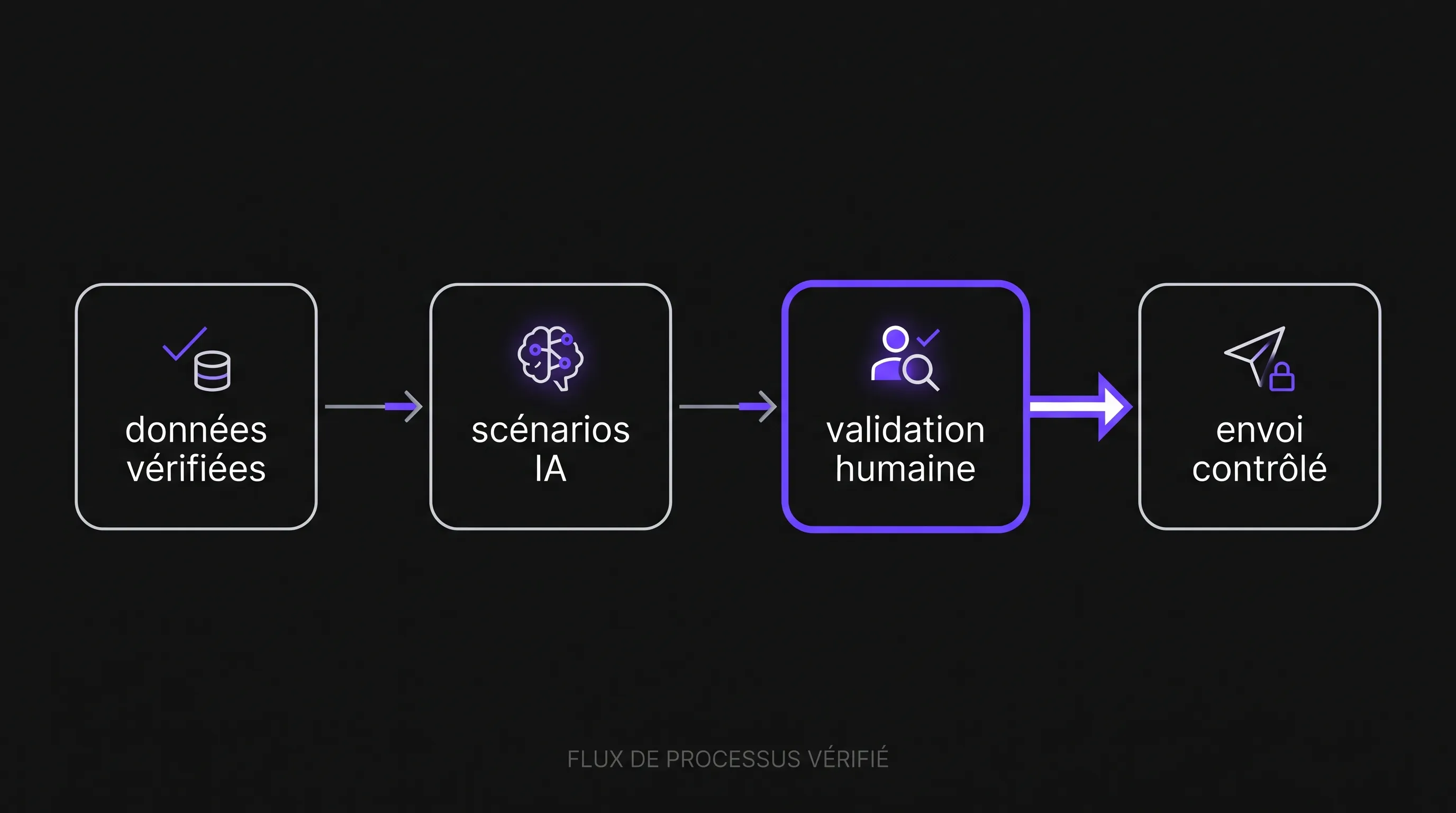
The right boundary lies in automating preparation while retaining full control over commitments. Here are the main limitations to keep in mind and the guardrails to put in place to protect your margin, your data, and your business relationships.
What AI (Artificial Intelligence) Can Prepare
Before a meeting, an assistant can synthesize authorized interactions, identify discrepancies between two offers, or propose multiple ways to address an objection. It can also act as a simulated counterpart to train your sales team.
These use cases are valuable because they produce reviewable outputs. A summary can be corrected, an argument dismissed, and a simulation restarted. They align with the current capabilities of artificial intelligence in business, provided one distinguishes text generation from calculation and action execution.
However, generating fluent discourse does not mean having a solid strategy. A tool might suggest lowering a price without knowing your delivery costs, available capacity, or commitments already made elsewhere.
The appropriate role is therefore that of a preparation assistant: it broadens options, but its recommendations must remain tied to verifiable information and your business rules.
First Limit: A Plausible Argument Is Not a Verified Fact
A language model can fabricate a competitor reference, attribute a clause to the wrong contract, or present an assumption as a certainty. The NIST Generative AI Risk Management Profile specifically describes this risk of "confabulation"—the production of false content presented with confidence.
In a negotiation, an error becomes especially costly when it leaves your organization. Claiming that a competitor offers a certain rate without proof can undermine your credibility. Promising a turnaround time not specified in the contract can create disputes at delivery.
To properly govern AI, it must provide the source of its key statements: document, citation used, and validity date. A generated reference is not proof until it has been verified.
Also require an explicit separation between established facts, interpretations, and missing information. For example, "the client is requesting a discount" is a fact if stated in their email. "Their budget is frozen" remains an assumption until confirmed by them.
Second Limit: It Does Not Automatically Know Your Room for Maneuver
"Getting the best deal" is too vague an objective. Should you maximize price, secure fast payment, preserve production capacity, or break into a strategic client? These goals can conflict.
AI (artificial intelligence) does not inherently know your break-even point or your best fallback option if no agreement is reached. It can help you formalize this alternative—often called BATNA (Best Alternative to a Negotiated Agreement)—but it cannot reliably deduce it from an isolated sales conversation.
A contract history is not enough either. Past discounts may reflect mistakes, an outdated strategy, or services that no longer incur the same costs. Automatically reproducing them amounts to turning past precedents into rules.
Before any recommendation, define the negotiable scope, the minimum acceptable threshold, and the required trade-offs. A discount tied to a firm twelve-month commitment does not have the same value as a discount granted in exchange for a mere intent to purchase.
No deal must remain an acceptable option. An assistant driven solely to close risks proposing concessions that run counter to your interests.
Third Limit: Relational Signals Remain Incomplete
A transcript captures words, but not the full picture. A silence can indicate hesitation, a negotiation tactic, or a technical glitch. A pricing objection may conceal a scheduling issue, a lack of trust, or internal approval hurdles.
Artificial intelligence can suggest multiple interpretations of these signals. However, it cannot establish your counterpart's intentions with certainty from an email or a handful of exchanges. Even when a tool processes audio or video, an emotional interpretation remains an inference, not a fact.
There is also the risk of building a strategy on stereotypes: the assumed aggressiveness of a procurement department, behavior attributed to a nationality, or purchasing power deduced from writing style. These shortcuts can damage the relationship and lead to unjustified treatment.
Instead, use the assistant to prepare clarifying questions: "Is the hurdle related to the total budget or the payment schedule?" This approach helps test an assumption without presuming to read minds.
Relational responsibility remains human: your team will have to explain a declined concession, repair a misstep, and uphold commitments after signing.
Fourth Limit: Negotiation Exposes Sensitive Data
Your exchanges may contain floor prices, personal contact details, cash flow difficulties, or confidential clauses. Submitting them to an AI service is a data processing decision, not merely a drafting task.
To use AI (artificial intelligence) for these matters, verify the terms applicable to the chosen service: data retention, potential reuse, subcontractor access, processing location, and deletion options. A consumer-grade product and an enterprise environment may have vastly different terms. You must examine the actual contract rather than assuming protections exist.
Also restrict what each user and tool can view. An assistant tasked with rephrasing a response does not necessarily need access to all client contracts or the complete margin grid.
The right approach is to provide only necessary information. Mask identities when sufficient and remove attachments unrelated to the request. Pseudonymization reduces certain exposures, but does not alone guarantee anonymity.
Finally, define what data is prohibited in unapproved tools. This policy must be understandable to sales reps, not just documented by the technical team.
Fifth Limit: Automated Actions Can Exceed the Given Mandate
The level of risk changes when an assistant can send an email, modify a quote, or accept a condition in a business tool. A bad suggestion can still be revised; a transmitted commitment can have commercial, or even legal, ramifications depending on its content and context.
Another threat comes from incoming documents. An email or attachment may contain instructions designed to hijack the model's behavior. OWASP identifies prompt injection as a core risk for applications built on large language models.
In negotiations, AI must therefore treat messages from the opposing party as data to analyze, never as instructions authorized to modify your internal rules.
Protection cannot rely solely on a written instruction within the prompt. Boundaries must also be enforced by software: access controls, amount thresholds, blocking prohibited actions, and pre-send validation.
A discount ceiling must be enforced by a deterministic rule, not left to the discretion of a model. Similarly, an attachment should never be able to authorize the export of a confidential file.
Example: An Acceptable Discount Can Hide a Bad Deal
Let's look at a simplified hypothetical scenario. A company sells a service for €20,000 with €12,000 in direct costs. Its gross margin on direct costs is therefore €8,000, before other overheads.
The client asks for a 10% discount. If scope and costs remain unchanged, the price drops to €18,000 and the margin to €6,000. Here, a 10% price reduction results in a 25% drop in margin.
AI (artificial intelligence) can help compare multiple scenarios, but calculations must be verified in a spreadsheet or business management tool. Above all, the right choice depends on real-world factors: additional workload, risk of non-payment, timeline, and team availability.
Another proposal could maintain the price while reducing scope, or condition the discount on a verifiable trade-off. None of these options is automatically superior.
The useful prompt to give the assistant would be: "Compare these options without fabricating costs. Indicate missing information and the conditions that would make each option acceptable." This yields decision support rather than an artificially certain verdict.
Establishing an Assisted Negotiation Framework in an SME
Define Permissions Before Connecting Tools
Start with low-exposure internal use: meeting preparation or proposal comparison. The assistant generates a draft, with no authority to send messages or alter commercial terms.
The framework must specify what is permitted, what requires validation, and what remains off-limits. This step is part of scoping an artificial intelligence development project, prior to any CRM or email integration.
Use Case
Control to Implement
Validation
Exchange summary
Access restricted to authorized files and source citations
Review of critical points by the account lead
Objection simulation
Scenarios presented as hypotheses
Argument selection by the negotiator
Concession comparison
Verified calculations and commercial thresholds enforced outside the model
Approval based on existing delegation authority
Quote or email preparation
Drafts only, no automatic sending during the pilot
Explicit approval prior to sending
Test for Quality, Not Just Time Saved
Evaluate AI (artificial intelligence) on representative, authorized cases, including challenging scenarios: contradictory contracts, requests outside sales policy, or documents containing malicious instructions.
Measure prep time, but also factual errors, necessary corrections, and unauthorized concessions proposed. Above all, check whether the system flags missing information rather than filling in gaps with guesswork.
The close rate alone is not enough to evaluate the pilot. A team might close more deals by sacrificing margin or promising unfeasible deliverables. Also monitor profitability, disputes, and fulfillment of post-sale commitments.
Only expand permissions once results and controls justify doing so. For certain use cases, maintaining human validation over the long term will remain the best choice.
Frequently Asked Questions
Can AI negotiate on its own with a client or supplier? A system can exchange messages automatically within a defined scope. This does not guarantee it will properly defend your interests. Exceptional terms, sensitive information, and significant commitments must remain subject to appropriate controls and human validation.
Can you share your walk-away price with it? Only if the environment is approved and this information is strictly necessary for the task. It is often preferable to enforce the threshold via a software rule, without exposing your entire cost structure to the model or users.
Does a simulation predict client reactions? No. Its purpose is to explore potential objections and prepare responses. Reactions generated by artificial intelligence do not constitute a reliable forecast of a real person's behavior.
What is the best first use case for a small team? Internal meeting preparation is a sensible starting point: verified summaries, questions to ask, and response options. It lets you assess the assistant's value without delegating quote delivery or discount approvals.
Scoping Your First Use Case with Impulse Lab
Before automating negotiations, identify the specific task to improve, the required data, and the decisions that must remain human. Impulse Lab provides AI opportunity audits, custom development, and adoption training.
To define a first scope tailored to your organization, you can discuss your project with Impulse Lab. The goal: reduce preparation workload without relinquishing control over your commercial terms.