AI only has value if it concretely improves a business metric. In 2025, companies transforming AI into ROI are those framing value from the start, integrating quickly into workflows, and instrumenting measurement. Here is a proven, pragmatic method to move from idea to measurable impact.
décembre 13, 2025·7 min de lecture
AI only has value if it concretely improves a business indicator. In 2025, companies transforming AI into ROI are those framing value from the start, integrating quickly into workflows, and instrumenting measurement. Here is a proven, pragmatic method to move from idea to measurable impact.
What ROI for AI Really Means in 2025
The ROI of an AI project is not limited to cost reduction. It combines four complementary levers.
Productivity gains, time saved, increased capacity
Revenue uplift, conversion, average basket, retention
Quality and risk, error reduction, compliance, security
Execution speed, time to market, shorter decision cycles
Build your economic model with explicit assumptions, then instrument to compare reality against assumptions. Several frameworks insist on this scoping-plus-measurement duo, such as the NIST AI RMF for risk management and the requirement for alignment with business objectives, or Forrester's TEI approaches to quantify the benefits and costs of a technology investment (Forrester TEI).
Simple Calculation Framework
ROI, net benefits, total costs, ROI equals benefits minus costs, all divided by costs
Benefits, sum of savings, additional revenue, avoided risks, time value
Costs, build and run, licenses, infra, integrations, change management, support
Type of value
How to measure it
Example indicator
Conversion to euros
Productivity
Average time per task before, after
12 minutes, 7 minutes
minutes saved multiplied by fully loaded monthly cost
Revenue
Variation in conversion, basket, retention
conversion plus 0.4 points
variation multiplied by volume multiplied by margin
Quality and risk
Errors, rejections, incidents, compliance
minus 30 percent errors
average cost per error or avoided incident
Speed
Lead time, validation cycle, time to market
product delivered 2 weeks earlier
value of time, commercial windows captured
Important: define a baseline and a measurement window, for example 8 to 12 weeks post-deployment, and align stakeholders on acceptance metrics.
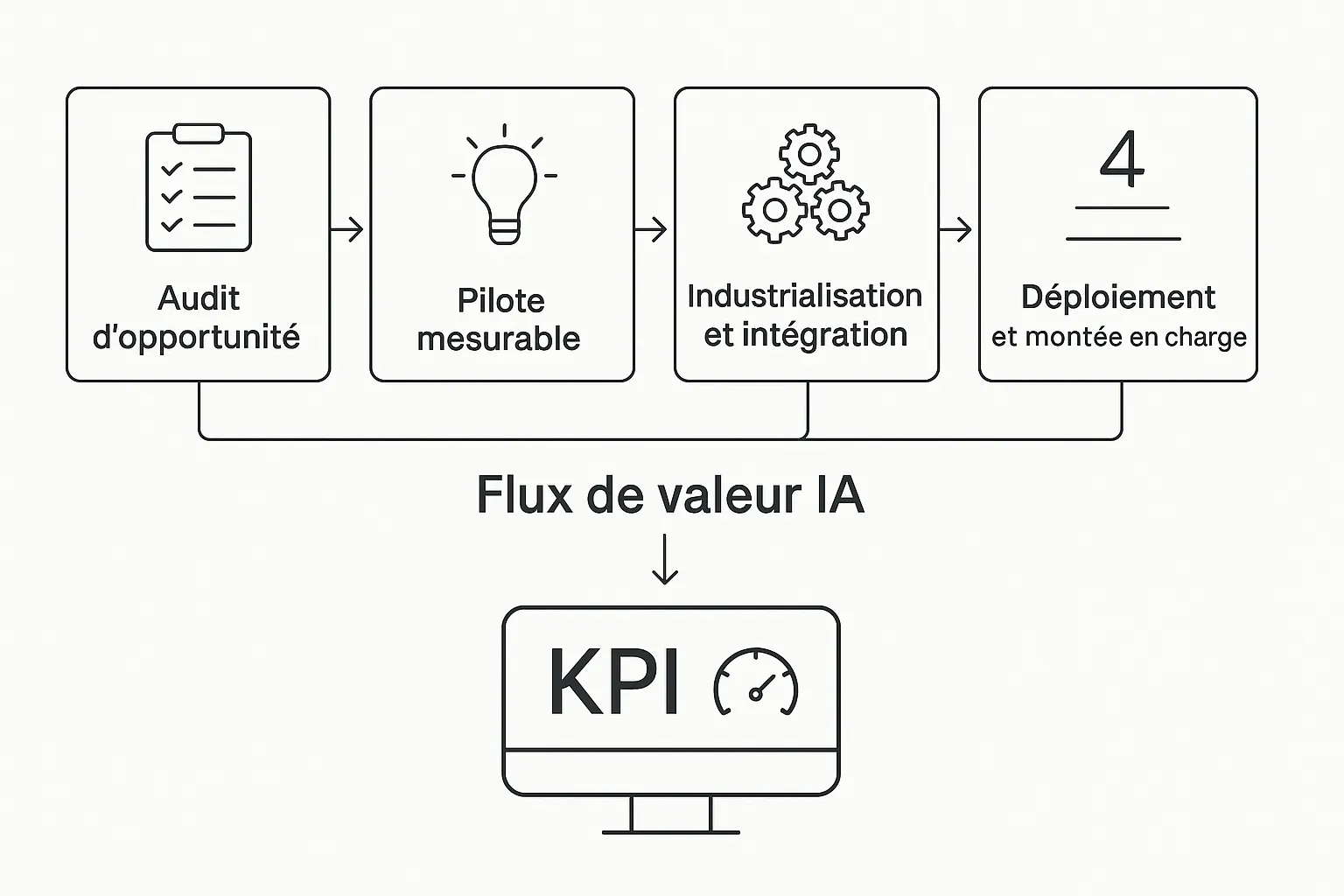
Proven 4-Step Method to Transform AI into ROI
At Impulse Lab, we apply a short, impact-oriented sequence. It is compatible with weekly delivery, a client portal, and the continuous involvement of your teams.
1. AI Opportunity Audit, 2 to 3 weeks
Objective: select 2 to 3 high-leverage use cases, feasible in the short term.
Process, data, tools, and regulatory constraints mapping
Value hypothesis per case, metrics, measurement method
Build versus buy analysis, necessary integrations, risks
Prioritized backlog, acceptance criteria, test plan
Key deliverables: value and feasibility scoring, business case canvas, pilot plan.
2. Measurable Pilot, 4 to 6 weeks
Objective: prove value in the field, within a real workflow.
MVP integrated into existing tools via API, minimum viable automation
Instrumentation, logs, dashboards, A/B protocol or before/after test
Human-in-the-loop in the process if necessary, guardrails and logging
Targeted training for pilot users, rapid support
Acceptance criteria, impact thresholds, for example at least 20 percent time saved, no quality degradation. Decision: go for industrialization or iteration.
3. Industrialization and Integration, 4 to 8 weeks
Objective: secure performance, costs, and compliance at scale.
Robust pipelines, drift and quality monitoring, alerts
Use case: customer service agent assistance with an AI copilot integrated into the contact center. The figures below are illustrative; replace them with your data.
Baseline: 300 agents, 35 tickets per day, AHT 6 minutes, fully loaded cost 38 euros per hour
Pilot: copilot drafts response drafts and suggests back-office actions
After: AHT 4.8 minutes, stable quality, CSAT plus 0.3 points
Simplified calculation over 12 months, 220 working days, 300 agents
Minutes saved per ticket: 1.2 minutes. Annual tickets: 300 times 35 times 220 equals 2,310,000
Total minutes saved: approx 2,772,000, or 46,200 hours
Gross productivity value: 46,200 times 38 euros, approx 1,756,000 euros
Total project costs Year 1: development, integration, licenses, monitoring, training, e.g., 520,000 euros
Net benefit: approx 1,236,000 euros, ROI approx 238 percent
Add revenue effects, churn reduction, plus 0.3 CSAT points, and error reduction to complete the business case. Prove impact with an A/B test on a representative scope.
ROI-First Architecture, 2025 Technical Choices
Your architecture must serve value, security, and unit cost.
Model selection, open or proprietary depending on sensitivity, quality, cost, latency
Quality RAG, source governance, relevance evaluation and citations
Agent orchestration, only if the use case requires it, strict instrumentation
AI Observability, tracking cost per request, error rate, semantic drift, use for example Evidently AI for data monitoring
Compliance, privacy by design, decision logging, preparation for the European AI Act
Measure and Govern, Without Burdening
Draw inspiration from value tree measurement approaches.
North Star Indicator, e.g., tickets resolved per hour
Contributory metrics, time per step, automation rate, escalation rate
Trust metrics, accuracy, detected hallucinations, useful refusals, human feedback
Unit cost, euros per request or per document processed
Instrument from the pilot phase, define alerts, schedule a monthly review. Sources like the annual McKinsey AI report insist on focusing on a few high-value use cases and change management to materialize impact; see The State of AI 2024 on mckinsey.com.
Frequent Mistakes That Kill ROI
The traps are known; they are avoidable.
Museum POC, pilot without integration or metrics, no adoption
Underestimation of non-technical costs, change, security, support
Ignored data quality, perfect prompts on shaky data
Vendor lock-in, absence of multi-model strategy and portability
Absence of human loop when necessary, late detection of drift
Reference KPI Pack
Adoption, active users, daily usage rate, activation of key features
Productivity, time per task, throughput, cost per transaction
Quality, accuracy score, incident rate, human corrections per 100 outputs
Risk and compliance, incidents, audits passed, control coverage, remediation times
Checklist Before Giving the Go
Is the problem recurrent, costly, measurable?
Is the data accessible, compliant, clean enough for a pilot?
Is the target workflow clear and instrumentable?
Is user acceptance being worked on? Who is sponsoring?
Are full costs budgeted (build plus run plus change)?
Are acceptance criteria and the measurement window shared?
Are risks and guardrails defined (logging, human review)?
Is the integration plan with your tools ready?
Does a vendor exit and portability plan exist?
Who owns the continuous improvement loop after deployment?
FAQ
How to measure the ROI of an AI project without a reliable baseline? Start with a control sample and a test group. If an A/B test is impossible, use a before/after period on a stable operational indicator and document confounding variables.
How long to see measurable ROI? The majority of operational use cases show results in 8 to 12 weeks if the pilot is integrated into the workflow and instrumented. Heavier data projects require more preparation.
Should AI development be internalized or outsourced? To accelerate and reduce risk, outsource framing and initial integration; keep business governance and ownership of prompts, data, and metrics. Progressively internalize the run if it is strategic.
How to avoid lock-in with a model provider? Plan for an abstraction layer, version prompts and evaluations, test at least two models, negotiate data portability and embedding clauses.
Is AI compatible with European regulatory requirements? Yes, by applying privacy by design, logging, risk assessments, and appropriate controls. Anticipate the AI Act with an AI system register, risk mapping, and human supervision procedures.
Move from Intention to Impact with Impulse Lab
Transforming AI into ROI requires a methodical approach, clean integrations, and disciplined measurement. This is precisely our playground: AI opportunity audits, custom web and AI platforms, automations and integrations with your tools, adoption training. We deliver every week, with full transparency via a client portal, and we involve you at every step so that value is seen quickly.
Tell us about your priority use cases and let's start with an opportunity audit. Discover our approach, Impulse Lab.