Turning an AI Book into Practical Business Exercises
Intelligence artificielle
Stratégie IA
Productivité
Optimisation
Searching for an "AI book" easily yields reading lists, but applying theory to business operations is where teams struggle. Discover a practical method to turn AI reading into measurable workplace exercises, complete with four concrete test cases.
November 03, 2026·12 min read
Searching for an "AI book" easily leads to curated reading lists. For an SME or a scale-up, the real challenge often begins after the purchase: how do you move from an interesting concept to practical, workplace value? Understanding a chapter guarantees neither better execution nor saved time.
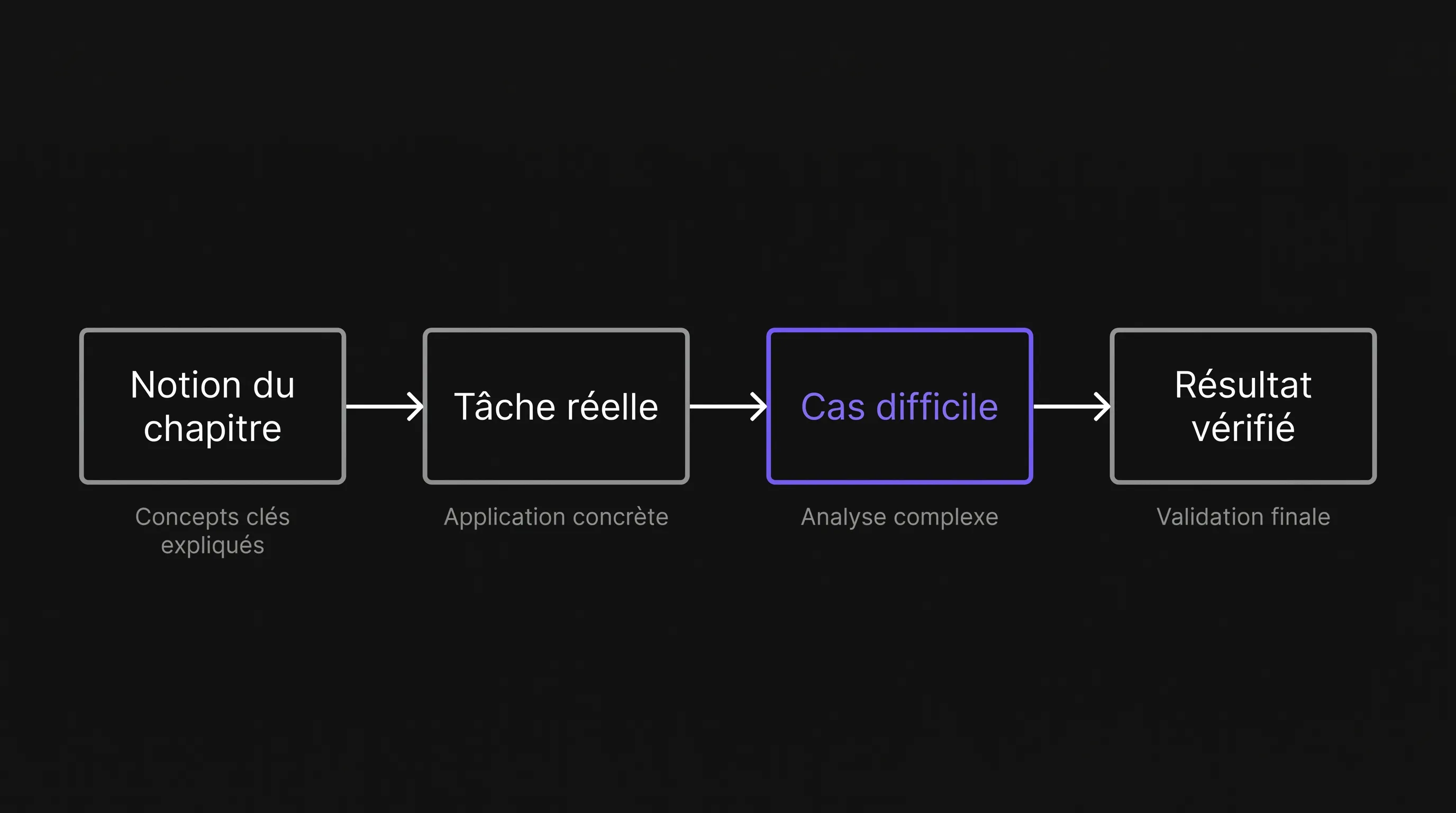
The solution is to treat every reading as the starting point for a small business experiment. Here is a method to choose your material, build an exercise sheet, and test four concrete applications—without mistaking a flashy demo for an actionable result.
Moving from "AI Book" to a Business Goal
Before picking a title, define what your team should be able to do after reading it. "Understanding artificial intelligence" is too broad to guide a workshop. "Preparing a meeting briefing sheet without hallucinating information about the prospect" provides an observable goal.
An AI book then becomes a practical workbook rather than an end in itself. The right book is not necessarily the most exhaustive one: it is the one that introduces the concepts needed for your next exercise.
Choosing the Right Type of Book
Distinguish foundational books from tool-centric guides. The former explain mechanisms, limitations, or enduring challenges. The latter allow you to quickly replicate specific steps, but their screenshots and instructions can age quickly.
These three references illustrate different use cases, without serving as a ranking:
Book
Reading Profile
Potential Workshop Use
Co-Intelligence, Ethan Mollick
Practical, use-case-oriented approach to collaborating with AI; no programming required for the exercises suggested here
Designing a comparison between manual work and AI-assisted work
L’Intelligence artificielle n’existe pas, Luc Julia
Big-picture reading, accessible without technical background
Spotting phrasing that mistakenly attributes understanding or intent to a system
Artificial Intelligence: A Modern Approach, Stuart Russell and Peter Norvig
Technical textbook with prerequisites in logic, probability, and programming depending on the sections
Deepening system evaluation with a technical team
The companion website for Russell and Norvig's textbook allows you to examine its content before committing to that path. A business leader does not need to start with an academic textbook to test a writing workflow.
Checking the Edition and Organizing Access
Verify the publication date, language, and table of contents with the publisher or a library catalog. For a book translated from another language, review the translation quality and the terminology used. A team that struggles to decipher the text will spend the workshop decoding it rather than applying it.
Also choose a format suited to the exercise: a borrowed hard copy, a legally purchased e-book, or an audiobook if available. Text remains best for annotating a method; audio can suffice for debating an idea.
Finally, do not mistake an AI book for up-to-date product documentation. Any workflow that depends on a specific interface must be cross-checked against the tool's current documentation.
The Bridge Sheet: One Chapter, One Task, One Proof
The main mistake is asking: "How can we apply this chapter in our business?" This question opens too many doors. Instead, start from a recurring task, then look for what the reading allows you to change in it.
Your sheet fits on a single page. It should allow a colleague to replicate the test without having attended your discussion:
Target concept: rephrase a single idea from the chapter in your own words.
Target task: describe an existing action, its owner, and its recipient.
Permitted inputs: specify usable documents and excluded data.
Expected deliverable: set a verifiable format, such as a five-field table.
Edge cases: include missing, contradictory, or ambiguous information.
Success criteria: define deal-breaking errors and key metrics prior to testing.
Include the reference of the passage used so you can trace back to the original idea. Summarize it rather than copying an entire chapter into a conversational assistant.
This sheet prevents an AI book from becoming an excuse for a random prompt collection. A prompt is merely one component of the exercise; the data, validation, and failure conditions matter just as much.
Example: Turning a Model Limitation into a Test
Suppose your reading explains that a model can generate plausible yet false answers. Do not just ask participants to memorize this definition. Have them observe the behavior on a familiar task.
Prepare three fictional meeting minutes. The first contains all required information. The second omits a date. The third contains two conflicting dates. Ask the system to extract decisions and deadlines from them.
The exercise succeeds if the missing date remains missing and the contradiction is flagged. A fluent answer that arbitrarily picks a date fails, even if its formatting is impeccable.
You have turned a general concept into an operational rule: the absence of information must never be concealed behind an authoritative tone. This rule can then be tested across other workflows.
Four Business Exercises Drawn from Your Reading
The following exercises rely on dummy data or explicitly authorized documents. They do not assume any specific tool. For each one, always produce a manual baseline result first: without a benchmark, you will end up evaluating impressions rather than performance.
Sales Exercise: Preparing a Meeting Without Hallucinating the Prospect
Choose this exercise when an AI book leads you to explore assisted drafting or the importance of context provided to the model.
Prepare a fictional company profile, two sales email exchanges, and a few discovery notes. Deliberately introduce an unknown area, such as the budget. The deliverable has four sections: verified facts, assumptions to validate, priority questions, and missing information.
Here is a starting prompt to adapt: "Use only the provided documents. For each fact, cite the source document. Separate assumptions from facts. If information is missing, write 'not specified'. Propose five questions for the meeting."
The sales rep then checks every claim and removes questions that the documents already answer. Measure the time required to obtain an actionable brief, not just to generate a draft.
The trap to watch for is inference disguised as certainty: a hiring company does not necessarily have an available budget. A single invented budget is enough to invalidate the output. The final deliverable for the exercise therefore includes the corrected sheet and the list of observed errors.
Customer Support Exercise: Responding from Limited Documentation
Start with two pages of fictional internal documentation and six customer requests. Four can be answered directly from the docs, one requests a commercial exception, and another asks about an undocumented feature.
The task is to draft a concise response accompanied by the excerpt that justifies it. For the last two cases, the expected behavior is a request for clarification or an escalation to an authorized team member, not an improvised response.
This exercise tests a key distinction: being able to write well does not mean having the necessary information to answer. It also demonstrates why adding documents does not eliminate the need to verify their relevance.
Next, introduce two conflicting versions of a rule. If your AI book covers document retrieval or reliability, you can connect the concept directly to the problem at hand. Define a priority rule—such as a clearly marked validated version—and rerun the test.
The support manager evaluates accuracy, justification, and escalation relevance. A polite response that violates refund policy is still incorrect.
Finance Exercise: Extracting Data Without Authorizing Payments
Assemble five completely fictional invoices. Vary the layouts and include a foreign currency, a hard-to-read invoice number, or a missing date. Keep a manually prepared baseline table.
Request extraction only for defined fields: vendor, invoice number, date, subtotal, tax, total, and currency. Any uncertain value must be flagged rather than guessed.
Compare each field to the baseline. An invoice with seven fields allows seven distinct checks, but not all errors carry the same weight. An incorrect currency must be treated as a critical blocker, even if every other field is correct.
The exercise drawn from the AI book must maintain a clear boundary here: extracting data is neither approving nor paying. It does not justify immediately connecting the model to your accounting software.
The deliverable includes the extracted table, flagged anomalies, and correction time. If reviewing the output takes as much effort as manual entry, the use case has not yet proven its value on this scope.
Operations Exercise: Writing a SOP that Knows When to Stop
Select a simple Standard Operating Procedure (SOP), such as processing a tool access request. Provide a validated version detailing the requester, required justifications, and the person authorized to grant access.
Ask the model to produce an operational checklist that distinguishes mandatory steps from best-practice tips. Any suggestion not found in the original procedure must be tagged as such and submitted for review.
Then test three scenarios: complete request, missing justification, and unavailable approver. The system must not invent an alternative approval path to finish the process.
You can draw this exercise from an AI book on practical use cases, or from a reading on the limits of automation. The goal is not to write a longer procedure; it is to make visible the conditions under which execution must halt.
The operations lead verifies fidelity to the source document and exception handling. The actionable deliverable pairs the final checklist with a list of items requiring human decision-making. This list often exposes a pre-existing process issue: a rule that had never been clearly documented.
Facilitating an Evidence-Based Workshop
Keep the group small, bringing together the person performing the task and the person who normally reviews the result. A short preliminary reading is sufficient if the selected passage introduces a clear concept.
For a 75-minute session, here is a suggested agenda, to be adapted based on difficulty:
Suggested Time
Activity
Documentation Kept
10 minutes
Rephrase the concept and select the task
Exercise objective
15 minutes
Produce or review the manual baseline
Expected result
20 minutes
Test the prompt on planned test cases
Inputs and outputs
20 minutes
Correct and categorize errors
Evaluation scorecard
10 minutes
Decide on next steps
Decision and owner
Have participants evaluate outputs individually first, then compare judgments. Disagreements often reveal that the definition of a "good result" was vague to begin with.
If several teams need to replicate this work, integrate the validated sheets into your operational AI training roadmap. The book remains the educational resource; competence is proven in execution.
Measuring What Remains After Correction
The number of pages read or prompts written does not measure actual workplace skill transfer. To evaluate an exercise derived from an AI book, track three dimensions: final quality, total time, and handling of edge cases.
Total time includes preparation, generation, verification, and edits. In a fictional example, a manual task takes 20 minutes. With AI, preparing inputs takes 4 minutes, generating the result takes 1 minute, and correcting it takes 8 minutes. The observed time saving is 7 minutes, at comparable final quality.
If initial setup required two extra hours, log it separately. Do not immediately project those 7 minutes across the entire year: a handful of cases does not prove steady performance across all scenarios.
Also record the test date, prompt version, source documents, and the model used. A change in model or source data can shift the output.
Finally, keep a subset of test cases out of the optimization phase. Retesting only on the examples used to refine the prompt can mask poor generalization. Decisions must be based on verified outcomes, not on your single best run.
Making the Decision: Discard, Document, or Integrate
An exercise can lead to three valid outcomes. You discard the workflow if verification is too costly or if errors are hard to catch. You document an assisted use case if the task works reliably with human oversight. You consider technical integration once business value is proven and responsibilities are defined.
Before using real data, review confidentiality, access permissions, and the terms of service of the chosen tool. The CNIL resources on artificial intelligence offer a solid starting point for personal data considerations. A training exercise does not constitute compliance clearance.
An AI book can trigger an experiment, but it replaces neither technical scoping nor governance. To move from a validated exercise sheet to a tool connected to your organization, rely on the stages of production-grade AI development. Do not confuse workshop success with operational reliability.
Frequently Asked Questions
Which book should I choose to start with a non-technical team? Favor an accessible book that explains practical use cases and limitations, then pick an excerpt tied to a familiar task. Review an excerpt before buying. A machine learning textbook is not needed to learn how to review a summary or a customer support response.
Does the entire team need to read the same AI book? No. A shared excerpt and a summary sheet are often enough for the exercise. Make sure participants understand the targeted concept and its boundaries. Reading the full book can remain optional, depending on individual roles and interest.
Can we ask AI to create the exercises from the book? Yes, starting from your summary or authorized content. Then review its alignment with the studied concept. The model may suggest an appealing exercise that misses the point, or overlook the edge case that truly assesses competence.
When should the tested task be automated? When multiple comparable trials demonstrate value, errors are easily detectable, and an owner signs off on verification protocols. Some tasks are better off remaining assisted. High task frequency alone does not justify automation if an error triggers actions that are difficult to reverse.
Turning Your Next Chapter into an Actionable Test
Pick a recurring task, a relevant excerpt, and an approval owner. Prepare a standard case and an edge case before opening any tool. You will already have a firmer framework than an improvised demo.
To identify opportunities worth testing and structure their transition into production workflows, Impulse Lab supports organizations with AI audits, training, and custom engineering. Bring your exercise sheet and your results: they will anchor discussions in concrete business needs rather than general promises.