Understanding Multimodal Artificial Intelligence (AI) for SMBs
Intelligence artificielle
Stratégie IA
Automatisation
Optimisation
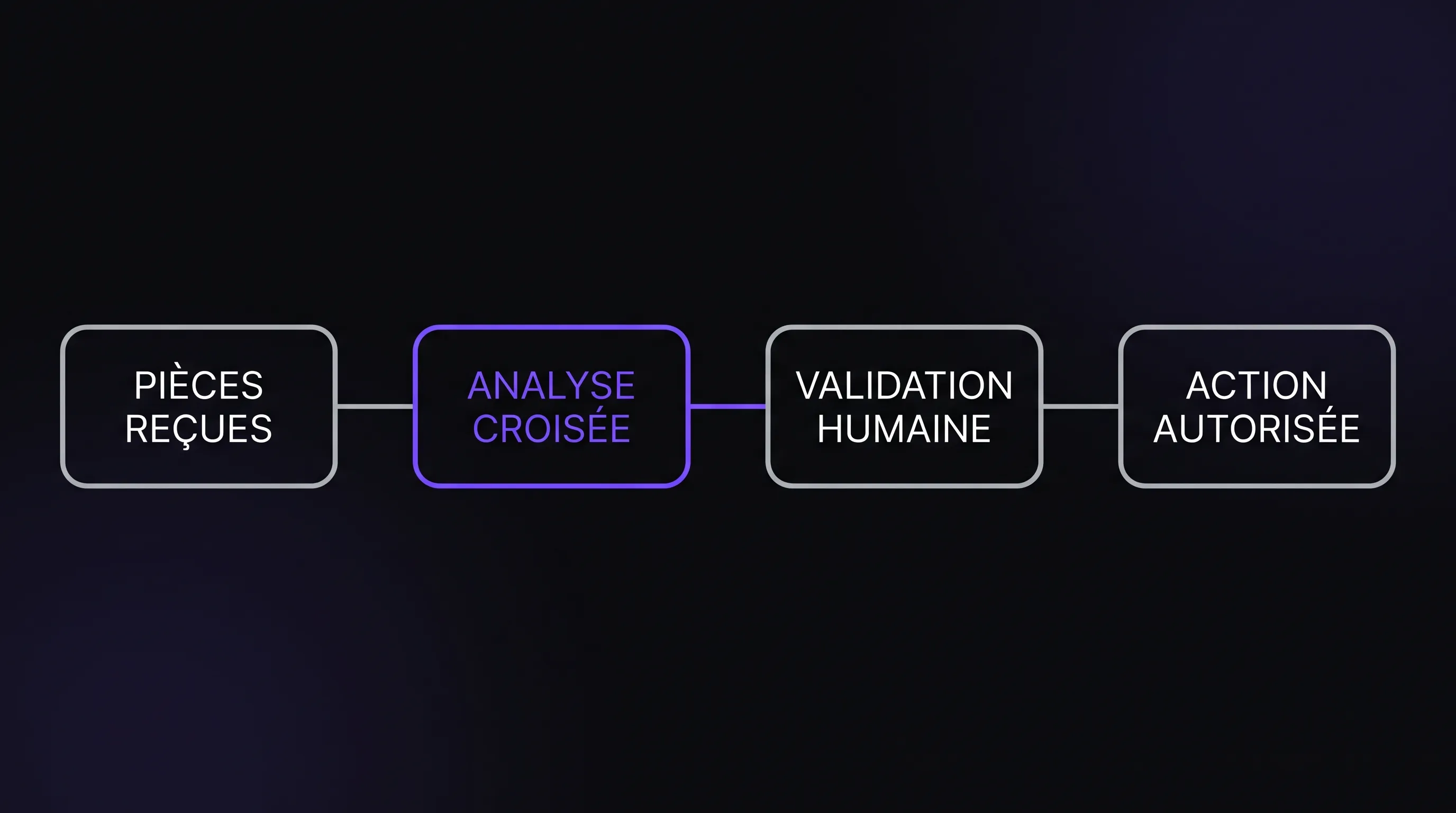
Multimodal AI processes multiple data formats—such as text, images, and audio—within a single task. For SMBs, it helps connect damaged product photos, customer voice notes, and purchase orders, streamlining operations while keeping humans in the loop for validation.
October 28, 2026·12 min read
Multimodal artificial intelligence (AI) makes it possible to process multiple types of information—such as text, images, or audio—within a single task. For an SMB, this can be used to reconcile a photo of a damaged item, a customer's voice message, and their purchase order, rather than reviewing each piece separately.
Yet this capability guarantees neither perfect comprehension nor reliable decision-making. Its true value depends on the process being improved, the available documents, and the controls put in place. Here is how to understand how it works, identify relevant use cases, and test its value without unnecessarily exposing your data.
What "Multimodal" Really Means
A modality here refers to a form of information: text, image, audio, or video. A multimodal system can leverage several of these formats to fulfill a request. Some systems accept multiple input modalities but only produce text. Others can also generate images or audio.
The difference from a text-only assistant becomes clear when information depends on its visual layout. In a scanned quote, the dollar amount alone is not enough: its association with a specific line, column, or handwritten note matters just as much.
Information Received
What the System Can Leverage
Watch-out Point
Text
Instructions, descriptions, exchanges
Ambiguities and missing information
Image or scanned document
Objects, layout, visible text
Resolution, fine print, framing
Audio
Spoken words and, depending on the model, acoustic characteristics
Background noise, accents, overlapping voices
Video
Sequential frames and sometimes an audio track
Frame sampling that might miss a transient event
Multimodal does not mean compatible with all formats. A tool capable of analyzing an image will not necessarily accept an audio recording or a long video file.
How Does Multimodal Artificial Intelligence (AI) Work?
The system first converts the incoming inputs into numerical representations. Depending on its architecture, it then cross-references relevant information to generate an answer: for instance, linking a part number spoken in a voice recording to a label visible on a photo.
In a business workflow, several components may interact. One tool transcribes audio, another extracts text from a scan, and a model reconciles the results. Conversely, some models process multiple modalities natively. To the end user, both approaches may look similar, but their limitations and cost structures differ.
Reading a Document Is Not the Same as Flawlessly Understanding It
OCR (Optical Character Recognition) extracts text from an image. Visual analysis can also interpret document layout, but it can easily tie an amount to the wrong row or overlook a handwritten annotation.
The model relies on patterns learned during training. Feeding it a case file does not mean it permanently learns your business. Whether your data is used to train or improve a provider's service depends strictly on their terms of service.
Finally, a plausible answer is not proof. The system may fill in missing information with an assumption, especially if the prompt instructs it to provide an answer at all costs.
Positioning Multimodality Alongside Other Technologies
Artificial intelligence (AI) encompasses methods designed to perform tasks such as classifying, predicting, recognizing, or generating. Machine learning is one family within it: the system adjusts its behavior based on examples rather than following hand-coded rules alone.
Deep learning uses neural networks with many layers. It is central to image recognition, speech processing, and large language models.
These terms do not refer to competing tools. Generative describes an ability to produce content; multimodal describes the types of information being processed. A system can combine both—for example, when drafting an incident report based on site photos and voice notes.
A Shift Toward Cross-Referencing Information
Companies were already using specialized technologies to read characters, classify images, or transcribe conversations. Modern architectures make it easier to combine them and query them using natural language.
Another helpful concept is RAG (Retrieval-Augmented Generation). This approach provides the model with relevant information retrieved from your company resources before asking it for an answer. It can complement multimodal processing, though it still does not guarantee that every excerpt will be interpreted correctly.
Three Practical Use Cases for SMBs
Preparing Customer Claims for Processing
A customer sends a photo of a damaged parcel, an email, and an invoice. The system can prepare a summary, extract the relevant product reference, and flag missing documents before forwarding the file to customer service.
In this scenario, AI primarily reduces reconciliation workload. It should not infer carrier liability solely from a photo, nor should it trigger an automatic refund.
The actionable output is a verifiable summary sheet: customer claim, received files, probable item reference, and elements requiring confirmation. A team member then validates the final resolution based on applicable business terms.
Multimodality brings little value if all relevant data already lives inside a well-structured form. It becomes worthwhile when teams genuinely spend time cross-referencing information across scattered media.
Turning Field Interventions into Reports
A technician photographs an installation and dictates field notes. An assistant can draft a report organized by equipment, highlight reported defects, and suggest form fields to fill.
A clear distinction must be kept between what a photo shows and what a technician states. "A mark is visible on the casing" is not equivalent to "a leak is confirmed." The report must maintain this distinction and trace back to the original source.
For safety-critical processes, the system does not replace regulatory inspections or the diagnosis of a certified professional. Its role can remain purely administrative: drafting, categorizing, and checking for mandatory information. This boundary saves time without delegating decisions that an image cannot objectively prove.
Preparing Administrative Reconciliations
In accounting and operations, AI can help cross-check a scanned invoice, a photographed delivery note, and an email comment. It can flag quantity discrepancies or missing item codes.
However, mathematical validation must rely on deterministic calculations for totals, taxes, and exact reconciliations. A generative model is not the right tool to guarantee arithmetic accuracy.
The sensible goal is to prepare exception lists for human review, not to authorize payments autonomously. If your suppliers already provide structured digital data, traditional integration may be more reliable and less expensive. The key question is not "can we use a multimodal model?", but rather "what valuable information currently slips through our standard workflows?".
What Benefits to Expect—and What Limitations to Accept
The primary benefit is minimizing manual tasks: opening multiple files, transcribing references, or writing summaries. The second is standardization when varied inputs must feed into a unified business record.
However, time saved during preparation can easily be lost during review. A poorly framed document, noisy audio, or an unusual layout can degrade results. Two seemingly similar tasks may therefore exhibit drastically different reliability rates.
When evaluating AI, measure the total time to a validated result, not just raw generation speed. Include file preparation, proofreading, manual corrections, and handling edge cases.
Distinguishing between minor and critical errors is equally essential. An awkward turn of phrase and an incorrect billing amount should not carry the same weight in your assessment. A tool is only viable if its accuracy controls match your operational requirements.
Choosing Between an Assistant, an Integrated Tool, and a Custom Solution
A general-purpose assistant lets you explore a use case on authorized sample files. It works well for testing prompts or assessing summary quality, but manual copy-pasting becomes a bottleneck as volumes grow.
A tool integrated into your existing business software can eliminate manual steps. Still, verify its actual capabilities: does it analyze embedded images within a PDF, or only raw text? Can it cite its sources? How does it handle access permissions?
A custom solution makes sense when the workflow needs to orchestrate multiple tools, follow strict business rules, or include specific approval flows. It also requires maintaining integrations, monitoring tests, and managing incidents.
Selecting a multimodal AI solution should stem from your file formats, volumes, and fault tolerance—not from an impressive demo. Our guide on the steps and pitfalls of developing an AI solution helps structure this journey toward operational deployment.
How to Verify a Generated Response
Asking a model whether it is confident is not a valid control mechanism. Useful verification relies on tangible evidence that your team can inspect and compare.
Demand source attribution: Every key piece of data must trace back to a specific page, bounding box on an image, or timestamped audio segment, whenever the platform supports it.
Allow for non-answers: Unreadable data should be flagged as "needs review" rather than filled in by guesswork.
Verify business rules independently: Totals, dates, references, and thresholds must undergo dedicated validation logic.
Tailor review depth to risk: An internal summary and a wire transfer approval do not require the same guardrails.
Include challenging edge cases in your benchmarks: rotated documents, faint digits, near-identical names, or contradictions between an image and an accompanying comment. Consistent success on easy files does not prove broad reliability.
AI must be able to fail gracefully: flagging an issue and handing the case over to a human, without fabricating the missing piece. Avoid treating model confidence scores as guarantees; validate outputs against established ground truth on your actual case files.
Confidentiality, Security, and Governance
Frame Data Policies Before Running the First Test
A photo may contain a face, an ID badge, or an address. A voice note may include personal details unrelated to the task. Before uploading anything, confirm that every piece of data is necessary and redact anything irrelevant.
Review the vendor's terms: data retention, model retraining policies, subcontractors, processing location, cross-border transfers, and deletion mechanisms. A business subscription does not automatically resolve all compliance concerns. The CNIL resources on AI provide a helpful baseline for data protection requirements.
Received files should also be treated as untrusted inputs. Malicious instructions (prompt injections) can hide inside a document or image. The system must not treat them as internal system instructions or allow them to trigger high-risk actions.
Maintain Identifiable Human Oversight
Deploying AI requires clearly identifying who reviews outputs, who manages incidents, and who can halt the process. The European AI Act includes AI literacy requirements applicable since February 2, 2025, to relevant providers and deployers. Specific obligations depend on your operational role and use case.
Biases must be tested concretely: lower transcription quality on regional accents, degraded interpretation in poor lighting, or adverse classification of edge cases. Avoid turning such discrepancies into automated decisions that affect individuals.
Confirm that you hold the necessary rights to use the uploaded images, documents, and recordings. Finally, keep resources proportional to the need: extracting a few relevant pages or leveraging a lightweight specialized tool can avoid systematically sending large media files. This lean approach cuts unnecessary computation, even if precise carbon footprints remain hard to benchmark without vendor disclosures.
Testing Value on a Controlled Scope
Define an Observable Outcome
Pick a task with defined inputs, an expected output, and a clear owner. "Drafting a claim sheet from three documents" can be tested; "making customer support smart" cannot.
Assemble a representative sample dataset, including everyday files and edge cases. Have your domain experts create gold-standard reference answers. Then establish evaluation metrics before comparing tools: field extraction accuracy, critical errors, review time, and fallback rates to humans.
An AI pilot should start without irreversible actions. The system prepares a recommendation; your team retains final decision-making power and logs required adjustments.
Calculate Net ROI After Review and Maintenance
Consider a fictional example: a company processes 200 files per month, spending 12 minutes on each. If the updated workflow requires 3 minutes of preparation and 4 minutes of human review, time savings equal 5 minutes per file—or 16 hours and 40 minutes each month.
At a hypothetical labor rate of €35 per hour, this represents roughly €580 in reclaimed capacity before costs. From this, you must deduct subscription fees, API calls, maintenance, training, and integration amortization. Furthermore, freed-up time only translates to monetary savings if it can be reallocated to higher-value activities.
Track errors and downstream friction carefully. A faster initial process that leads to more customer disputes destroys value instead of creating it.
Finally, set clear success gates: scale up, refine, or stop. Whenever the underlying model, system prompts, or incoming file formats change, re-run your benchmark tests. Performance can shift even when the user interface stays the same.
Frequently Asked Questions
Does an SMB need to train its own multimodal model? Generally not as a starting point. An off-the-shelf model combined with clear prompts and controlled document access is usually enough to validate a use case. Custom model training is only justified when specific performance requirements and edge constraints demand it.
Is a PDF always analyzed as an image? No. Depending on the tool, only extracted text may be forwarded, or the pages may undergo visual document layout analysis. Test documents where the correct interpretation relies on a table layout, a checked box, or a handwritten margin note.
Can recorded meetings be analyzed? AI can assist in transcribing and summarizing discussions, depending on tool capabilities. You must establish recording guidelines, inform participants according to applicable privacy laws, and verify all decisions or commitments before distributing meeting notes.
Should you always choose the most powerful model? No. Compare performance on your specific task, review overhead, total cost of ownership, and privacy requirements. A specialized tool or deterministic automation often delivers better ROI.
When can actions be automated following analysis? Only when the operating boundary is fully controlled, validation checks have been rigorously tested, and potential failure modes are acceptable. Sensitive actions must always require explicit human authorization and manual override capabilities.
Framing Your First AI Initiative with Impulse Lab
The ideal starting point is a workflow where your teams already cross-reference multiple formats, produce a verifiable outcome, and carry measurable processing costs.
Impulse Lab helps companies navigate this journey with AI opportunity audits, tailored web and AI solutions, and hands-on adoption training. To prepare for an exploratory discussion, identify a handful of representative case files, record the time spent processing them, and pinpoint the errors your team cannot afford to make. These elements ensure a conversation rooted in concrete operational gains rather than abstract promises.