Behind the search for 'AI today', business leaders ask a concrete question: which tasks can actually be delegated to AI, and with what level of control? The answer goes far beyond writing text. AI can extract data, analyze images, classify requests, and take action in software.
Behind the search for "artificial intelligence today", a business leader's question is practical: which tasks can already be entrusted to it, and with what level of control? The answer goes far beyond writing text. AI can also extract information, analyze images, classify requests, generate code, and execute certain actions within software.
It is especially useful when the task is clearly defined, the information is accessible, and the output is verifiable. It remains much less reliable when it has to fill in missing context, guarantee an exact answer, or independently navigate a sensitive situation.
For an SME or a growing business, this distinction separates viable use cases from flashy demonstrations.
What Already Works in Business
There is no single AI capable of doing everything with equal reliability. Language models, computer vision, and predictive models meet different needs. An operational solution can also combine several of these techniques with traditional rules.
Capability
Concrete Example
Reliability Condition
Generate and rephrase
Draft a sales response
Provide facts, tone, and constraints
Extract and structure
Extract fields from a purchase order
Verify critical fields and atypical documents
Classify and route
Route a ticket to the right team
Define categories and plan for ambiguous cases
Analyze and predict
Estimate out-of-stock risk
Have relevant historical data and test predictions
Interpret multiple formats
Match a photo with an incident description
Check input quality and potential errors
Take action in tools
Create a draft in a CRM
Limit permissions and review sensitive actions
The value of artificial intelligence today therefore depends as much on the operational framework as on the chosen model.
Drafting, Summarizing, and Preparing Responses
Language models can turn notes into a meeting summary, adapt a proposal for a recipient, or prepare a response based on an internal procedure. They are particularly useful when the necessary information is already provided.
A sales manager can, for instance, delegate the preparation of an email based on a customer conversation, an approved proposal, and specific instructions. The remaining work consists of checking commitments, pricing, and sensitive wording.
The limitation arises when the model must invent substance rather than rephrase it. A smooth summary might omit an important caveat. A convincing text might cite a non-existent reference. Writing quality does not prove factual accuracy.
Reading Documents, Images, and Audio
AI can extract information from a PDF, transcribe a meeting, or describe specific elements visible in an image. Multimodal models allow combining several formats into a single task.
For an administrative team, this can be used to prepare a structured record from a folder received by email. For support, to match an incident description with a screenshot.
What artificial intelligence today makes possible here is accelerating the initial reading, not guaranteeing exhaustive comprehension. A missing page, a complex table, or poor recording quality can alter the result. Account numbers, quantities, and deadlines must be properly verified.
A useful system should also be able to report "information not found" rather than filling in every field at all costs.
Classifying Requests and Spotting Trends
Classification consists of assigning a category: refund request, technical issue, job application, or supplier invoice. It can streamline sorting and reduce repetitive handling.
Prediction follows a different logic. Estimating sales or churn risk generally requires historical data, a measurable target, and evaluation on examples not used to train the model.
A conversational assistant can explain a spreadsheet, but that does not automatically make it a good forecasting tool. For exact calculations, it is better to have it call a computation engine, a controlled query, or a business rule rather than asking it to produce a number directly.
Assisting with Development and Technical Analysis
AI can suggest code, explain a function, or write tests. It can also support data exploration by writing a query or a script.
These outputs must be executed, tested, and reviewed in context. A program that runs on a toy example might fail on real-world data or introduce a security vulnerability. Our examples of AI use cases in programming detail this distinction between assistance and technical delegation.
For a company, artificial intelligence today speeds up certain implementation steps without eliminating the responsibility for design, maintenance, and oversight.
"Artificial Intelligence Today": How Far Should You Let an Agent Act?
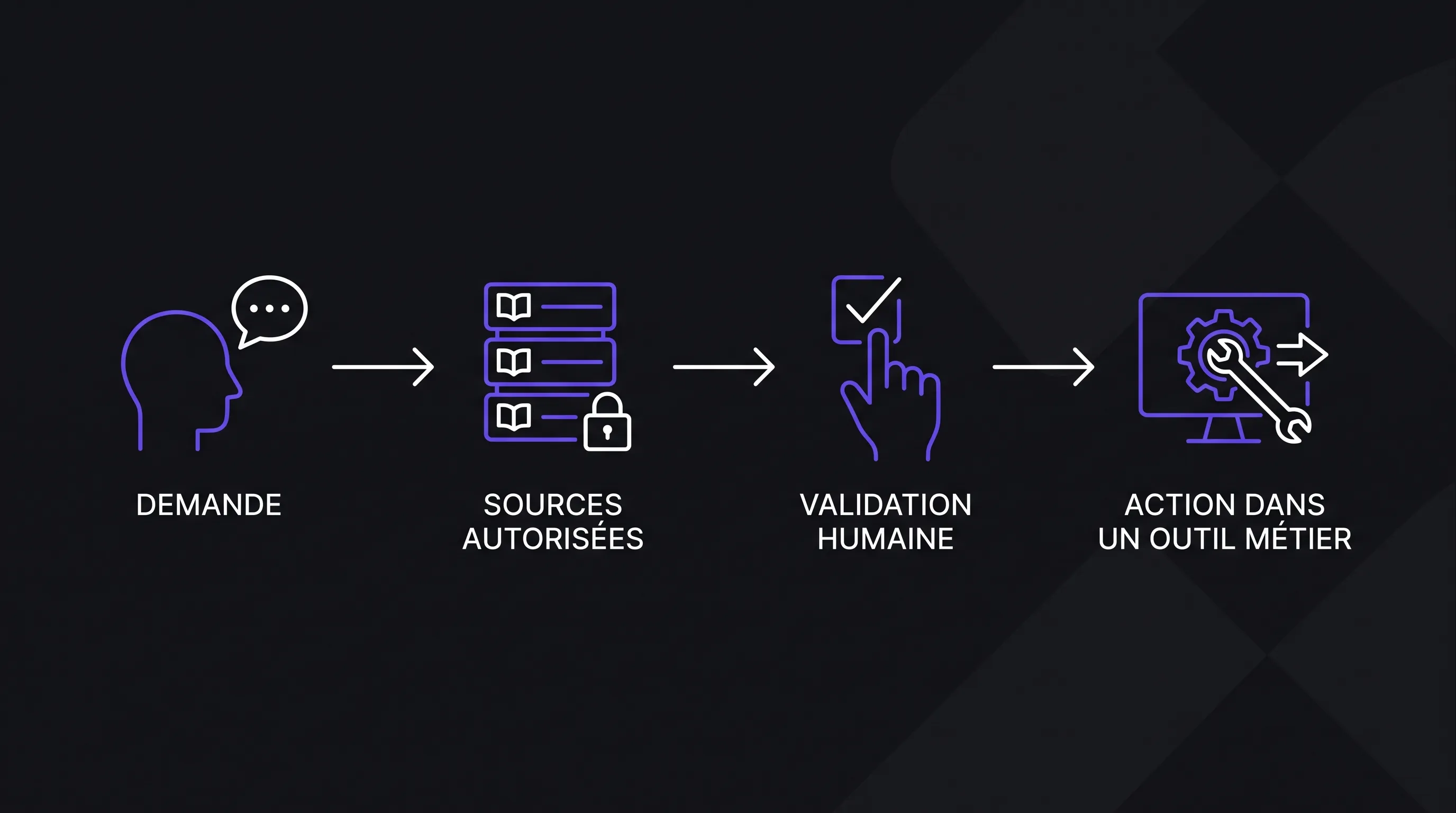
An agent is a system that uses a model to select steps and call tools within a given scope. It can, for instance, look up information in an authorized database, prepare a reply, and then create a task in customer support software.
The difference with a chatbot is not just its conversational ability: the agent can modify something in your information system. This changes the risks.
Delegation Level
What the System Does
Oversight Required
Assistance
Suggests text or analysis
User review
Preparation
Fills out a draft or suggests an edit
Validation before final save
Supervised Execution
Performs an authorized, reversible action
Rules, logging, and exception handling
Extended Autonomy
Chains decisions across multiple tools
Thorough evaluation, limited permissions, and kill switches
A successful demo is not enough to justify the final level. The more steps in a workflow, the more failure points multiply.
For a first deployment to production, preparing a CRM update is often safer than letting the system merge or delete records. The level of autonomy should follow observed results, not vendor promises.
Connecting an assistant to internal documents—an approach commonly known as RAG (Retrieval-Augmented Generation)—provides relevant reference material when formulating answers. However, it does not guarantee that the model will pick the right passage or interpret it correctly.
Artificial intelligence today can also access recent information when connected to a search tool or updated source. Without that access, you should never assume it knows your current pricing, inventory, or a recent regulatory change.
Business Judgment and Autonomous Accountability
A model does not inherently understand informal agreements with a client, the delicate nature of a negotiation, or the repercussions of a commercial exception. These elements must be explicitly provided, translated into rules, or left to a human manager.
Technical capability must also be distinguished from the legal right to use data. A solution that accepts a file is not necessarily suitable for its content. For personal data, GDPR obligations continue to apply: purpose limitation, data minimization, security, and vendor oversight, among others.
Finally, incoming documents can contain malicious prompt injections designed to hijack an assistant. Access to tools and data must remain strictly restricted, even when responses appear sound.
Three Realistic Use Cases for a Growing Business
These scenarios illustrate possibilities, not guaranteed outcomes. Their value depends on processed volume, data quality, and the cost of errors.
Customer Support: Preparing Before Sending
An assistant searches an authorized knowledge base, suggests a response, and cites the sources used. The support agent reviews and sends the message.
This scope is much easier to control than a system set up to answer all queries autonomously. Exceptional refunds, disputes, and contractual commitments remain routed to qualified staff.
Artificial intelligence today can thus reduce research time without sacrificing control over customer relationships. The key metric is total handling time per ticket, including corrections, while tracking answer quality.
Administration: Streamlining Reliable Data Entry
Upon receiving a purchase order, the system extracts line items, matches the customer against the database, and drafts a record entry. An unknown reference or ambiguous quantity triggers manual review.
Part of the workflow may not even need AI. Validating totals or checking IDs can rely on deterministic rules. The most robust solution often blends intelligent extraction with traditional checks, rather than asking the model to do everything.
Sales: Structuring Follow-Ups After a Meeting
From notes or a properly consented transcript, the assistant compiles a summary, identifies next steps, and drafts CRM updates.
The sales rep confirms commitments and deadlines before saving. The system must not turn a prospect's hypothetical remark into a confirmed deal.
For a growing team, the benefit goes beyond drafting: better-structured records streamline account handovers. But this requires that CRM fields and follow-up guidelines are already clearly established.
How to Know if a Use Case is Ready for Your Business
The right question is not "Can the model do it once?", but "Does the system do it well enough on our real-world cases at an acceptable cost?".
Evaluate artificial intelligence today on a representative set of cases, including incomplete files, unusual formats, and edge cases. Success on a few cherry-picked examples says very little about daily operations.
Before deciding, check four points:
Useful quality: Does the output meet the business need without critical omissions or fabricated commitments?
Remaining effort: How long does it take to review and correct the output?
Total cost: What are the expenses for tooling, integration, maintenance, and oversight?
Failure behavior: Does the system fail gracefully or escalate the file when information is missing?
Consider a purely illustrative example: a ten-minute task drops to four minutes of preparation, but requires five minutes of review. The net gain is only one minute. If review requires scarce expertise, automation may simply displace the bottleneck rather than resolve it.
A sensible first scope typically has steady volume, easily verifiable output, and recoverable errors. Conversely, an infrequent, highly variable task with high-stakes consequences is rarely the best place to start.
Frequently Asked Questions
What kinds of AI exist today? We notably find general-purpose assistants like ChatGPT, Claude, or Gemini, image and speech recognition systems, and specialized predictive models. These categories can be combined. A chat interface alone reveals nothing about a system's true capabilities or reliability guarantees.
What are the three main disadvantages for an SME? Inaccurate answers, data risks, and true operational costs are three major concerns. The latter includes integration, human oversight, and maintenance—not just software subscriptions.
Can AI replace an employee? It can take over specific tasks within a role. That does not mean it can replace the entire role, which also encompasses coordination, relationship-building, judgment, and accountability. Work must be assessed task by task.
Do you need custom-built software? Not necessarily. An off-the-shelf tool can be sufficient for standard individual needs. Custom development or integration becomes necessary when the workflow spans multiple applications, proprietary internal data, or company-specific business rules.
Choose a Useful Task Before Choosing a Tool
The potential of artificial intelligence today is proven in real workflows: identifiable input, clear expected output, and oversight balanced against risk.
Impulse Lab helps businesses through AI opportunity audits, custom web and AI development, integration with existing tools, and adoption training. To identify a first use case, you can discuss your processes with Impulse Lab starting with a concrete task, its volume, and your team's current pain points.