What Business Model Should You Use to Sell Artificial Intelligence?
Intelligence artificielle
Stratégie IA
ROI
Productivité
Sales
Searching for "AI business" often yields tool lists or startup ideas. To sell a solution, the key question is commercial: who pays, for what outcome, and with what margin after delivery?
October 29, 2026·11 min read
Searching for "artificial intelligence business" often leads to lists of tools or startup ideas. Yet to sell a solution, the decisive question is commercial: who pays, for what outcome, and with what margin after service delivery?
A subscription might seem appealing, but it can quickly become unprofitable if each customer requires hours of hands-on support. Conversely, a well-defined service offering can fund the development of a future software product.
The right business model depends on the value delivered, the true cost of each usage, and the work required to deploy the solution. Here is how to choose between six revenue models, and how to verify their profitability before scaling your offer.
AI Business: Defining What the Customer Actually Buys
A customer rarely buys "AI." They buy files prepared faster, requests routed more effectively, or additional processing capacity without immediate hiring.
Before deciding on pricing, frame your offer like this: "We help [a specific type of company] complete [a specific task], within [their work environment], delivering [a verifiable outcome]."
For example: preparing supplier invoice data entry for an SME, extracting fields, and flagging items that need review. This promise is much easier to evaluate than an "intelligent administrative assistant."
To build a viable artificial intelligence business, you must also identify the user, the decision-maker, and the budget owner. An operations manager might love your solution without having the authority to purchase it. Your offer must address both the person dealing with the problem and the one paying to resolve it.
Finally, pinpoint what makes your proposition hard to replace: a workflow integration, a proven verification method, or specialized industry expertise. Access to a general-purpose model alone rarely constitutes a sustainable differentiator.
Six Business Models for Selling an AI Solution
These models are not mutually exclusive. A company might start with a consulting engagement, then transition to a recurring subscription once its process becomes sufficiently standardized.
Model
What You Bill
Best Suited When…
Main Risk
SaaS Subscription
Recurring access
Usage is consistent and standardized
Costly consumption hidden under a flat fee
Usage-Based Pricing
Units consumed or processed
Volume fluctuates significantly
Less predictable revenue
Hybrid Model
Base tier plus extra consumption
You have both fixed and variable costs
Overly complex pricing tiers
Productized Service
A deliverable with a defined scope
Human involvement remains substantial
Production scope creep
Performance-Based Pricing
An attributable result
The outcome can be reliably measured and audited
Disputes over attribution
B2B License or API
Integration or usage rights
A partner distributes your technology
Reliance on a small number of large contracts
SaaS Subscription: Selling Recurring Access
A subscription model fits tools used on a weekly basis: internal document search, sales enablement, or meeting summary generation. You can charge per user, per team, or per company.
Seat-based pricing becomes less relevant when tasks run automatically in the background without regular user logins. In such cases, pricing per workspace or by volume tier may better reflect the value provided.
However, an AI-driven business must distinguish between software access and model consumption. A subscription should not promise unlimited usage until you fully understand cost distribution. Set included quotas, explicit caps, or add-ons tailored for heavy users.
Usage-Based Pricing: Aligning Price with Activity
You bill per document processed, per minute transcribed, or per query executed. This model suits irregular needs and lowers the client's upfront commitment.
The billing unit must be straightforward. For an accounting team, "invoice prepared for approval" is far more intuitive than "million tokens consumed." Tokens are a technical metric used by model providers, not an indicator of value for your buyer.
Clearly define billable events: do duplicates count? Are failed runs charged? Who covers reprocessing costs? Clarifying these details upfront prevents every invoice from turning into a debate over system behavior.
Hybrid Model: Covering Fixed Bases and Variable Volumes
The hybrid model pairs a subscription containing an included volume allowance with additional usage fees. An onboarding or setup fee can cover configuration, tool integrations, and initial staff training.
For an AI business embedded in a customer's core processes, this structure funds two operational realities: maintaining continuous service availability and handling variable workloads.
Keep your pricing table concise. A customer must be able to estimate their monthly spend based on typical activity. Provide usage alerts before limits are reached, and specify whether the service continues, throttles, or pauses pending budget approval. Predictability matters just as much as unit price in B2B sales.
Productized Service: Selling a Scoped Deliverable
You leverage AI to produce an outcome without requiring the customer to operate the software directly. Examples include restructuring an e-commerce catalog or producing industry research reports backed by human verification.
You sell a fixed-price package with a clear scope, defined timelines, and precise acceptance criteria. AI serves simply as your internal production engine.
This approach lets you validate an AI business concept before sinking capital into a full platform. It teaches you which steps can be automated and which require human discretion. The main bottleneck remains delivery capacity: if every project turns into custom consulting, revenue remains tied to available hours.
Performance-Based Pricing: Selling a Measured Outcome
You charge based on an agreed-upon result: a qualified sales meeting meeting specific criteria, an accepted loan application, or verified cost savings.
This model strongly aligns your incentives with those of your client. However, it becomes risky when you have no control over the variables that determine success. A lead qualification engine cannot control the client's pricing or the closing skills of their sales reps.
Establish a baseline benchmark, a measurement timeframe, and a shared data source accessible to both parties. Clearly detail exclusions and dispute mechanisms. If attribution remains uncertain, a base fee paired with a performance bonus protects your delivery capacity far better than an entirely contingent contract.
Licensing, APIs, and White-Labeling: Selling to Distributors
Your buyer might be a software vendor or system integrator looking to embed your capability into their own product suite. You then bill through a minimum contract value, API consumption, or specific licensing rights.
This AI business model demands a different sales approach: pursuing fewer partners while negotiating higher-stakes, more structured contracts. Clear documentation, API stability, and reliable technical support become critical.
Always separate your own licensing terms from third-party provider terms. Using an underlying model API does not automatically grant you the legal right to resell all downstream services under any conditions. Also, define who handles end-user support and who assumes liability for system outages.
Setting Prices Based on Value and Total Cost
Your infrastructure costs determine your economic floor. Perceived value and available alternatives set the ceiling of what a customer will pay. Neither can be considered in isolation.
Take invoice processing again. A customer compares your solution against manual data entry, native features in their accounting software, or outsourced providers. Your pricing must therefore be justified by tangible benefits: fewer errors, faster turnaround times, or increased processing bandwidth.
In an artificial intelligence business, calculating true costs extends far beyond model API calls. You must account for hosting, storage, third-party software, human-in-the-loop validation, customer support, and reprocessing. Base provider rates, such as those on the OpenAI API pricing page, represent only a small fraction of total operating costs.
Time saved does not automatically translate into cash saved. If a company does not reduce headcount or eliminate existing expenses, you are primarily selling unlocked capacity. Identify what the team will do with that freed-up time: process more cases, reduce delivery delays, or enhance client satisfaction.
A Concrete Example: How a Profitable Subscription Can Quickly Erode
The following numbers are an illustrative simulation, not market prices or an Impulse Lab commercial offer.
Consider a monthly subscription of €600 (excl. VAT) that includes 1,000 documents, with additional documents billed at €0.30 each. At 2,000 monthly documents, revenue reaches €900.
Monthly Breakdown for this Customer
Hypothetical Amount
Revenue
€900
Model API calls
€80
Infrastructure and dedicated storage
€40
Human review and quality control
€150
Support and ongoing operations
€100
Total direct costs
€370
Contribution margin before fixed costs & CAC
€530
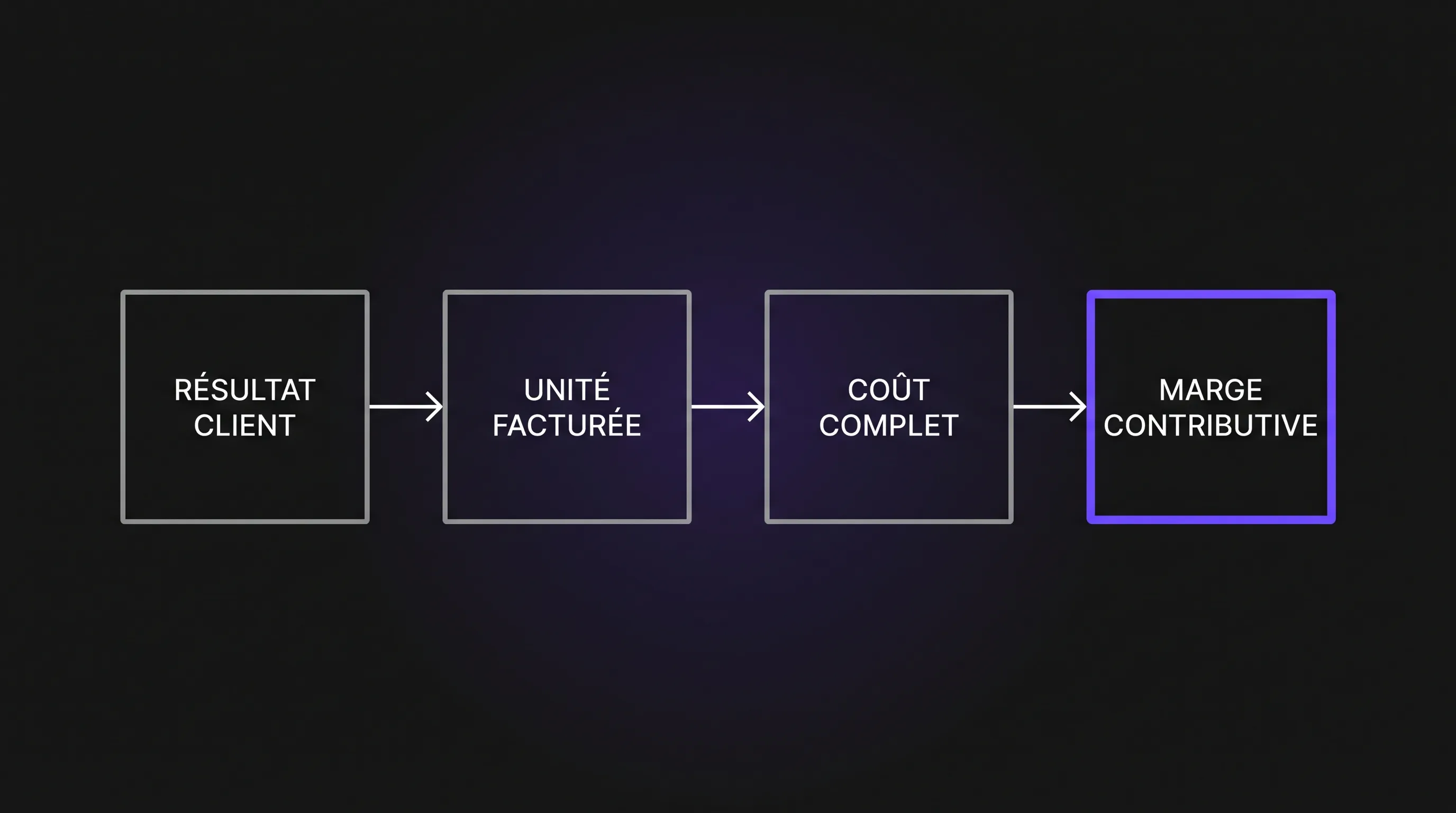
The contribution margin is roughly 59%: (900 - 370) / 900.
If model calls, human verification, and support demands double, direct costs jump to €700. With unchanged revenue, the contribution margin drops to €200, or approximately 22%.
This shift can stem from longer documents, lower-quality scans, or unusual edge cases. An AI business must therefore be evaluated against realistic, messy real-world scenarios—not just idealized product demos.
Calculating Your Commercial Break-Even Point
With a contribution margin of €530 per client and €6,000 in monthly fixed overhead, you need at least 12 comparable clients just to break even. This assumes direct costs remain stable and no expenses are double-counted.
Next, factor in customer acquisition cost (CAC). An acquisition cost of €1,590 requires three months of a €530 contribution margin to recover, excluding churn. If clients leave quickly or require extensive unbilled onboarding, apparent unit profitability will not translate to real business success.
Validating the Model with a Paid Pilot
Selecting a Representative Scope
Before building out every feature, sell a targeted pilot restricted to a single workflow, team, and dataset. The pilot price should reflect meaningful work: an audit, initial integration setup, or processing an agreed volume of data.
Focus on a frequent bottleneck whose current cost is measurable and for which the client can provide necessary system access. A flashy but rare use case is far less valuable to validate than a modest daily routine.
To prove out an AI business, the pilot must also expose realistic edge cases. Track configuration time, manual corrections, and support requests. These operational metrics dictate your future pricing just as much as model accuracy.
Defining Success Criteria Upfront
Agree in advance on what justifies moving to a recurring contract: field extraction accuracy, end-to-end processing times, volume handled, and required human intervention. Compare these results against a baseline measured using the exact same methodology.
Monitor adoption closely. A technically impressive tool provides no value if team members quietly revert to their old manual methods. Appoint an internal business champion, schedule targeted training, and implement clear error-handling procedures.
At the end of the pilot, make a clear decision: standardize the offering, adjust the scope, or stop. Avoid indefinitely extending unpaid prototypes when commercial terms have not been finalized.
Managing Commitments That Can Drain Your Margin
Your contract is an integral part of your business model. It must separate system availability from model accuracy and validation responsibilities. A high-availability SLA does not guarantee that every single AI output will be correct.
Specify included volumes, supported file formats, support turnaround times, and billing rules for out-of-scope requests. Cover data portability and offboarding: what data will be returned, in what format, and under what timeline?
An artificial intelligence business must account for privacy and data compliance costs from day one. When processing personal data, clarify roles, processing purposes, retention periods, and downstream processors. The CNIL's AI regulatory resources offer a solid starting point for European compliance.
Finally, make software ownership, customer data rights, and deliverable ownership explicit, without promising IP exclusivity that underlying foundation models cannot support. Our article on AI rights and responsibilities in business helps navigate these issues.
Frequently Asked Questions
Do you need to train your own proprietary model to sell an AI solution? No. You can combine existing models, business logic, and tailored integrations. Your core value often lies in process reliability, domain knowledge, or workflow convenience. Just ensure you comply with the commercial licensing terms of your underlying providers.
Which business model is best when starting as a solo founder? A productized service allows you to generate revenue before building complex software. Define a clear deliverable, limit revisions, and track your actual time spent. A SaaS subscription becomes appropriate once the customer need is recurring and service delivery can be largely automated.
How can you prevent an AI subscription from losing money? Track your unit costs per customer, enforce usage caps, and monitor edge cases closely. In an AI business, human review and ongoing technical support can cost just as much as cloud compute. Revisit your scope or pricing tiers whenever your underlying cost to serve changes permanently.
Define the Offer Before Building the Platform
Your first deliverable does not need to be software code. It should be an offer connecting a buyer, a verifiable result, a clear billing metric, and a sustainable delivery cost.
Impulse Lab supports companies through AI opportunity audits, custom web and AI software engineering, system integrations, and adoption training. To stress-test your business model against technical execution realities, share your project with Impulse Lab. We help you identify what must be validated before committing to full-scale development.