What Does a Full-Stack Developer Do on Your Business Platform?
Design UI/UX
Développement logiciel
SaaS
Architecture web
A full-stack developer works across every layer of your business platform: user interfaces, server processing, and the underlying database. Their role goes far beyond building UI—they connect user actions to reliable business outcomes.
November 14, 2026·10 min read
A full-stack developer works across the different layers of your business platform: the screens used by your teams, server-side processing, and the data that powers the entire system. Their role is therefore not limited to building an interface. They connect a user action to a reliable business outcome.
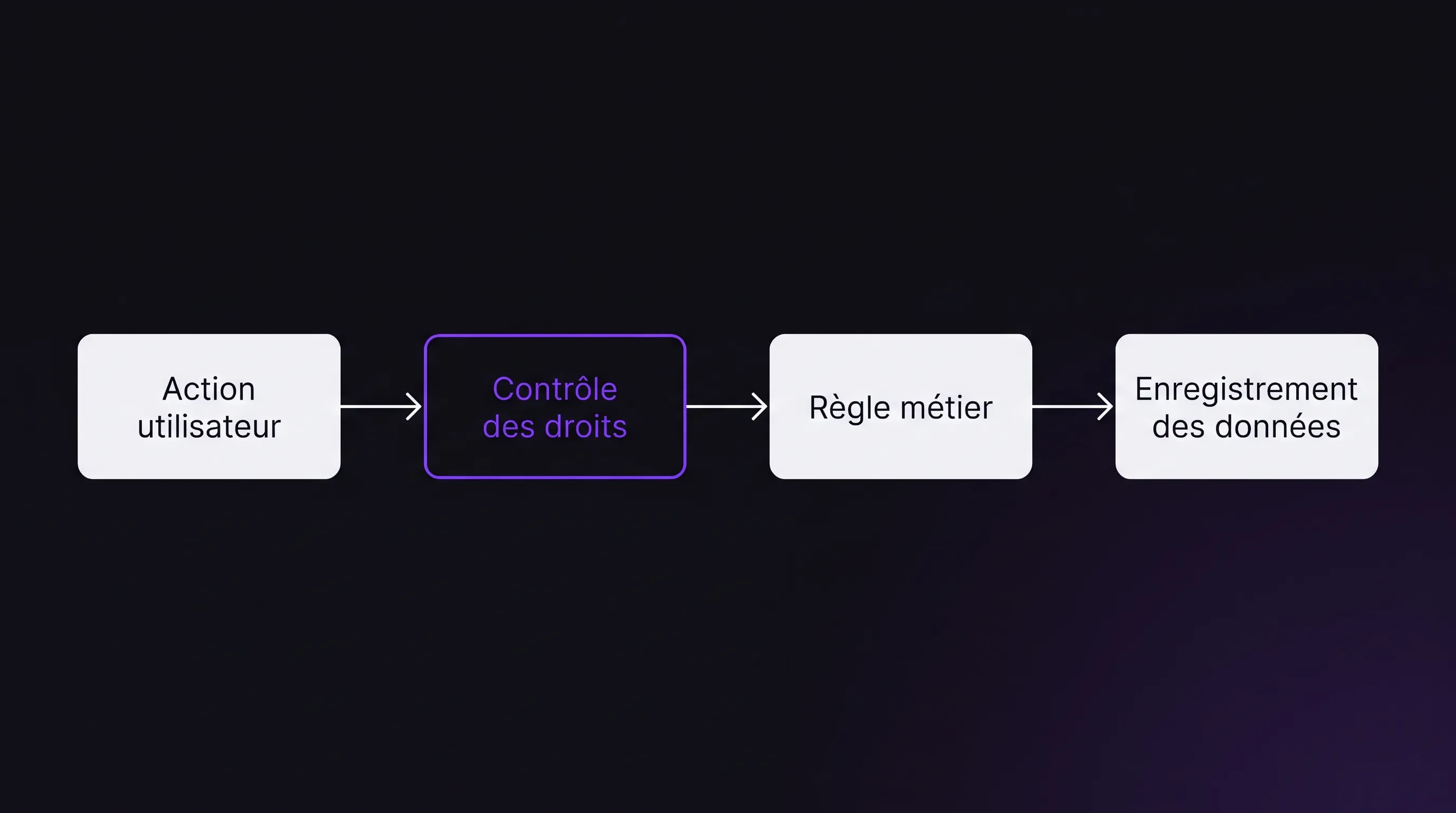
For an SME or a growing company, this continuity matters more than an exhaustive list of mastered technologies. When a manager approves a field service job, the correct status must be recorded, permissions respected, and information relayed to the relevant tools. A button that merely looks functional is not enough.
Let’s take a fictional example: a service company wants to centralize customer requests, assign technicians, and prepare invoices. Here is what this professional handles, how they collaborate with your teams, and what you can expect from their deliverables.
What a Full-Stack Developer Actually Handles
A business platform generally consists of three tightly connected layers. The developer needs to understand their interactions to deliver an end-to-end user journey, rather than a succession of isolated components.
Layer
Work Performed
Example on a Field Service Platform
Front-end
Building screens and interactions
Displaying a schedule, filtering requests, and reporting input errors
Back-end
Executing business rules and controlling access
Verifying that a manager is authorized to approve a job
Database
Organizing information and relationships
Linking a client, a site, an intervention, and its history
The front end makes the action understandable. The back end determines whether it is permitted and how to execute it. The database preserves the result consistently.
This cross-cutting perspective helps identify issues invisible in a simple mockup. For example, what happens if two managers edit the same assignment simultaneously? The answer involves the UI just as much as the server and data storage.
Being versatile does not mean working alone. Depending on the project, this developer collaborates with a designer, a product manager, a security specialist, or an infrastructure expert. Their scope must be clear from the start: working across the entire stack does not mean automatically shouldering every project responsibility.
Turning a Business Need into a Verifiable Feature
Before writing code, the full-stack developer must understand what your teams are trying to achieve. “We want to automate field operations” is an intention, not yet an actionable specification.
You need to clarify who creates a request, which fields are mandatory, who can assign it, and what triggers its completion. Exceptions are often critical: late cancellations, an unavailable technician, or disagreements over a service report.
In our example, a first feature could be: “A manager assigns a request to an available technician.” The developer translates this need into UI, validation rules, and data to persist.
Acceptance criteria then make the deliverable verifiable:
Only a user with the appropriate role can modify the assignment.
A canceled intervention cannot be reassigned without being reopened first.
The audit log shows who made the change and when.
These criteria should not be decided solely by the technical team. Your business stakeholders arbitrate the rules; the developer checks their consistency and translates them into software.
Their job also involves narrowing the scope when appropriate. A well-controlled manual assignment flow can be a better initial delivery than a complex scheduling engine. This lets you validate real-world usage before investing in more ambitious automation.
Balancing Development, Testing, and User Feedback
A full-stack developer's daily work alternates between understanding requirements, development, verification, and bug fixing. They do not spend their entire day creating new features.
On our fictional platform, they might start by reproducing an issue reported by a user: a job appears twice on the schedule. They then investigate whether the problem stems from display rendering, a duplicate submission from the browser, or a record saved multiple times on the server.
After the fix, an automated test can verify that the same scenario no longer produces duplicates. The developer then resumes the feature in progress, prepares a demo build, and gathers feedback from an operations manager.
A useful demo showcases an end-to-end journey. Creating a request, assigning it, and viewing its history lets you assess how the business process works. Showing isolated screens in isolation does not prove that data flows properly.
On your side, designate a stakeholder capable of deciding on business questions. Contradictory feedback or approvals left hanging stall the project, even when development is progressing smoothly.
Regular deliveries therefore serve as much to validate choices as to track progress. They should enable decision-making: accept, fix, or adjust the next priority.
Connecting the Platform to Your Tools Without Weakening Data Flows
A full-stack developer can also connect your platform to your CRM, accounting software, or an external service using their APIs—the interfaces that allow applications to exchange information.
This integration is not just about “plugging two tools together.” You must determine which application acts as the single source of truth for each piece of data. If a customer’s address changes, should it be updated in the CRM, the platform, or both? Without clear rules, discrepancies will accumulate.
To send an approved intervention to invoicing software, the developer must plan field mappings, error handling, and potential retries. A service unavailable for a few minutes should not silently cause data loss.
You must also prevent a retry from generating a duplicate invoice. The solution depends on the connected tool's capabilities, documentation, and the guarantees offered by its API.
If an AI feature is added—for example, to generate a service report summary—it becomes an additional component in the workflow. The developer organizes the model call, data payload, failure handling, and human validation when required.
All these decisions impact the budget. An integration should be estimated after reviewing access, documentation, and actual constraints, not just based on the name of the software.
Securing Access and Preparing for Production
On a business platform, the full-stack developer must embed security checks into the product’s architecture. Hiding a button from unauthorized users is not enough: the server must also reject the request if someone tries to call it directly.
Controls primarily focus on authentication, permissions, and data access. In a multi-tenant platform used by multiple client companies, a user must not be able to view another company's records simply by changing an ID.
The OWASP ASVS framework provides verification requirements for web application security. It can serve as a foundation for defining controls tailored to the project’s risk profile, without replacing project-specific analysis.
Deploying to production also requires preparing configuration, database schema migrations, and error monitoring tools. A backup only offers real protection if its restoration process is tested and verified.
The developer may implement some of these mechanisms or collaborate with an infrastructure/DevOps specialist. In either case, clarify who monitors incidents, who responds, and how to roll back to a stable state after a failed deployment.
These responsibilities must be agreed upon in advance. Delivering an application does not automatically mean continuous monitoring or on-call support is included.
A Versatile Profile, Not a Specialist in Everything
The term "full-stack" describes the ability to work across multiple layers. It guarantees neither the same depth of expertise everywhere nor mastery of every technology.
For your project, the most valuable skill is first and foremost the ability to understand a process, design consistent data structures, and deliver maintainable workflows. Knowing a framework matters, but it does not replace reasoning about business rules or test quality.
A skilled professional also knows how to explain their choices without overwhelming you with technical jargon. They should be able to present the trade-offs of a decision regarding cost, timelines, reliability, and future scalability.
Ask the full-stack developer to define their boundaries: on which topics are they autonomous? When do they request a review? Who steps in if the project involves strict security, performance, or high-availability requirements?
A platform handling sensitive data or mission-critical operations may require dedicated specialists. Acknowledging this need is a sign of maturity, not a weakness.
Choosing the right profile is also distinct from choosing the architecture. If you are still deciding on the technical setup for your project, the criteria for choosing a full-stack web architecture for your SME will help you separate these two decisions.
Deliverables to Request to Maintain Full Ownership
Your company must be able to operate and evolve its platform without depending on knowledge held by a single individual. This continuity is built during development, not just during final handover.
Beyond a demo, ask the full-stack developer for deliverables that prove functionality and make handovers smooth.
Deliverable
What It Allows You to Verify
Testable user journey in a staging environment
Users can test features before production deployment
Acceptance criteria and test results
Agreed-upon business rules are properly verified
Source code and deployment procedures
The project can be taken over under the agreed contractual terms
Integration and configuration documentation
Dependencies and necessary configurations are clearly identifiable
Operating procedures and responsibilities
Everyone knows how to report and resolve incidents
Also clarify code ownership rights, technical account access, and maintenance terms in the contract. A job title alone does not settle these questions.
To evaluate the value delivered, look at your operations: time spent processing a request, number of duplicate entries, or files blocked due to missing information. Establish a baseline, then compare after adoption. A delivered feature only improves your business if it is used and solves the intended problem.
Frequently Asked Questions
How does this differ from a front-end or back-end developer? A front-end developer focuses on the user interface and interactions. A back-end developer primarily works on server-side logic and databases. A full-stack developer operates on both, with varying depth depending on their experience.
Can they build our entire platform alone? A full-stack developer can build a platform with a well-defined, manageable scope. However, this does not eliminate the need for product strategy, user feedback, or specialized reviews when risks justify them. Team size should depend on scope, deadlines, and operational requirements.
Do they need to know our industry before starting? Industry experience can accelerate initial understanding, but it does not replace proper requirement scoping with your teams. Their ability to ask precise questions, identify edge cases, and formalize rules remains the determining factor.
Do they stay involved after launch? This depends on the agreed engagement. Bug fixes, new features, and ongoing maintenance are distinct services whose terms must be clearly defined. You should also plan for knowledge transfer if another team takes over the platform.
Start from a Concrete Process to Scope Your Platform
Before searching for a profile or technology, pick a workflow that currently slows down your teams: assigning an intervention, validating a case, or passing information to billing. Define the users involved, the exceptions, and the expected outcome.
Impulse Lab builds custom web and AI platforms, automates workflows, and integrates them with existing tools. Weekly deliveries and a dedicated client portal allow you to track the project alongside your team. To start the conversation, bring a real-world case study and the steps you want to streamline.