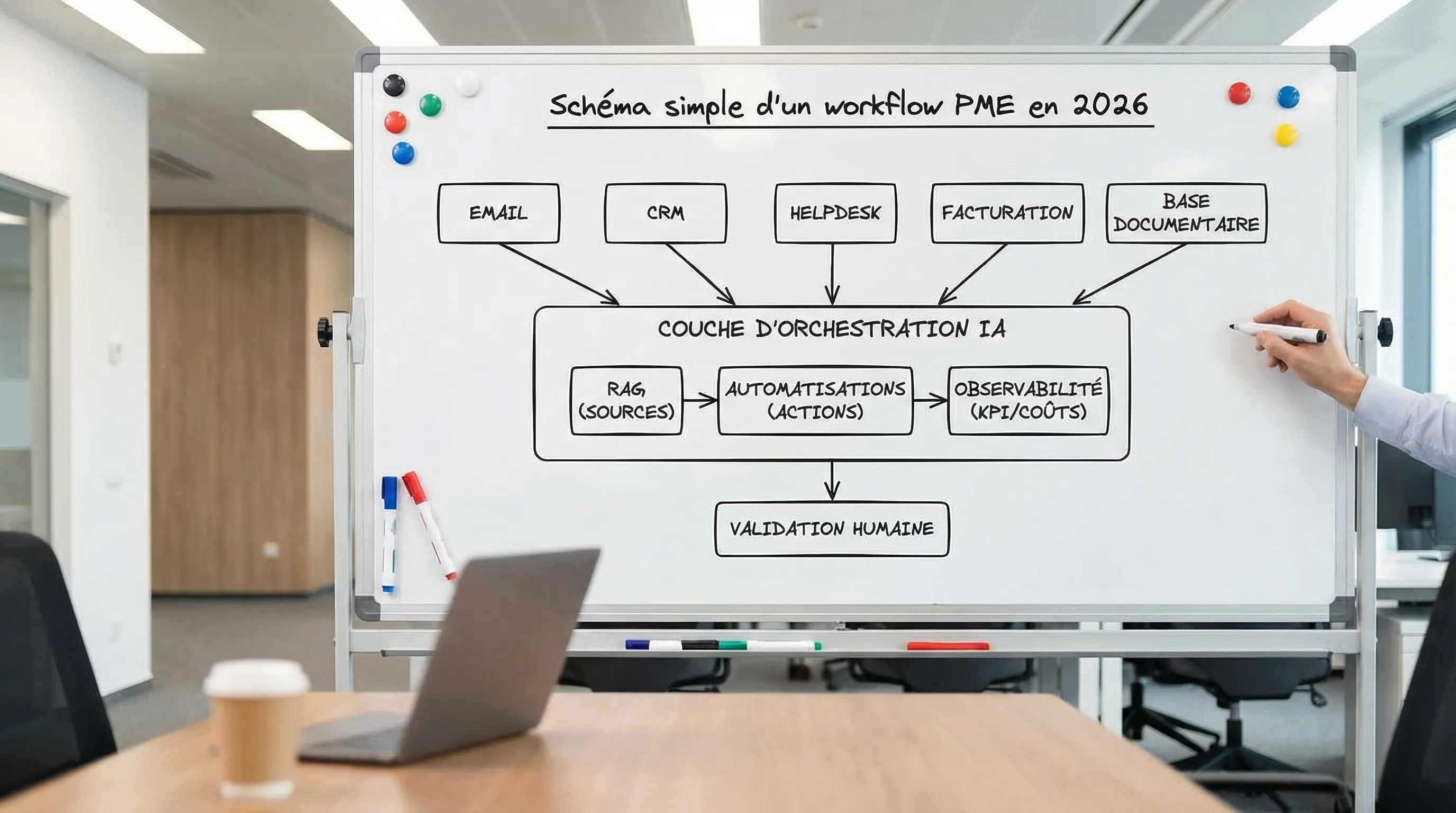
What is the purpose of artificial intelligence in SMEs in 2026?
Intelligence artificielle
Stratégie IA
ROI
Productivité
Automatisation
In 2026, AI is no longer an R&D project reserved for large corporations. For an SME, it mainly serves to **save time**, **reduce errors**, **standardize quality**, and **accelerate decisions**, provided it is integrated into real workflows (CRM, support...)
In 2026, artificial intelligence is no longer an "R&D project" reserved for large corporations. For an SME, it mainly serves to save time, reduce errors, standardize quality, and accelerate decisions, provided it is integrated into real workflows (CRM, support, billing, ERP, Google Workspace, or Microsoft 365) and managed with KPIs.
The key point to keep in mind is simple: value does not come from the model, but from well-defined usage, connected data, and appropriate safeguards.
What is the purpose of artificial intelligence in SMEs in 2026? (the short answer)
If you are searching for "what is artificial intelligence used for", the useful answer for SMEs comes down to 5 concrete roles:
Assist (copilots): help an employee produce faster (email, summary, analysis, code).
Automate: execute repetitive tasks using rules + AI (sorting, extraction, routing, CRM data entry).
Personalize (without being "creepy"): adapt a message or a journey according to the context and authorized data.
A successful SME in 2026 doesn't try to "put AI everywhere". It chooses 1 to 3 frequent use cases, closely tied to cash flow or operational workload, and puts them into production in a measured way.
The 6 most profitable (and realistic) use cases in SMEs
The use cases below are not the most "spectacular". They are the ones that, in practice, offer the best value / effort / risk ratio when starting from an SME environment.
1) Production copilot (writing, summarizing, research) in your everyday tools
This is the fastest use case to deploy, but only if it is properly governed.
Summarizing meetings and transforming them into tasks (minutes, actions, follow-ups)
Drafting emails and commercial proposals from templates
Summarizing long documents (contracts, specifications, accounts)
What really saves time: deliverable templates, an internal style guide, and a clear rule on what can or cannot be copied/pasted.
2) Document extraction and processing (invoices, vouchers, contracts, forms)
Most SMEs still have many "semi-digital" flows: PDFs, scans, attachments, forms.
Here, AI is used to:
Extract fields (amounts, dates, references, line items)
Classify and route (to the right folder, the right person, the right status)
These KPIs do not require a complex setup. They mainly require a simple baseline (before/after) and weekly tracking.
What has changed in 2026 (and why it matters for an SME)
Models are becoming commoditized, integration becomes the real differentiator
In 2026, most companies have access to very good models. The difference is made on:
Context: AI responds better if it is connected to your sources (docs, CRM, helpdesk)
Action: AI creates value when it can trigger a controlled action (not just generate text)
Measurement: cost, quality, adoption, incidents
This is exactly the logic of modern integration patterns (API, RAG, agents) that we detail in our article on enterprise AI integration.
RAG and "sources of truth": the key to reducing fragile responses
Without getting too technical, RAG (retrieval-augmented generation) is used to anchor responses to your documents, and to better track where the information comes from. If you don't know "what the right version" of a process or an offer is, AI will not be able to invent a stable truth.
How to get started in an SME (without losing focus): the pragmatic plan
The most common mistake in 2026 is buying a tool, doing a demo, and then realizing that "the teams aren't using it". To avoid this, you can apply this framework.
1) Choose a frequent, measurable, and "workflow-ready" use case
A good first use case has three properties:
Frequency: it occurs every day or every week
Clear KPI: time, cost, quality, conversion, lead time
Classic pitfalls that destroy ROI (and how to avoid them)
Confusing "AI tool" and "AI capability"
A subscription does not create a capability if:
The data is not connected
The outputs are not actionable
No one is responsible for the run (quality, costs, incidents)
Automating too fast (especially when action is involved)
The more an AI can act (send, modify, trigger), the more you must keep it "under control": confirmations, permissions, logs, degraded modes. The right reflex is to start by assisting, then automating, then eventually agentifying.
Leaving variable costs unmanaged
Even with "good" models, costs explode when:
Too much context is sent
No volume limits are set
Cost per task (or per ticket, per case) is not tracked
Neglecting compliance and security because "it's just a test"
In 2026, many problems stem from an unmanaged pilot that becomes a habit, then a dependency. Minimum safeguards (classification, access, logs, sharing rules) must be present from the start, even in a lightweight version.
When to get support (and what to demand)
If your SME wants to move fast while avoiding the "unusable demo", look for support that knows how to deliver:
A KPI-oriented framework
Integration into your existing tools
A simple and reproducible testing protocol
A run plan (quality, costs, security, ownership)
At Impulse Lab, we intervene precisely on these steps via AI opportunity audits, adoption training, and the development of custom web & AI solutions when off-the-shelf tools are not enough.
If you want a highly operational starting point, you can begin with a short audit, followed by an instrumented pilot. A good reference is our page on the strategic AI audit, which details what needs to be mapped (processes, data, stack, risks, organization) before industrializing.
How to Write a Short AI Charter That Teams Actually Follow
A short AI charter provides teams with a simple framework to use artificial intelligence tools without stifling initiative, exposing sensitive data, or producing unverifiable deliverables.