When to Choose a Full-Stack Web Architecture for Your SME
Stratégie d'entreprise
Développement logiciel
Outils internes
Performance
Architecture web
A **full-stack web architecture** makes sense for your SME when you need to master an end-to-end business journey, from user interface to data and tool integrations. It is not always better than off-the-shelf software, but it gives you tailored operational control.
A full-stack web architecture becomes relevant for your SME when you need to master an end-to-end business workflow, from the interface used by your teams down to the underlying data and integrations with your tools. It is not automatically preferable to off-the-shelf software, nor does it require rebuilding everything from scratch or entrusting the entire project to a single person.
The right criterion is therefore not the popularity of a framework. It is the solution's ability to run your operations smoothly without creating disproportionate maintenance overhead. Here is how to decide, and then choose a technical structure suited to your growth.
Full Stack: A Complete Scope, Not a Single Architecture
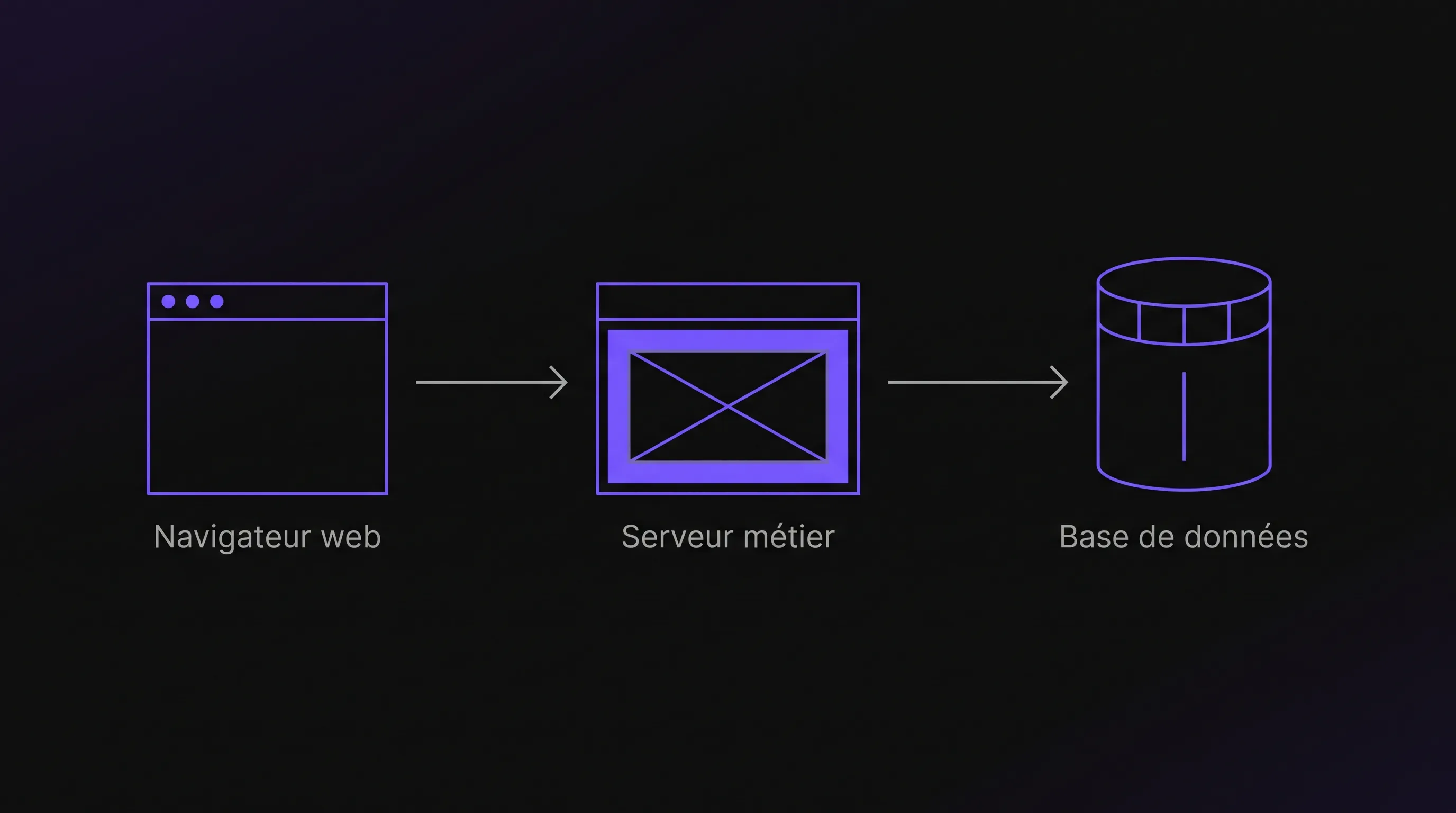
Full-stack development covers both the front end—the user interface visible in the browser—and the back end, which enforces business rules, accesses data, and communicates with other software.
Layer
Role
Example for a Customer Portal
Front end
Present information and enable interactions
Request form and case tracking
Back end
Check permissions and execute business logic
Document validation and status updates
Database
Store structured information
Customers, records, and history
Integrations
Exchange data with existing tools
Invoice creation in accounting software
The term "full-stack web" therefore describes technical coverage rather than an imposed architecture. An application can combine these layers into a single project or separate them. It can also use multiple languages.
Finally, a versatile profile is not necessarily an expert in security, UI design, and cloud operations. Ownership of each domain must remain explicit, even within a small team.
When to Choose a Full-Stack Web Architecture for Your SME
Your Operations Require Specific Business Rules
Take a maintenance SME: an on-site service depends on customer contracts, technician availability, and quote approval. If these rules are scattered across spreadsheets, emails, and duplicate data entry, an integrated application can make them far more reliable.
Custom development is justified primarily when these rules are critical to your business and stable enough to be formalized. Automating an ill-defined process often only cements its flaws.
Multiple Users Need to Share the Same Record State
A sales rep, an operations manager, and a customer do not see the same information. Yet, they all need to work from a consistent version of the case record.
A full-stack web approach allows you to design screens, user permissions, and transitions together: who can edit a quote, at what stage an order becomes final, and which actions are logged. The true benefit stems from this consistency, not the number of technologies used.
Your Product Evolves Through Complete Workflows
A scale-up that continuously refines its offering benefits from being able to evolve features end to end. Adding a booking feature may require a new interface, availability logic, and automated notifications.
A team covering all of these layers minimizes handoffs. However, it must maintain adequate testing and documentation so that early development speed doesn't compromise future maintainability.
When Existing Software Remains the Better Choice
A standard requirement alone does not justify a dedicated custom application. Invoicing, appointment booking, or recruitment can often be handled by specialized SaaS tools, potentially integrated into your information system.
For human resources, for example, start by choosing a recruitment tool suited to your SME based on your primary need. If an ATS adequately manages candidate tracking, rebuilding that function introduces maintenance overhead that is hard to justify.
The same logic applies to a full-stack web architecture: only build what provides unique value to your organization. A custom interface connected to existing services may be all you need.
Two other situations call for patience: when no one can arbitrate business rules, and when no owner is appointed to manage the application post-launch. Technical choices cannot fix a lack of governance. To assess whether custom development makes sense first, our guide on the conditions to succeed with custom software development complements this thought process.
Which Technical Architecture to Choose at the Start?
The Modular Monolith as a Viable Starting Point
For an SME with a lean technical team, a modular monolith is often a sound starting point to consider. The application is deployed as a single unit, but its codebase clearly separates business domains: customers, orders, billing, or documents.
This architecture simplifies deployments and data exchanges without ruling out APIs or third-party integrations.
A full-stack web project can rely on a framework like Django or Laravel, a PostgreSQL database, and a user interface tailored to specific workflows. React or Vue can be helpful for rich interactions, without being mandatory for every single screen. The choice also depends on the skills available to maintain the stack.
Decoupling Components When Constraints Warrant It
Decoupling the front end from the back end becomes valuable when multiple interfaces consume the same core logic: for instance, a customer portal, a mobile app, and a partner dashboard. However, this separation requires managing API contracts, versioning, and more comprehensive integration testing.
Microservices address different constraints: autonomous teams, components with distinct availability requirements, or workloads that must scale independently. They also introduce network overhead, distributed tracing, and complex deployments.
Expected growth alone does not justify them. Instead, ask what concrete bottleneck decoupling solves today, and what it will cost to operate. Finer-grained architecture can always be implemented once performance metrics and organizational scale make it necessary.
Treat Integrations as First-Class Components
Connecting to a CRM involves more than simply sending an API request. You must define which system is the single source of truth for each data point, how to detect duplicates, and what to do when the remote service is unavailable.
In a full-stack web application, long-running processes should be handled via task queues rather than blocking the user. Synchronizations must be idempotent, allowing retries without generating duplicate invoices or records.
If you introduce AI features, apply the same rigor: keep API keys secure on the server side, transmit only the strictly necessary data, and require human review whenever an error carries significant consequences. AI is just another component of the workflow, not an excuse to bypass safeguards.
Security and Maintenance: Requirements to Define Before Building
Hiding a button does not secure an action. The server must verify that the user possesses the necessary permissions for every sensitive operation. Browser-submitted data must always be validated on the server side.
To structure your checks, the OWASP ASVS framework provides a practical baseline for discussing application security requirements. The goal is not to check every single box, but to select controls tailored to the project's actual risks.
Maintenance must cover dependency updates, error alerting, backups, and disaster recovery testing. A backup that has never been restored does not prove your ability to recover.
As soon as a full-stack web architecture handles personal data, explicitly define access permissions, retention periods, and vendor responsibilities. Hosting location alone does not resolve all GDPR compliance obligations.
Finally, document account ownership: source repositories, hosting providers, domain names, and third-party services. Your company must be able to manage handover or recovery without relying on a single individual.
Evaluating Total Cost of Ownership Rather Than Just Initial Development
Comparing two quotes requires looking well beyond screen development. The full cost encompasses scoping, data migration, integrations, testing, ongoing operations, and maintenance.
Distinguish initial expenses from recurring operating costs. Hosting, third-party subscriptions, and maintenance persist long after launch. An integration with poorly documented legacy software can easily demand more effort than a flashy front-end form.
To assess the ROI of a full-stack web project, start from a measurable process. For example: six team members each save 30 minutes per day across 20 business days. That amounts to 60 hours saved per month. Assuming a fully loaded cost of €40/hour, the theoretical gained capacity is worth €2,400 monthly.
This amount is not an automatic cash saving. You need to determine whether that time is genuinely recaptured to absorb more business, and what overhead the new system introduces. A pilot on a representative workflow helps validate these assumptions against reality.
Key Decisions to Secure Before Giving the Green Light
Before kicking off development, request a concise architecture brief understandable to business leaders. It should outline the core workflow, relevant data flows, selected components, and the rationale behind each choice.
Four points require explicit clarity:
Single source of truth: Which system is authoritative for customers, orders, and payments?
Ownership and governance: Who signs off on business logic, security, and deployments?
Degraded mode: What happens when an external tool or background job fails?
Reversibility: How can you retrieve data, source code, and credentials needed for a transition?
For a full-stack web project, evaluate the team's ability to deliver a complete, testable slice of functionality rather than a series of disconnected mockups. Our guide on how to choose a web development partner for an SME explains how to evaluate vendors against a unified brief.
A valuable first release should allow you to test the core workflow with real users. Non-essential features can wait as long as they don't compromise security or basic operations.
Frequently Asked Questions
Does full-stack mean a single developer builds everything? No. The term refers to covering all layers of the application. Multiple team members can collaborate, including specialists in security, UX/UI, or cloud infrastructure.
Is a full-stack web architecture suitable for a small SME? Yes, if the business need warrants a custom tool and ongoing maintenance is accounted for. For standard requirements, off-the-shelf software is often simpler to operate.
Must the same language be used on both the front end and back end? No. A full JavaScript or TypeScript stack can facilitate code sharing, but other combinations are equally valid. Team maintainability and expertise matter far more than language uniformity.
Can we keep our existing CRM or ERP? Yes, provided appropriate integration mechanisms exist. Always review APIs, access permissions, rate limits, and contractual terms before committing to synchronization.
Should we architect for millions of users from day one? Not unless you have an immediate, proven need. Instead, specify expected traffic volumes, acceptable response times, and mission-critical workflows, then test those assumptions.
Start With Your Process, Not the Tech Stack
The right starting point is a clear process map: who does what, with which data, and where the bottlenecks occur. This mapping clarifies what to keep, what to integrate, and what to build custom.
Impulse Lab builds custom web and AI platforms seamlessly integrated with your existing software ecosystem. Share your priority workflow to explore a solution whose scope, governance, and maintenance are tailored to your SME.