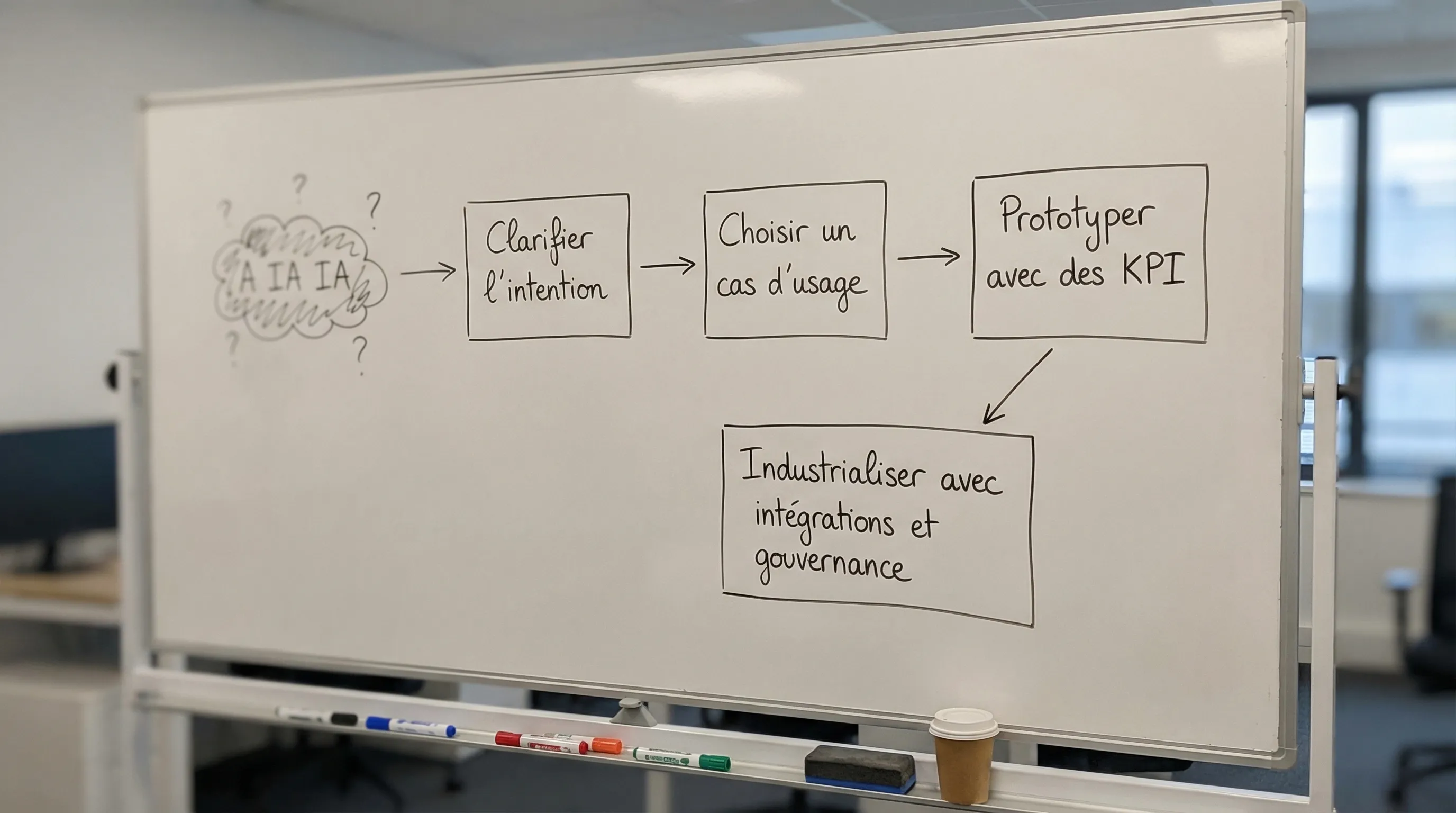
You may have encountered "A IA IA" in search logs or transcripts. What does it mean? It is not a standard term but usually a typo for "AI" or "IA". This article explains how to interpret this signal and address the underlying business needs for artificial intelligence.
January 30, 2026·8 min read
You might have stumbled upon “A IA IA” in a Google search, a query export (Search Console), a meeting transcript, or even a Slack message. And the question quickly arises: what does it mean, exactly?
The most honest answer is also the most useful: “A IA IA” is not a standard term in the world of AI (unlike LLM, RAG, AI agent, etc.). In the vast majority of cases, it is a writing artifact (typo, autocorrect, voice dictation, duplication) that practically refers to “IA / AI” and, by extension, artificial intelligence.
The objective of this article is twofold:
To help you correctly interpret “A IA IA” according to the context.
To show you how to handle this type of term regarding communication, SEO, and AI adoption in business (without over-interpreting, without wasting time).
“A IA IA”: An Unofficial Expression (And Why It Matters)
In glossaries and technical documentation, terms related to AI have relatively stable definitions: LLM, machine learning, generative AI, RAG, agent, MLOps, etc. “A IA IA” is not one of them.
This point is important to avoid two common errors:
The analysis error: Believing it is a “hidden” concept or an advanced acronym.
The execution error: Launching a search, training, or tool purchase based on a vague foundation.
Clearly, if someone says “A IA IA”, your first reflex should be: “What are you talking about concretely? Generative AI? Chatbot? Automation? Agent?”
In practice, “A IA IA” appears mostly in contexts where the text is not “editorialized”: raw queries, transcriptions, quick messages, log exports.
Here are the most common interpretations.
Probable Interpretation
Context Example
What it means “in reality”
Recommended Action
Typo or repetition
Google query “a ia ia training”
“IA” (or “AI”) with uncertain typing
Respond to the intent (AI training), not the form
Voice dictation / transcript
Meeting notes, Fireflies/Teams/Meet
“AI AI AI” or “à IA” (to AI) poorly transcribed
Refer back to the concrete example mentioned in the meeting
Copy-paste / input noise
CRM, support tickets, free text fields
Noise, not a concept
Normalize internal terminology
Confusion IA vs AI
Marketing/SEO discussions
“IA” (French) vs “AI” (English)
Define an editorial rule
Proper noun (rare)
Product search
Sometimes confusion with “AIAIAI” (brand)
Verify intent (audio vs artificial intelligence)
The key point: you don’t “deploy” “A IA IA”. You deploy an AI use case, with a scope, data, integration, KPIs, and governance.
Where You Encounter This Term (And Why It Appears in Your Tools)
If you are an SME leader, ops manager, marketing, product, or revops, you might see “A IA IA” surface in several places.
1) In SEO queries (Search Console, analytics, keyword tools)
“a ia ia” typically looks like:
A short, non-normalized query
A quick attempt on mobile
An “AI” intent but misspelled
In SEO, this type of query is useful not for its spelling, but because it signals an informational intent: understanding AI, finding uses, getting trained, comparing tools.
2) In meeting transcriptions and note-taking tools
Voice dictation and automatic transcription often produce approximations of technical terms, especially when:
Several people speak quickly
The microphone is average
Acronyms (AI, API, SaaS) follow one another
“A IA IA” can then be a degraded form of “IA, IA…” (repetition) or “AI”.
3) In internal messages (Slack, email, tickets)
When a subject becomes a “buzzword”, it gets distorted. “A IA IA” can be a clumsy way of saying: “we want to put AI everywhere”.
It is precisely a useful warning signal: if the language is vague, the project will often be too, unless you reframe it quickly.
How to Respond When Someone Asks About “A IA IA”
If a prospect, manager, or colleague asks you the question, the goal is not to correct the syntax. The goal is to clarify the need.
Here is a simple, professional, and effective response:
Clarification: “I don’t know ‘A IA IA’ as a standard term. Are you talking about AI (artificial intelligence) in the broad sense?”
Reframing: “When you say AI, are you thinking more of a chatbot, an automation, an internal assistant, or an agent that executes actions?”
Concretization: “Which process do you want to improve, and how do we measure the gain (time, cost, quality, revenue, risk)?”
This reframing is exactly what allows you to move from the “word” to the “project”.
“A IA IA” and Terminology: IA vs AI (And Why It Matters)
A part of the confusion also comes from the mix between:
IA: French term (Intelligence Artificielle), the clearest for a Francophone audience.
AI: English term (Artificial Intelligence), frequent in tools, APIs, product names, and international content.
For a company, the subject is not just linguistic. It impacts:
This doesn't mean “braking”. It means choosing the right use cases, setting the right guardrails, and integrating properly.
And If You See “A IA IA” in Your Company: What to Do Now?
Consider “A IA IA” as a signal, not as a concept.
If you see it in SEO: you have a “beginner” demand to capture with a clear explanation and links to uses.
If you see it internally: you have a need to standardize vocabulary and align teams on 2 or 3 priority use cases.
If you see it in a project discussion: you must return to the process, the data, and the KPIs.
Impulse Lab supports SMEs and scale-ups precisely on these steps, via AI opportunity audits, adoption training, and then the development and integration of custom web and AI solutions. To start properly, you can visit the homepage: Impulse Lab.
AI at Work: 10 Tasks to Delegate Without Losing Control
AI at work is useful when it removes friction, not when it replaces business judgment. For SMEs and scale-ups, the right question isn't "what can AI do for me?", but rather: "what tasks can I delegate to it to save time while keeping control?"