Under pressure to "integrate AI" without burning political capital or budget? Discover a pragmatic method to maximize success and limit risks. The AI Explorer framework is a results-oriented adoption guide designed for managers to demonstrate value quickly.
décembre 18, 2025·8 min de lecture
You are under pressure to "integrate AI" without burning your political capital, your budget, or the trust of your teams. Good news: there is a pragmatic method to maximize chances of success, limit risks, and demonstrate value quickly. The AI Explorer framework is an adoption guide designed for managers, results-oriented, combining opportunity audits, measured pilots, clean integration into existing tools, and targeted training.
AI Explorer in Brief
AI Explorer is a structured exploration approach to move from intuition to impact, without skipping steps. The goal is to create a short loop, from spotting opportunities to proof of value, with light governance and deliverables useful for decision-making.
Key principles:
Prioritize value, not technology, by anchoring every AI initiative to a measurable business indicator from the start.
Move in increments, with a visible weekly cadence and clear decision gates after each step.
Integrate rather than duplicate, by plugging AI into existing tools to capture value where it is already being created.
Frame quality and risk, with data, security, and compliance guardrails inspired by recognized best practices, such as the NIST AI RMF.
Train teams where adoption happens, at the moment usages materialize.
Light Governance, High Impact
No need for a sprawling committee. A tight-knit team is enough to start, provided roles are clarified.
Role
Main Responsibilities
Executive Sponsor
Aligns with strategy, decides at decision gates, secures resources
Business Product Owner
Defines the problem, KPIs, validates user experience and integration
Technical Lead
Architecture, security, system integration, performance
Data Steward
Data quality, access, anonymization, traceability
Security and Compliance
Risk review, EU AI Act depending on the case, internal policies
Practical tip: set the definition of "done" for a pilot right at the launch, for example 15 percent time saved on a target process, with an output accuracy greater than 95 percent on a test sample.
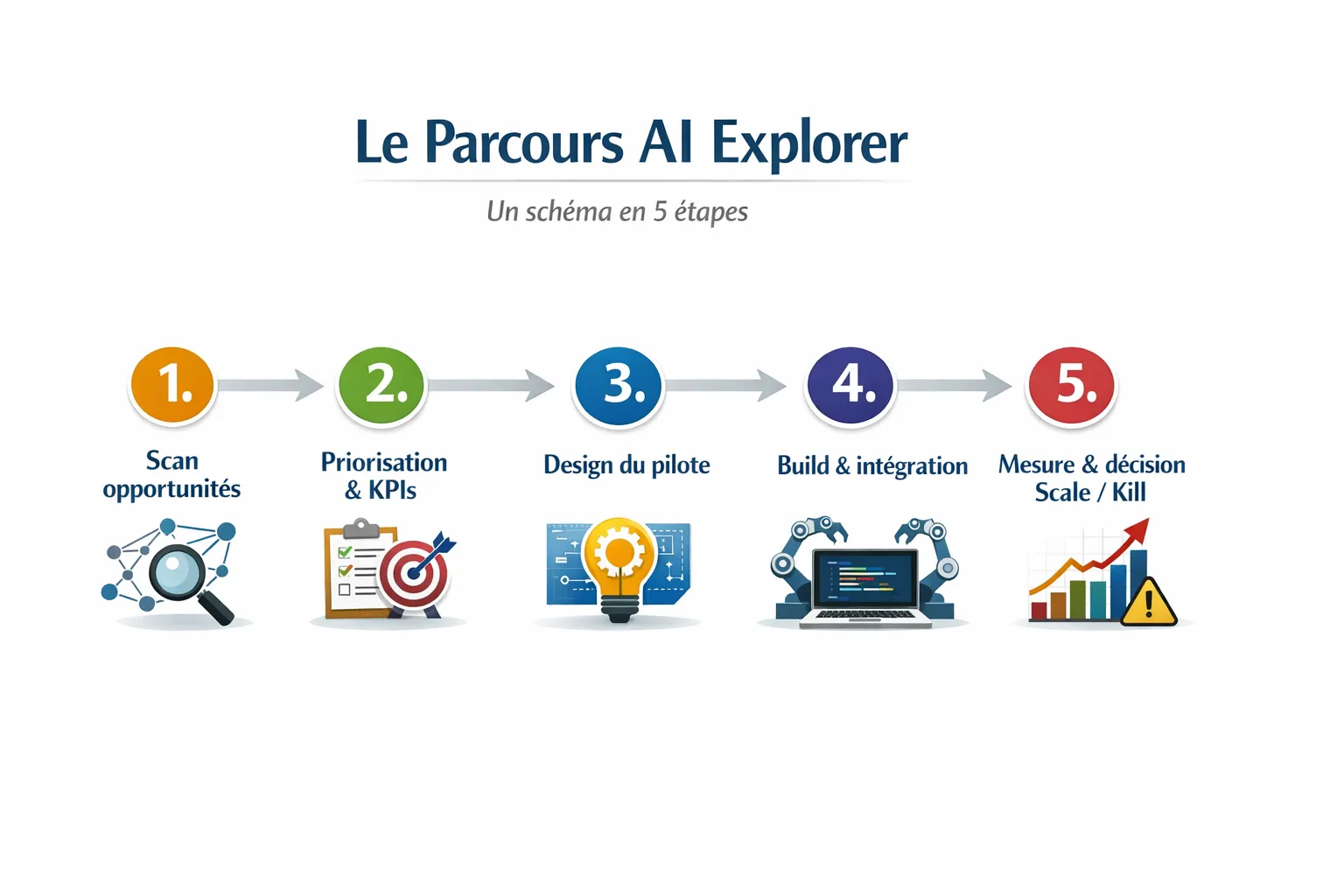
AI Explorer Journey in 90 Days
Five steps, concrete deliverables, and decision gates to avoid getting bogged down.
Step
Objective
Deliverables
Decision Gate
1. Opportunity scan, flash audit
Identify 5 to 10 high-potential use cases, map data and risks
Process map, data inventory, quick wins
Validate 2 to 3 pilot candidates
2. Prioritization and KPIs
Quantify value and complexity, define the "north star metric"
Value, effort, risk scoring, roadmap
Choose 1 priority pilot
3. Pilot design
Define user experience, prompts, quality guarantees, test sets
Specification, test sets, experimentation plan
Go build if design test validated
4. Build and integration
Develop the agent, automation, or API, connect to target tool
Measure ROI, quality, adoption, define deployment plan
Impact report, scale or stop plan
Decision: scale, iterate, or kill
The weekly cadence is essential. It accelerates learning, keeps stakeholders engaged, and makes value visible early.
Measuring Value Unambiguously
Before coding, set the baseline. Three families of indicators cover the essentials:
Productivity: time per task, volume processed per FTE, cycle times.
Quality: error rate, compliance, internal or client satisfaction.
Experience: Internal NPS, active adoption, friction in the first minutes.
Simple reminder to estimate productivity ROI: Estimated monthly value equals minutes saved per execution multiplied by frequency multiplied by average cost per minute. Test this estimation on a representative sample and compare it to the pilot reality to adjust.
Data and Integration, the Real Key to Success
Most AI failures don't come from models, but from integration. Two golden rules:
Treat data as a product: quality, traceability, access policies, anonymization where possible.
Take care with integration: clean secret management, model call control, logging, and defense against prompt injection.
Value only exists if teams use the solution. Work on onboarding as seriously as the algorithm.
Make AI accessible where work already happens: CRM, helpdesk, ERP, office suites.
Reduce friction in the first interactions: ready-to-use example cases, in-situ help text, visible metrics.
Train at the moment of usage: 10-minute micro-trainings integrated into the workflow.
Install local champions and a feedback loop: dedicated channel, office hours, request prioritization.
For internal products and SaaS, the impact of initial onboarding is decisive. A useful resource to diagnose and improve this critical moment is this conversion guide oriented towards "first minutes". See the method to fix your first five minutes, very relevant if you are deploying an AI assistant or an AI-driven feature.
High-Leverage Recurring Use Cases
Customer service: assisted responses, auto-classification, suggestions. Measurement: first contact resolution rate, average handling time.
Sales: lead qualification, personalized email drafting, call notes. Measurement: conversion rate, time per opportunity.
Operations: document extraction, reconciliation, planning. Measurement: cycle time, errors.
Finance: reconciliations, automated controls, summaries. Measurement: closing time, anomalies detected.
Tip: prefer high-frequency tasks with clear rules. The more repetitive the flow, the faster the proof of value arrives.
Risks and Compliance, Pragmatism First
Adopt guardrails proportionate to the risk.
Confidentiality and secrets: encryption, partitioning, access and logging policy.
Prompt and output security: filtering, sensitive content detection, action limitation on critical systems.
Compliance: apply the principles of the NIST AI Risk Management Framework for assessment, documentation, and governance. See the reference resource for the NIST AI RMF.
Regulation: take into account EU AI Act requirements depending on the risk level of your use case.
Recommended Minimalist Tooling
Prompt management and evaluation: versions, A/B tests, quality metrics on samples.
Orchestration and integration: workers, queues, webhooks, timeouts, retries.
RAG or connectors: to bring the right data at the right moment.
Observability: traces, cost per request, latency, quality drifts.
Security: secrets, light red teaming, access policies.
Keep a "vendor-neutral" posture, and choose your blocks according to data sensitivity, total cost of ownership, and ease of integration.
Anti-Patterns to Avoid
The generic chatbot everywhere: prefer specialized assistants per task and context.
The POC without metrics: without clear KPIs, no one will believe in the value.
The technical big bang: start small, integrate well, measure, scale what works.
Disconnected training: train when and where usage occurs.
Forgetting support: plan for help and continuous improvement from the pilot stage.
How Impulse Lab Can Accelerate Your AI Explorer
Impulse Lab intervenes where speed and reliability count: AI opportunity audits, development of custom web and AI platforms, process automation and integration with your tools, adoption training. Our practices include weekly deliveries, a dedicated client portal, and end-to-end support, from exploration to industrialization. For detailed approaches on measurement, read Turning AI into ROI, proven methods.
FAQ
What is the right first project to launch AI Explorer? Choose a high-frequency process, with available data and low risk, for example, assisted support response or field extraction from a repetitive document. Set a simple KPI: time per ticket, extraction accuracy, and a realistic target.
How long to see a measurable return? A well-scoped pilot shows signals in 4 to 8 weeks, if the baseline is defined and integration with existing tools is in place. The decision to scale is generally taken around 90 days.
Should we build custom or buy a turnkey tool? Start from the problem. If a market tool covers 80 percent of the need and integrates with your IS, adopt it. Otherwise, develop a limited and well-integrated custom brick. Evaluate the total cost of ownership and data sensitivity.
How to manage confidentiality and security risks? Implement access policies, encryption, anonymization where possible, audit logs, and input/output filtering. Apply a risk management framework, such as the NIST AI RMF, and regularly review use cases.
How to train teams without slowing down operations? Prefer micro-trainings integrated into the workflow, 10 minutes, concrete scenarios, and set up local champions. Add an evolving knowledge base within the tool where AI is used.
Which KPIs to follow for an AI pilot? Time saved per task, volume processed, accuracy, error rate, active adoption, satisfaction. Select 2 or 3 indicators maximum to stay focused.
How to avoid the "POC that doesn't scale" effect? Work on integration from the pilot stage: secret management, observability, load tests, and plan for scaling. Document dependencies and unit costs per request.
Ready to explore without getting lost in the labyrinth of AI options? Let's start with an opportunity audit calibrated to your context, then a high-impact pilot with integration into your tools and team training. Contact us at Impulse Lab to frame your AI Explorer journey and transform AI into tangible value, step by step.