AI Agency Paris: How to Compare and Avoid False Promises
Intelligence artificielle
Stratégie IA
Validation IA
Gouvernance IA
Gestion des risques IA
Choosing an **AI agency in Paris** can accelerate your productivity, acquisition, or support. But in 2026, the market is full of optimistic pitches, impressive demos, and promises that are hard to keep when faced with your data, tools, and constraints (GDPR...
Choosing an AI agency in Paris can accelerate your productivity, acquisition, or support. But in 2026, the market is also full of optimistic pitches, impressive demos, and promises that are hard to keep when faced with your data, tools, and constraints (GDPR, security, operations).
The goal of this article is simple: to help you compare AI agencies in Paris pragmatically, and above all, avoid false promises by demanding verifiable proof (deliverables, KPIs, integrations, run).
Why false promises are so common in AI (and why they are expensive)
AI has become more accessible (APIs, multimodal models, frameworks, agents), which has two effects.
On one hand, it's excellent news: it's easier to prototype and deliver quickly. On the other, it makes it very easy to sell an "AI capability" without delivering an operable system.
False promises almost always focus on the same gray areas:
Demo vs. production: a demo "that responds well" doesn't necessarily have logs, access management, monitoring, or a business continuity plan.
POC vs. ROI: a POC can be "successful" without creating measurable value.
Perceived quality vs. measured quality: the "wow" effect is confused with reliability.
Variable costs: AI in production has inference, evaluation, run, and sometimes licensing costs, which are often underestimated.
Late compliance: GDPR and the AI Act cannot be cleanly "tacked on" at the end.
To frame your compliance requirements, here are two useful (non-exhaustive) references:
7 risky promises (and how to dismantle them without being an expert)
The idea is not to trap an agency, but to distinguish a "demo" provider from a partner capable of delivering a measured, integrated, and operable V1.
1) "We can automate everything"
In practice, profitable automation is bounded: clear scope, managed exceptions, human validation if necessary.
What to check: can the agency precisely describe what the system does and does not do? Do they offer degraded modes?
2) "Our agent is autonomous"
An agent acting within your tools (CRM, helpdesk, ERP) must be controlled: permissions, idempotency, preview, logs, cost limits.
What to check: does the agency propose an "agent contract" (objective, authorized sources, authorized actions, failure criteria, traceability)?
3) "It's GDPR compliant" (without details)
"GDPR-washing" exists. Compliance is proven through concrete elements: roles of the parties (controller/processor), minimization, retention, register, DPIA if necessary, DPA, access control.
What to check: what data flows? what data leaves the company? where are the logs stored? who has access?
4) "We can plug into your IT system in two days"
Integration is often the longest part: SSO, permissions, APIs, CRM field quality, mapping, environments, sandbox, rate limits.
What to check: has the agency already delivered comparable integrations? Do they describe a realistic and tested connection plan?
5) "We guarantee 90% accuracy" (without a protocol)
Without a definition of "accuracy," without a test set, without a baseline, this figure means nothing.
What to check: can the agency propose an evaluation method (golden set, offline tests, instrumented pilot, Go/No-Go thresholds)?
6) "We don't need your data"
Sometimes true for generic cases, rarely true for high-ROI cases (support, quoting, operations). Even with high-performing models, the quality of the result depends on the sources, context, and rules.
What to check: does the agency help you identify a "source of truth" and a context strategy (often via RAG)?
7) "We will deliver a complete AI platform"
A complete platform without prioritization often leads to a feature graveyard. In 2026, a good approach is "use case first," followed by progressive industrialization.
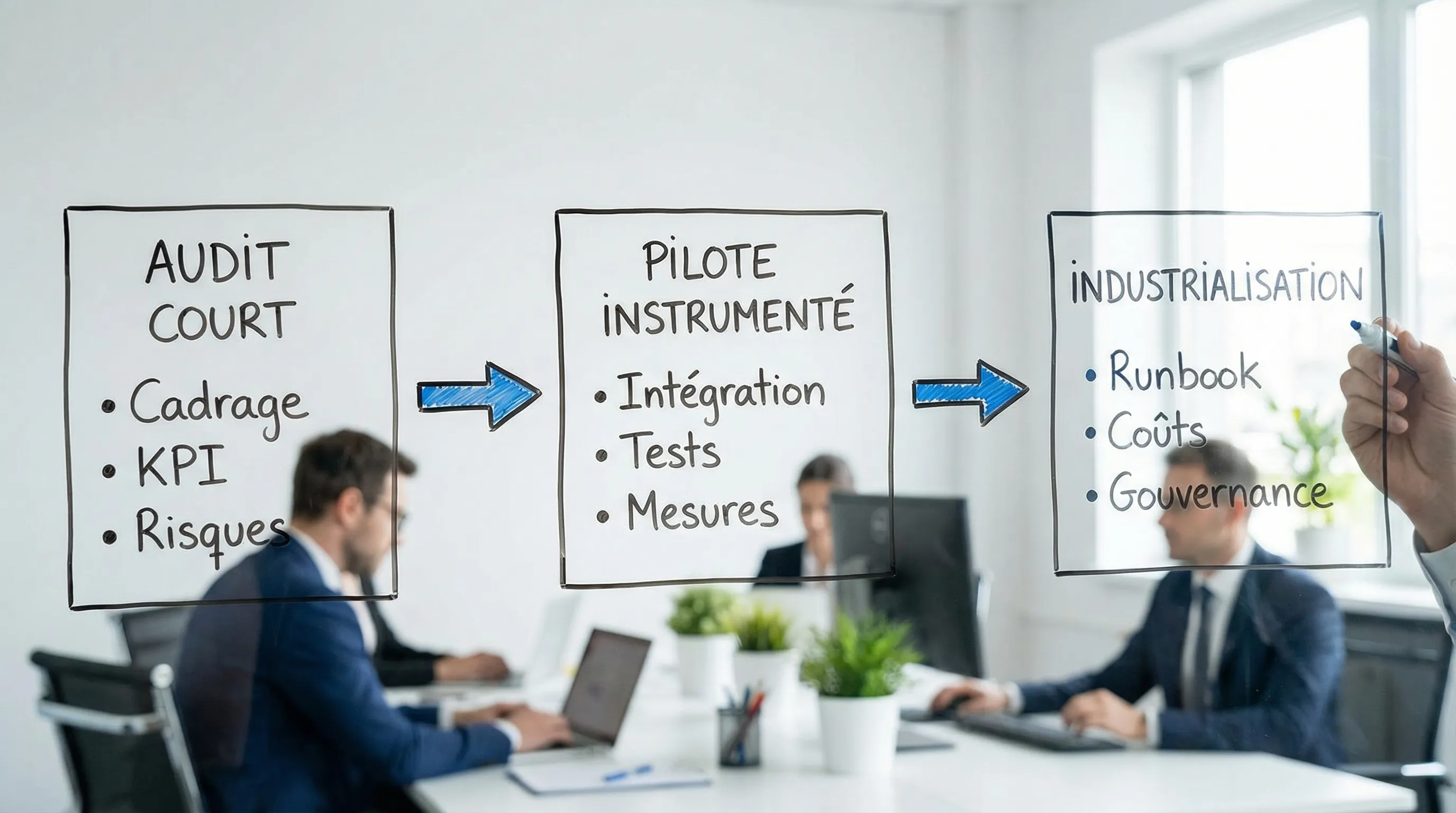
What to check: does the agency propose a trajectory of short audit → measured pilot → industrialization, with deliverables at each stage?
No-nonsense table: typical promises vs. proof to demand
Commercial promise
Simple question to ask
Acceptable proof
Red flag
"We'll put this in prod quickly"
"What exactly are you delivering in V1?"
V1 backlog, target architecture, run plan
"We'll see later"
"Autonomous agent"
"What actions are authorized, and how is it logged?"
list of actions, permissions, logs, validations
no traceability
"GDPR compliant"
"What flows, what retention periods, what DPA?"
mapping, DPA, minimization rules
vague answers
"Very reliable"
"What test protocol, what Go/No-Go thresholds?"
test set, scorecard, metrics
no reproducible tests
"Easy integration"
"Who handles mapping, access, SSO, API errors?"
integration plan, responsibilities, risks
clear underestimation
"Guaranteed ROI"
"What North Star KPI and what baseline?"
baseline, dashboard, measurement plan
ROI = unmeasured "time saved"
How to compare an AI agency in Paris (practical production-oriented grid)
For an SME or scale-up, the question isn't "who has the best AI," but "who knows how to create an operable asset in your context." Here is a comparison grid that works well for procurement.
1) Business orientation: KPIs, baseline, frequency
A serious agency will quickly bring you back to:
the impacted cost or revenue
the volume (frequency of the problem)
the baseline (before/after)
the North Star KPI and 2 to 4 guardrails (quality, risk, cost)
If you want to dig into the measurement logic, Impulse Lab has also published a KPI framework (useful even if you don't work with them): AI KPIs: measuring the impact.
In 2026, value rarely comes from an isolated "chat." It comes from integration with tools (CRM, helpdesk, knowledge base, internal tools) and an adapted architecture pattern.
KPIs and measurement plan: baseline, North Star, guardrails, instrumentation.
Architecture diagram: integrations, data flows, components.
Test plan: case set, protocol, Go/No-Go thresholds.
Compliance and security plan: DPA, access, logs, retention, minimization.
Run plan: ownership, monitoring, costs, incident management.
An agency can iterate on these elements, but if they refuse to make them explicit, it's a strong signal.
How to read an AI agency commercial proposal (and spot hidden costs)
When comparing multiple quotes, the trap is comparing one "AI line item" vs. another. Instead, compare the total cost of ownership and responsibilities.
Points to clarify in writing:
Who prepares the data, who maintains the knowledge base, who validates the content?
What is included in integration (SSO, environments, mapping, errors)?
What is included in operations (monitoring, patches, on-call support, evolutions)?
How are variable costs managed (usage, tokens, volumes)?
What is the reversibility (code, documentation, access, transfer)?
Paris: when proximity is a real advantage (and when it's useless)
Being located in Paris is useful if you need:
on-site workshops (business scoping, process mapping)
rapid alignment between management, operations, IT, and legal
a partner available for short feedback loops, with numerous stakeholders
However, proximity does not replace the ability to deliver an operable V1. An agency "near you" but demo-oriented remains a risk.
FAQ
How to recognize a false promise from an AI agency? A promise becomes suspicious when it is not accompanied by a protocol (tests), an integration plan, a run plan, and measurable KPIs with a baseline.
What are the most frequent red flags? The most common are: demo without integration, performance figures without definition or test set, "GDPR compliant" without flows or DPA, and a total absence of an operations plan.
Do you necessarily have to choose an AI agency based in Paris? No. Choose Paris if proximity accelerates your workshops and governance. Otherwise, prioritize "production-first" maturity and integration capability.
What deliverables should you ask for before signing? A scoping document, KPIs with a measurement plan, an architecture and data flow diagram, a test plan, a security/compliance plan, and a run plan.
What is the best starting format to limit risk? Generally: a short audit (opportunities, KPIs, risks) then an instrumented pilot, and only then industrialization if the scorecard is green.
Need a solid comparison (without the fluff) for your AI project in Paris?
Impulse Lab supports SMEs and scale-ups with a value- and production-oriented approach: AI opportunity audit, adoption training, and custom development (automation, integration with existing tools, web and AI platforms). The team works in short cycles with weekly delivery and a dedicated client portal, to stay on track with deliverables and results.
If you want to compare options factually, you can start with a scoping discussion: contact Impulse Lab to present your context, your constraints (data, GDPR, IT systems), and define an initial audit → pilot → decision trajectory.