AI automation agency: how to compare without making mistakes
Intelligence artificielle
Stratégie IA
ROI
Automatisation
Optimisation
Comparing an **AI automation agency** is hard because offers quickly look alike: audit, chatbot, agents, integrations, automations, training, ROI. Yet, behind the same words, two providers can have radically different approaches. One will sell an attractive demo...
Comparing an AI automation agency is difficult because offers quickly look alike: audit, chatbot, agents, integrations, automations, training, ROI. Yet, behind the same words, two providers can have radically different approaches. One will sell an attractive demo. The other will know how to transform a real process into a reliable, measurable system adopted by your teams.
For an SMB or a scale-up, the challenge is not to choose the agency that cites the most AI models. It is to choose the one that understands your operations, secures your data, integrates with your existing tools, and delivers fast enough to prove value before expanding the scope.
This guide gives you a simple method to compare without making mistakes: what to frame before consulting, the criteria to check, the proofs to ask for, the red flags, and a ready-to-use scorecard.
What an AI automation agency must really deliver
An AI automation agency shouldn't just plug a tool into your CRM or create a chatbot. It must help you automate part of a business process with a level of control adapted to the risk.
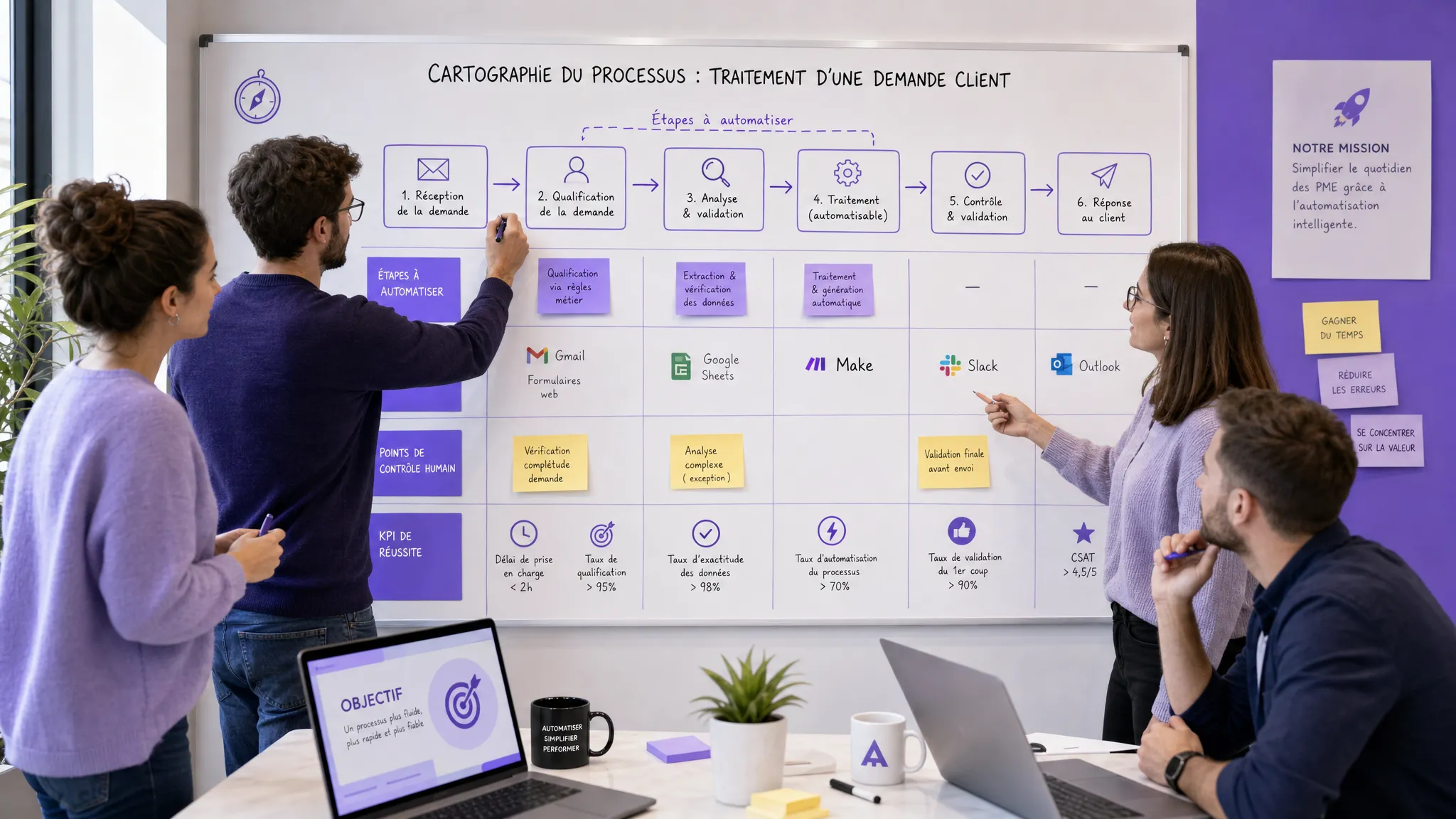
Concretely, this can mean: qualifying inbound requests, generating draft responses, enriching CRM profiles, routing tickets, preparing quotes, extracting information from documents, following up with prospects, or producing automated reporting.
The difference between a useful automation and a gimmick often comes down to three elements: the right process, the right data, and a clear measurement of the gain achieved.
Bad habit
Better approach
Comparing agencies based on the tools mentioned
Comparing their ability to solve a measurable business problem
Asking for a generic demo
Asking for a test on a real scenario from your company
Seeking maximum automation
Defining the right level of autonomy with human validation if necessary
Looking only at the project price
Comparing the total cost, including maintenance and adoption
Signing on a productivity promise
Demanding a baseline, KPIs, and a measurement method
Before comparing: frame the same problem for all providers
You cannot properly compare three agencies if each responds to a different need. Before the first meeting, prepare a short brief that describes the process to automate.
It doesn't need to be perfect. It simply needs to allow each agency to reason on the same ground. If you are still hesitating on the first process to choose, start with a structured reflection on process automation in SMBs.
Your framing brief should specify:
The process concerned: support, sales, back-office, finance, HR, operations, marketing.
The volume: number of requests, tickets, files, or actions per week.
The time spent today: estimation of human time consumed.
The tools involved: CRM, ERP, helpdesk, spreadsheets, emails, drive, business software.
The data used: documents, customer history, knowledge base, forms, sales notes.
Requires serious framing to avoid a scope that is too broad
You want to transform a real process into a measurable system
The right choice depends on your maturity. If you don't have priorities yet, start with an audit. If you have already identified a simple process, an integrator may suffice. If you need to connect multiple tools, manage access rights, track decisions, and train teams, a more comprehensive agency often becomes necessary.
The 7 criteria to compare an AI automation agency
1. The ability to start from the business, not the technology
A serious agency starts by understanding your value chain. It asks questions about your volumes, your deadlines, your operational pain points, your customer constraints, and your current metrics.
It must be able to rephrase the need as a result: reduce ticket processing time, increase qualification rate, speed up quote production, decrease data entry errors, or improve managerial visibility.
The positive signal: the agency talks about baselines, KPIs, and processes before talking about AI models.
The red flag: it directly pitches an autonomous agent or a chatbot without having analyzed the workflow.
2. Mastery of integrations with your existing tools
AI automation rarely creates value if it remains isolated. It must fit into your environment: CRM, inboxes, forms, helpdesk, ERP, document base, project tool, data warehouse, or business software.
Ask how the agency handles APIs, access rights, data synchronization, integration errors, and cases where a tool is unavailable. Reliable automation is not just a happy path. It is also proper exception handling.
A good answer usually includes a mapping of systems, data flows, permissions, and human control points.
3. Choosing the right level of AI
Not all problems require an LLM, a RAG, or an agent. Some tasks must remain deterministic: simple routing, notification, status update, score calculation, mandatory field verification.
AI is useful when it is necessary to interpret a message, summarize content, extract unstructured information, suggest a response, classify an ambiguous request, or assist a decision.
A good agency knows how to combine classic rules, automation, generative AI, and human validation. It doesn't try to make everything autonomous. It chooses the level of intelligence that maximizes ROI while limiting risk.
4. Security, GDPR, and data governance
In 2026, privacy is no longer an option. Before entrusting your data to a provider, check how they handle sensitive information, user access, retention, logging, AI providers, and test environments.
The questions to ask are simple: what data leaves our system? Where is it processed? Who accesses it? Is it used to train a model? How are deletions managed? What logs are kept?
The point is not to block every AI project out of fear of risk. It is about putting in place guardrails proportionate to the use case. A commercial email draft does not have the same level of criticality as a credit decision, an HR file, or health data.
5. The delivery method
An AI automation agency must be able to deliver fast, but not in a messy way. Look for a short rhythm with regular proofs: framing workshop, instrumented prototype, test on real cases, limited integration, pilot, then decision to expand.
The best providers avoid tunnel projects. They show something testable every week: a flow, an interface, an integration, a measurement report, or a quality improvement.
Also ask how the agency manages acceptance criteria. Without clear criteria, you risk validating a nice demo that is unusable in production.
6. Adoption by the teams
An automation often fails not because the technology is bad, but because the teams don't use it. Users must understand what the AI does, what it doesn't do, when to check, when to take over, and how to report a problem.
A solid agency plans for training, simple materials, usage rules, field feedback, and an improvement loop. For SMBs, this part is decisive: a poorly adopted tool quickly becomes an invisible expense.
7. Reversibility and total cost
Comparing only the initial quote is dangerous. A cheaper project can become more expensive if the documentation is weak, if the agency keeps all the knowledge, if API costs explode, or if every change requires heavy intervention.
Ask what belongs to you: code, workflows, documentation, architecture diagrams, prompts, test sets, access, monitoring, runbook. Also check recurring costs: hosting, licenses, AI APIs, maintenance, supervision, support, and continuous training.
Scorecard: a simple grid to compare objectively
Assign a score from 1 to 5 for each criterion, then apply the recommended weight. The goal is not to produce a perfect mathematical truth, but to avoid a decision based on a meeting impression.
Criterion
Recommended weight
What you evaluate
Business understanding and ROI
20%
Ability to prioritize a measurable use case
Integrations and architecture
15%
Clean connection to existing tools, scalability, error handling
Security and compliance
15%
GDPR, access rights, logs, providers, data governance
AI quality and control
15%
Tests, guardrails, human validation, hallucination management
Delivery and management
15%
Short cycles, demos, acceptance criteria, transparency
Adoption and training
10%
User support, documentation, change management
Total cost and reversibility
10%
Full budget, maintenance, ownership of deliverables, vendor lock-in
An agency that gets an excellent technical score but a low score on adoption or security is not necessarily the best choice. For AI automation in production, balance matters more than a single strong point.
The proofs to ask for before signing
Promises are not enough. Ask for concrete elements, even if the project hasn't started yet. A good provider can show their method without exposing their clients' confidential data.
Proof to ask for
Why it's useful
Example of a framing brief
Verifies that the agency knows how to transform a vague need into an actionable scope
Example of a V1 roadmap
Shows the ability to break down the project without pushing everything to later
Example of a KPI scorecard
Proves that measurement is planned from the start
Typical architecture diagram
Clarifies data flows, integrations, and control points
Example of documentation or runbook
Reduces dependence on the provider after delivery
AI testing method
Verifies that quality is not judged only by eye
Adoption plan
Shows how teams will be onboarded
If the agency refuses any transparency on its method, be careful. It doesn't need to reveal trade secrets, but it must be able to explain how it secures a project.
The questions to ask in a meeting
Here is a short list to distinguish a credible agency from a provider that is too generic:
What process would you automate first in our context, and why?
What baseline should be measured before starting?
Which part should remain deterministic rather than generative?
At what point do you plan for human validation?
What data will be sent to which external services?
How do you test the quality of AI responses or decisions?
What happens if the AI makes a mistake or if an integration fails?
What deliverables remain with us at the end of the project?
What recurring costs should we anticipate over 12 months?
How do you train users and managers?
The quality of the answers matters as much as their content. A good agency knows how to say no, reduce the scope, and propose a realistic V1.
Concrete example: comparing on the same use case
Imagine a service SMB that receives quote requests every week via its website, emails, and calls. Today, the team manually sorts the requests, checks for missing information, creates an opportunity in the CRM, replies to the prospect, and then follows up a few days later.
A relevant AI automation could qualify the request, detect missing information, prepare a personalized response, create or enrich the CRM profile, suggest a sales priority, and trigger a follow-up if the prospect doesn't reply.
The same logic applies to highly operational trades, for example a professional painter in Copenhagen and Nordsjælland who receives quote requests from individuals and businesses: the value doesn't come from putting AI everywhere, but from streamlining the request, structuring the information, speeding up the response, and keeping a usable record.
To compare three agencies, give them exactly this scenario. Ask them for a V1 proposal, the tracked KPIs, the necessary integrations, the guardrails, the pilot timeframe, and the estimated total cost. You will quickly see who thinks in terms of an operational product and who is selling a simple demo.
The red flags to take seriously
Certain signals should make you slow down, even if the sales pitch is convincing.
The agency promises complete automation without a pilot period.
It talks mostly about AI models, very little about processes and KPIs.
It asks no questions about your existing tools.
It downplays GDPR, security, or access rights issues.
It does not plan for human validation for sensitive actions.
It does not document workflows, prompts, connectors, or technical decisions.
It refuses to talk about recurring costs.
It pushes you to automate a scope that is too broad from the start.
The biggest trap is often the impressive demo. A demo can work on five prepared cases and fail as soon as it encounters your real exceptions. To avoid this, impose a test on representative data and difficult scenarios.
Comparing quotes: look at the total cost, not just the entry price
An AI automation quote should be read as a product investment, not as a simple technical service. The initial price rarely covers the entire life of the system.
Items to check include framing, design, integrations, data preparation, testing, hosting, API costs, licenses, documentation, training, support, and post-launch evolutions.
Cost item
Question to ask
Framing
Is it included or billed separately?
Integrations
Are the connectors standard or custom?
Data
Who cleans, structures, and maintains the sources?
AI APIs
How do you estimate costs based on real volume?
Testing
What scenarios will be tested before the pilot?
Maintenance
What does support cover after going into production?
Adoption
Is team training included?
Reversibility
What do we get back if we change providers?
A higher quote can be more profitable if it reduces risk, accelerates adoption, and avoids a redesign six months later. Conversely, a low quote can be suitable if the process is simple, low-criticality, and easily reversible.
A 10-day selection method
You don't need three months to choose. With a clear scope, ten days are often enough to get a serious comparison.
Timing
Action
Expected deliverable
Day 1
Define the target process and KPIs
One-page framing brief
Days 2-3
Meet 3 to 4 agencies
Structured notes with the same questions
Day 4
Send the same mini-case to each agency
Anonymized real scenario
Days 5-7
Receive proposals
V1, architecture, KPIs, risks, budget
Day 8
Score the agencies
Weighted scorecard
Day 9
Clarify gray areas
Final questions and adjustments
Day 10
Choose or launch a short audit
Documented decision
If you can't produce a clear framing brief on day 1, don't launch a big project right away. Start with a strategic AI audit to map opportunities, risks, and priorities.
When to choose an agency rather than a standalone tool?
A SaaS tool is enough if your need is standard, low-criticality, and well covered by the market. For example, a simple FAQ chatbot, basic email automation, or highly structured document extraction can sometimes be launched without custom development.
An agency becomes relevant when you have multiple tools to connect, specific business rules, sensitive data, a need to measure ROI, users to train, or an ambition to evolve the automation over time.
In practice, the best model is often hybrid: use existing tools when they are sufficient, add custom development where your process creates differentiation, and integrate everything cleanly.
FAQ
How long does it take to launch a first AI automation? For a well-framed use case, a testable V1 can often be built in a few weeks. The timeframe depends mostly on data availability, integrations, and the risk level.
Should you start with an audit or a prototype? If you already know the priority process and the KPI, an instrumented prototype may suffice. If you have multiple ideas, scattered data, or compliance risks, start with a short audit.
Must an AI automation be fully autonomous? No. In many SMBs, the best ROI comes from an AI that prepares, classifies, suggests, or pre-fills, with human validation on sensitive actions.
How to avoid hallucinations in an AI automation? You must limit the scope, connect the AI to reliable sources, test real scenarios, log outputs, set confidence thresholds, and keep human validation when the impact is significant.
What is the best criterion for choosing an AI automation agency? The best criterion is its ability to link technology, processes, KPIs, security, and adoption. An agency that only talks about tools or AI models risks missing the point.
Want to compare without starting from a blank page?
Impulse Lab supports SMBs and scale-ups in identifying, framing, and developing custom web and AI solutions: AI opportunity audits, process automation, integration with existing tools, custom platforms, and team training.
If you need to compare multiple providers or verify that a use case deserves a pilot, you can start with a short framing, a scorecard, and a measurable V1. The goal: transform AI into operational value, without tunnel projects or uncontrolled automation.
To discuss your priority processes and identify the most profitable automations, contact Impulse Lab.