Edge AI vs Cloud AI: How to Choose Based on Your Constraints
Intelligence Artificielle
Stratégie IA
Confidentialité des données
Architecture IA
In 2026, many leaders realize that simply "adding AI" to a process isn't enough. The real operational question is: where should AI run to create value without adding unnecessary risk, latency, or complexity?
July 22, 2026·14 min read
In 2026, many leaders realize that simply "adding AI" to a process isn't enough. The real operational question is: where should AI run to create value without adding unnecessary risk, latency, or complexity?
This is exactly the debate between Edge AI and cloud AI. Edge AI executes all or part of the AI processing as close to the data as possible, on a device, a machine, a local gateway, or an on-site server. Cloud AI centralizes processing in a cloud infrastructure, which is often more powerful, flexible, and easier to scale.
For an SME, mid-market company, or scale-up, the right choice doesn't depend on a technological preference. It depends on your constraints: latency, connectivity, privacy, costs, internal skills, integration with existing tools, and the maturity level of the use case.
Edge AI and cloud AI: what are we really talking about?
Cloud AI refers to artificial intelligence systems hosted in the cloud. Data is sent to a remote infrastructure, where models analyze, generate, classify, predict, or automate a decision. This is the most common model for AI assistants, content generation tools, recommendation systems, document analysis, sales scoring, or automations connected to SaaS software.
Edge AI, or AI at the edge, consists of running the model close to the data source. This could be an industrial camera, a mobile terminal, a store checkout, a sensor, a production machine, a vehicle, an IoT gateway, or a mini-server installed on-site. The goal is to reduce network dependency, accelerate decision-making, and sometimes avoid transferring sensitive data.
The important distinction is not just "local versus remote". In a real AI system, several elements can be distributed differently:
Data collection and preprocessing
Inference, meaning the execution of the model to produce a response
Storage of data and activity logs
Training or retraining of the model
Supervision, alerts, updates, and governance
In many projects, the best answer is therefore neither 100% edge nor 100% cloud. It is a hybrid architecture, designed around business constraints.
The right selection criterion: the most costly constraint
A common mistake is to compare Edge AI and cloud AI solely on technical performance. In reality, the choice must start from the constraint that could cause the project to fail in production.
If an alert arrives two seconds too late, is that acceptable? If the connection drops for an hour, can the process continue? If personal data leaves the site, is it compliant? If the model needs to be updated every week, can your team maintain a fleet of devices?
Here is a simple reading grid.
Constraint
Edge AI is often preferable if
Cloud AI is often preferable if
Point of vigilance
Latency
The decision must be almost immediate on-site
A few seconds of delay are acceptable
Measure total time, not just model time
Connectivity
The site is isolated, unstable, or mobile
The connection is reliable and secure
Plan a degraded mode in case of an outage
Sensitive data
Raw data must not leave the site
Data can be transferred with appropriate guarantees
Edge does not replace GDPR governance
Computing power
The model is lightweight or optimized
The model is heavy, multimodal, or generative
Large models are expensive to run locally
Multi-site deployment
Each site must act autonomously
Rules and models must be centralized
Managing versions becomes critical in edge
Cost
Data volumes sent to the cloud are very high
The load varies greatly and must be elastic
Compare hardware, maintenance, network, and operations
Internal team
The question to ask is therefore not "which architecture is the most modern?", but "which business constraint must we protect as a priority?".
When to favor cloud AI
Cloud AI is often the most rational starting point for a company that wants to quickly launch an AI use case, especially if the need involves already centralized data or digital workflows.
It is generally the best choice for internal assistants, business copilots, document analysis, customer support tools, CRM automations, meeting summaries, content generation, ticket analysis, lead qualification, or AI-augmented dashboards.
The cloud has three major advantages.
First, it provides access to flexible computing power. You can absorb usage peaks without buying dedicated hardware. This is particularly useful for generative models, processing large documents, or use cases that start small and then expand rapidly.
Second, it facilitates integrations with existing tools. An SME or scale-up already uses billing software, CRM, support, ERP, data warehouse, collaborative tools, or marketing platforms. The cloud often allows connecting these systems via APIs, webhooks, or connectors, and then orchestrating the processing in the same place.
Finally, it accelerates iteration. When the model, business rules, and interfaces are centralized, teams can test, fix, measure, and deploy faster. For an AI project that needs to prove its ROI, this learning speed often matters more than initial technical optimization.
However, cloud AI has its limits. It can create network dependency, generate variable costs that are difficult to anticipate, raise data localization issues, and become fragile if the architecture lacks safeguards. If you are comparing several solutions, it is useful to evaluate the total cost and integrations from the start, as in this guide on selection criteria, TCO, and integrations of AI software.
When to favor Edge AI
Edge AI becomes relevant when the field environment imposes strong constraints that the cloud does not solve well.
The first case is latency. On a production line, a vision system that detects a defect must sometimes trigger an action immediately. In a warehouse, a security alert must be available without waiting for a cloud round-trip. In a vehicle, a robot, or mobile equipment, local decision-making can be essential.
The second case is connectivity. Some industrial sites, stores, construction sites, vehicles, or logistics areas do not have a stable network. If the process must continue despite an outage, the AI must be able to function locally, at least in a degraded mode.
The third case involves sensitive or heavy data. A camera, microphone, or sensor can produce a large volume of data. Sending the entire raw stream to the cloud can be costly, slow, or undesirable. Local processing can filter, anonymize, summarize, or detect only useful events before transmission.
Edge AI is not a "simple" choice, however. It requires managing a fleet of hardware, model updates, energy constraints, different versions depending on the site, and local cybersecurity. It also requires choosing models adapted to limited resources. An excellent model in the cloud might be too heavy to run efficiently on an edge device.
In practice, Edge AI is justified mainly when it protects a critical constraint: response time, service continuity, data flow reduction, or local control.
The most common case: a hybrid architecture
For many companies, the most solid compromise is to combine Edge AI and cloud AI.
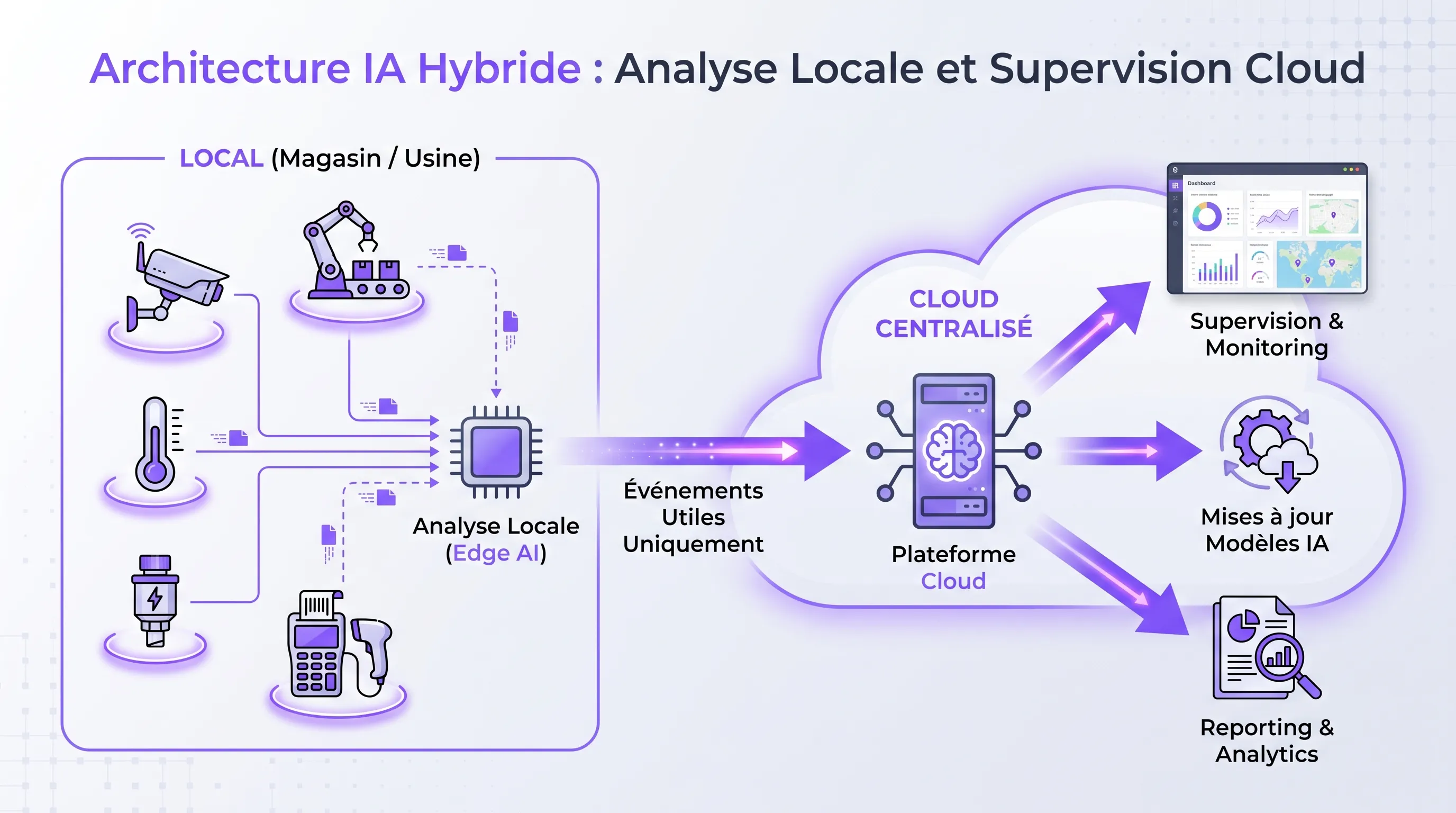
In a hybrid architecture, the edge processes what needs to be fast, local, or filtered. The cloud manages what needs to be centralized, supervised, improved, and connected to the rest of the information system. This approach avoids turning a technical choice into a dogma.
For example, a production site can locally analyze a video stream to detect anomalies in real time. Only the necessary events, metadata, or excerpts are then sent to the cloud for global analysis, reporting, model improvement, and quality monitoring. Similarly, a retail network can execute certain detections locally while centralizing performance indicators and updates.
The hybrid architecture is often the most pragmatic when the company wants to standardize a system across multiple sites while respecting local constraints.
Costs: don't just compare the price of computing
The cost of an Edge AI vs cloud AI project is never limited to the price of an API, a server, or a device. The real issue is the total cost of ownership, including development, integration, operations, security, supervision, support, and evolution.
The cloud may seem economical at the start because it avoids buying hardware. But costs can increase with the volume of calls, data size, multimodal processing, or frequency of use. Conversely, edge can reduce transfer costs and certain cloud dependencies, but it creates hardware, logistical, and maintenance expenses.
Cost item
Cloud AI
Edge AI
Question to ask
Startup
Often faster and less capital intensive
Purchase or preparation of hardware
What budget to prove value in 8 to 12 weeks?
Scalability
Flexible according to usage
Depends on physical deployment
Should we scale by user, by site, or by equipment?
Maintenance
Centralized
Distributed in the field
Who updates, monitors, and troubleshoots?
Data
Possible storage and transfer costs
Less raw transfer
What data really needs to be kept?
Security
Centralization of controls
Security of each device to be planned
Where are the exposure points?
Model evolution
Simpler to deploy
Requires local version management
How often will the model change?
For an SME or scale-up, a good compromise often consists of starting in the cloud when possible, then moving to the edge only the processing that truly needs it. This avoids overinvesting in a local architecture before validating the use case.
Security, GDPR, and governance: edge is not a magic wand
It is tempting to think that Edge AI automatically solves privacy issues because the data stays on-site. This is sometimes true, but only partially.
If personal data is collected, the GDPR applies, whether the processing is local or cloud-based. The principles remain the same: clear purpose, data minimization, legal basis, retention period, security, informing individuals, and control of subcontractors. The CNIL reminds us of the key GDPR principles, which must guide the architecture as much as the choice of tool.
Edge can help minimize transferred data. For example, it can transform a raw stream into an event, score, or metadata. But it adds other risks: stolen device, outdated software, poorly protected local access, heterogeneity between sites.
The cloud, on the other hand, can offer simpler centralization of security policies, logs, access rights, and backups. But it requires special attention to data localization, contracts, permissions, outbound flows, and vendor dependencies.
To structure this reflection, the NIST AI Risk Management Framework offers a useful approach: govern, map, measure, and manage the risks associated with AI systems. Even for an SME, this logic helps move from enthusiastic experimentation to a reliable capability.
How to choose in 30 minutes: the constraints method
Before consulting vendors or choosing a tech stack, gather the people who know the field: business, IT, data, operations, compliance, and management. Then rate each constraint from 1 to 5.
Question
Low score
High score
Must the decision be immediate?
A delay is acceptable
Latency is critical
Is the network reliable?
Stable connection
Unstable or absent connection
Can raw data leave?
Yes, under conditions
No or very limited
Is the data volume high?
Lightweight data
Heavy streams, video, audio, sensors
Does the model change often?
Little evolution
Frequent updates
Can the team manage local hardware?
No
Yes, with a clear process
Must the use case integrate with several SaaS?
Few integrations
Many digital workflows
If the highest scores concern latency, network, raw data, and heavy volumes, Edge AI or hybrid deserves a serious study. If the highest scores concern integrations, scalability, rapid experimentation, and generative models, cloud AI will often be more suitable.
This method does not replace a technical audit, but it avoids the classic trap: choosing an architecture before formulating the constraint that justifies this choice.
Concrete scenarios for SMEs and scale-ups
A service SME that wants to automate the qualification of inbound requests, summarize customer interactions, and enrich its CRM will generally benefit from starting with cloud AI. The data is already digital, integrations are central, and the value comes from orchestrating workflows.
A B2B scale-up that wants to integrate an AI assistant into its SaaS product will also often favor the cloud, at least initially. This allows controlling the user experience, measuring usage, testing different approaches, and deploying improvements quickly. Compliance constraints or large enterprise clients may later push towards more isolated, hybrid, or private options.
A retail network with cameras, kiosks, or terminals may benefit from a hybrid approach. Certain local analyses reduce data flows and maintain service in case of network problems, while the cloud centralizes management and indicators.
An industrial company with critical machines, numerous sensors, and imperfect connectivity will look more seriously at Edge AI. Service continuity and latency can justify local processing, but supervision, updates, and global analysis will often remain centralized.
The common thread in these scenarios is simple: the architecture follows the process, not the other way around.
Starting without over-engineering the architecture
The best way to choose between Edge AI and cloud AI is rarely to produce a grand architecture diagram on day one. It is better to start from a specific use case, a success metric, and a pilot scope.
Start by clarifying the expected result: reduce processing time, detect an anomaly earlier, lower support costs, improve quality, accelerate a business decision, or make a control more reliable. Only then should you identify the non-negotiable constraints.
A robust AI project generally follows a progressive logic: business scoping, representative data collection, prototype, real-world testing, measurement, securing, integration, then deployment. If you want to avoid overly complex architectures from the start, this guide on the minimal architecture of a reliable AI system complements this reflection well.
Finally, remember that the edge or cloud choice is only one part of the project. Value also comes from adoption by teams, integration with existing tools, data quality, performance monitoring, and the ability to scale the system. To move from an idea to a truly utilized solution, it is useful to structure the steps, costs, and risks as in an artificial intelligence development project.
Frequently Asked Questions
What is the difference between Edge AI and cloud AI? Edge AI executes AI processing close to the data source, for example on a device, a machine, or a local gateway. Cloud AI executes processing in a centralized cloud infrastructure. The former favors low latency, local continuity, and reduced data flows. The latter favors power, flexibility, integrations, and rapid iteration.
Is Edge AI always more secure than cloud AI? No. Edge AI can limit the transfer of raw data, which is an advantage in certain contexts. But it adds risks related to distributed devices, updates, physical access, and local supervision. Security depends mainly on the architecture, controls, and governance.
Can generative models be used in Edge AI? Yes, in some cases, especially with smaller or optimized models. But advanced generative models often require a lot of memory, computing, and supervision. For many generation, augmented search, or document analysis uses, the cloud remains easier to operate, unless there is a strong privacy or connectivity constraint.
What is the best choice for an SME starting with AI? If the use case concerns office processes, CRM, support, documents, reporting, or internal automation, cloud AI is often the most pragmatic starting point. Edge AI becomes relevant if the use case involves physical equipment, sensors, critical latency, sensitive raw data, or an unstable connection.
When should you move from a cloud architecture to a hybrid architecture? Moving to hybrid becomes interesting when data transfer costs increase, latency limits business value, connectivity creates interruptions, or certain data must no longer leave the site. The right time is after validating the use case and precisely identifying the processing to be brought closer to the field.
Need to decide between Edge AI and cloud AI for your company?
The right choice is not just a technical preference. It depends on your real constraints, your workflows, your existing tools, and the level of adoption expected by your teams.
Impulse Lab supports companies in identifying AI opportunities, designing custom web and AI solutions, automating processes, integrating with existing tools, and training for adoption. If you want to transform an AI use case into a reliable, useful, and maintainable system, you can chat with the team via Impulse Lab.
Can You Trust Artificial Intelligence with Your Math Calculations?
Can you trust AI with math calculations? Yes, provided you distinguish suggested reasoning from actual computation. Discover how to inspect, verify, and ground AI-driven calculations into reliable business decisions.