The era of endless POCs is over. In 2025, an AI chatbot is only justified if it demonstrates its financial impact clearly. The good news is that with the right KPIs and clean instrumentation, you can prove ROI in weeks, not quarters.
December 24, 2025·9 min read
The era of endless POCs is over. In 2025, an AI chatbot is only justified if it demonstrates its financial impact in black and white. The good news is that with the right KPIs and clean instrumentation, you can prove ROI in weeks, not quarters.
In this guide, you will find a complete framework for selecting your KPIs, measuring them correctly, and linking every percentage point gained to a line on the P&L. It is aimed at growing SMEs and scale-ups that want to move from intuition to proof.
The KPI Framework, from Business Result to Model Quality
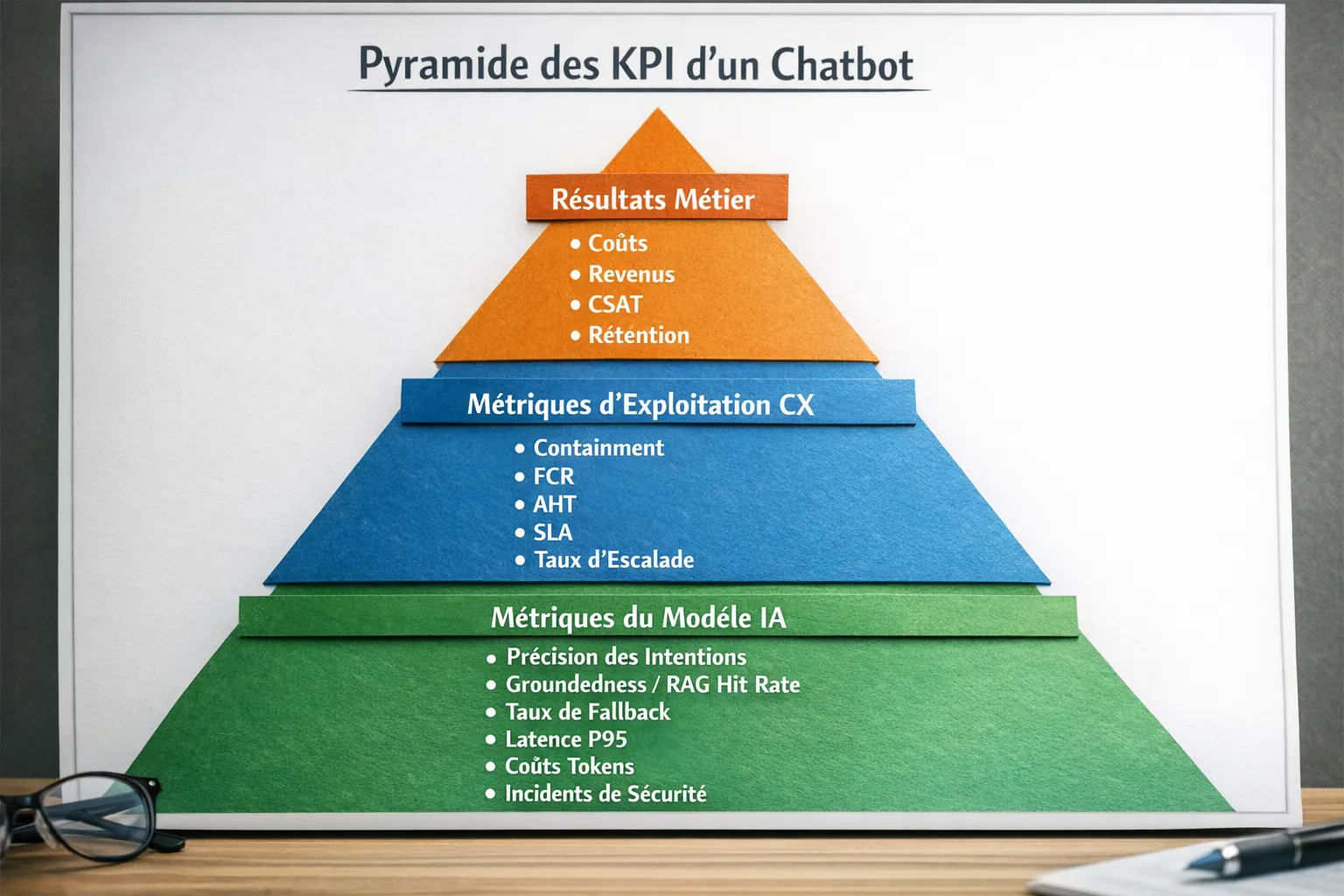
Think of your indicators as a value chain, from bottom to top:
AI Quality: what the bot answers and how it does it, e.g., intent accuracy, groundedness, latency.
CX Operations: what the bot changes in service, e.g., containment, FCR, AHT, SLA, escalation rate.
Business Results: what the company gains, e.g., avoided costs, incremental revenue, CSAT, retention.
If an indicator at the bottom improves, it must be reflected higher up. Otherwise, it is decorative.
Essential KPIs by Use Case
1) Customer Support, Reduce Cost per Contact and Accelerate Response Time
Priority KPIs to track:
Containment rate: proportion of conversations managed entirely by the bot without an agent.
Deflection rate: proportion of requests that would have reached an agent without the bot. To be estimated via control group or blackout windows.
Bot FCR: First Contact Resolution on the bot side.
Escalation rate: share of sessions transferred to a human agent.
Bot CSAT and Bot vs Agent CSAT gap.
First response time and p95 latency of bot response.
Cost per bot conversation and avoided service cost.
Useful formulas:
Containment = bot conversations resolved without agent / total bot conversations.
Monthly savings = deflected contacts multiplied by (average cost per human contact minus cost per bot contact).
What to measure, where:
Conversation events in your CX platform, e.g., bot_session_started, bot_resolved, handoff_to_agent, conversation_closed.
CSAT surveys at the end of the session.
Latency and error logs on the AI platform side.
Note that reference reports like the Zendesk CX Trends 2024 present customer expectations regarding response times and self-service, which are useful for setting goals.
2) Sales and Marketing, Qualified Leads and Conversions
Priority KPIs to track:
Lead capture rate via bot: share of visitors who leave contact details.
Qualification rate: share of leads matching your ICP or scoring threshold.
Meetings booked or demos scheduled via the bot.
Influenced pipeline and revenue attributed to or assisted by the bot.
Guided conversion: add to cart, checkout completion, cart recovery.
Attribution and proof:
Unique promo codes per bot path, specific UTM links, tracked clicks to associate sales with the bot.
Holdout groups, e.g., 10 to 20 percent of traffic without the bot, to measure the real increment.
Consistent attribution model: last click, assisted, data-driven, and stable during the experiment.
Useful formulas:
Incremental revenue generated by the bot = number of attributed or assisted sales multiplied by average basket, or by margin if calculating operational ROI.
Qualification rate = qualified leads divided by collected leads.
3) Internal Productivity, Team Assistance
Priority KPIs to track:
Time saved per employee per automated task.
Cycle time of a process, e.g., onboarding, data entry, validation.
Internal self-resolution rate, HR or IT.
eNPS or employee satisfaction related to tools.
Useful formulas:
Hours saved per month = task occurrences multiplied by (average manual time minus time with bot).
Savings: hours saved multiplied by fully loaded hourly cost (be careful not to confuse freed hours with cash out).
Technical KPIs for Robustness and Security
These metrics are not marketing; they make the ROI sustainable:
Understanding and generation: intent accuracy, fallback rate, rate of flagged irrelevant responses.
RAG and response grounding: retrieval hit rate, groundedness, knowledge corpus coverage.
Technical costs: token consumption per conversation, API cost per 1,000 requests, storage, monitoring.
Security and compliance: policy incidents, presence of PII in logs, GDPR compliance and consent.
To deepen your understanding of RAG system robustness in production, see our guide on robust RAG in production.
How to Prove ROI, Step-by-Step Method
Define the scope and priority business objective: support, sales, internal—no more than one or two goals initially.
Instrument before launching: event plan, data schema, user ID governance.
Establish a baseline: two to four weeks without the bot, same channels, same hours.
Launch a pilot with a control group: A/B by traffic, by channel, or by period, avoiding seasonality effects.
Calculate gains: avoided costs and incremental revenue, then ROI.
Iterate every two weeks: improve intents, knowledge base, flows.
Instrumentation elements to log in your analytics tool, e.g., Google Analytics 4 or a CDP:
bot_session_started, optional contact_id.
bot_resolution with reason and category.
handoff_to_agent with reason and channel.
csat_submitted with score and verbatim.
lead_submitted, meeting_booked, order_placed.
policy_violation_detected, rag_source_cited.
Standard ROI formula: ROI equals (benefits minus costs) divided by costs.
Benefits: savings on service cost plus margin on incremental revenue plus retention value.
Costs: licenses, infrastructure, initial development, maintenance, and continuous improvement.
Useful resource for estimating macro impacts of AI on operations: McKinsey analysis on the economic potential of generative AI, The economic potential of generative AI.
Minimalist Dashboard, Your Checklist
KPI
Definition
Data Source
Frequency
Owner
Alert Threshold
Containment rate
Share of sessions managed without agent
CX Platform
Weekly
Support
Drop of 5 points
Escalation rate
Sessions transferred to a human
CX Platform
Weekly
Support
Above target
Bot CSAT
Post-conversation satisfaction
Surveys
Weekly
CX
Bot vs agent gap > 10 points
FRT and p95 latency
First response time and 95th percentile
Bot logs
Daily
Tech
p95 above 2s depending on channel
Cost per bot conversation
Bot costs divided by conversations
Finance and analytics
Monthly
Finance
Attribution, Do Not Confuse Correlation and Impact
Unique codes or links: they link sales to the bot path unambiguously.
Permanent holdout: a small percentage of traffic lives without the bot continuously; you get a sustainable incremental measure.
Difference in differences: correct for seasonality by comparing the evolution of the test group to that of the control group.
Consistent observation windows: same horizon for cost and benefit, no cherry-picking.
Prudent Quality Targets for a First Quarter
p95 latency under 2 seconds on web, slightly more for messaging apps.
Fallback rate under 10 percent on critical intents, before expanding scope.
Bot CSAT close to agent on routine topics; the gap must reduce sprint after sprint.
These targets are reasonable starting points, to be adapted to your sector and channel. High customer expectations regarding speed and consistency are confirmed by studies like the Salesforce State of Service.
Common Mistakes That Ruin ROI
Confusing started chats with deflected requests: measure resolution, not opening.
Ignoring reopening and repeat contact: a quick resolution that generates re-contacts does not create value.
Expanding scope too fast: better to excel on 20 percent of intents that cover 80 percent of volume.
Forgetting knowledge base maintenance: no sustainable ROI without up-to-date content.
Not tracking full costs: include continuous improvement, monitoring, and security.
Governance, Security, and Compliance
Log without exposing PII: pseudonymization and retention policies.
Monitor hallucinations and require sources: the groundedness metric must progress with every sprint. See our Conversational AI UI principles to frame perceived quality.
30, 60, 90 Day Plan for Measured ROI
Days 1 to 30: Scoping and instrumentation, objectives, tracking plan, baseline, CSAT survey scripts, top 20 intents by volume, validated response content.
Days 31 to 60: Pilot on one channel, A/B with holdout, minimalist dashboard, two cycles of understanding and flow improvement.
Days 61 to 90: Scope extension of intents, internal tool integration, SLA and production alerting, first ROI review with finance.
Example of Summary Formulas
Savings equals volume of deflected contacts multiplied by (average cost per human contact minus cost per bot contact).
Incremental revenue equals sales attributed to bot multiplied by average margin.
Retention value equals clients retained thanks to bot multiplied by average LTV.
ROI equals (total benefits minus total costs) divided by total costs.
What are the 3 must-have KPIs for a support chatbot? Containment rate, Bot CSAT, Cost per conversation. They directly link customer experience and savings.
How to correctly estimate contact deflection? Use a control group without a bot continuously, or scheduled blackout windows. Compare incoming volumes and resolutions.
How to attribute revenue to the bot unambiguously? Deploy unique codes or links, track key events, and maintain a holdout group. Use a single attribution model during the experiment.
Does bot latency impact ROI? Yes, a high p95 deteriorates CSAT and increases escalations, therefore cost. Target responses under one second on web when possible.
Should AI metrics like intent accuracy be measured? Yes, they feed your business KPIs. A drop in accuracy often translates to more fallback and escalations, thus higher costs.
How long does it take to prove ROI? With a well-chosen scope and a control group, you can present credible results in 60 to 90 days.
Menu bot or generative bot, do KPIs change? Business KPIs remain identical, but on the quality side, add groundedness, hallucination rate, and source tracking for generative bots.
You want a chatbot that proves its value, not just a demo. Impulse Lab designs and integrates ROI-oriented AI chatbots, with a measurement plan from the first sprint. Our team combines opportunity audits, custom development, and training for your teams, and we deliver visible increments every week.